
North America Halal Food Market Size & Forecast 2025–2033
How Ethics, Clean Labels, and Cultural Shifts Are Powering a USD 226 Billion Opportunity Across the U.S. and Canada

North America Halal Food Market Overview
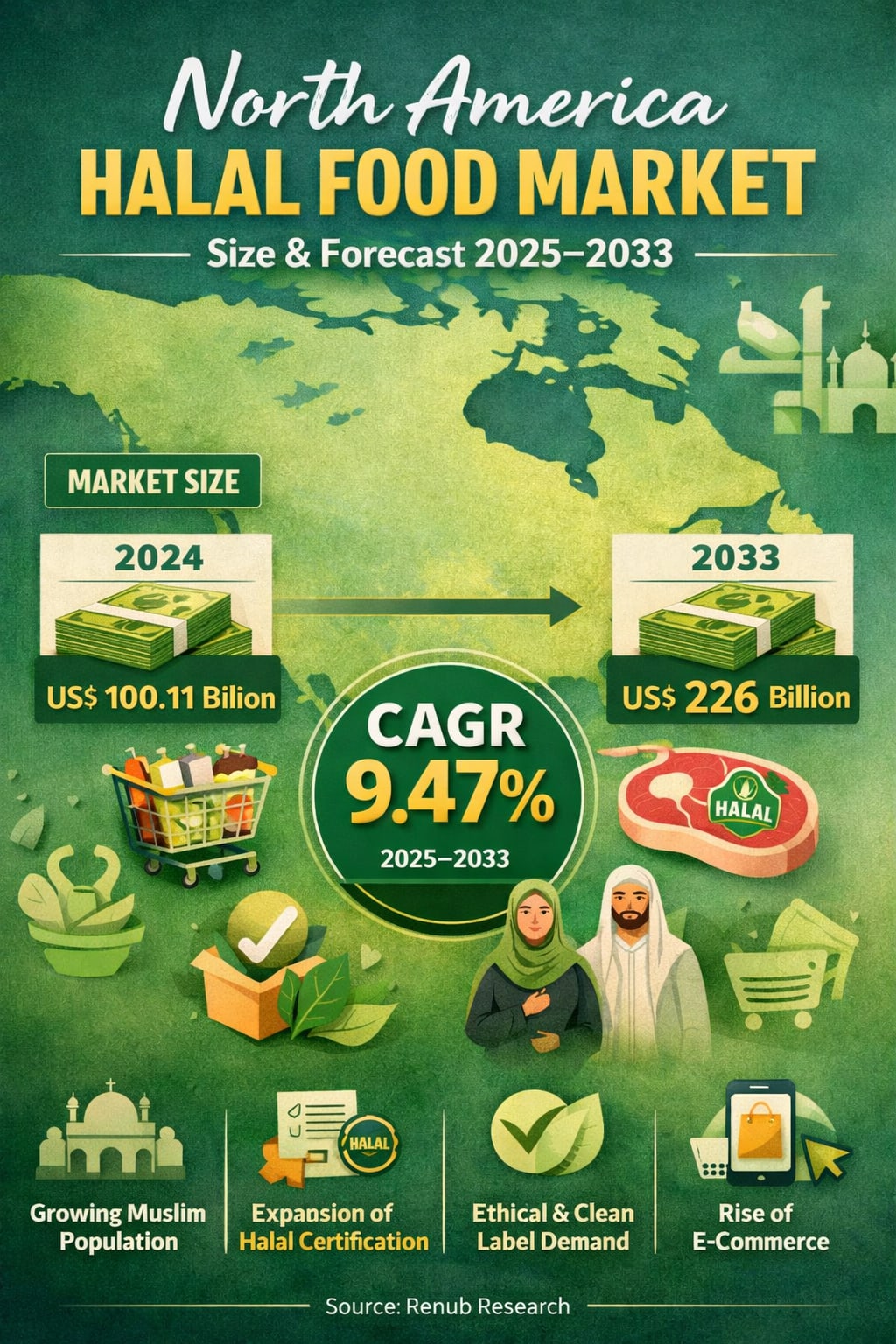
The North America Halal Food Market is entering a phase of strong and sustained expansion, driven by demographic change, evolving consumer values, and the mainstreaming of ethical food choices. According to industry estimates, the market is expected to grow from US$ 100.11 billion in 2024 to around US$ 226 billion by 2033, registering a robust CAGR of 9.47% during 2025–2033.
What was once considered a niche, faith-based food segment is now becoming a widely accepted and commercially attractive category across the United States and Canada. While the growing Muslim population remains the core consumer base, halal food is increasingly being embraced by non-Muslim consumers who associate it with clean-label products, ethical sourcing, food safety, and humane animal treatment.
In North America, halal is no longer limited to butcher shops or ethnic grocery stores. Today, it can be found in large supermarket chains, online platforms, quick-service restaurants, and premium food retailers. From fresh meat and poultry to dairy products, snacks, frozen meals, and beverages, halal-certified products are steadily moving into the mainstream.
This shift reflects broader changes in consumer behavior. Shoppers are paying closer attention to where their food comes from, how it is processed, and whether it aligns with their personal values. In this environment, halal certification has become more than a religious label—it has turned into a symbol of quality, transparency, and trust.
A Market Shaped by Demographics and Values
North America is home to a steadily growing Muslim population. The United States alone has over 3.4–3.5 million Muslims, while Canada has more than one million. This expanding demographic naturally increases demand for food that complies with Islamic dietary laws.
However, the real transformation of the halal food market lies beyond religious consumption. A rising number of non-Muslim consumers now perceive halal food as cleaner, safer, and more ethically produced. The emphasis on hygiene, traceability, and humane slaughter methods resonates strongly with health-conscious and ethically minded shoppers.
Retailers and foodservice operators have taken notice. Major supermarkets are expanding halal product lines, and restaurants—especially in multicultural urban centers—are increasingly offering halal menu options. E-commerce has further amplified this trend by making halal products accessible even in regions where physical availability remains limited.
At the same time, certification bodies and regulatory frameworks are playing a critical role in strengthening consumer confidence. Recognized halal certification helps ensure consistency, authenticity, and compliance with global standards, making it easier for brands to build trust in a competitive food market.
Technology, Marketing, and the Rise of E-Commerce
Technology is quietly reshaping the halal food ecosystem in North America. From digital supply chain tracking to online retail platforms, innovation is making halal products more accessible and transparent. E-commerce, in particular, has become a powerful growth channel, enabling consumers in smaller cities and rural areas to purchase certified halal food with ease.
Marketing strategies have also evolved. Brands are using social media, influencer partnerships, and content-driven campaigns to educate consumers about what halal stands for—not just in religious terms, but in terms of quality, safety, and ethical responsibility. This broader narrative is helping halal products reach audiences far beyond their traditional consumer base.
In parallel, the industry is aligning itself with major consumer trends such as sustainability, clean labels, and health-focused diets. These values fit naturally with halal principles, reinforcing the segment’s relevance in today’s food and beverage landscape.
Key Growth Drivers for the North America Halal Food Market
1. Rising Muslim Population
One of the most fundamental growth drivers is the steady increase in the Muslim population in both the United States and Canada. As this community grows, so does the demand for halal-certified meat, processed foods, snacks, beverages, and ready-to-eat meals.
This demand is not limited to traditional products. Consumers are now seeking greater variety, convenience, and premium options, encouraging manufacturers and retailers to expand their halal portfolios across multiple categories.
2. Expansion of Halal Certification and Regulation
The improvement and standardization of halal certification systems across North America have significantly boosted market credibility. Clearer guidelines, stronger certification bodies, and better enforcement have increased trust among both Muslim and non-Muslim consumers.
For food manufacturers and foodservice providers, certification has become a strategic tool—not just to serve religious consumers, but also to tap into the broader market for ethical, high-quality, and transparent food products. As more companies pursue certification, halal food continues to move closer to the mainstream.
3. Urbanization and Demand for Ethnic & Diverse Cuisines
Major urban centers such as New York, Toronto, Los Angeles, and Chicago are becoming increasingly multicultural. This diversity fuels demand for authentic international cuisines, including halal food.
Food trucks, casual dining chains, fine-dining restaurants, and supermarkets are all expanding their halal offerings to cater to a wider, more adventurous consumer base. This trend reflects not only demographic change but also a growing cultural openness to diverse food experiences.
Challenges Facing the Market
Higher Production Costs
Producing halal-certified food often involves higher costs due to specialized slaughter methods, strict segregation from non-halal products, certification fees, audits, and staff training. These additional requirements can make halal products more expensive than conventional alternatives.
For small and medium-sized producers, these costs can be a significant barrier to entry or expansion, potentially limiting innovation and competition within the market.
Distribution and Availability Issues
Despite strong growth, halal products are still unevenly distributed across North America. Availability is generally good in major cities but remains limited in smaller towns and rural areas.
Logistical challenges also play a role. Halal products must be handled, stored, and transported separately to avoid contamination, which increases complexity and cost for distributors and retailers. These factors can slow market penetration and affect consumer trust in certain regions.
United States Halal Food Market
The United States represents the largest and most dynamic halal food market in North America. Growth is being driven by both a diverse Muslim population and increasing interest from non-Muslim consumers seeking ethical and high-quality food options.
Halal products in the U.S. now span fresh meat, processed foods, snacks, beverages, and ready-to-eat meals, with distribution expanding across mainstream supermarkets and online platforms. While challenges remain—such as inconsistent certification standards and limited awareness in some regions—the overall trajectory is strongly positive.
Importantly, many companies no longer see halal as merely a religious niche. Instead, they view it as a value-driven category aligned with modern consumer expectations around transparency, ethics, and food safety. This shift is encouraging greater investment, product innovation, and brand-building across the sector.
A notable example of market expansion occurred in January 2022, when Crescent Foods introduced its halal-certified beef, lamb, and poultry products at H.E.B. stores in Houston, Texas, highlighting how halal offerings are increasingly entering mainstream retail channels.
Canada Halal Food Market
Canada’s halal food market is also experiencing strong and steady growth, supported by a rapidly expanding Muslim population and rising demand for certified products among diverse consumer groups.
Major retailers and independent producers alike are increasing their halal offerings, particularly in categories such as meat, snacks, frozen foods, and packaged goods. However, the market still faces challenges related to certification consistency, supply chain complexity, and limited availability outside urban centers.
Despite these hurdles, Canada presents significant long-term opportunities. As awareness increases and distribution networks improve, halal food is set to become an even more prominent part of the country’s broader food and beverage industry.
North America Halal Food Market Segmentation
By Product
Meat, Poultry & Seafood
Fruits & Vegetables
Dairy Products
Cereals & Grains
Oil, Fats & Waxes
Confectionery
Others
By Distribution Channel
Hypermarkets & Supermarkets
Online Stores
Convenience Stores
Specialty Stores
Others
By Country
United States
Canada
Competitive Landscape and Company Analysis
The North America halal food market features a mix of global food giants and specialized halal-focused companies, all competing to capture a share of this fast-growing segment. Key players are investing in certification, product innovation, brand positioning, and distribution expansion to strengthen their market presence.
Major companies covered include:
Nestlé SA
JBS SA
BRF SA
Kawan Food Berhad
Cargill Inc.
Carrefour SA
Crescent Foods Inc.
VegaVites
American Halal Company Inc.
American Foods Group LLC
Al Islami Foods
These companies are focusing on new product launches, partnerships, retail expansion, and supply chain improvements to meet rising demand and build long-term consumer trust.
Market Outlook: 2025–2033
With the market projected to reach US$ 226 billion by 2033, the future of halal food in North America looks exceptionally strong. Growth will be supported by a combination of demographic trends, ethical consumerism, improved certification systems, and expanding retail access.
Perhaps most importantly, halal food is no longer confined to a single community. It is increasingly being recognized as a quality-driven, values-based food choice that aligns with modern expectations around health, transparency, and sustainability.
As brands continue to innovate and retailers continue to broaden availability, halal food is poised to become a permanent and influential part of the North American food landscape.
Final Thoughts
The North America Halal Food Market is at a defining moment. What began as a niche religious segment has evolved into a mainstream, high-growth industry shaped by ethics, quality, and cultural diversity.
With a forecasted rise from US$ 100.11 billion in 2024 to US$ 226 billion by 2033, and a CAGR of 9.47%, the sector offers compelling opportunities for manufacturers, retailers, investors, and foodservice operators alike.
As consumer values continue to shift toward clean labels, ethical sourcing, and transparency, halal food is perfectly positioned to thrive—not just as a dietary requirement, but as a symbol of modern, responsible consumption in North America.



Comments
There are no comments for this story
Be the first to respond and start the conversation.