
Global IV Bags Market Size and Forecast: How Sterile Fluid Delivery Is Powering the Next Decade of Healthcare
From hospital wards to home infusion therapy, IV bags are becoming one of the most indispensable tools in modern medicine—driven by rising hospitalizations, safer materials, and expanding access to care worldwide.

Introduction: A Quiet Backbone of Modern Healthcare
In the complex world of modern healthcare, some of the most critical products are also the least visible. Among them, intravenous (IV) bags play a central role in saving lives every day. Whether used for hydration, medication delivery, blood transfusions, or parenteral nutrition, IV bags are a fundamental component of treatment across hospitals, clinics, emergency rooms, and increasingly, home healthcare settings.
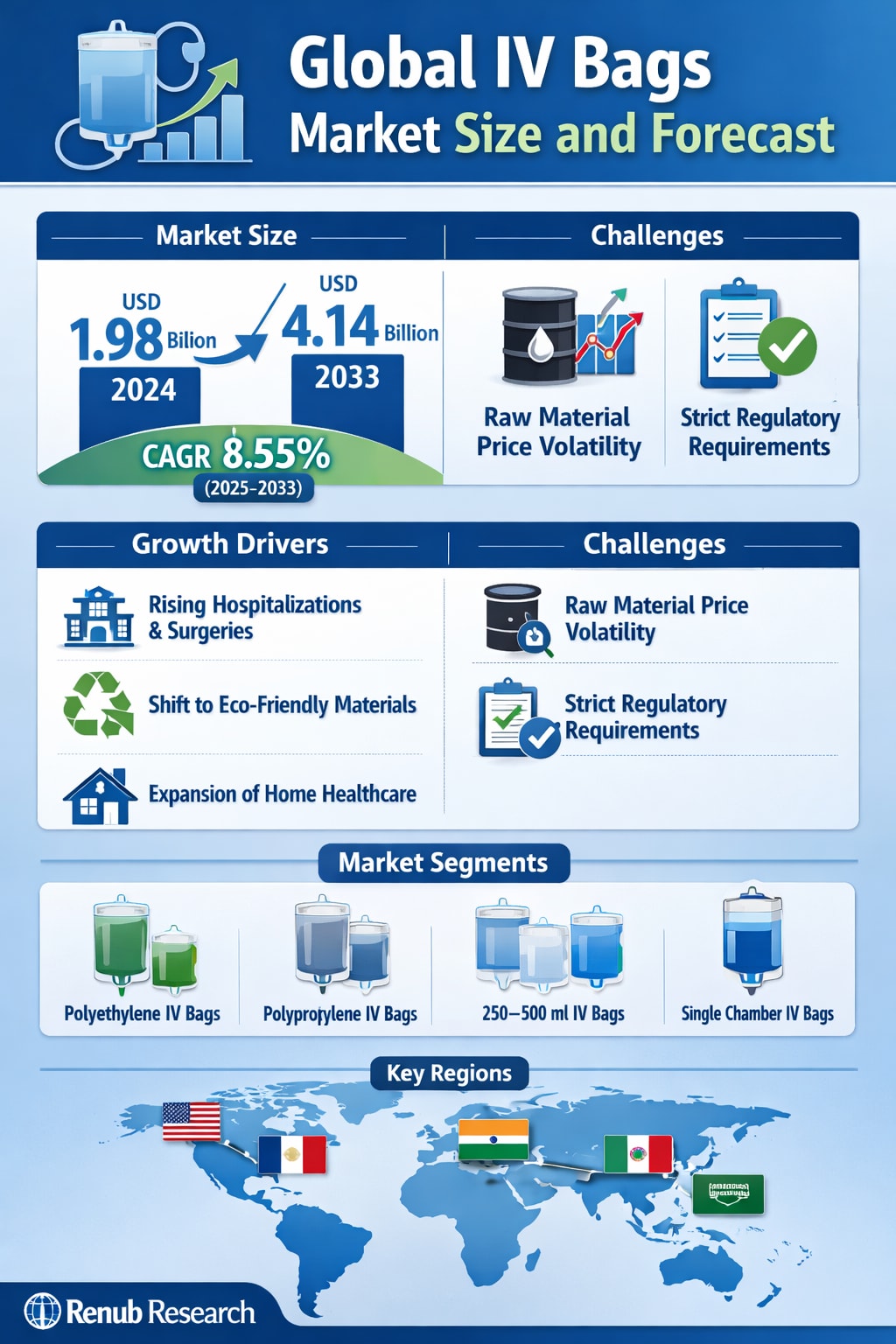
According to Renub Research, the Global IV Bags Market is expected to grow from US$ 1.98 billion in 2024 to US$ 4.14 billion by 2033, registering a robust compound annual growth rate (CAGR) of 8.55% during the period 2025–2033. This strong growth outlook reflects not only rising hospitalization rates and surgical procedures, but also a broader transformation in how healthcare systems deliver fluids and medications safely, efficiently, and sustainably.
As healthcare systems worldwide face aging populations, increasing chronic disease burdens, and rising expectations for patient safety, IV bags are no longer just basic consumables. They are becoming high-value medical devices shaped by material innovation, regulatory standards, and changing models of care.
Global IV Bags Market Outlook
IV bags are sterile containers used to administer fluids, nutrients, or drugs directly into a patient’s bloodstream through an intravenous line. Traditionally produced from materials such as polyvinyl chloride (PVC), and increasingly from non-PVC polymers like polyethylene and polypropylene, these bags are essential across almost every clinical setting.
They are used for hydration therapy, electrolyte balancing, antibiotic and drug delivery, blood transfusions, chemotherapy, and nutritional support. From emergency departments and intensive care units to surgical theaters and long-term care facilities, IV bags are a constant presence.
The global market continues to expand due to several structural trends: growing hospitalization rates, a rising number of surgical procedures, expanding healthcare infrastructure in emerging economies, and the rapid growth of home healthcare and ambulatory services. At the same time, the industry is undergoing a material transition, with healthcare providers and regulators pushing for safer, more environmentally friendly alternatives to traditional PVC-based products.
Growth Drivers Within the Global IV Bags Market
Increasing Global Rates of Hospitalizations and Surgery
One of the most powerful drivers of IV bag demand is the steady rise in hospital admissions and surgical procedures worldwide. Aging populations, the growing prevalence of chronic diseases, and improved access to healthcare services are pushing more patients into hospitals and clinics every year.
IV bags are indispensable in these settings. They are used for fluid resuscitation, medication administration, anesthesia support, post-operative recovery, and nutritional therapy. The expansion of outpatient surgical centers and emergency departments further adds to usage volumes.
Globally, chronic diseases remain a major burden. Estimates suggest that millions of people die each year from cardiovascular diseases, cancers, chronic respiratory diseases, and diabetes—conditions that often require repeated hospital visits and intensive IV-based therapies. As healthcare infrastructure expands in emerging economies, the consumption of IV bags is also rising, making them a cornerstone product in the global medical supply chain.
Transition to Non-PVC and Environmentally Friendly IV Bags
Another major trend reshaping the market is the shift away from traditional PVC and DEHP-containing products. DEHP, a commonly used plasticizer in PVC, has been associated with potential health risks, prompting hospitals and regulators to look for safer alternatives.
As a result, materials such as polyethylene and polypropylene are gaining popularity. These materials are considered safer for patients, reduce the risk of chemical leaching, and are more environmentally friendly. Regulatory bodies in North America and Europe, along with frameworks such as the EU’s REACH regulations, are accelerating this transition.
Manufacturers are responding with increased investment in research and development to create cost-effective, compliant, and high-performance non-PVC IV bags. A notable example is Baxter International’s IV bag recycling initiative, which in late 2023 successfully diverted several tons of PVC IV bag waste from landfills, highlighting the industry’s growing focus on sustainability alongside patient safety.
Expansion of Home Healthcare and Ambulatory Services
Healthcare delivery is no longer confined to hospitals. The rapid growth of home healthcare and ambulatory care services is creating fresh demand for portable, easy-to-use IV bags. Patients with chronic conditions, those requiring long-term therapies, and individuals recovering from surgery are increasingly receiving treatment at home.
This shift reduces the burden on hospitals, lowers costs, and improves patient comfort. It also requires reliable and safe IV delivery systems that can be used outside traditional clinical environments. The introduction of ready-to-use and premixed IV solutions, such as newly approved formulations for emergency and chronic care, is further supporting this trend.
In regions with aging populations and rising healthcare expenses, home infusion therapy is becoming a preferred option, making IV bags an essential component of decentralized care models.
Challenges Facing the Global IV Bags Market
Unstable Raw Material Prices
IV bag manufacturing relies heavily on petrochemical-based polymers such as PVC, polyethylene, and polypropylene. Fluctuations in crude oil prices, geopolitical tensions, and global supply chain disruptions can significantly impact raw material costs.
This volatility makes it difficult for manufacturers to maintain stable pricing and predictable profit margins. In developing economies with limited domestic production capacity, dependence on imported raw materials can further increase healthcare costs. As a result, supply chain optimization, long-term sourcing contracts, and strategic inventory management are becoming critical priorities for industry players.
Stringent Regulatory and Compliance Requirements
IV bags are classified as medical devices and are subject to strict regulatory oversight to ensure patient safety. Compliance with standards set by organizations such as the FDA, EMA, and ISO requires extensive testing, documentation, and regular audits.
While these regulations are essential for quality and safety, they also increase development costs and can delay the introduction of new products. For multinational companies, navigating different regulatory frameworks across regions adds further complexity. Smaller manufacturers, in particular, may find it challenging to scale globally under such stringent compliance demands.
Market Insights by Segment
Global Polyethylene IV Bags Market
Polyethylene IV bags are rapidly gaining market share as a safer and more environmentally friendly alternative to PVC. Being DEHP-free and non-toxic, they are especially suitable for sensitive applications such as oncology and neonatal care.
These bags offer strong barrier properties, good clarity, and high durability. As hospitals aim to reduce chemical exposure and align with stricter environmental standards, demand for polyethylene IV bags is rising steadily, particularly in North America and Europe.
Global Polypropylene IV Bags Market
Polypropylene IV bags are valued for their high thermal resistance, chemical stability, and low leachability. These properties make them ideal for applications that require intensive sterilization or long-term storage of medications, such as parenteral nutrition.
Their inert nature reduces the risk of drug interactions, which is crucial for sensitive formulations. With increasing regulatory pressure to phase out PVC-based products, polypropylene bags are expected to see strong growth, especially in Asia-Pacific and Europe.
Global 250–500 ml IV Bags Market
The 250–500 ml capacity segment is among the most widely used across healthcare facilities. These mid-sized bags offer a practical balance between volume and ease of handling, making them suitable for both adult and pediatric patients.
They are commonly used for hydration, electrolyte replacement, and medication delivery in general wards, emergency departments, outpatient clinics, and home-care settings. Consistent demand in this segment is driving manufacturers to focus on improvements in sterility, portability, and material performance.
Global Single Chamber IV Bags Market
Single chamber IV bags dominate the global market due to their simplicity, affordability, and wide range of applications. They are used for routine hydration, drug administration, and electrolyte therapy across virtually all healthcare settings.
Compared to multi-chamber bags, single chamber designs are easier to manufacture and more cost-effective, making them especially popular in emerging economies. Ongoing improvements in sealing technology and sterility assurance are further strengthening their position in the market.
Regional Market Highlights
United States IV Bags Market
The United States represents one of the largest and most advanced markets for IV bags. High surgical volumes, widespread chronic disease management, and a strong focus on patient safety are key growth drivers.
The country is also at the forefront of the shift toward non-PVC and DEHP-free products, supported by regulatory guidance and growing awareness among healthcare providers. The rise of home infusion therapy, driven by cost pressures and an aging population, is further boosting demand. Major manufacturers continue to invest heavily in innovation, compliance, and supply chain resilience.
France IV Bags Market
France is a major contributor to the European IV bags market, supported by a strong public healthcare system and a growing emphasis on environmentally friendly medical devices. French hospitals are steadily moving away from PVC-based products in line with EU policies.
High surgical rates and the prevalence of chronic diseases ensure consistent demand, while investments in local manufacturing are helping reduce dependence on imports and strengthen supply security.
India IV Bags Market
India’s IV bags market is expanding rapidly due to improving healthcare infrastructure, growing medical tourism, and wider access to hospital care under government initiatives. The rise in dialysis centers, cancer treatment facilities, and infection management programs is driving steady demand.
Domestic manufacturers are scaling up production, and there is a clear shift toward DEHP-free and cost-effective alternatives such as polypropylene and polyethylene bags, particularly in urban hospitals and large healthcare chains.
Mexico IV Bags Market
Mexico’s market is benefiting from investments in public healthcare infrastructure, growing pharmaceutical manufacturing, and increasing demand from private hospitals. Rising cases of diabetes and gastrointestinal diseases are also contributing to higher usage of IV therapies.
As a strategic manufacturing and export hub for North and Latin America, Mexico is attracting global players and gradually adopting safer, non-PVC alternatives in line with international standards.
Saudi Arabia IV Bags Market
Saudi Arabia’s IV bags market is being driven by healthcare reforms under Vision 2030, aimed at modernizing and expanding medical services. A high burden of chronic diseases and increasing surgical procedures are boosting demand for IV therapies.
The government’s push to localize medical manufacturing and reduce import dependence is supporting domestic production, while rising patient safety standards are increasing demand for sterile and DEHP-free products.
Competitive Landscape
The global IV bags market features a mix of multinational corporations and specialized manufacturers. Key players include Baxter International Inc., B. Braun Medical Inc., Fresenius Kabi, ICU Medical Inc., Technoflex, Polycine GmbH, Haemotronic, MedicoPack, Sippex IV Bags, and Kraton Corporation.
These companies compete on product quality, material innovation, regulatory compliance, and supply chain reliability. Many are also investing in sustainability initiatives, advanced manufacturing technologies, and ready-to-use IV solutions to differentiate themselves in an increasingly competitive market.
Final Thoughts: A Market Built on Safety, Scale, and Innovation
The global IV bags market may not always be in the spotlight, but its importance to modern healthcare cannot be overstated. With the market projected to grow from US$ 1.98 billion in 2024 to US$ 4.14 billion by 2033, the sector is clearly on a strong upward trajectory.
Rising hospitalizations, expanding surgical volumes, the growth of home healthcare, and the shift toward safer, non-PVC materials are all reshaping the industry. At the same time, manufacturers must navigate raw material volatility and strict regulatory environments while continuing to innovate.
In the years ahead, IV bags will remain a quiet but essential backbone of healthcare systems worldwide—supporting everything from emergency care to chronic disease management, and from hospital wards to patients’ homes.



Comments
There are no comments for this story
Be the first to respond and start the conversation.