
Middle East Building Automation Market Size & Forecast 2026–2034
Smart Cities, Energy Efficiency, and Mega Projects Power a High-Growth Decade for Intelligent Buildings in the Middle East

Introduction: A Region Building Smarter, Not Just Bigger
The Middle East is in the midst of one of the most ambitious construction and infrastructure transformations in the world. From futuristic smart cities and mega tourism hubs to next-generation airports, hospitals, and commercial districts, the region is no longer focused solely on scale—it is focused on intelligence, efficiency, and sustainability. In this context, building automation has moved from being a “nice-to-have” technology to a strategic necessity.
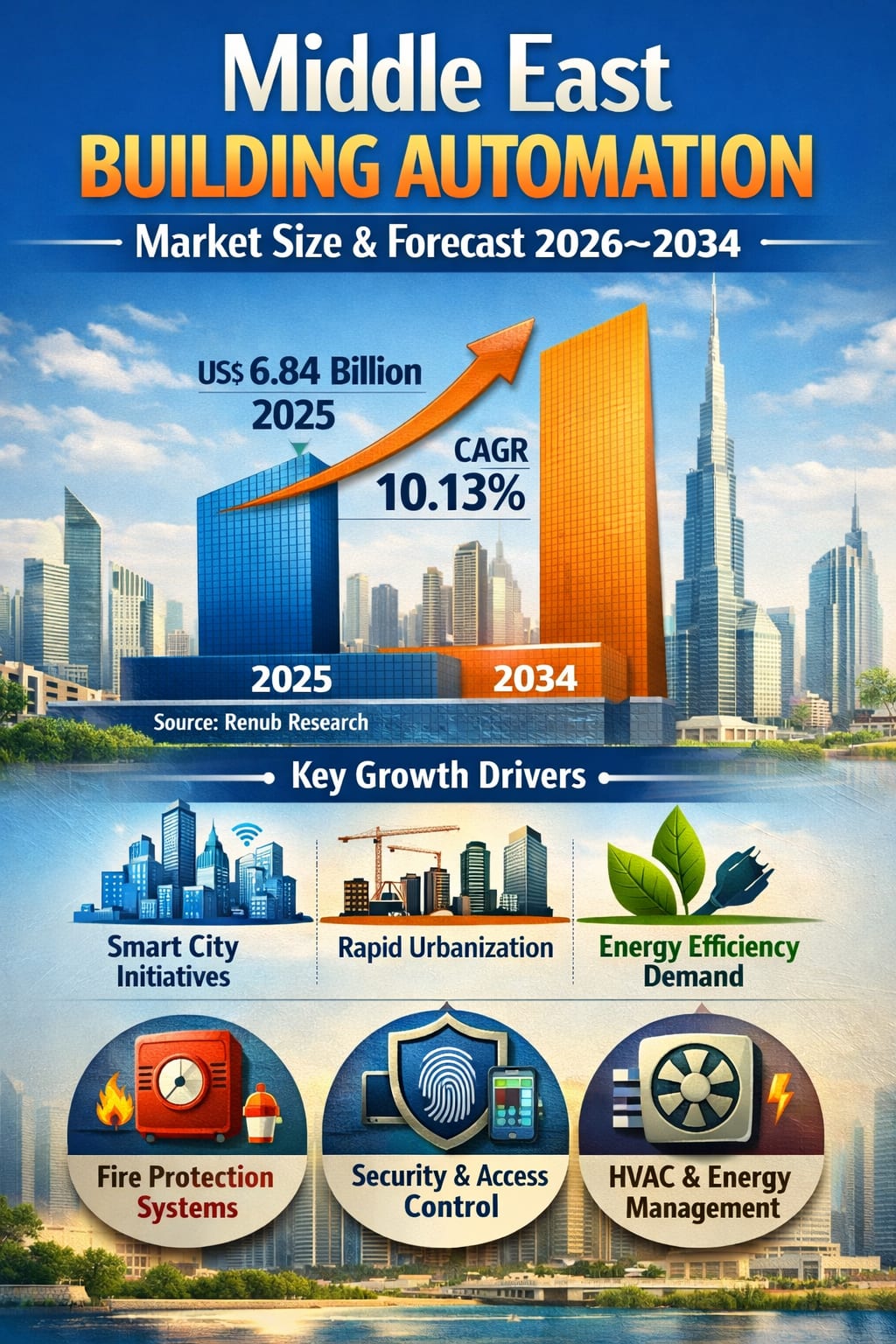
According to Renub Research, the Middle East building automation market is expected to expand from US$ 6,842.33 million in 2025 to US$ 16,306.28 million by 2034, growing at a robust CAGR of 10.13% during 2026–2034. This growth reflects not only rising construction activity, but also a structural shift in how buildings are designed, operated, and optimized across the region.
Building automation refers to the use of smart technologies and digital systems to automatically control and optimize core building functions such as HVAC, lighting, energy management, security, and fire protection. These systems rely on sensors, controllers, software platforms, and communication networks to improve operational efficiency, reduce energy consumption, and enhance occupant comfort and safety.
In a region characterized by extreme climatic conditions, high energy demand, and rapidly growing urban populations, the value proposition of building automation is especially compelling. Governments, developers, and facility owners are increasingly turning to intelligent building systems to meet sustainability goals, manage costs, and deliver premium user experiences.
Middle East Building Automation Market Outlook
The adoption of building automation in the Middle East has accelerated significantly over the past decade, driven by rapid urbanization, smart city initiatives, and large-scale infrastructure investments. Countries such as Saudi Arabia, the United Arab Emirates, and Qatar are at the forefront of this transition, embedding smart building technologies into new developments from the planning stage itself.
Automation systems allow complex buildings—such as airports, hospitals, hotels, shopping malls, and mixed-use towers—to be managed centrally and efficiently. Instead of relying on manual controls and fragmented systems, building owners can now monitor and optimize energy use, indoor climate, lighting, and security in real time. This not only improves performance and reliability, but also significantly reduces operating costs over the building’s lifecycle.
Another key factor behind the market’s growth is the region’s rising focus on sustainability and green building standards. With cooling accounting for a major share of energy consumption in the Middle East, intelligent HVAC and energy management systems play a critical role in reducing carbon emissions and meeting national climate targets. As a result, building automation is increasingly seen as a core pillar of sustainable urban development.
Growth Drivers of the Middle East Building Automation Market
Rapid Urbanization and Mega Construction Projects
The Middle East—particularly the GCC region—continues to witness fast-paced urban development, supported by strong government spending and private sector investment. New cities, economic zones, tourism hubs, and transportation networks are being developed at an unprecedented scale. Managing these complex, high-density environments efficiently would be nearly impossible without advanced automation systems.
Saudi Arabia alone has lined up several major global events and mega projects over the coming decade, including the AFC Asian Cup 2027, Asian Winter Games 2029 (at Trojena in NEOM), World Expo 2030 in Riyadh, and the FIFA World Cup 2034. Each of these events requires massive investments in stadiums, hotels, airports, and urban infrastructure—much of which is being designed as “smart” from the ground up.
Building automation enables centralized control of HVAC, lighting, energy, and security systems across large and complex facilities. As buildings grow bigger and more sophisticated, manual management becomes inefficient and costly, making automation not just an upgrade, but a necessity.
Government Smart City Initiatives and Sustainability Goals
Governments across the Middle East are actively promoting smart cities, digital infrastructure, and sustainable development. Countries such as Saudi Arabia, the UAE, and Qatar have launched national programs aimed at reducing energy consumption, cutting carbon emissions, and improving the quality of urban life.
In hot climates where cooling demand is extremely high, smart climate control and lighting systems can deliver significant energy savings. For example, the UAE has invested heavily in smart city initiatives, allocating substantial funding to digital and intelligent infrastructure projects aimed at improving public services and urban efficiency.
Building automation systems support these goals by enabling real-time monitoring, predictive maintenance, and data-driven optimization of building operations. This makes them a key enabler of national sustainability and energy efficiency strategies across the region.
Demand for Energy Efficiency and Enhanced Occupant Comfort
Rising electricity costs and increasing awareness of environmental impact are pushing building owners to seek smarter ways to manage energy consumption. Automated systems can adjust HVAC, lighting, and other building functions based on occupancy levels, weather conditions, and usage patterns, significantly reducing waste and improving efficiency.
At the same time, occupant comfort has become a critical differentiator, especially in commercial offices, hotels, healthcare facilities, and high-end residential developments. Building automation improves indoor air quality, temperature control, and lighting comfort, creating healthier and more productive environments.
In January 2023, ABB introduced its Cylon Smart Building Management Systems in the Middle East, offering scalable solutions for centralized energy and building control. Such innovations highlight how technology providers are tailoring advanced automation platforms to meet the region’s specific needs.
Challenges Facing the Market
High Initial Investment and Integration Costs
Despite its long-term benefits, building automation requires significant upfront investment in sensors, controllers, software platforms, and communication infrastructure. Retrofitting older buildings can be particularly expensive and technically complex, which may discourage small and medium-sized property owners from adopting these solutions.
While lifecycle cost savings are substantial, the initial capital requirement remains a key barrier to wider adoption, especially in price-sensitive segments of the market.
Shortage of Skilled Workforce and Technical Expertise
Implementing and maintaining advanced automation systems requires expertise in software, networking, cybersecurity, and building systems engineering. In some parts of the Middle East, the shortage of trained professionals and reliance on foreign expertise can increase project costs and timelines.
The lack of standardized training and certification programs in certain markets also adds to the complexity, making skill development an important long-term priority for the industry.
Key Market Segments and Related Industries
Middle East Building Fire Protection Systems Market
Fire protection systems are increasingly being integrated with building automation platforms to enable real-time monitoring, faster response, and centralized control. Given the region’s hot climate, dense urban developments, and large public venues, fire safety is a critical concern.
Mega projects such as airports, hotels, and shopping malls are driving strong demand for advanced fire detection and suppression systems, further strengthening the role of automation in safety-critical applications.
Middle East Building Security and Access Control Market
Security and access control systems are seeing rising adoption due to growing concerns around infrastructure protection, data security, and public safety. Technologies such as biometric authentication, RFID, smart cards, and mobile-based access control are increasingly being integrated with building management systems.
This integration enables remote monitoring, real-time alerts, and faster incident response—capabilities that are especially important in high-value commercial and government facilities.
Residential and Commercial Building Automation
While commercial buildings remain the largest adopters, residential building automation is also gaining traction, particularly in premium housing projects and smart communities. Homeowners are increasingly interested in smart lighting, climate control, and security systems that offer convenience, comfort, and energy savings.
In the commercial segment, automation has become almost essential for offices, hotels, malls, hospitals, and airports. High energy usage, complex operations, and sustainability targets make intelligent building management systems a strategic investment rather than a discretionary one.
Hardware and Software Segments
The hardware segment includes sensors, controllers, actuators, meters, and communication devices—the physical backbone of any automation system. Demand for reliable and accurate hardware is rising as more buildings adopt smart technologies in both new construction and renovation projects.
On the software side, the market is rapidly moving toward cloud-based platforms, AI-driven analytics, and predictive maintenance tools. These solutions provide centralized dashboards, real-time insights, and automated reporting, helping facility managers optimize performance and reduce downtime.
Country-Level Insights
Saudi Arabia
Saudi Arabia is the largest and fastest-growing building automation market in the region, driven by Vision 2030, mega projects, and smart city developments such as NEOM. The country’s extreme climate makes energy-efficient HVAC and smart energy management systems especially important.
In March 2023, Honeywell introduced a self-testing fire alarm solution, marking a significant step forward in automated fire and life safety systems. Such innovations highlight how Saudi Arabia is becoming a key testing ground for next-generation building technologies.
United Arab Emirates
The UAE is a regional leader in smart building adoption, with cities like Dubai and Abu Dhabi integrating automation into commercial, residential, hospitality, and public infrastructure projects. The country’s strong focus on green buildings and carbon reduction continues to fuel demand for smart HVAC, lighting, and energy management systems.
In early 2025, CIBSE launched the TM65 UAE guide on calculating embodied carbon in building services, underlining the growing emphasis on sustainability and data-driven building design in the market.
Kuwait
Kuwait’s building automation market is smaller but steadily expanding, supported by infrastructure development and rising awareness of energy efficiency. Given the country’s heavy reliance on HVAC systems, automation offers a practical way to reduce costs and improve performance in both commercial and residential buildings.
Market Segmentation Overview
By System Type:
Facilities Management Systems
Security and Access Controls
Fire Protection Systems
Building Energy Management Software
BAS Services
Others
By Application:
Industrial
Residential
Commercial
By Component:
Hardware
Software
By Country:
Saudi Arabia
United Arab Emirates
Qatar
Kuwait
Bahrain
Oman
Turkey
Others
Competitive Landscape
Key players operating in the Middle East building automation market include:
Siemens AG, Honeywell International Inc., LG Electronics, Hitachi Ltd., Schneider Electric, Electrolux, Samsung, and Haier Inc.
These companies compete on the basis of technology innovation, system integration capabilities, energy efficiency performance, and long-term service support. Most are also expanding their portfolios to include AI-driven analytics, cloud platforms, and cybersecurity features to meet the evolving needs of smart buildings.
Final Thoughts: A Smarter Future for Middle Eastern Cities
The Middle East building automation market is entering a decisive growth phase. With the market projected to rise from US$ 6.84 billion in 2025 to US$ 16.31 billion by 2034, automation is no longer a niche technology—it is becoming a foundational element of modern urban development in the region.
Driven by mega projects, smart city ambitions, sustainability goals, and the need for energy efficiency, building automation is reshaping how buildings are designed, operated, and experienced. While challenges such as high initial costs and skills shortages remain, the long-term benefits in terms of efficiency, comfort, safety, and environmental performance are simply too compelling to ignore.
In the coming decade, as the Middle East continues to build some of the world’s most advanced cities and infrastructures, building automation will stand at the center of this transformation—quietly, intelligently, and indispensably powering the future of smart living and working.
About the Creator
Dow Jones Industrial Average Insight: Quiet Market Pressure Building Beneath the Surface
Dow Jones Industrial Average activity often looks calm before major change appears. Right now, the Dow Jones Industrial Average is moving without strong direction, but hidden pressure is building. Many investors overlook these quiet signals and only react when prices move fast. Understanding what the Dow Jones Industrial Average is showing today can help investors stay one step ahead.
By John.doe798a day ago in Trader
A Love Forboding
The chipped stone slope caused unbearable footing. I slid, skirting on my heels. I cast my shield, relinquishing my guard to stay upright. Left with my double-edge and a prayer to the maker, I skated toward my objective. The earthly stubble gave way to solid ground. I found myself restored, a trail of dust in my wake.
By James U. Rizzi7 days ago in Fiction



Comments
There are no comments for this story
Be the first to respond and start the conversation.