
Mexico Non-Invasive Prenatal Testing Market Size & Forecast 2025–2033
Rising Awareness, Preventive Healthcare, and Advanced Diagnostics Push Mexico’s NIPT Market Toward a US$ 179.89 Million Future

Introduction: A New Era in Prenatal Care in Mexico
Mexico’s healthcare landscape is undergoing a quiet but powerful transformation, and one of the most promising areas of change is prenatal diagnostics. Among the most impactful innovations is Non-Invasive Prenatal Testing (NIPT)—a modern screening method that allows doctors to detect chromosomal abnormalities in a fetus using a simple maternal blood test. Safer, more accurate, and far less stressful than traditional invasive procedures, NIPT is rapidly becoming a preferred choice for expectant parents and healthcare providers alike.
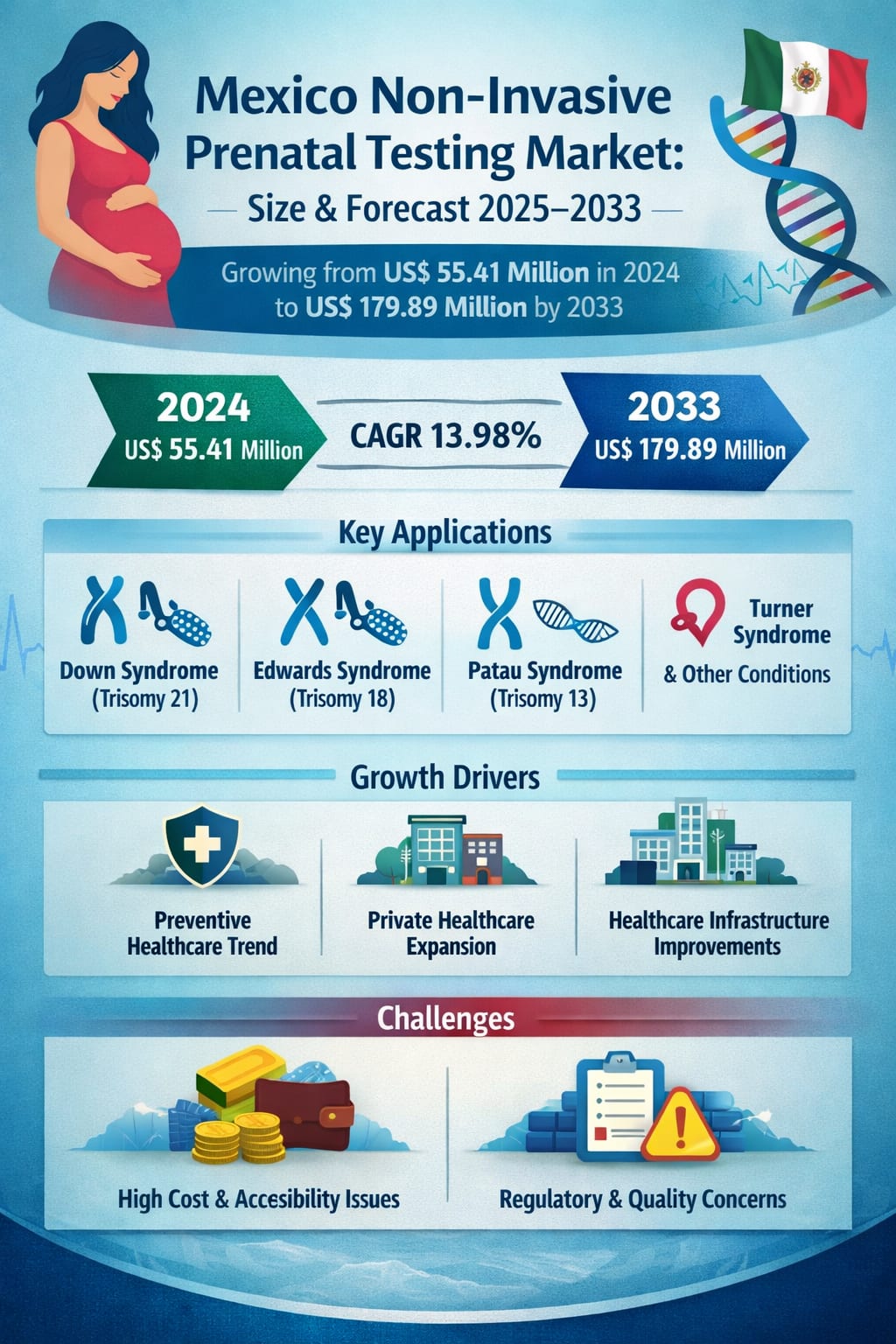
According to Renub Research, the Mexico Non-Invasive Prenatal Testing Market is expected to grow from US$ 55.41 million in 2024 to US$ 179.89 million by 2033, registering a robust CAGR of 13.98% from 2025 to 2033. This remarkable growth reflects not only technological progress but also deeper changes in how prenatal care is perceived and delivered across the country.
Rising awareness of genetic disorders, increasing maternal age, expanding private healthcare infrastructure, and a broader shift toward preventive medicine are all playing crucial roles in shaping this market. As Mexico continues to modernize its healthcare system, NIPT is steadily moving from a premium diagnostic option to a mainstream component of prenatal care.
Understanding Non-Invasive Prenatal Testing (NIPT)
Non-invasive prenatal testing is a screening method that analyzes small fragments of fetal DNA circulating in the mother’s blood. Unlike invasive procedures such as amniocentesis or chorionic villus sampling (CVS), NIPT poses no risk of miscarriage and can be performed as early as the first trimester of pregnancy.
NIPT is primarily used to screen for chromosomal abnormalities such as:
Down Syndrome (Trisomy 21)
Edwards Syndrome (Trisomy 18)
Patau Syndrome (Trisomy 13)
Turner Syndrome
Other genetic and chromosomal conditions
Because of its high accuracy and safety profile, NIPT has become an increasingly attractive option for both physicians and expectant parents in Mexico, especially in urban centers where access to advanced diagnostics is improving rapidly.
Mexico Non-Invasive Prenatal Testing Market Overview
The NIPT market in Mexico is expanding at a strong pace, driven by a combination of medical, social, and economic factors. Improvements in prenatal care standards, greater health awareness among parents, and better access to modern healthcare facilities have all contributed to this growth.
Major cities such as Mexico City, Monterrey, and Guadalajara are at the forefront of this transformation. Private hospitals and diagnostic laboratories in these regions are increasingly incorporating NIPT into routine prenatal screening packages. At the same time, Mexico’s growing reputation as a medical tourism destination is also supporting demand, as international patients seek high-quality diagnostics at comparatively lower costs.
However, the market is not without its challenges. Cost barriers, limited access in rural areas, and shortages of genetic counseling services continue to restrict widespread adoption. Even so, with ongoing investments in healthcare infrastructure and rising insurance coverage, the long-term outlook for the NIPT market in Mexico remains highly positive.
Key Growth Drivers of the Mexico NIPT Market
1. Shift Toward Preventive Healthcare
One of the strongest forces behind the rise of NIPT in Mexico is the country’s gradual shift toward preventive and proactive healthcare. More expectant parents are choosing to screen for potential genetic conditions early in pregnancy rather than waiting for complications to arise.
NIPT fits perfectly into this mindset. Its non-invasive nature, combined with high accuracy, allows families to make informed decisions early on—without the anxiety and risks associated with invasive tests. This aligns with the broader global trend toward personalized and preventive medicine, where healthcare is increasingly focused on early detection and tailored treatment strategies.
As awareness grows and more physicians recommend NIPT as part of routine prenatal care, adoption rates are expected to continue rising across Mexico.
2. Expansion of Private Healthcare
The rapid growth of private healthcare facilities in Mexico has significantly improved access to advanced diagnostic technologies, including NIPT. Private hospitals and specialized diagnostic labs are often quicker to adopt new medical innovations, and many now offer NIPT as a standard option for expectant mothers.
This trend is especially visible in large urban areas, where competition among private providers is driving investments in cutting-edge equipment and high-quality services. In addition, expanding private health insurance coverage is making NIPT more affordable for a growing segment of the population.
As private healthcare continues to expand, NIPT is likely to become even more widely available, further supporting market growth.
3. Advancements in Healthcare Infrastructure
Mexico has been steadily investing in its healthcare infrastructure, particularly in urban and semi-urban regions. New hospitals, modern diagnostic centers, and upgraded laboratory facilities are improving the overall quality of maternal and fetal care.
These infrastructure upgrades make it easier for healthcare providers to offer advanced tests like NIPT. At the same time, better training for medical professionals and improved laboratory standards are enhancing the reliability and credibility of test results.
Although access remains uneven between urban and rural areas, continued investment in healthcare infrastructure is expected to gradually narrow this gap and bring advanced prenatal screening options to a broader population.
4. Rising Maternal Age and Changing Demographics
Another important factor driving demand for NIPT in Mexico is the increase in maternal age. More women are choosing to have children later in life due to career, education, and lifestyle considerations. Since the risk of chromosomal abnormalities increases with maternal age, the need for accurate and safe prenatal screening becomes more critical.
This demographic shift is directly boosting demand for NIPT, as older expectant mothers and their healthcare providers seek reliable ways to assess genetic risks without exposing the pregnancy to unnecessary danger.
Challenges Facing the Mexico NIPT Market
Affordability and Accessibility
Despite its advantages, NIPT remains expensive for many families in Mexico, especially those who rely on public healthcare services or lack private insurance. In many cases, NIPT is not fully reimbursed, forcing patients to pay out of pocket.
This cost barrier disproportionately affects lower-income and rural populations, who may have to rely on less accurate or more invasive testing methods. Addressing this issue will require a combination of policy support, broader insurance coverage, and continued efforts to reduce testing costs through technological innovation and economies of scale.
Regulatory and Quality Control Issues
As the NIPT market grows, ensuring consistent quality and reliability across all testing providers becomes increasingly important. Differences in laboratory standards, testing methodologies, and equipment can lead to variations in accuracy, which may undermine trust in the technology.
A stronger regulatory framework, along with strict quality control standards and accreditation requirements, will be essential to maintain confidence in NIPT services across Mexico. Clear guidelines and oversight can help ensure that all patients receive accurate, reliable, and ethically delivered testing.
Market Segmentation: A Closer Look
By Component
Instruments
Kits and Reagents
Services
Among these, services and kits & reagents play a critical role, as the demand for testing continues to rise across hospitals and diagnostic laboratories.
By Application
Down Syndrome (Trisomy 21)
Edwards Syndrome (Trisomy 18)
Patau Syndrome (Trisomy 13)
Turner Syndrome
Other Applications
Down syndrome screening remains the most widely used application of NIPT, reflecting both its prevalence and the strong clinical demand for early, accurate detection.
By End User
Hospitals
Diagnostic Labs
Diagnostic laboratories are playing an increasingly important role, particularly in urban areas where specialized testing centers are expanding rapidly.
Competitive Landscape: Key Players Shaping the Market
The Mexico NIPT market is supported by several major global and regional players, all of whom are contributing to technological innovation, service expansion, and market development. Key companies covered in the market include:
Eurofins Scientific
F. Hoffmann-La Roche Ltd
Invitae Corporation
Illumina Inc.
Natera Inc.
Centogene NV
Qiagen
These companies are активно investing in research and development, improving testing accuracy, expanding their service networks, and forming strategic partnerships to strengthen their presence in the Mexican market.
Future Outlook: Where Is the Market Headed?
Looking ahead, the future of the Mexico Non-Invasive Prenatal Testing market appears exceptionally promising. With the market projected to reach US$ 179.89 million by 2033, NIPT is set to become an integral part of prenatal care across the country.
Several trends are likely to shape the next phase of growth:
Wider insurance coverage and improved reimbursement policies
Continued expansion of private healthcare and diagnostic labs
Ongoing technological innovation that reduces costs and improves accuracy
Greater public awareness and physician adoption of NIPT
Stronger regulatory frameworks ensuring quality and trust
As these factors come together, NIPT is expected to move beyond niche usage and become a standard screening tool for a broad segment of Mexico’s pregnant population.
Final Thoughts
The rise of non-invasive prenatal testing in Mexico reflects a broader transformation in the country’s healthcare system—one that is increasingly focused on prevention, precision, and patient safety. From a market value of US$ 55.41 million in 2024 to a projected US$ 179.89 million by 2033, the growth trajectory of the NIPT market underscores both the medical and social importance of early, reliable prenatal screening.
While challenges related to affordability, accessibility, and regulation remain, the long-term outlook is undeniably positive. With continued investment, supportive policies, and technological progress, NIPT is poised to play a central role in improving maternal and fetal health outcomes across Mexico.
About the Creator
Tom Shane
Tom Shane is a content writer specializing in SEO-driven blogs, product descriptions, and thought leadership. He crafts engaging, research-backed content that connects with audiences and drives results.
I Don't Need My Phone... Wait, Is That Actually True?
My parents gave me my first cell phone when I was twelve years old. It wasn't a fancy iPhone or anything, not even close. Just a simple black flip phone for when I needed to call or text them after school.
By Madison "Maddy" Newton4 days ago in Humans




Comments
There are no comments for this story
Be the first to respond and start the conversation.