
United States HVAC Equipment Market Trends & Growth Outlook 2025–2033
Smart Buildings, Energy Efficiency, and Climate Extremes Are Powering a USD 41.22 Billion Market Transformation

United States HVAC Equipment Market Overview
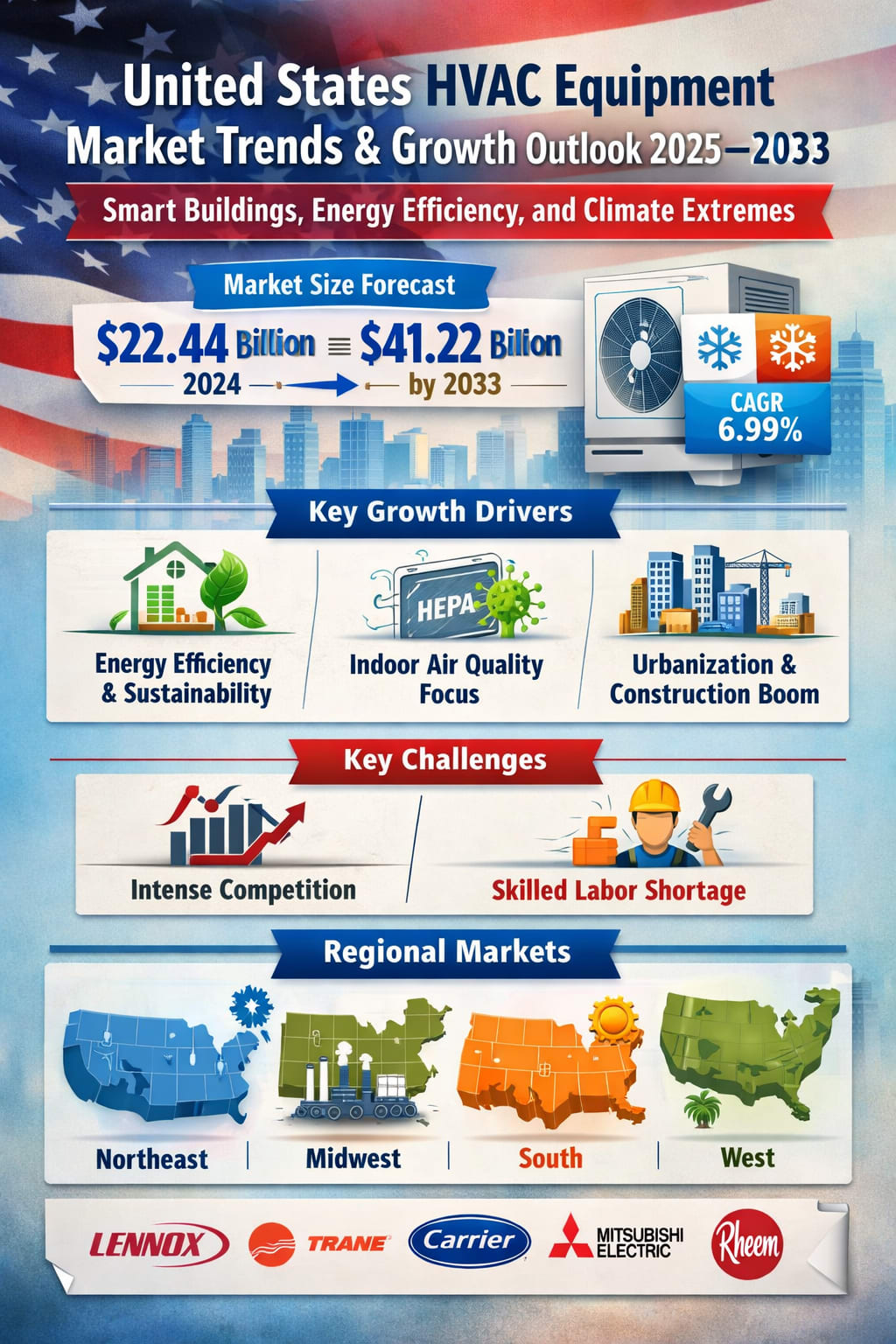
The United States HVAC equipment market is entering a decisive growth phase, shaped by climate variability, energy efficiency mandates, and the rapid adoption of smart building technologies. According to Renub Research, the United States HVAC Equipment Market is expected to grow from US$ 22.44 billion in 2024 to US$ 41.22 billion by 2033, registering a CAGR of 6.99% from 2025 to 2033.
This strong expansion is not happening in isolation. The U.S. spans a vast geographic area with extreme climate variations—from freezing winters in the Midwest and Northeast to scorching summers in the South and Southwest. These conditions make heating, ventilation, and air conditioning systems not just a comfort feature, but a necessity for both residential and commercial buildings. As a result, HVAC installations remain a critical part of new construction, renovation, and infrastructure modernization across the country.
Beyond climate needs, the market is being reshaped by technological innovation, stricter environmental regulations, and changing consumer expectations. Energy efficiency, smart controls, environmentally friendly refrigerants, and improved indoor air quality (IAQ) features are no longer optional upgrades—they are becoming standard requirements in modern HVAC systems. Major players such as Carrier, Trane, Lennox, Rheem, and Mitsubishi Electric are investing heavily in high-performance, low-emission solutions to meet these demands.
The post-pandemic world has also elevated the importance of indoor air quality. Offices, hospitals, schools, and even homes are increasingly prioritizing advanced filtration, ventilation, and air purification systems. At the same time, the growth of smart homes and connected buildings is accelerating the adoption of HVAC systems that can be monitored and controlled remotely for better comfort, efficiency, and cost savings.
Taken together, these forces are pushing the U.S. HVAC equipment market into a new era—one defined not just by temperature control, but by sustainability, intelligence, and health-focused design.
Policy Support and Smart Building Investments
Government policy is playing a major role in shaping the future of the HVAC sector. The U.S. government has expanded building renovation and energy-efficiency programs to reduce emissions and lower long-term operating costs for both public and private buildings. These initiatives also improve indoor air quality, reinforcing the link between HVAC modernization and public health.
A notable example came in June 2024, when the U.S. General Services Administration (GSA) announced plans to invest USD 80 million from the Inflation Reduction Act (IRA) into intelligent building technologies. Across more than 560 federal buildings, these systems aim to reduce emissions, improve energy efficiency, cut operational costs, and enhance occupant comfort. HVAC systems sit at the heart of this transformation, as they account for a significant share of building energy consumption.
At the same time, consumer adoption of smart home technology is creating a fertile environment for next-generation HVAC solutions. According to the Consumer Technology Association (CTA), U.S. smart home hardware sales revenue reached USD 23.5 billion in 2023, up from USD 19.70 billion in 2018. As homeowners become more comfortable with connected devices, demand is rising for HVAC systems that integrate seamlessly with smart thermostats, home automation platforms, and energy management systems.
Key Growth Drivers in the United States HVAC Equipment Market
1. Energy Efficiency and Sustainability
Energy efficiency is one of the strongest forces driving the U.S. HVAC market. With rising energy costs and stricter environmental regulations, both consumers and businesses are actively seeking systems that reduce power consumption and carbon emissions. The U.S. Department of Energy (DOE) has introduced more stringent efficiency standards, pushing manufacturers to innovate and deliver higher-performance equipment.
Modern HVAC systems now focus on variable-speed compressors, advanced heat exchangers, smart controls, and eco-friendly refrigerants. These technologies not only help meet regulatory requirements but also provide tangible savings on utility bills. For commercial users, energy-efficient HVAC systems are becoming a key part of broader corporate sustainability strategies, helping organizations meet ESG goals while reducing operating expenses.
Government incentives, rebates, and tax credits further accelerate adoption, making energy-efficient systems more affordable and attractive across residential, commercial, and industrial segments.
2. Rising Awareness of Indoor Air Quality (IAQ)
The COVID-19 pandemic fundamentally changed how people think about indoor environments. Clean air is no longer just a comfort issue—it is a health priority. This shift has significantly increased demand for HVAC systems equipped with advanced filtration, air purification, and ventilation technologies.
Features such as HEPA filters, UV-C disinfection, and enhanced ventilation controls are becoming more common, especially in offices, hospitals, schools, and public buildings. Even in residential spaces, homeowners are investing in systems that can reduce allergens, pollutants, and airborne pathogens.
As people continue to spend more time indoors—whether working from home or in climate-controlled commercial spaces—the focus on indoor air quality is expected to remain a long-term growth driver for the HVAC equipment market.
3. Urbanization and Construction Growth
Urbanization continues to reshape the U.S. landscape, driving demand for new residential complexes, commercial buildings, data centers, healthcare facilities, and industrial spaces. Every new building requires reliable and efficient HVAC systems, while older structures are increasingly being retrofitted to meet modern energy and environmental standards.
In fast-growing metropolitan areas, HVAC systems play a critical role in ensuring comfort, productivity, and sustainability. Energy-efficient and smart HVAC solutions are particularly attractive in urban settings, where energy costs are high and environmental regulations are often stricter.
The combination of new construction, renovation projects, and replacement of aging systems creates a steady and long-term demand pipeline for HVAC equipment manufacturers and service providers.
Challenges Facing the U.S. HVAC Equipment Market
1. Intense Competition
The U.S. HVAC market is highly competitive, with established giants like Carrier, Trane, Lennox, and Rheem competing alongside regional players and new entrants. Innovation is no longer optional—companies must continuously invest in research and development to stay ahead in areas such as smart systems, energy efficiency, and sustainable refrigerants.
Price sensitivity among customers adds further pressure, forcing manufacturers to balance performance, features, and affordability. In addition, customer expectations around service quality, maintenance support, and long-term reliability are higher than ever. Companies that fail to deliver strong after-sales service risk losing market share in an increasingly crowded landscape.
2. Skilled Labor Shortage
A significant challenge for the industry is the shortage of skilled HVAC technicians, particularly in installation, maintenance, and repair roles. As demand for HVAC systems grows, the gap between available jobs and qualified workers continues to widen.
This labor shortage can lead to project delays, higher labor costs, and inconsistent service quality. An aging workforce and limited entry of younger professionals into the trade further compound the problem. Over the long term, workforce development and training initiatives will be critical to sustaining the industry’s growth.
Regional Outlook: United States HVAC Equipment Market
Northeast
The Northeast experiences harsh winters and warm summers, creating year-round demand for both heating and cooling systems. Major cities such as New York, Boston, and Philadelphia drive strong residential and commercial demand. The region is also at the forefront of adopting energy-efficient and environmentally friendly systems, partly due to strict regulations and high energy costs. Retrofit projects, government incentives, and a strong focus on indoor air quality continue to support market growth here.
Midwest
The Midwest’s extreme seasonal temperature swings make HVAC systems essential for both homes and businesses. States like Illinois, Michigan, Ohio, and Wisconsin see strong demand across residential, commercial, and industrial sectors. Energy efficiency, smart controls, and improved filtration systems are gaining traction, supported by government incentives and a robust construction and renovation market.
A notable industry development occurred in May 2024, when Lennox and Samsung announced a joint venture focused on ductless air conditioning and heat pump products, including mini-split, multi-split, and VRF systems, across the U.S. and Canada. The new entity, expected to operate as Samsung Lennox HVAC North America, highlights the growing importance of advanced and flexible HVAC solutions in the region and beyond.
South and West
While not detailed earlier, these regions also play a crucial role in the national market. The South, with its long, hot summers, remains a stronghold for air conditioning systems, while the West’s focus on sustainability and green building standards is accelerating the adoption of energy-efficient and smart HVAC technologies.
Market Segmentation: United States HVAC Equipment Market
By Type of Equipment
1. Air Conditioning Equipment
Unitary Air Conditioners
Room Air Conditioners
Packaged Terminal Air Conditioners
Chillers
2. Heating Equipment
Warm Air Furnaces (Gas and Oil)
Boilers
Room and Zone Heating Equipment
Heat Pumps (Air-sourced and Geothermal)
3. Ventilation Equipment
Air Handling Units
Fan Coil Units
Building Humidifiers and Dehumidifiers
By End User
Residential
Commercial
Industrial
By Region
West
South
Midwest
Northeast
Competitive Landscape and Company Analysis
The U.S. HVAC equipment market is dominated by well-established global and regional players, each focusing on innovation, efficiency, and service quality. The report covers key companies from four viewpoints: Overview, Key Persons, Recent Developments, and Revenue.
Major companies include:
Lennox International Inc.
Rheem Manufacturing Inc.
Trane Inc. (Trane Technologies PLC)
Mitsubishi Electric Hydronics & IT Cooling Systems (Mitsubishi Electric Corporation)
Nortek Air Solutions LLC (Madison Air)
Carrier Corporation
Whirlpool Corporation
SPX Technologies
These companies are активно investing in smart HVAC systems, low-GWP refrigerants, heat pump technologies, and digital service platforms. Strategic partnerships, product launches, and regional expansions continue to shape the competitive dynamics of the market.
Final Thoughts
The United States HVAC Equipment Market is on a strong growth trajectory, driven by climate diversity, energy efficiency mandates, smart building adoption, and rising awareness of indoor air quality. With the market expected to expand from US$ 22.44 billion in 2024 to US$ 41.22 billion by 2033 at a CAGR of 6.99%, HVAC systems are evolving from simple climate control tools into intelligent, sustainable, and health-focused infrastructure solutions.
While challenges such as intense competition and skilled labor shortages remain, the long-term outlook is clearly positive. As the U.S. continues to invest in energy-efficient buildings, smart homes, and healthier indoor environments, the HVAC industry will remain at the center of this transformation—quietly shaping how Americans live, work, and breathe indoors in the years ahead.

Comments
There are no comments for this story
Be the first to respond and start the conversation.