
Bicycle Market Trends & Summary: How Cycling Is Powering the Future of Sustainable Mobility
Global Bicycle Market to Reach US$ 74.59 Billion by 2033, Driven by E-Bikes, Green Policies, and Urban Mobility Shifts

Introduction: A Market That Keeps Moving Forward
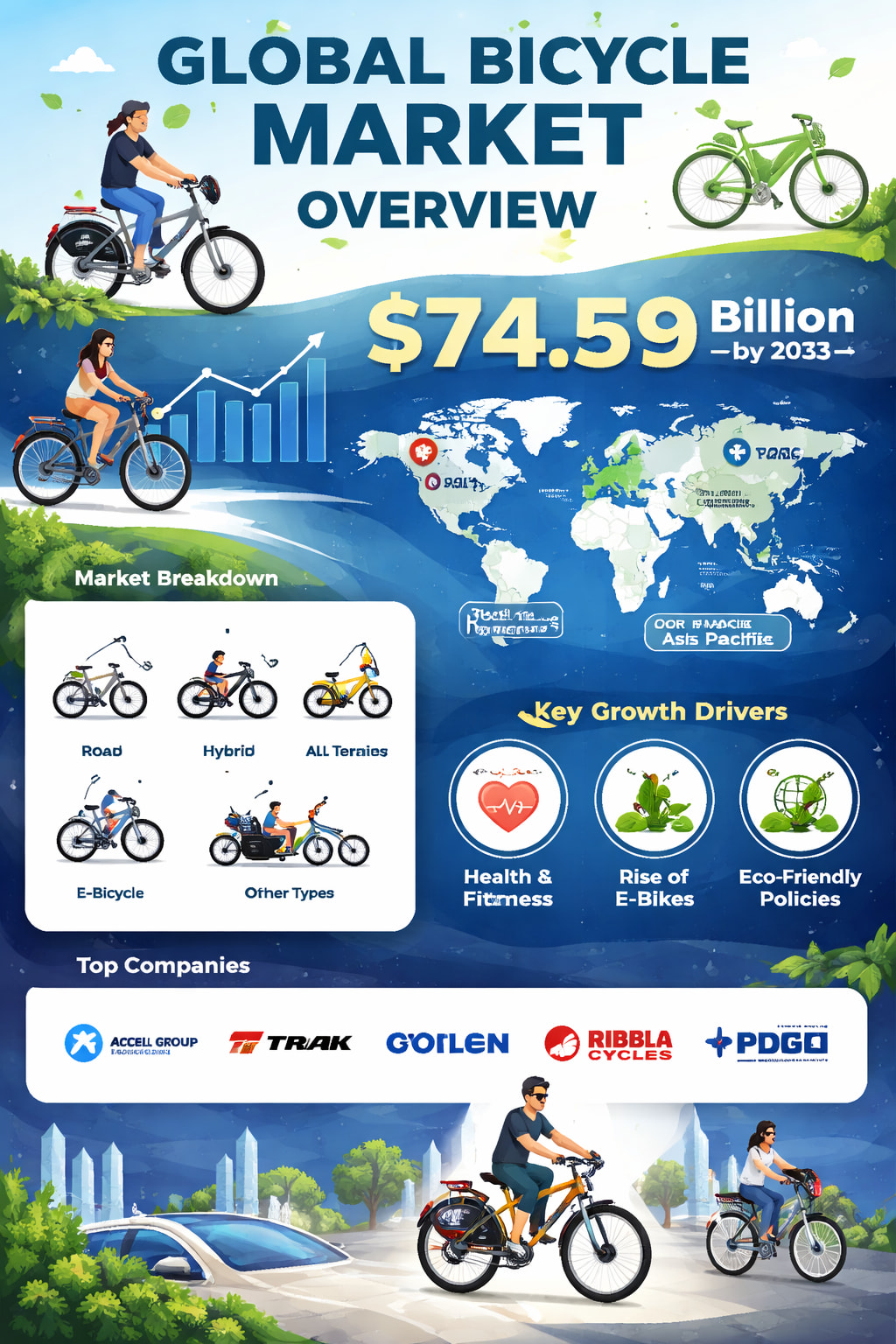
The global bicycle market is rolling steadily into a future shaped by sustainability, urbanization, and changing consumer lifestyles. According to Renub Research, the Bicycle Market is expected to grow from US$ 52.63 billion in 2024 to US$ 74.59 billion by 2033, registering a compound annual growth rate (CAGR) of 3.95% from 2025 to 2033. This consistent expansion reflects a broader transformation in how people commute, exercise, and think about personal mobility.
Bicycles are no longer viewed merely as recreational tools or basic transport options. Today, they represent a powerful intersection of health, environmental responsibility, and smart urban planning. The rise of electric bicycles (e-bikes), supportive government policies aimed at reducing carbon emissions, and increasing investments in cycling infrastructure have turned the bicycle industry into a strategic segment of the global mobility ecosystem.
The global bicycle market covers a wide range of products, including road bicycles, hybrid bicycles, all-terrain bicycles, e-bikes, and other specialized models, distributed through both online and offline channels. With strong demand across North America, Europe, Asia Pacific, Latin America, and the Middle East & Africa, the industry is firmly positioned as one of the most resilient and future-ready segments in the broader transportation market.
Global Bicycle Industry Overview
Urbanization, environmental awareness, and the growing push for sustainable transportation have significantly reshaped the global bicycle industry. As cities become more congested and concerns over air pollution intensify, bicycles are increasingly seen as a practical, low-cost, and eco-friendly alternative to cars and motorbikes. Beyond commuting, cycling has also gained popularity as a fitness activity and a leisure pursuit, further strengthening market demand.
One of the most important developments in recent years has been the rapid rise of electric bicycles (e-bikes). Thanks to improvements in battery technology, motor efficiency, and design, e-bikes have become more accessible, reliable, and appealing to a broader group of users. They allow riders to cover longer distances, tackle steep terrains, and commute without excessive physical strain, making cycling more inclusive for older adults, office commuters, and people with lower fitness levels.
Asia Pacific continues to dominate the global bicycle market, with China and India playing central roles in both production and consumption. These countries benefit from strong manufacturing bases, large populations, and growing urban middle classes. Meanwhile, Europe and North America are characterized by higher demand for premium bicycles and e-bikes, supported by strong cycling cultures, better infrastructure, and rising environmental awareness.
The industry’s supply chain has also evolved. Traditional retail models are now complemented by direct-to-consumer and online sales platforms, allowing brands to reach customers more efficiently and offer customized products. At the same time, governments around the world are investing heavily in cycling infrastructure. For instance, the Netherlands committed over USD 1.2 billion to bike infrastructure development, while France announced a EUR 2 billion investment plan through 2027 to expand cycling networks, improve parking facilities, and promote everyday bicycle use. These initiatives are creating long-term structural support for market growth.
Innovation and Product Trends Shaping the Market
Product innovation remains a central driver of competition in the bicycle industry. Manufacturers are increasingly focused on lightweight materials, ergonomic designs, and improved aerodynamics to enhance performance and comfort. Carbon fiber frames, advanced aluminum alloys, and smart components are becoming more common, even in mid-range models.
The e-bike segment, in particular, is witnessing rapid diversification. Companies are now offering models designed specifically for urban commuting, cargo transport, adventure touring, and family use. For example, in 2023, Giant Group introduced its Momentum brand of e-bikes in Germany, including models like the PakYak E+ for light cargo hauling and the Voya E+ for city commuting. These launches highlight how manufacturers are tailoring products to meet the specific needs of different consumer groups.
Digital integration is another emerging trend. Smart displays, GPS tracking, anti-theft systems, and app-based performance monitoring are gradually becoming standard features, especially in premium and electric bicycles. This blend of mobility and technology is helping reposition bicycles as modern, connected transport solutions rather than simple mechanical products.
Key Growth Drivers of the Bicycle Market
1. Rising Focus on Health and Wellness
Health and fitness awareness has become a major catalyst for bicycle adoption worldwide. Cycling is widely recognized as an effective way to improve cardiovascular health, build muscle strength, burn calories, and enhance overall physical fitness. As more people seek active lifestyles, bicycles are increasingly chosen as both a fitness tool and a daily transport option.
The growing burden of lifestyle-related diseases further supports this trend. According to global health organizations, cardiovascular diseases remain one of the leading causes of death worldwide, affecting hundreds of millions of people. This has encouraged individuals, schools, and communities to promote physical activities such as cycling. Initiatives like wellness programs in schools and community fitness campaigns are helping embed cycling into everyday routines, boosting long-term demand for bicycles.
2. Growing Popularity of Cycling Events and Recreational Riding
The rise of cycling events, marathons, and recreational tours has significantly contributed to the market’s expansion. These events not only increase bicycle sales but also create strong emotional and lifestyle connections with the sport. Public figures, athletes, and social media influencers promoting cycling have further amplified its appeal.
In Europe, cycling culture is particularly strong. For example, surveys conducted by cycling associations in Germany indicate extremely high participation and usage rates, reflecting how deeply integrated bicycles are in daily life. Similarly, government-backed funding for cycling events and awareness campaigns in countries like Ireland has helped increase participation and public interest. These activities not only boost short-term sales but also build a long-term consumer base committed to cycling.
3. Rapid Adoption of E-Bikes
E-bikes are one of the most powerful growth engines of the global bicycle market. Rising fuel prices, increasing traffic congestion, and longer commuting distances are pushing consumers to seek smarter mobility solutions. E-bikes offer a compelling balance between convenience and sustainability, allowing users to travel faster and farther without the costs and emissions associated with cars or motorcycles.
Urbanization is another crucial factor. According to United Nations projections, around 68% of the world’s population is expected to live in urban areas by 2050, which will further strain transport systems. E-bikes provide a flexible and space-efficient alternative for urban mobility. Supported by global initiatives such as World Bicycle Day (June 3), promoted by the UN and WHO, governments are actively encouraging cycling and e-bike adoption as part of broader sustainability strategies.
Challenges Facing the Bicycle Market
High Cost of E-Bikes
Despite their advantages, e-bikes remain significantly more expensive than traditional bicycles due to the cost of batteries, motors, and electronic components. In many developing countries, this price gap makes e-bikes inaccessible to a large portion of the population. As a result, e-bikes are often perceived as premium or luxury products rather than mass-market transport solutions.
To unlock the full potential of this segment, manufacturers will need to focus on cost optimization, local manufacturing, and scalable production. Over time, as battery costs decline and technology matures, e-bikes are expected to become more affordable, but price remains a short-term barrier to widespread adoption.
Competition from Alternative Mobility Solutions
Bicycles also face growing competition from electric scooters, ride-sharing services, and micro-mobility platforms. For short urban trips, many consumers find scooters or shared vehicles more convenient, as they require less physical effort and no ownership responsibilities. In densely populated cities, where parking and storage are major concerns, these alternatives can appear more practical.
While bicycles offer clear advantages in terms of health benefits and environmental impact, the industry must continue innovating in areas such as convenience, integration with public transport, and urban infrastructure to remain competitive in the evolving mobility landscape.
Regional Market Insights
United States Bicycle Market
The United States has a diverse and mature bicycle market, driven by demand for fitness, recreation, and urban commuting. The growing emphasis on sustainable transport and healthy living has boosted interest in both traditional bicycles and e-bikes. Many cities are investing in bike lanes, cycling trails, and public awareness campaigns, which supports long-term market growth.
However, the market also faces challenges, including competition from ride-sharing services and electric scooters, seasonal demand fluctuations, and the relatively high cost of e-bikes. Despite these hurdles, supportive government policies and a strong outdoor recreation culture continue to keep the U.S. bicycle market on a steady growth path.
Germany Bicycle Market
Germany is one of Europe’s strongest and most influential bicycle markets. Cycling is deeply embedded in everyday life, supported by excellent infrastructure, strong retail networks, and high consumer awareness. The country has also emerged as a major hub for e-bike adoption, with electric bicycles accounting for a growing share of total sales.
Specialty retailers play a key role in Germany’s market structure, offering premium products, maintenance services, and expert guidance. Even during economic slowdowns, the industry has shown resilience, supported by consistent demand and innovation. Looking ahead, continued government support for green mobility and infrastructure development is expected to sustain long-term growth.
India Bicycle Market
India’s bicycle market is expanding rapidly, fueled by rising health awareness, increasing fuel prices, and the need for affordable, eco-friendly transportation. The market includes a wide range of segments, from standard and children’s bicycles to premium models and e-bikes. E-bikes, in particular, are gaining traction in urban areas due to their suitability for crowded traffic conditions.
The industry features a mix of strong domestic players such as Hero Cycles, Avon Cycles, and TI Cycles, alongside global brands like Decathlon and Trek. Manufacturing hubs, especially in regions like Ludhiana, play a crucial role in meeting both domestic and export demand. While challenges such as infrastructure gaps and import duties remain, favorable government policies and changing consumer preferences are expected to keep the Indian market on a growth trajectory.
United Arab Emirates Bicycle Market
In the UAE, the bicycle market is benefiting from government-led sustainability initiatives and growing health consciousness. Cities like Dubai and Abu Dhabi have invested heavily in cycling infrastructure, including dedicated bike lanes and tracks. The introduction of bike-sharing programs, such as Abu Dhabi’s ADCB Bikeshare, has further increased accessibility and visibility for cycling.
As environmental goals and lifestyle changes continue to shape consumer behavior, demand for a wide range of bicycles, including e-bikes, is expected to rise steadily across the region.
Recent Developments in the Bicycle Industry
The global bicycle industry has seen several notable strategic moves and product launches in recent years:
March 2023: DOUZE Factory SAS partnered with Toyota to co-develop and market a new range of electric cargo bikes.
February 2023: Trek Bicycle Corporation launched the Fetch Plus 2 and Fetch Plus 4, marking its entry into the family and cargo e-bike segment.
February 2023: Pon.Bike announced the development of a new manufacturing plant in Lithuania’s Kėdainiai Free Economic Zone, aimed at expanding European production capacity.
January 2023: Yadea unveiled new electric bike models, including Trooper 01, URider S, and Innovator, at CES 2023 in Las Vegas.
These developments highlight the industry’s strong focus on innovation, capacity expansion, and diversification into new use cases such as cargo and family transportation.
Market Segmentation Overview
By Type:
Road Bicycle
Hybrid Bicycle
All Terrain Bicycle
E-Bicycle
Other Types
By Distribution Channel:
Online Stores
Offline Stores
By Geography:
North America, Europe, Asia Pacific, Latin America, Middle East & Africa, covering major countries such as the United States, Canada, Germany, France, United Kingdom, China, Japan, India, Australia, Brazil, Mexico, South Africa, Saudi Arabia, Turkey, and the United Arab Emirates, among others.
Competitive Landscape
Key players shaping the global bicycle market include:
Accell Group NV, Trek Bicycle Corporation, Pon Holdings BV, Giant Manufacturing Co. Ltd, Bulls Bikes, Pedego Inc., Benno Bikes LLC, Hero Cycles Limited, Ribble Cycles, and Riese & Müller GmbH.
These companies compete through product innovation, geographic expansion, strategic partnerships, and investments in e-bike technology and manufacturing capabilities.
Final Thoughts
The global bicycle market is no longer just about two wheels and pedals—it is about sustainable cities, healthier lifestyles, and smarter mobility choices. With the market projected to reach US$ 74.59 billion by 2033, bicycles—especially e-bikes—are set to play an increasingly important role in the future of transportation.
While challenges such as pricing pressures and competition from alternative mobility solutions remain, strong government support, infrastructure investments, and continuous product innovation provide a solid foundation for long-term growth. As urban populations rise and the push for greener transport intensifies, the bicycle industry is well-positioned to keep moving forward—steadily, sustainably, and with growing global impact.
About the Creator
Tom Shane
Tom Shane is a content writer specializing in SEO-driven blogs, product descriptions, and thought leadership. He crafts engaging, research-backed content that connects with audiences and drives results.
Introduction to Mutual Funds: A Beginner’s Guide to Smart Investing
Introduction Mutual funds are one of the most popular investment options for beginners and experienced investors alike. They pool money from multiple investors to invest in a diversified portfolio of stocks, bonds, or other securities. Mutual funds offer a simple way to achieve diversification, professional management, and potential long-term growth without the complexity of managing individual investments.
By Hammad Nawaza day ago in Trader
infosys share price today: should investors buy or wait?
The infosys share price is grabbing attention today. After recent ups and downs, investors are asking whether it is the right time to buy or hold. Understanding the reasons behind its movement is key for making informed decisions. This article examines the current infosys share price trend, expert opinions, key factors influencing the stock, and strategies for investors. By reading this, you can get a clear view of the market situation.
By John.doe798about 3 hours ago in Trader


Comments
There are no comments for this story
Be the first to respond and start the conversation.