
Medical Devices Cuffs Market Size and Forecast 2025–2033
Smart Monitoring, Aging Populations, and Home Healthcare Are Reshaping a Quiet but Essential Healthcare Segment

Global Medical Devices Cuffs Market Overview
The global medical devices cuffs market is quietly but steadily becoming one of the most essential segments within modern healthcare infrastructure. Often overlooked compared to high-profile diagnostic or imaging equipment, medical cuffs—such as blood pressure cuffs, cuffed endotracheal tubes, and tracheostomy tubes—play a critical role in everyday clinical practice and long-term patient monitoring. As healthcare systems worldwide shift toward preventive care, early diagnosis, and home-based monitoring, these seemingly simple devices are gaining renewed strategic importance.
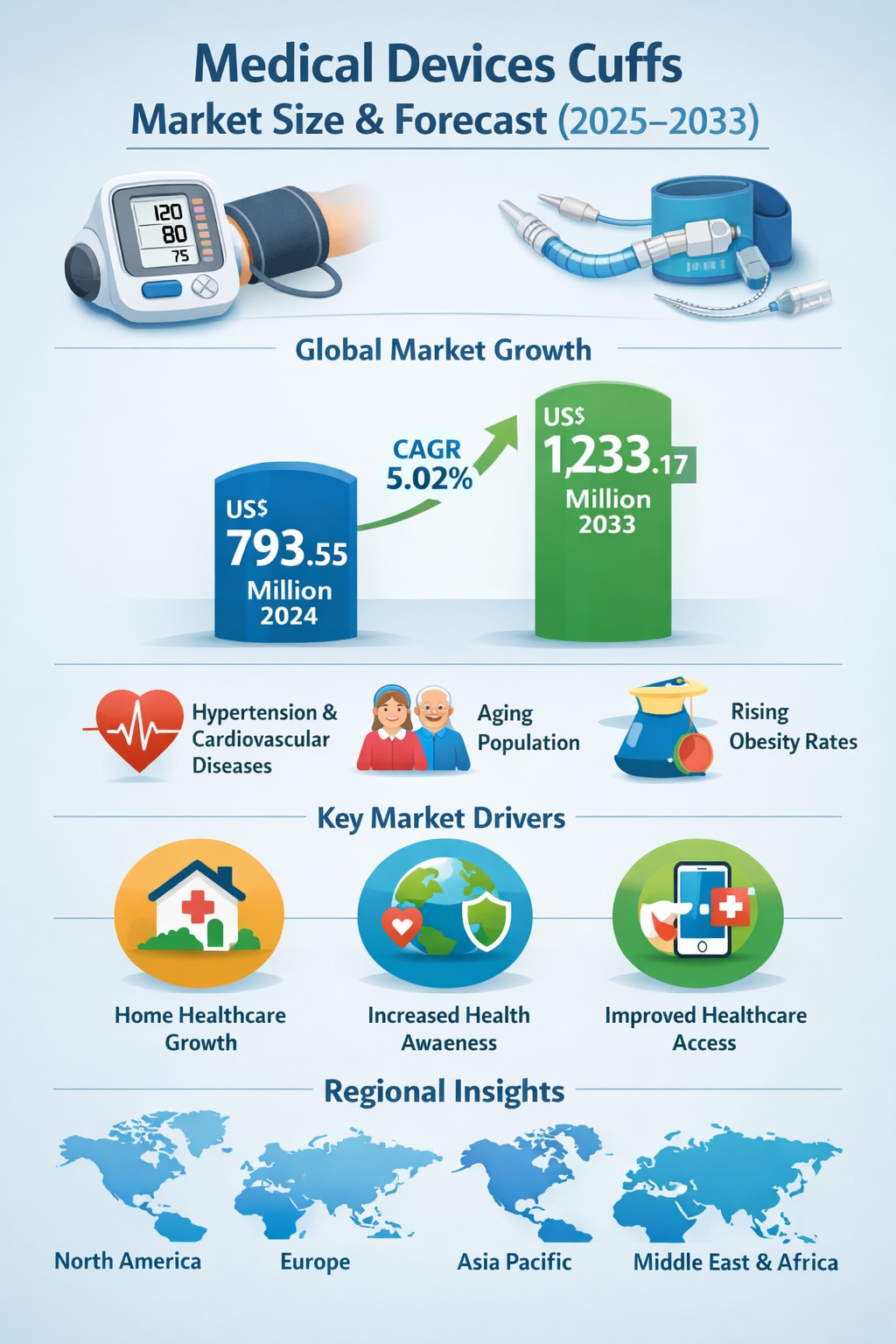
According to Renub Research, the Global Medical Devices Cuffs Market is expected to reach US$ 1,233.17 million by 2033, up from US$ 793.55 million in 2024, growing at a CAGR of 5.02% from 2025 to 2033. This steady expansion reflects a convergence of powerful long-term trends: the rising burden of chronic diseases, a rapidly aging global population, increasing health awareness, and the growing demand for non-invasive, easy-to-use monitoring tools.
Medical device cuffs are indispensable in both acute and chronic care settings. Blood pressure cuffs remain the backbone of cardiovascular monitoring, while cuffed endotracheal and tracheostomy tubes are essential in anesthesia, critical care, and respiratory management. Together, these products support everything from routine check-ups to life-saving interventions in intensive care units.
Technological progress is also reshaping this market. The integration of wireless connectivity, digital sensors, and smart monitoring features is transforming traditional cuffs into connected health devices. These innovations allow real-time data sharing, remote patient monitoring, and more accurate long-term tracking of vital signs. As healthcare systems increasingly embrace digital health and telemedicine, the role of smart, connected cuffs is expected to expand even further.
Another important driver is the growing adoption of home healthcare. Patients with chronic conditions such as hypertension, cardiovascular disease, and respiratory disorders are increasingly managing their health outside hospitals. This shift is boosting demand for reliable, user-friendly, and affordable cuff-based monitoring devices that can be used safely at home without professional supervision.
The Rising Burden of Hypertension and Cardiovascular Disease
One of the strongest growth engines for the medical devices cuffs market is the global surge in hypertension and cardiovascular disorders. High blood pressure is now one of the most widespread and dangerous risk factors for heart disease, stroke, and kidney failure. The World Health Organization estimates that around 1.28 billion people worldwide live with hypertension, making routine blood pressure monitoring a daily necessity for a significant portion of the global population.
In the United States alone, cardiovascular disease continues to be a leading cause of death. The Centers for Disease Control and Prevention reports that heart disease claims one life approximately every 33 seconds, and in 2022, nearly one in five deaths in the country was linked to heart disease. These sobering statistics underline why blood pressure cuffs—both in clinical settings and at home—remain among the most frequently used medical devices in the world.
Age is another crucial factor. The prevalence of hypertension rises sharply with age, making regular monitoring essential for older adults. In the U.S., hypertension affects a minority of young adults but becomes the norm among people aged 60 and above. This demographic shift is being mirrored globally as populations age, especially in developed and rapidly developing economies.
As a result, demand for both disposable and reusable blood pressure cuffs is rising across hospitals, clinics, ambulatory surgery centers, and home healthcare environments. The emphasis on early detection, continuous monitoring, and preventive care ensures that medical cuffs will remain a cornerstone of basic healthcare delivery for decades to come.
Key Growth Drivers Shaping the Market
Growth in Home Healthcare
The rapid expansion of home healthcare is one of the most transformative trends influencing the medical devices cuffs market. Patients today increasingly prefer managing chronic conditions from the comfort of their homes, supported by portable and easy-to-use medical devices. Blood pressure cuffs, in particular, have become household essentials for millions of people living with hypertension, heart disease, or metabolic disorders.
Home-based monitoring reduces the need for frequent hospital visits, lowers healthcare costs, and allows for earlier detection of potential complications. Modern cuffs are designed with simplicity in mind, enabling even elderly patients to measure and track their vital signs with minimal assistance. This shift not only empowers patients but also supports healthcare systems by easing the burden on hospitals and clinics.
Increased Health Awareness
Rising health awareness across the globe is another major catalyst for market growth. Public health campaigns, digital media, and improved access to medical information have made people more conscious of the importance of regular health check-ups and preventive care. Blood pressure monitoring, once limited mostly to clinical environments, is now widely recognized as a routine part of personal health management.
As health literacy improves, more individuals are investing in personal monitoring devices and adopting proactive approaches to disease prevention. This trend is especially visible in urban and semi-urban areas, where lifestyle-related conditions such as obesity, hypertension, and diabetes are becoming increasingly common.
Improved Healthcare Access
In many emerging economies, healthcare infrastructure is expanding rapidly. New hospitals, clinics, and diagnostic centers are being established, and access to basic medical devices is improving. This expansion is driving demand for essential tools like medical cuffs across multiple levels of care.
At the same time, the growth of telemedicine and remote patient monitoring is creating fresh opportunities for cuff-based devices. Portable, affordable, and reliable monitoring tools are becoming indispensable for extending healthcare services to rural and underserved regions, where access to specialists may be limited.
Challenges Facing the Medical Devices Cuffs Market
Cost and Affordability
Despite strong growth prospects, cost remains a significant barrier, particularly in low- and middle-income regions. Advanced cuffs with digital displays, wireless connectivity, and smart features are often priced beyond the reach of smaller healthcare providers and many individual patients.
For households managing multiple chronic conditions, the cumulative cost of medical devices—including blood pressure cuffs, glucose monitors, and pulse oximeters—can become a serious financial burden. Limited or inconsistent insurance coverage for home-use devices further restricts adoption. Addressing affordability through cost-effective manufacturing, subsidies, and inclusive pricing strategies will be critical for expanding market reach.
Limited Awareness in Underserved Markets
In many rural and underserved regions, awareness about the importance of routine health monitoring remains low. A lack of education, limited access to healthcare professionals, and cultural skepticism toward medical technology can all slow the adoption of medical device cuffs.
Bridging this awareness gap will require targeted public health campaigns, community outreach programs, and culturally sensitive education initiatives. Without these efforts, large segments of the global population may remain excluded from the benefits of early detection and preventive care.
Regional Market Insights
United States
The United States represents one of the most mature and technologically advanced markets for medical devices cuffs. Growth is driven by an aging population, high prevalence of chronic diseases, and strong demand for home monitoring solutions. The country’s advanced healthcare infrastructure supports rapid adoption of both traditional and smart, connected cuff devices across hospitals, clinics, and home care settings.
Innovation by domestic and international manufacturers, combined with supportive regulatory frameworks, continues to fuel product development. However, challenges related to cost and unequal access among underserved communities persist.
United Kingdom
In the United Kingdom, strong public health initiatives and the role of the National Health Service (NHS) are central to market development. Rising cases of hypertension and cardiovascular disease are increasing demand for reliable and user-friendly monitoring tools. The growing focus on preventive care and remote patient monitoring further supports adoption in both clinical and home environments.
Ensuring equitable access and affordability across different regions and population groups remains an ongoing challenge, even within a well-established healthcare system.
Japan
Japan’s market is shaped by its rapidly aging population and strong emphasis on preventive healthcare. The country has one of the highest proportions of elderly citizens in the world, making routine health monitoring a national priority. Technological innovation, supported by leading domestic medical device manufacturers, is driving the development of highly accurate and user-friendly cuff devices.
Government initiatives promoting health monitoring and early diagnosis further support market growth, although regional disparities in healthcare access still need to be addressed.
United Arab Emirates
The United Arab Emirates is emerging as a dynamic market for medical devices cuffs, supported by a modern healthcare infrastructure and rising prevalence of lifestyle-related chronic diseases. The adoption of smart and wireless technologies is particularly strong, aligning with the country’s broader digital health ambitions.
Government investments in healthcare modernization and preventive care are creating favorable conditions for market expansion, although affordability and regional access differences remain important considerations.
Recent Developments in the Industry
The medical devices cuffs market is witnessing steady innovation aimed at improving accuracy, usability, and connectivity. In February 2025, AD Medical introduced upgraded home blood pressure monitors designed to combine precision measurement with seamless digital connectivity. These devices reflect the growing demand for user-friendly, connected health solutions in home care settings.
In November 2024, OMRON Healthcare received FDA De Novo authorization for its new AI-powered blood pressure monitors with atrial fibrillation (AFib) detection. This milestone highlights how artificial intelligence and advanced analytics are beginning to reshape even the most traditional medical devices, opening new possibilities for early diagnosis and chronic disease management.
Market Segmentation Overview
By Type:
Blood Pressure Cuffs
Cuffed Endotracheal Tube
Tracheostomy Tube
By End Use:
Hospitals
Clinics
Ambulatory Surgery Centers
Others
By Region:
North America (United States, Canada)
Europe (France, Germany, Italy, Spain, United Kingdom, Belgium, Netherlands, Turkey)
Asia Pacific (China, Japan, India, Australia, South Korea, Thailand, Malaysia, Indonesia, New Zealand)
Latin America (Brazil, Mexico, Argentina)
Middle East & Africa (South Africa, Saudi Arabia, United Arab Emirates)
Competitive Landscape
The global medical devices cuffs market is moderately competitive, with several established players focusing on product innovation, strategic partnerships, and geographic expansion. Key companies operating in this space include:
Cardinal Health
ConvaTec Inc.
Cook Medical
GE Healthcare
Omron Healthcare Inc.
Pulmodyne Inc.
Smiths Medical
SunTech Medical Inc.
Teleflex Incorporated
Welch Allyn Inc.
These companies are evaluated across multiple dimensions, including company overview, key leadership, recent developments and strategies, and revenue performance. Continuous investment in research and development, along with a focus on smart and connected devices, is expected to remain a central competitive strategy in the coming years.
Final Thoughts
The global medical devices cuffs market may not always grab headlines, but its importance to modern healthcare cannot be overstated. From routine blood pressure checks to critical care respiratory management, cuff-based devices are woven into the fabric of everyday medical practice. With the market projected to grow from US$ 793.55 million in 2024 to US$ 1,233.17 million by 2033, the sector is set for steady and sustainable expansion.
Driven by aging populations, rising chronic disease prevalence, growing health awareness, and the shift toward home healthcare and digital health solutions, medical device cuffs are evolving from simple tools into smart, connected health companions. While challenges related to cost and awareness remain, ongoing innovation and expanding healthcare access are likely to unlock new opportunities across both developed and emerging markets.
About the Creator
North America Automotive Paint Market Size and Forecast 2025–2033
Introduction: A Market That Colors the Future of Mobility The automotive industry has always been about more than just engines and performance. Design, durability, and visual identity play a crucial role in how vehicles are perceived—and at the heart of that identity lies automotive paint. From glossy showroom finishes to durable protective coatings, automotive paints are no longer just about aesthetics; they are now central to performance, sustainability, and brand differentiation.
By Sakshi Sharma3 days ago in Trader
Asian Stock Markets Climb as Australia Surges on CBA Earnings; China CPI Weakness Watched Closely
Asia Stocks Today: Market Overview Asian stock markets traded mostly higher as investor sentiment improved across the region. Gains were led by Australia, where equities surged following better-than-expected earnings from Commonwealth Bank of Australia (CBA). Meanwhile, attention remained firmly on China, as weak consumer price index (CPI) data raised fresh concerns about slowing demand in the world’s second-largest economy.
By Hammad Nawaz6 days ago in Trader




Comments
There are no comments for this story
Be the first to respond and start the conversation.