
Medical Gas Market Trends & Summary: A Lifeline Powering the Future of Global Healthcare
From hospital ICUs to home healthcare, medical gases are quietly becoming one of the fastest-growing pillars of modern medicine

Global Medical Gas Market Overview
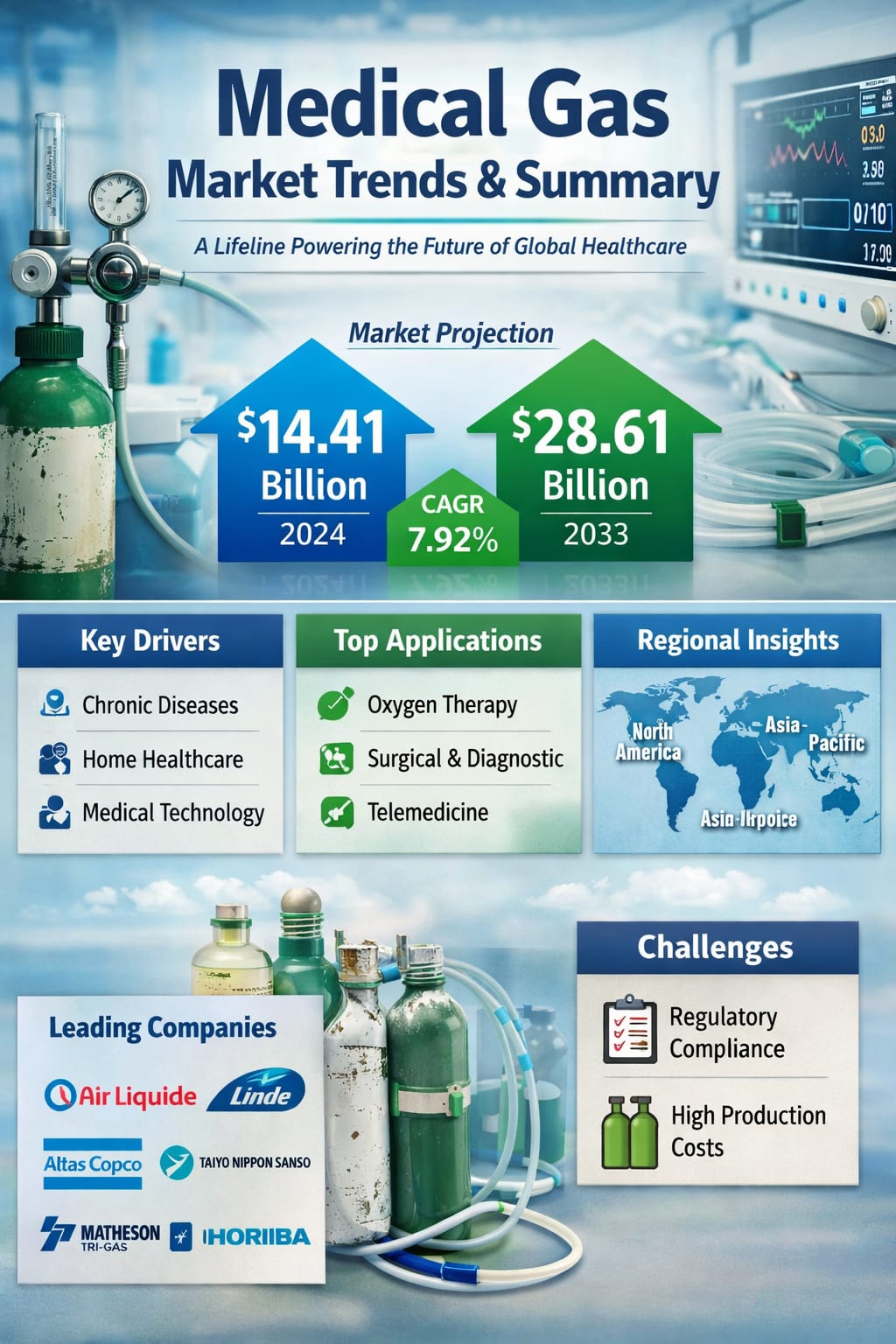
The global medical gas market is entering a decisive growth phase, reflecting the healthcare sector’s rising dependence on reliable, high-purity gases for diagnostics, therapeutics, and life-support applications. According to Renub Research, the Global Medical Gas Market is expected to reach US$ 28.61 billion by 2033, up from US$ 14.41 billion in 2024, registering a strong CAGR of 7.92% from 2025 to 2033. This expansion is being driven by a powerful combination of factors: the growing burden of chronic diseases, rapid adoption of home healthcare and telemedicine, and continuous technological innovation in medical equipment and gas delivery systems.
Medical gases—including oxygen, nitrous oxide, carbon dioxide, nitrogen, and medical air—are indispensable across modern healthcare systems. They are used in operating rooms, intensive care units, emergency departments, diagnostic laboratories, ambulatory surgical centers, and increasingly in patients’ homes. From anesthesia and respiratory therapy to imaging, cryosurgery, and minimally invasive procedures, these gases form the invisible backbone of countless life-saving interventions.
The market’s importance has become even more evident in recent years, as healthcare systems worldwide focus on improving critical care capacity, strengthening home-based treatment models, and modernizing hospital infrastructure. While North America currently holds a significant share of the global market, the Asia-Pacific region is expected to grow at the fastest pace, supported by expanding healthcare access, government investments, and rising awareness of advanced medical treatments.
At the same time, the industry faces notable challenges. Strict regulatory frameworks, high production and storage costs, and supply chain complexities continue to shape competitive strategies. Yet, despite these hurdles, the long-term outlook remains highly positive, as medical gases are no longer viewed as simple commodities but as strategic healthcare essentials.
Why Medical Gases Matter More Than Ever
The growing global burden of respiratory and cardiovascular diseases is one of the most powerful demand drivers for the medical gas market. Conditions such as chronic obstructive pulmonary disease (COPD), asthma, interstitial lung diseases, and heart failure often require long-term oxygen therapy and respiratory support. The World Health Organization has consistently highlighted the rising impact of chronic respiratory diseases worldwide, with millions of patients depending on oxygen and other therapeutic gases for daily survival and improved quality of life.
Asthma alone affects hundreds of millions of people globally, and COPD remains one of the leading causes of death. In countries like Australia, national health data shows that asthma accounts for a significant share of the total burden of respiratory disease, underlining how critical respiratory care has become. In hospitals, commonly used medical gases include oxygen, nitrous oxide, carbon dioxide, nitrogen, and medical air, each playing a specific role in treatment, diagnostics, and surgical procedures.
Major healthcare gas providers such as Air Liquide Healthcare now serve tens of thousands of hospitals and millions of patients worldwide, supplying specialized gas mixtures like heliox and lung gas blends for advanced respiratory care. This reflects a broader industry shift: medical gases are no longer just supporting tools—they are central to patient outcomes in critical and chronic care alike.
The Rise of Home Healthcare and Telemedicine
One of the most transformative trends reshaping the medical gas market is the rapid growth of home healthcare and telemedicine. More patients are now being treated outside traditional hospital settings, particularly those with chronic respiratory conditions, sleep apnea, and long-term oxygen needs. Portable oxygen concentrators, home oxygen cylinders, and compact gas delivery systems have made it possible for patients to receive hospital-grade therapy in the comfort of their homes.
This shift is driven by multiple factors: the need to reduce hospital stays, rising healthcare costs, aging populations, and patient preference for home-based care. Medical gases are at the center of this transition. Oxygen therapy, nebulization, pain management, and ventilator support increasingly rely on reliable home delivery systems.
Reimbursement policies are also playing a role in accelerating adoption. For example, safety innovations such as firebreak and thermal fuse systems in home oxygen setups have gained regulatory recognition in several countries. These measures not only improve patient safety but also build trust in home-based oxygen therapy models. As telemedicine expands, allowing clinicians to remotely monitor and manage patients, the demand for dependable medical gas solutions at home is expected to grow even further.
Technology as a Key Growth Engine
Technological innovation is another major force driving the medical gas market forward. Advances in minimally invasive surgery, including laparoscopy and endoscopy, rely heavily on gases like carbon dioxide to create clear operating fields and improve surgical precision. These techniques reduce patient trauma, shorten recovery times, and lower overall healthcare costs—making them increasingly popular worldwide.
In respiratory care, modern oxygen delivery systems, portable concentrators, and smart monitoring devices have transformed how chronic conditions are managed. Patients are no longer tied to bulky, stationary equipment, and healthcare providers can now tailor oxygen therapy more precisely to individual needs.
Medical gases also play a critical role in cryosurgery and dermatology, where substances like liquid nitrogen are used to freeze and remove abnormal or diseased tissue. The precision and control offered by modern cryotherapy systems have expanded their use across oncology, dermatology, and other specialties. Together, these innovations are steadily increasing both the scope and the value of medical gas applications across the healthcare spectrum.
Chronic Diseases: A Long-Term Demand Driver
The steady rise in chronic diseases ensures that demand for medical gases will remain strong over the long term. Respiratory conditions such as asthma, COPD, and interstitial lung disease often require ongoing oxygen support, while cardiovascular diseases—responsible for millions of deaths each year globally—frequently depend on oxygen therapy and anesthetic gases during both emergency and elective procedures.
Nitrous oxide continues to be widely used as an anesthetic and analgesic agent, particularly in surgical and dental settings, while oxygen remains fundamental for emergency care, intensive care, and post-operative recovery. In palliative care, medical gases also play a crucial role in improving comfort and quality of life for patients with advanced, life-limiting illnesses.
As populations age and lifestyle-related diseases become more prevalent, healthcare systems will increasingly rely on medical gases not just for acute interventions, but for long-term disease management and supportive care.
Challenges: Regulation and Cost Pressures
Despite its strong growth outlook, the medical gas market faces significant operational challenges. Stringent regulatory compliance is one of the most critical. Because these gases are directly linked to patient safety, regulators impose strict standards for purity, labeling, storage, transportation, and traceability. Meeting these requirements demands continuous monitoring, extensive documentation, and regular audits.
For manufacturers and suppliers, this means higher operational costs, increased investment in quality control systems, and the need for highly trained personnel. Navigating different regulatory frameworks across countries further complicates international distribution strategies, especially for smaller or emerging players.
In addition, high production and storage costs remain a persistent issue. Producing medical-grade gases requires advanced purification processes, energy-intensive compression and liquefaction systems, and specialized storage infrastructure. Transportation also demands purpose-built containers and strict safety protocols. All of these factors make medical gases more expensive to produce and distribute than many other healthcare consumables, putting pressure on both suppliers and healthcare providers.
Regional Spotlight: Key Markets
United States:
The U.S. medical gas market is driven by an aging population, high surgical volumes, and strong demand for advanced healthcare services. Hospitals, ambulatory surgical centers, and home healthcare providers are the main end users. Chronic conditions such as COPD and sleep apnea continue to fuel long-term demand for oxygen therapy. Strict regulatory oversight ensures high safety and quality standards, while ongoing innovation in gas delivery systems supports market growth.
Germany:
Germany represents one of Europe’s most advanced medical gas markets, supported by a strong healthcare infrastructure and an aging population. Hospitals remain the largest consumers, followed by ambulatory care and home healthcare. Technological innovations such as smart gas distribution systems and portable oxygen devices are improving efficiency and patient care. Major players like Linde, Air Liquide, and Messer Group continue to shape the competitive landscape through innovation and strategic partnerships.
India:
India’s medical gas market is expanding rapidly, fueled by healthcare infrastructure development, government initiatives such as Ayushman Bharat, and rising awareness of advanced medical treatments. The growing burden of respiratory diseases and the shift toward home healthcare are increasing demand for both hospital-based and portable medical gas solutions. With a large population and improving access to healthcare, India represents one of the most promising growth markets globally.
United Arab Emirates:
The UAE medical gas market is benefiting from strong government investment in healthcare, rapid hospital expansion, and rising demand for high-quality medical services. Chronic diseases, particularly respiratory conditions, are driving increased use of oxygen and other therapeutic gases. At the same time, strict regulatory standards and modern gas distribution technologies are ensuring high safety and quality levels across the healthcare system.
Recent Industry Developments
The competitive landscape continues to evolve through acquisitions, partnerships, and sustainability initiatives. In January 2025, Atlas Copco Group acquired Medi-teknique Ltd., a UK-based company specializing in medical gas maintenance and services, strengthening its presence in the British market. Around the same time, Air Liquide partnered with 20 hospitals and clinics across six European countries to help reduce their carbon footprint, highlighting the industry’s growing focus on sustainability alongside operational efficiency.
Market Segmentation at a Glance
By Product:
Pure Gases
Gas Mixtures
By Application:
Therapeutics
Diagnostics
Others
By End Use:
Hospitals
Pharmaceutical & Biotechnology Companies
Ambulatory Surgical Centers
Diagnostic & Research Laboratories
Academic & Research Institutes
Home Healthcare
By Region:
North America (United States, Canada)
Europe (France, Germany, Italy, Spain, United Kingdom, Belgium, Netherlands, Turkey)
Asia Pacific (China, Japan, India, Australia, South Korea, Thailand, Malaysia, Indonesia, New Zealand)
Latin America (Brazil, Mexico, Argentina)
Middle East & Africa (South Africa, Saudi Arabia, United Arab Emirates)
Key Companies:
Air Liquide, Linde PLC, Atlas Copco Group, INOX-Air Products Inc., Taiyo Nippon Sanso Corporation, Matheson Tri-Gas, HORIBA Group, SOL India Private Limited
Final Thoughts
The global medical gas market is no longer a quiet, behind-the-scenes segment of healthcare—it is becoming a strategic pillar of modern medicine. With the market projected to nearly double in value by 2033, driven by chronic disease prevalence, technological innovation, and the rapid rise of home healthcare, medical gases will play an even more central role in patient care worldwide.
While regulatory complexity and cost pressures remain real challenges, ongoing investment, innovation, and sustainability initiatives are reshaping the industry’s future. From high-tech operating rooms to living rooms turned into care centers, medical gases are truly becoming a lifeline that connects every level of the global healthcare system.
About the Creator
Australia Furniture Market 2026: Set for Steady Growth on Urbanization, Digital Retail & Sustainability
Australia Furniture Market Overview The Australia furniture market size is gaining significant momentum as consumer lifestyles evolve, urban housing development continues, and digital retail channels expand access to a wider array of products. According to the latest IMARC Group analysis, the market reached USD 19.7 billion in 2025 and is projected to grow to USD 32.9 billion by 2034, exhibiting a compound annual growth rate (CAGR) of 5.68% during 2026–2034.
By Amyra Singhabout 16 hours ago in Trader
Cardiac Mapping Market Size to Surpass USD 4.02 Billion by 2033 | At CAGR 8.60%
Overview – Cardiac Mapping Market Cardiac mapping refers to advanced diagnostic techniques used to analyze the electrical activity of the heart to detect arrhythmias and other cardiac abnormalities. These technologies play a critical role in guiding electrophysiology procedures, improving procedural accuracy, and enhancing patient outcomes. The market includes electroanatomical mapping systems, contact and non-contact mapping technologies, and advanced mapping catheters.
By James Smith6 days ago in Trader


Comments
There are no comments for this story
Be the first to respond and start the conversation.