
North America Automotive Paint Market Size and Forecast 2025–2033
How EVs, customization trends, and green coatings are reshaping the region’s $5.57 billion opportunity

Introduction: A Market That Colors the Future of Mobility
The automotive industry has always been about more than just engines and performance. Design, durability, and visual identity play a crucial role in how vehicles are perceived—and at the heart of that identity lies automotive paint. From glossy showroom finishes to durable protective coatings, automotive paints are no longer just about aesthetics; they are now central to performance, sustainability, and brand differentiation.
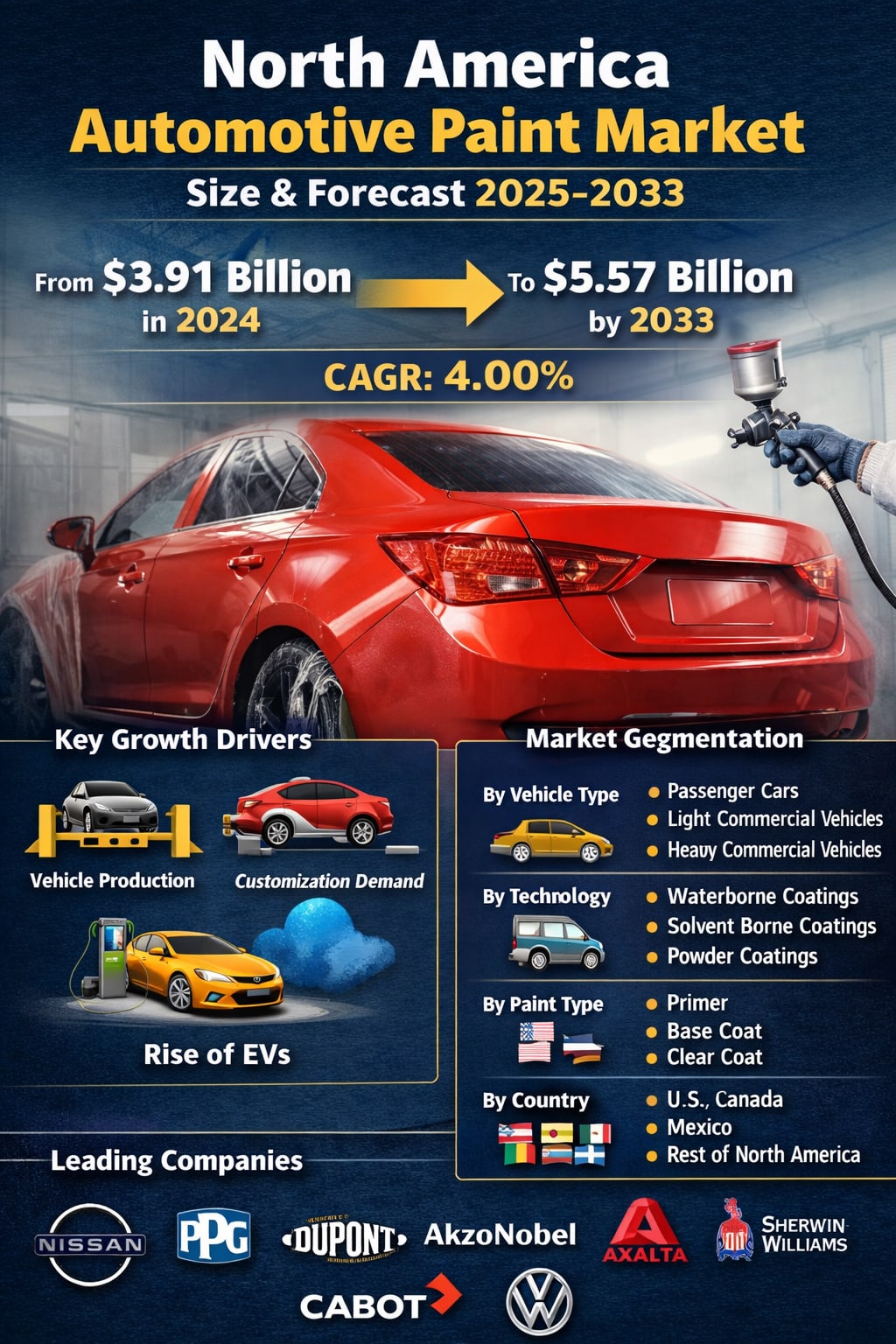
According to Renub Research, the North America Automotive Paint Market was valued at US$ 3.91 billion in 2024 and is expected to reach US$ 5.57 billion by 2033, expanding at a CAGR of 4.00% from 2025 to 2033. This steady growth reflects a region in transition—where rising vehicle production, the boom in electric vehicles (EVs), increasing consumer demand for customization, and stricter environmental regulations are collectively reshaping how automotive coatings are developed, produced, and applied.
Across the United States, Canada, and Mexico, automotive manufacturers and coating suppliers are investing heavily in advanced technologies such as waterborne and powder coatings, multi-layer systems, and high-performance clear coats. At the same time, the aftermarket segment is thriving, driven by vehicle repairs, refurbishments, and personalization trends.
In short, automotive paint in North America is no longer a supporting act—it is becoming a strategic pillar of the automotive value chain.
Market Overview: More Than Just a Coat of Color
Automotive paint is typically applied using spray systems in controlled environments and is designed to protect vehicle surfaces from corrosion, weathering, and wear, while also enhancing visual appeal. Modern automotive coating systems usually consist of multiple layers, including electrocoat, primer, base coat, and clear coat, each serving a specific functional and aesthetic purpose.
The painting process begins after vehicle body panels are assembled into what is known as the body-in-white (BIW) structure. The vehicle then passes through a series of coating stages in temperature-controlled paint shops to ensure uniform coverage, durability, and long-term performance.
Among these layers, base coats play a particularly important role, as they provide the actual color of the vehicle. Since base coats lack hardeners or strengtheners, they must be protected by clear coats to ensure durability. This is why coating manufacturers continue to innovate in base coat formulations. For instance, Axalta Coating Systems introduced its solvent-borne Cromax XP base coats to improve performance and application efficiency—an example of how product innovation is driving this segment forward.
In addition, metallic and special-effect paints have gained strong traction. These coatings incorporate metal powders or special pigments that create shimmering, pearlescent, or color-shifting effects. Although they are more expensive than solid colors, their ability to enhance visual appeal and even mask minor surface imperfections makes them increasingly popular among both automakers and consumers.
Key Growth Drivers in the North America Automotive Paint Market
1. Rising Vehicle Production and Ownership
One of the strongest drivers of the automotive paint market in North America is the continued rise in vehicle production and ownership, particularly in the United States, Canada, and Mexico. As automakers ramp up production to meet domestic and export demand, the need for OEM coatings increases in parallel.
At the same time, a growing vehicle population on the road fuels demand in the aftermarket segment, including repainting, refinishing, and repair coatings. Accidents, wear and tear, and aesthetic upgrades all contribute to sustained demand for high-quality automotive paints.
With more vehicles in circulation, there is also a greater emphasis on durable, long-lasting, and environmentally compliant coatings, opening up significant opportunities for coating manufacturers that can combine performance with sustainability.
2. Consumer Demand for Customization
Today’s car buyers increasingly view their vehicles as an extension of their personal identity. This has led to a surge in demand for custom colors, special finishes, matte textures, metallic effects, and premium clear coats. Younger consumers and automotive enthusiasts, in particular, are driving this trend, pushing both OEMs and aftermarket service providers to expand their color palettes and finish options.
This customization wave is encouraging paint manufacturers to develop innovative formulations that offer vibrant colors, improved scratch resistance, and longer-lasting shine—while still meeting strict environmental standards. As a result, customization is no longer a niche trend; it is becoming a mainstream growth engine for the automotive paint market across North America.
3. Strategic Investments by Industry Leaders
Major industry players are making large-scale investments to expand capacity and modernize production facilities. A notable example is PPG Industries, which has announced a US$ 300 million investment over four years to expand its manufacturing footprint in North America. The company is building a new 250,000-square-foot facility in Loudon County, Tennessee—its first new U.S. plant in more than 15 years—expected to be operational by 2026 with an annual capacity of over 11 million gallons of paint and coatings.
In addition, PPG is upgrading its existing facilities in Cleveland, Ohio, and San Juan Del Rio, Mexico, with advanced equipment aimed at improving efficiency and supporting the growing demand for eco-friendly solutions such as waterborne coatings. These investments signal strong long-term confidence in the North American automotive coatings market.
Challenges Facing the Market
1. Stringent Environmental Regulations
One of the most significant challenges for the automotive paint industry in North America is strict environmental regulation, particularly around volatile organic compound (VOC) emissions. Regulatory bodies such as the U.S. Environmental Protection Agency (EPA) impose tight limits on VOC levels due to their impact on air quality and human health.
As a result, manufacturers are under pressure to transition from traditional solvent-borne coatings to waterborne and powder coatings, which are more environmentally friendly but often require substantial investment in R&D, new equipment, and process upgrades. For smaller players, these compliance costs can be a serious financial and technical burden.
2. Rising Competition and Market Saturation
The North American automotive paint market is highly competitive, with numerous global and regional players vying for market share. This intense competition puts pressure on pricing and profit margins, forcing companies to continuously differentiate themselves through innovation, performance improvements, sustainability credentials, and service quality.
To stay relevant, manufacturers are investing in advanced technologies such as self-healing coatings, scratch-resistant clear coats, and multi-layer protective systems. However, this constant need for innovation also means sustained R&D spending, which can be challenging in a market where customers are increasingly cost-conscious.
Country-Level Insights
United States Automotive Paint Market
The United States represents the largest share of the North American automotive paint market, driven by both strong OEM production and a massive aftermarket segment. Demand for automotive paints in the U.S. is fueled by vehicle manufacturing, collision repair, refurbishment, and customization trends.
Environmental regulations are shaping product development, accelerating the shift toward waterborne and powder coatings. At the same time, consumer preferences for unique colors and premium finishes are pushing manufacturers to continuously expand their offerings. With innovation and sustainability becoming top priorities, the U.S. market is expected to maintain steady growth throughout the forecast period.
Canada Automotive Paint Market
In Canada, the automotive paint market is supported by rising vehicle ownership, steady production levels, and a strong aftermarket. As environmental regulations tighten, there is a clear shift toward low-VOC and eco-friendly coating solutions.
Technological advancements, including nano-coatings and durable multi-layer systems, are improving both performance and aesthetics. However, challenges such as fluctuating raw material prices and the ongoing need for regulatory compliance continue to influence market dynamics.
Mexico Automotive Paint Market
Mexico plays a critical role in the North American automotive ecosystem, being one of the world’s largest passenger car producers. This strong manufacturing base drives significant demand for both OEM and aftermarket automotive paints.
Sustainability goals and environmental regulations are accelerating the adoption of waterborne and low-VOC coatings. At the same time, technological innovations are enhancing the durability and visual appeal of vehicle finishes. Despite challenges like raw material price volatility and intense competition, the Mexican market continues to grow, supported by the expansion of EV production and lightweight vehicle components.
Market Segmentation Snapshot
By Vehicle Type:
Passenger Cars
Light Commercial Vehicles
Heavy Commercial Vehicles
By Technology:
Waterborne Coatings
Solvent Borne Coatings
Powder Coatings
By Paint Type:
Primer
Base Coat
Clear Coat
Electrocoat
By Country:
United States
Canada
Mexico
Rest of North America
Competitive Landscape: Key Players to Watch
The North America automotive paint market is shaped by a mix of global coating giants and major automotive manufacturers. Leading companies include:
Nissan Motor Company
PPG Industries
DuPont de Nemours Inc.
Akzo Nobel N.V.
Axalta Coating Systems Ltd.
The Sherwin-Williams Company
Cabot Corporation
Volkswagen AG
These players compete across multiple dimensions, including product innovation, sustainability initiatives, manufacturing scale, and strategic partnerships with automakers and aftermarket service providers.
The Road Ahead: Where the Market Is Headed
Looking ahead, the North America automotive paint market is set to evolve in line with broader automotive trends. The rise of electric vehicles, increasing focus on lightweight materials, and growing demand for eco-friendly coatings will continue to shape product development strategies.
At the same time, customization, premium finishes, and advanced protective coatings will remain key differentiators in a crowded market. Companies that can successfully balance performance, sustainability, cost-efficiency, and visual appeal will be best positioned to capture future growth.
With the market projected to grow from US$ 3.91 billion in 2024 to US$ 5.57 billion by 2033, the automotive paint industry in North America is clearly on a steady upward trajectory—one that reflects not just changing consumer tastes, but a deeper transformation in how vehicles are designed, built, and experienced.
Final Thoughts
The North America Automotive Paint Market is no longer just about adding color to cars—it is about protecting value, enabling sustainability, and enhancing brand identity. As regulations tighten and consumer expectations rise, innovation in coatings technology will play an increasingly strategic role in the automotive sector.
From advanced waterborne formulations to premium customization finishes, the next decade will see automotive paints become smarter, greener, and more performance-driven. For manufacturers, suppliers, and investors alike, this is a market that truly colors the future of mobility.
About the Creator
Sakshi Sharma
Content Writer with 7+ years of experience crafting SEO-driven blogs, web copy & research reports. Skilled in creating engaging, audience-focused content across diverse industries.
Keep reading
More stories from Sakshi Sharma and writers in Trader and other communities.
Asia-Pacific Telemedicine Market Size and Forecast 2025–2033
Introduction: A Digital Healthcare Revolution in Motion The Asia-Pacific region is witnessing one of the most dramatic transformations in modern healthcare history. Telemedicine—once considered a niche or emergency solution—has rapidly evolved into a core pillar of healthcare delivery across both developed and emerging economies. According to Renub Research, the Asia-Pacific Telemedicine Market is expected to reach US$ 215.53 billion by 2033, rising sharply from US$ 28.51 billion in 2024, registering a robust CAGR of 25.2% from 2025 to 2033.
By Sakshi Sharmaabout 11 hours ago in Trader
Flavored Yogurt Market: Rising Demand for Healthy and Convenient Dairy Snacks
Overview – Flavored Yogurt Market Flavored yogurt refers to yogurt blended with fruit, sweeteners, natural flavors, or functional ingredients to enhance taste and nutritional value. It is widely used as a snack, dessert, or breakfast option due to its convenience and health benefits. The market includes spoonable yogurt, drinkable yogurt, and dairy-free alternatives made from plant-based sources such as almond, soy, and coconut.
By James Smith3 days ago in Trader



Comments
There are no comments for this story
Be the first to respond and start the conversation.