
Maritime Patrol Aircraft Market Size & Forecast 2026–2034
Rising Maritime Security Threats and Naval Modernization Drive the Next Wave of Aerial Surveillance

Introduction: Eyes in the Sky for a Changing Maritime World
The world’s oceans are no longer just trade highways—they are strategic arenas where geopolitics, security, and economic interests intersect. From contested sea lanes and expanding exclusive economic zones (EEZs) to the rise of asymmetric threats such as piracy, smuggling, and submarine warfare, maritime security has become a top priority for governments worldwide. In this environment, Maritime Patrol Aircraft (MPA) have emerged as one of the most critical tools for maintaining maritime domain awareness.
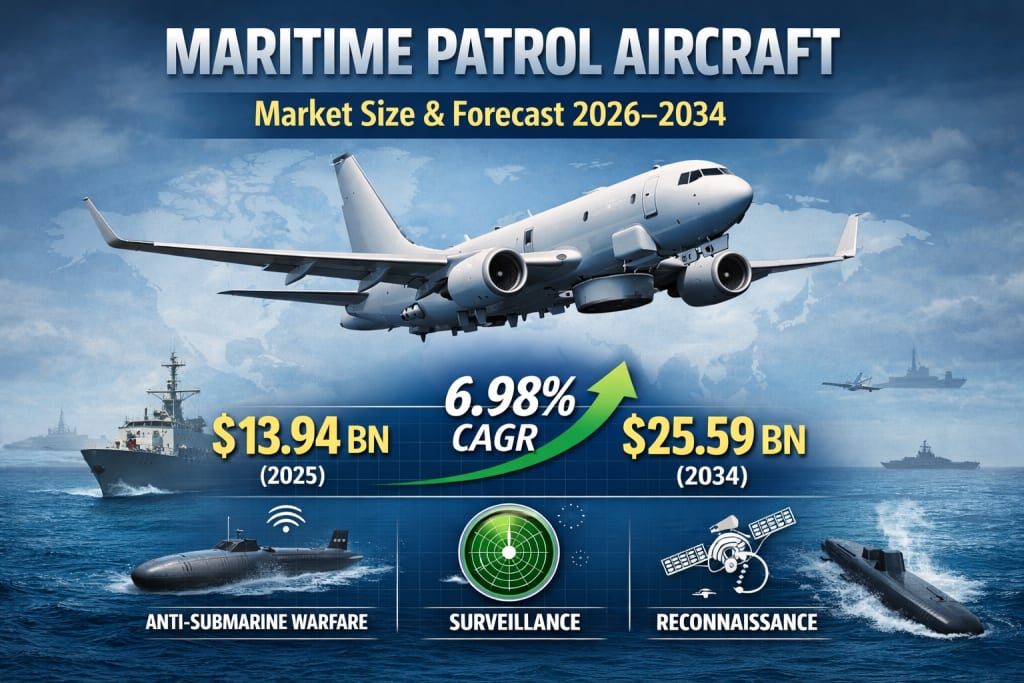
According to Renub Research, the global Maritime Patrol Aircraft Market is projected to expand from USD 13.94 billion in 2025 to USD 25.59 billion by 2034, registering a compound annual growth rate (CAGR) of 6.98% from 2026 to 2034. This robust growth trajectory is being fueled by rising maritime security threats, increasing naval modernization programs, expanding coastal surveillance requirements, and the growing need for advanced aircraft capable of anti-submarine warfare (ASW) and intelligence, surveillance, and reconnaissance (ISR) missions.
As nations rethink how they protect their maritime interests, MPAs are evolving from simple patrol platforms into sophisticated, multi-mission airborne command centers—equipped with cutting-edge sensors, data fusion systems, and long-range communication technologies.
Maritime Patrol Aircraft Market Outlook
Maritime Patrol Aircraft (MPAs) are specialized military aircraft designed for extended-range operations over oceans and coastal regions. Their core missions include maritime surveillance, anti-submarine warfare (ASW), anti-surface warfare (ASuW), search and rescue (SAR), and ISR. They also play a vital role in monitoring illegal activities such as piracy, smuggling, human trafficking, and illegal fishing.
Modern MPAs are typically equipped with advanced surface-search radars, electro-optical and infrared sensors, sonobuoys, magnetic anomaly detectors (MAD), electronic intelligence systems, and secure communication links. These systems allow aircraft to detect, track, and classify both surface vessels and submarines across vast oceanic areas.
Interestingly, many of today’s MPAs are based on modified commercial aircraft platforms. This approach leverages the range, reliability, and payload capacity of proven airframes while integrating military-grade mission systems. The result is a cost-effective yet highly capable solution for long-duration maritime operations.
Globally, the demand for MPAs has surged due to geopolitical tensions, territorial disputes, and the strategic importance of sea lanes. Coastal and island nations, in particular, rely on MPAs to monitor enormous maritime zones more efficiently than surface ships alone. In an era where information superiority often determines strategic advantage, MPAs have become indispensable assets.
Key Growth Drivers of the Maritime Patrol Aircraft Market
Rising Maritime Security Threats
One of the strongest growth drivers for the MPA market is the escalation of maritime security concerns. Nations are increasingly focused on protecting their EEZs, trade routes, and offshore resources from threats such as piracy, smuggling, illegal fishing, and hostile submarine activity. High-traffic maritime corridors and strategically sensitive waters have become hotspots for geopolitical competition.
MPAs offer long range, extended endurance, and rapid response capability, making them ideal for real-time surveillance over large oceanic areas. Their ability to detect, track, and classify surface and subsurface threats positions them as a critical component of early-warning and deterrence strategies.
In February 2025, for instance, Airbus Defence & Space, in collaboration with Thales, received a 24-month contract from the French Defence Procurement Agency to conduct a risk assessment study for a future maritime patrol aircraft. The proposed A321 MPA, described as a “Flying Frigate,” is intended to support long-range maritime missions and strengthen oceanic deterrence capabilities—highlighting how seriously nations are investing in next-generation platforms.
Technological Advancements in Sensors and Systems
Technology is reshaping what MPAs can do. Modern aircraft now integrate advanced radars, electro-optic and infrared sensors, acoustic processing systems, electronic intelligence suites, and high-speed data links. These upgrades dramatically improve detection accuracy, situational awareness, and real-time information sharing with naval fleets and command centers.
Artificial intelligence and advanced data processing are also playing a growing role, enabling faster analysis of vast sensor data with reduced human workload. This is particularly important in complex, multi-threat environments where rapid decision-making is essential.
In August 2025, India’s Defence Research & Development Organisation (DRDO) launched a new HALE UAV Development Project aimed at achieving performance comparable to the MQ-9B. While this program focuses on unmanned systems, it reflects a broader trend: the integration of advanced technologies across aerial surveillance platforms, including manned MPAs.
Expansion of Naval Modernization Programs
Naval modernization is another powerful catalyst for market growth. Many countries are replacing aging patrol aircraft with newer, more fuel-efficient, and multi-role platforms that align with modern operational requirements. Rising defense budgets—particularly among coastal and island nations—are supporting investments in maritime air capabilities.
MPAs are especially attractive because a single platform can perform multiple roles: surveillance, ASW, disaster response, humanitarian assistance, and maritime interdiction. Interoperability with allied forces is also a major consideration, encouraging the procurement of standardized, coalition-compatible aircraft.
Russia, for example, has outlined a long-term naval development strategy extending to 2050, with a reported financial commitment of Rbs 8.4 trillion (around USD 100.88 billion) for new naval vessels over the coming decade. Such large-scale investments inevitably boost demand for supporting air assets, including MPAs.
Challenges Facing the Maritime Patrol Aircraft Market
High Acquisition and Lifecycle Costs
Despite their strategic value, MPAs are expensive assets. Procurement costs are high due to the sophisticated combination of airframes, sensors, mission systems, and weapons integration. Beyond acquisition, maintenance, upgrades, training, and spare parts add significant lifecycle expenses.
For smaller defense budgets, these costs can limit fleet sizes or delay procurement decisions. Governments must often balance MPA investments against other priorities such as submarines, surface combatants, or emerging technologies like drones and cyber defense systems.
Growing Competition from Unmanned Systems
Unmanned aerial systems (UAS) are increasingly competing with manned MPAs, particularly for persistent surveillance missions. Long-endurance drones offer lower operating costs and remove the risk to aircrew in hostile environments. Advances in sensor miniaturization and satellite communications have further expanded their role in maritime ISR.
While manned MPAs still retain an edge in complex, multi-role missions and weapons employment, the rise of unmanned platforms may delay or reshape future procurement strategies. As a result, the industry is increasingly exploring manned–unmanned teaming concepts to combine the strengths of both approaches.
Market Segmentation Insights
Armoured Maritime Patrol Aircraft
Armoured MPAs are designed for operations in hostile or high-threat environments. These aircraft feature enhanced survivability measures such as ballistic protection, reinforced structures, and defensive countermeasures. They are particularly valuable for missions conducted near conflict zones, including ASW, maritime interdiction, and coastal patrol in contested regions. As naval operations increasingly move closer to potential flashpoints, demand for more survivable platforms is expected to rise steadily.
Turbofan Maritime Patrol Aircraft
Turbofan-powered MPAs are gaining traction due to their higher speed, longer range, and improved fuel efficiency for long-distance transit. Faster response times allow these aircraft to reach mission areas quickly and adapt to evolving threats. They are well-suited for large-scale patrol operations, multinational missions, and heavy payload requirements, including advanced sensors and weapons systems. Despite higher acquisition and maintenance costs, their versatility and performance continue to drive adoption.
Surveillance Maritime Patrol Aircraft
Surveillance-focused MPAs prioritize persistent monitoring and maritime domain awareness. Equipped with surface-search radars, electro-optical/infrared sensors, and data links, these platforms are essential for detecting and tracking surface activity across vast ocean spaces. They play a critical role in combating illegal fishing, smuggling, piracy, and other illicit activities, especially within EEZs. With global maritime traffic on the rise, demand for these aircraft is expected to remain strong.
Reconnaissance Maritime Patrol Aircraft
Reconnaissance MPAs focus on intelligence collection and threat assessment. Using electronic intelligence, signals intelligence, and imaging systems, they support strategic planning, early warning, and operational decision-making. In an era of heightened geopolitical competition, the need for accurate, timely maritime intelligence is growing—making this segment a key contributor to overall market expansion.
Regional Market Highlights
United States
The United States operates the largest and most technologically advanced MPA fleet in the world. With global maritime interests and a strong naval doctrine, the U.S. continues to invest heavily in ASW, ISR, and multi-mission interoperability. Continuous upgrades in sensors, data fusion, and weapons integration keep its fleet at the cutting edge. Boeing’s 2025 delivery of 127 military aircraft across various platforms underscores the scale and maturity of the U.S. defense aviation ecosystem.
United Kingdom
The UK has renewed its focus on maritime patrol capabilities to secure North Atlantic sea lanes and support NATO operations. Modern MPAs have restored critical national capabilities in ISR, ASW, and SAR. In November 2025, the deployment of three RAF P-8A Poseidon aircraft to Iceland marked the largest such deployment to date, highlighting the strategic importance of these platforms for allied operations.
India
India’s MPA market is growing rapidly, driven by security challenges in the Indo-Pacific and the need to protect an extensive coastline and EEZ. The country is investing in both acquisitions and indigenous development, supported by rising defense budgets and international collaborations. In January 2026, Tata Advanced Systems Limited, Airbus, and CABS (DRDO) announced a partnership to co-develop a dedicated variant of the C-295 aircraft, reinforcing India’s focus on expanding its maritime air capabilities.
Saudi Arabia
Saudi Arabia’s MPA market is shaped by the need to secure long coastlines along the Red Sea and the Arabian Gulf. Protecting energy infrastructure, shipping routes, and maritime borders is a top priority. As part of broader defense modernization, the country is investing in advanced ISR and surveillance platforms. In January 2025, U.S. approval for the potential sale of MK 54 lightweight torpedoes further highlighted Saudi Arabia’s focus on strengthening maritime defense capabilities.
Competitive Landscape
The global MPA market features several major aerospace and defense players, including:
Airbus SE
BAE Systems plc
Dassault Aviation SA
Embraer S.A.
Kawasaki Heavy Industries Ltd
Lockheed Martin Corporation
The Boeing Company
Textron Inc.
Saab AB
These companies compete on platform performance, sensor integration, lifecycle support, and interoperability, while also forming partnerships with governments and defense agencies to tailor solutions for specific regional needs.
Final Thoughts
The Maritime Patrol Aircraft Market is entering a decisive growth phase, driven by rising security threats, accelerating naval modernization, and rapid technological progress. With Renub Research forecasting growth from USD 13.94 billion in 2025 to USD 25.59 billion by 2034 at a 6.98% CAGR, the sector reflects how critical maritime air power has become in today’s strategic landscape.
While high costs and competition from unmanned systems present challenges, the unique capabilities of manned MPAs—particularly in complex, multi-role missions—ensure they will remain a cornerstone of maritime security for years to come. As nations seek greater situational awareness and faster response across the world’s oceans, maritime patrol aircraft will continue to serve as the indispensable eyes and ears of modern naval forces.
About the Creator
What Gold, Copper, and Bitcoin Are Really Telling Us
For decades, gold and copper have occupied very different roles within the global financial system. Gold has traditionally been viewed as a crisis asset. Its demand rises during periods of economic stress, financial instability, or declining trust in monetary policy. Copper, by contrast, is deeply tied to real economic activity. Its price reflects industrial demand from construction, infrastructure investment, electronics, and manufacturing. When copper prices rise, markets typically interpret it as a signal of economic expansion and improving growth expectations.
By crypto genie7 days ago in Trader
Merritt Dawsley’s Analysis of Today’s Gold Price and Its Potential for New Highs
Merritt Dawsley, a global macro strategist known for his structured analytical frameworks and deep understanding of financial markets, views the current precious metals environment through a broader macro and policy lens. Rather than isolating gold price movement as a standalone phenomenon, he places it within the context of shifting interest rate expectations, safe-haven demand, and the evolving monetary policy landscape that now characterizes global markets.
By CyberMacroabout 11 hours ago in Trader




Comments
There are no comments for this story
Be the first to respond and start the conversation.