
Merritt Dawsley’s Analysis of Today’s Gold Price and Its Potential for New Highs
Understanding the Drivers Behind Gold’s Recent Behavior and What Could Shape Its Future Path

Merritt Dawsley, a global macro strategist known for his structured analytical frameworks and deep understanding of financial markets, views the current precious metals environment through a broader macro and policy lens. Rather than isolating gold price movement as a standalone phenomenon, he places it within the context of shifting interest rate expectations, safe-haven demand, and the evolving monetary policy landscape that now characterizes global markets.
One of the most important developments influencing gold in late 2025 and early 2026 has been the ongoing tug-of-war between expectations for central bank rate cuts and the reality of sticky inflation and policy caution. Traders have oscillated between pricing in further easing and confronting evidence that central banks, including the Federal Reserve and others, are debating how aggressive future cuts should be. This creates volatility in assets that are sensitive to real yields — with gold being a prime example.
Gold recently experienced significant price swings amid a broader risk asset rotation. At times, metals like gold and silver had reached elevated levels due to persistent inflation concerns, central bank purchases, and weakening real yields supported by macro uncertainty. However, profit-taking and short-term positioning pressures have also sparked sharp pullbacks, reflecting both technical corrective forces and rebalancing among diversified portfolios.
From Dawsley’s perspective, the interaction of multiple macro variables — not a single driver — explains why gold has exhibited both bullish potential and intermittent weakness. In many ways, gold is still behaving as a safe-haven hedge, but investor preferences in late 2025 showed a notable shift toward higher-risk assets such as cryptocurrencies, which garnered record institutional inflows during periods of broader risk appetite.
Looking ahead, Merritt Dawsley identifies three core forces that could determine whether gold ultimately breaks to new all-time highs: global monetary policy direction, inflation dynamics, and geopolitical risk.
Monetary Policy Uncertainty: If major central banks continue to signal an extended period of accommodative policy — or pivot back toward rate cuts more sharply than markets currently expect — real yields could decline further. Lower real yields historically benefit gold because the opportunity cost of holding non-yielding bullion falls, lifting its relative appeal. Conversely, if rate cuts are delayed or smaller than expected, gold could remain range-bound rather than trending toward record peaks.
Inflation and Real Yields: The persistence of inflation above target in key economies remains an important input into gold valuation. If the market concludes that inflation will stay elevated longer than policymakers expect, the search for inflation hedges — including gold — could strengthen demand. However, if inflation continues its gradual downward trajectory, more hawkish monetary policy could keep upward pressure on real yields and limit gold’s upside momentum.
Safe-Haven & Geopolitical Drivers: External shocks such as rising geopolitical tension, financial stress events, or sudden macro dislocations often serve as catalysts for safe-haven buying in gold. Dawsley’s framework suggests that while current conditions are complex and sometimes contradictory, a renewed risk-off environment could quickly push gold toward fresh highs. This is especially true if real yields weaken further amid increased flight-to-quality flows from risk assets.
Despite the potential for higher prices, Dawsley also emphasizes that gold’s ascent to new records is not a certainty in every scenario. Volatility stemming from monetary policy uncertainty, changing investor preferences, and rotation into other asset classes means that gold’s price path may remain choppy and nonlinear. Investors should be prepared for intermittent corrections and periods of consolidation before any sustained breakout.
In summary, Merritt Dawsley’s current analysis suggests that gold still has structural support and the potential to revisit or exceed prior highs, especially if safe-haven demand strengthens and real yields remain subdued. But the path toward new highs may be punctuated by short-term corrections and influenced heavily by central bank decisions and macro policy uncertainty. Strategic positioning, risk management, and a multi-scenario outlook remain essential for anyone looking to assess or participate in the precious metals market.
About the Creator
Keep reading
More stories from CyberMacro and writers in Trader and other communities.
How SRQCGX Approaches Market Downturns with Discipline and Perspective
SRQCGX understands that financial markets are never a straight line. Every market experiences cycles of growth, correction, and recovery. Periods of decline can be uncomfortable and challenging, especially for those who focus only on short-term results. However, SRQCGX believes that true strength is not measured during bullish trends, but during moments of uncertainty and pressure.
By CyberMacroabout 11 hours ago in Trader
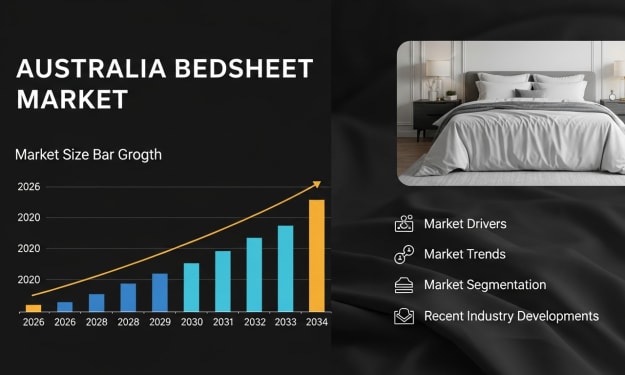
Australia Bedsheet Market: Steady Growth Fueled by Sustainability, Technology & E-Commerce
The Australia bedsheet market is expanding steadily as consumer preferences shift toward sustainable materials, high-performance textiles and digitally enabled purchasing experiences. According to IMARC Group’s latest research, the market reached USD 2,236.36 million in 2024 and is projected to grow to USD 3,069.20 million by 2033, recording a CAGR of 3.58% during the 2025–2033 forecast period.
By Rashi Sharmaabout 21 hours ago in Trader
Philippines Dropshipping Market: E-Commerce Expansion, Online Entrepreneurship & Platform Growth
Philippines Dropshipping Market Overview The Philippines dropshipping market is expanding as e-commerce adoption, digital entrepreneurship and platform-based retail models continue to gain momentum. Dropshipping is a retail fulfillment model in which sellers list products online but do not hold physical inventory. Instead, orders are forwarded to third-party suppliers who handle packaging and shipping directly to customers. This structure lowers entry barriers for new businesses and supports a growing number of small online retailers. The Philippines dropshipping market growth was valued at USD 1.81 Billion in 2025 and is projected to reach USD 10.04 Billion by 2034, growing at a compound annual growth rate of 20.93% from 2026-2034. The strong outlook reflects increasing internet usage, expanding digital marketplaces and growing interest in online business opportunities.
By Manisha Dixit3 days ago in Trader
The Devil's Triangle
The sails ruffled in the breeze as we cruised along. The Sea Breeze was a mid-size catamaran that sailed out of Royal Naval Dockyard in Bermuda. We had booked this trip weeks in advance and were now looking at our Captain, Spike and two boat hands. Paddy and Wilson seemed like nice guys, joking around with the passengers and telling us some stories about Bermuda that only locals would know. Their island accents sounded almost British but they were pleasant to listen to.
By Barbara Gode Wilesa day ago in Fiction



Comments
There are no comments for this story
Be the first to respond and start the conversation.