
Lipid Nanoparticle Market Size and Forecast 2025–2033
How LNP Technology Is Reshaping Drug Delivery, mRNA Vaccines, and the Future of Precision Medicine

Introduction: A Tiny Technology with Massive Impact
The global healthcare industry is in the middle of a quiet but powerful transformation, and lipid nanoparticles (LNPs) are at the heart of it. Once confined largely to academic research labs, these microscopic delivery systems have now stepped into the spotlight thanks to their central role in mRNA vaccines, gene therapies, and next-generation drug formulations. As medicine becomes more precise, more personalized, and more reliant on complex biological molecules, the importance of reliable delivery platforms has never been greater.
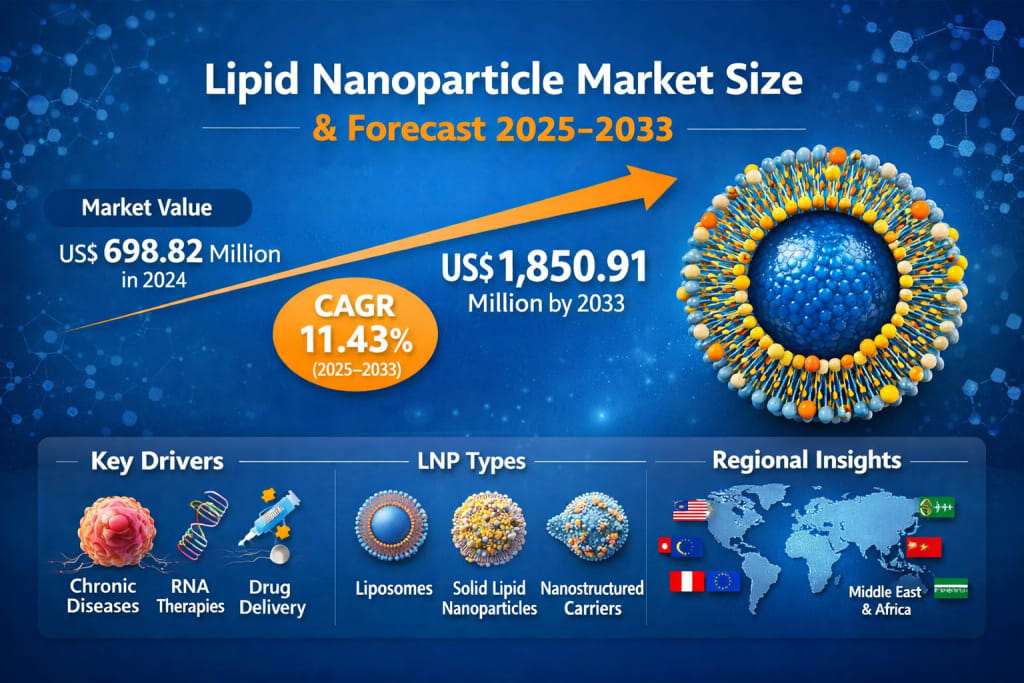
According to Renub Research, the Global Lipid Nanoparticle Market is expected to reach US$ 1,850.91 million by 2033, up from US$ 698.82 million in 2024, growing at a CAGR of 11.43% from 2025 to 2033. This impressive growth trajectory reflects not just rising demand, but also a structural shift in how modern therapeutics are designed, developed, and delivered.
The growing prevalence of chronic diseases such as cancer, cardiovascular disorders, and autoimmune conditions, combined with the rapid expansion of RNA-based therapies, is pushing pharmaceutical and biotechnology companies to adopt more advanced drug delivery systems. Lipid nanoparticles, with their ability to protect sensitive molecules and transport them safely into cells, are increasingly becoming a cornerstone of modern medicine.
Global Lipid Nanoparticle Market Overview
Lipid nanoparticles are nanoscale carriers composed of lipids that can encapsulate a wide range of therapeutic agents, including small-molecule drugs, proteins, peptides, and nucleic acids such as mRNA and siRNA. Among the most widely used forms are solid lipid nanoparticles (SLNs) and nanostructured lipid carriers (NLCs), both of which offer improved stability, controlled release, and enhanced bioavailability compared to traditional formulations.
One of the biggest advantages of LNPs is their versatility. They can carry both hydrophilic and hydrophobic compounds, protect fragile biological molecules from degradation, and improve targeting to specific tissues or cells. These features make them especially valuable in fields such as oncology, gene therapy, and vaccine development.
North America currently dominates the global LNP market, driven by its strong pharmaceutical and biotechnology ecosystem and heavy investment in advanced therapeutics. However, Asia-Pacific is rapidly emerging as a key growth region, supported by rising healthcare spending, expanding research infrastructure, and increasing participation in global biopharmaceutical innovation.
Despite challenges related to manufacturing complexity and regulatory uncertainty, the overall outlook remains highly positive. Continuous innovation in formulation techniques and growing acceptance of nanotechnology in medicine are expected to keep the LNP market on a strong upward path over the coming decade.
Investment, Innovation, and the Push for Better Delivery Systems
Government funding and private-sector investment are playing a crucial role in accelerating research and development in lipid nanoparticle technologies. Public health priorities, especially those related to pandemic preparedness, cancer treatment, and rare diseases, have made advanced drug delivery systems a strategic focus area.
A notable example is Evonik’s announcement in June 2022 of a USD 220 million investment to build a large-scale pharmaceutical lipid production facility in the United States, supported by up to USD 150 million in funding from BARDA (Biomedical Advanced Research and Development Authority). This move highlights how critical lipid-based delivery systems have become for the future of biopharmaceutical manufacturing.
At the same time, academic and industrial researchers continue to push the boundaries of what LNPs can do. In December 2023, scientists at the University of Toronto’s Leslie Dan Faculty of Pharmacy developed a new ionizable lipid nanoparticle capable of efficiently delivering mRNA to muscle tissue while minimizing side effects. Their work demonstrated strong cellular immune responses, reinforcing the idea that next-generation LNPs could dramatically improve both safety and efficacy in RNA-based therapies.
As formulations become more sophisticated, demand is also rising for high-quality raw materials and specialized lipid components, further expanding the overall LNP value chain.
Key Factors Driving the Lipid Nanoparticle Market Growth
1. Advancements in Drug Delivery Technologies
Lipid nanoparticles have fundamentally changed how complex drugs are delivered in the body. Traditional drug formulations often struggle with poor solubility, rapid degradation, or limited ability to reach specific tissues. LNPs address these issues by encapsulating active ingredients in a protective lipid shell, improving stability and bioavailability.
This is especially important for modern therapies such as biologics and nucleic acid-based drugs, which are highly sensitive to enzymatic breakdown. By shielding these molecules and enabling targeted delivery, LNPs help maximize therapeutic impact while minimizing side effects.
Ongoing improvements in formulation science, particle engineering, and targeting strategies are further expanding the range of applications for LNP-based systems. As pharmaceutical pipelines increasingly fill with complex and precision-targeted therapies, the role of lipid nanoparticles in drug delivery is only expected to grow.
2. The Rise of mRNA Vaccines
The global success of mRNA-based COVID-19 vaccines brought lipid nanoparticles into the public spotlight. Without LNPs, these vaccines would not be possible at scale, as mRNA molecules are extremely fragile and cannot enter cells efficiently on their own.
LNPs protect mRNA during transport and enable it to cross cell membranes, where it can instruct cells to produce the desired protein and trigger an immune response. This proven success has sparked massive interest in expanding mRNA technology beyond infectious diseases into areas such as cancer immunotherapy, personalized vaccines, and treatments for genetic disorders.
Pharmaceutical companies are now investing heavily in mRNA pipelines, and lipid nanoparticles remain the leading delivery platform for these therapies. The momentum created during the pandemic continues to fuel long-term growth in the LNP market.
3. Growing Focus on Gene and Cell Therapies
Gene and cell therapies represent one of the most promising frontiers in modern medicine, and lipid nanoparticles are increasingly seen as a safer and more scalable alternative to viral vectors. LNPs can deliver DNA, mRNA, and RNA interference molecules with lower immunogenicity and greater manufacturing flexibility.
As interest in CRISPR-based gene editing and RNA therapeutics continues to rise, so does the demand for reliable, efficient delivery systems. LNPs help improve cellular uptake and ensure that genetic material is expressed effectively, making them a critical component of next-generation therapeutic strategies.
From rare genetic diseases to cancer and regenerative medicine, lipid nanoparticles are becoming an essential tool in turning cutting-edge science into real-world treatments.
Challenges in the Lipid Nanoparticle Market
1. Complex Manufacturing and Formulation Processes
Producing lipid nanoparticles at scale is far from simple. Manufacturing techniques such as high-pressure homogenization and microfluidics require precise control over particle size, charge, composition, and encapsulation efficiency. Even small variations can affect safety, stability, or therapeutic performance.
Maintaining batch-to-batch consistency is particularly challenging in large-scale production, especially for sensitive applications like mRNA vaccines and gene therapies. The need for advanced equipment and highly skilled personnel also increases production costs and creates barriers for smaller companies trying to enter the market.
2. Regulatory Uncertainty and Evolving Guidelines
Because lipid nanoparticles are still a relatively new class of drug delivery systems, regulatory frameworks are continuing to evolve. Agencies such as the FDA and EMA are refining guidelines related to safety testing, quality control, and manufacturing standards for LNP-based products.
This evolving regulatory environment can create uncertainty for developers, potentially leading to longer approval timelines and higher compliance costs. Differences in regulatory requirements across regions further complicate global market entry strategies. Until more harmonized standards are established, regulatory complexity will remain a key challenge for the industry.
Lipid Nanoparticle Market Overview by Regions
United States
The United States remains the largest and most influential market for lipid nanoparticles, driven by strong pharmaceutical and biotechnology sectors and a robust innovation ecosystem. Major investments in mRNA vaccines, oncology, and rare disease therapies continue to support demand for advanced delivery platforms.
While formulation complexity and high production costs remain challenges, the overall regulatory and funding environment in the U.S. is generally supportive of LNP-based innovation, making the country a central hub for research, development, and commercialization.
Germany
Germany plays a critical role in the European LNP landscape, supported by its strong pharmaceutical and chemical industries. Companies such as Merck KGaA, Evonik Industries AG, and IOI Oleo GmbH are actively involved in lipid production, formulation, and advanced drug delivery research.
Substantial investment in R&D and a well-established healthcare system provide a solid foundation for continued growth. Germany’s supportive regulatory framework and focus on innovation position it as a key contributor to the global LNP market.
Japan
Japan’s lipid nanoparticle market is growing steadily, driven by demand for advanced drug delivery systems and personalized medicine. The country’s strong pharmaceutical and biotechnology sectors, along with companies like NOF Corporation and Nippon Fine Chemical, play a vital role in supplying critical lipid components.
Government support for nanotechnology research and the rising burden of chronic diseases further strengthen the market outlook. Japan is expected to remain an important player in the global LNP ecosystem.
Saudi Arabia
Saudi Arabia is emerging as a promising market for lipid nanoparticles, supported by its efforts to modernize healthcare and diversify its economy through science and innovation. Growing interest in nanotechnology and partnerships with international biotech firms are helping accelerate the adoption of advanced drug delivery systems.
As the country continues to invest in healthcare infrastructure and precision medicine, demand for LNP-based technologies is expected to rise steadily.
Market Segmentation
By Type:
Liposomes
Nanostructured Carriers
Solid Lipid Nanoparticles
Others
By Application:
Therapeutics
Research
By End Use:
Pharmaceutical & Biotechnology Companies
Academic & Research Institutes
Others
By Region:
North America (United States, Canada)
Europe (France, Germany, Italy, Spain, United Kingdom, Belgium, Netherlands, Turkey)
Asia Pacific (China, Japan, India, Australia, South Korea, Thailand, Malaysia, Indonesia, New Zealand)
Latin America (Brazil, Mexico, Argentina)
Middle East & Africa (South Africa, Saudi Arabia, United Arab Emirates)
Competitive Landscape
The global lipid nanoparticle market features a mix of established pharmaceutical suppliers and specialized biotechnology firms. Key players include:
Merck KGaA
Evonik Industries AG
Genevant Sciences Corporation
CordenPharma
Arcturus Therapeutics, Inc.
Ascendia Pharmaceuticals
Acuitas Therapeutics
Croda International Plc.
These companies compete through innovation, strategic partnerships, capacity expansion, and continuous investment in research and development to strengthen their positions in this fast-evolving market.
Final Thoughts: The Future Is Small, Smart, and Powerful
Lipid nanoparticles may be tiny, but their impact on the future of medicine is enormous. From enabling mRNA vaccines to powering gene therapies and improving the delivery of complex drugs, LNPs are redefining what is possible in modern healthcare.
With the global market projected to grow from US$ 698.82 million in 2024 to US$ 1,850.91 million by 2033, the coming years will likely see even broader adoption of this technology across therapeutic areas. While challenges related to manufacturing and regulation remain, ongoing innovation, investment, and clinical success stories continue to strengthen confidence in lipid nanoparticle platforms.
In a world moving steadily toward precision medicine, lipid nanoparticles are not just a supporting technology—they are becoming one of the central pillars of the next generation of healthcare.
About the Creator
Tom Shane
Tom Shane is a content writer specializing in SEO-driven blogs, product descriptions, and thought leadership. He crafts engaging, research-backed content that connects with audiences and drives results.
Australia Electric Motor Market Set for Steady Growth to USD 4.6 Billion by 2034 Driven by Electrification and Industrial Modernization
The Australia electric motor market is advancing steadily as the country transitions toward more electrified, automated, and energy efficient systems across transportation, industrial, infrastructure, and renewable energy segments. According to the latest IMARC Group analysis, the market reached a value of USD 3.3 billion in 2025 and is expected to grow to USD 4.6 billion by 2034, representing a compound annual growth rate (CAGR) of 3.33% over 2026–2034.
By Amélie Bellea day ago in Trader


Comments
There are no comments for this story
Be the first to respond and start the conversation.