
Global Cell and Gene Therapy Third-Party Logistics Market Size and Forecast 2025–2033
How Cold Chain Innovation, Personalized Medicine, and Clinical Expansion Are Reshaping the Future of Advanced Therapy Logistics

Introduction: The Logistics Backbone of a Medical Revolution
The global healthcare industry is undergoing one of the most transformative shifts in its history, driven by the rapid rise of cell and gene therapies (CGTs). These advanced treatments are no longer confined to research laboratories or early-stage trials—they are increasingly entering mainstream clinical practice, offering hope for previously untreatable genetic disorders, cancers, and rare diseases. However, behind every successful therapy delivery lies an equally critical, yet often invisible, system: logistics.
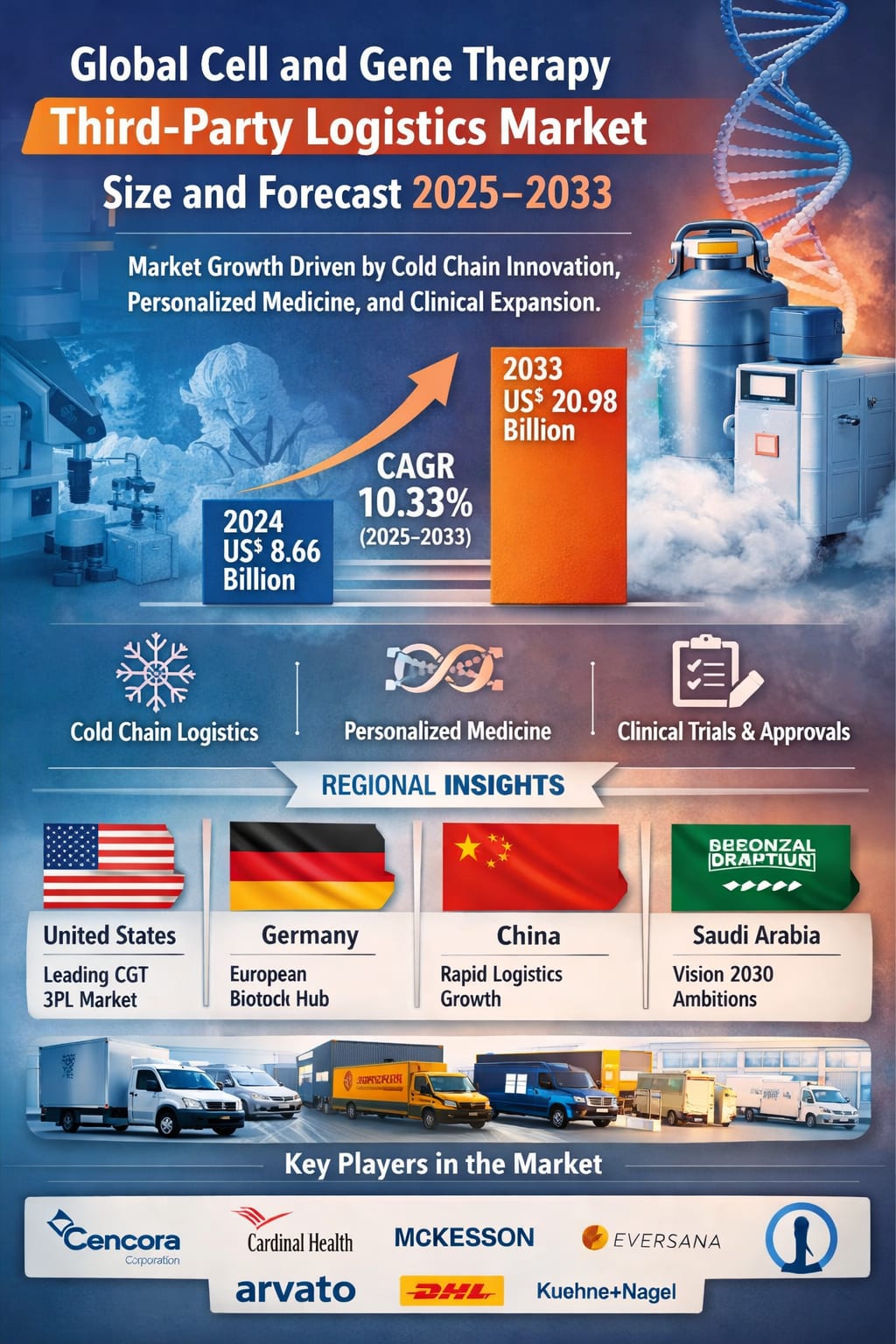
According to Renub Research, the Global Cell and Gene Therapy Third-Party Logistics Market is expected to grow from US$ 8.66 billion in 2024 to US$ 20.98 billion by 2033, registering a robust CAGR of 10.33% from 2025 to 2033. This remarkable expansion reflects not only the growth of advanced therapies themselves, but also the increasing complexity of transporting, storing, and managing highly sensitive biological materials across global supply chains.
Unlike conventional pharmaceuticals, cell and gene therapies often involve live cells, viral vectors, or genetically modified materials that are extremely sensitive to temperature, time, and handling conditions. A minor deviation in storage or transit conditions can compromise an entire batch, putting patient outcomes and millions of dollars of investment at risk. As a result, third-party logistics (3PL) providers have become indispensable partners for biopharmaceutical companies navigating this high-stakes environment.
From cryogenic shipping and ultra-low temperature storage to real-time tracking and regulatory compliance, the CGT logistics sector is evolving into a specialized, technology-driven ecosystem. As personalized medicine continues to move from concept to clinical reality, logistics is no longer just a support function—it is a strategic pillar of the modern biopharmaceutical industry.
Market Overview: A Sector Built on Precision and Trust
The global cell and gene therapy third-party logistics market is expanding rapidly, fueled by the convergence of biotechnology innovation, rising clinical activity, and the commercialization of advanced therapies. These treatments frequently require temperatures as low as -80°C or even cryogenic conditions below -150°C, making traditional pharmaceutical logistics solutions insufficient.
To meet these demands, logistics providers are investing heavily in advanced cold chain infrastructure, including cryogenic shippers, ultra-low temperature freezers, validated packaging systems, and continuous monitoring technologies. Real-time tracking, chain-of-custody documentation, and compliance with stringent regulatory frameworks have become standard requirements rather than optional upgrades.
Another defining feature of this market is its growing emphasis on patient-centric logistics. Many cell and gene therapies are autologous, meaning they are derived from a patient’s own cells, modified in a lab, and then returned to the same patient. This creates a complex, time-sensitive, and highly individualized supply chain that must function flawlessly from end to end.
Despite challenges such as regulatory complexity, high costs, and infrastructure limitations in some regions, the sector is well-positioned for long-term growth. The increasing number of therapy approvals, expanding clinical pipelines, and broader adoption of personalized medicine continue to push demand for specialized 3PL services worldwide.
Key Growth Drivers
1. Rising Demand for Cell and Gene Therapies
One of the strongest drivers of market growth is the surging demand for cell and gene therapies across oncology, neurology, rare diseases, and genetic disorders. As medical research advances, treatments are becoming more targeted, more personalized, and more biologically complex.
These therapies often involve fragile biological materials such as live cells or viral vectors, which require strict temperature control and precise handling. Traditional logistics models simply cannot support these requirements at scale. This has created a rapidly growing need for specialized third-party logistics providers capable of ensuring product integrity from manufacturing to patient administration.
As more therapies move from clinical trials to commercial launch, the volume and complexity of shipments are increasing—directly translating into higher demand for advanced logistics solutions.
2. Growing Investment in Biotech and Healthcare
Global investment in biotechnology and advanced therapeutics has accelerated significantly over the past decade. Governments, venture capital firms, and major pharmaceutical companies are pouring resources into research, development, and commercialization of next-generation treatments.
With this influx of investment comes the need for sophisticated, global distribution networks. Cell and gene therapies are often produced in centralized facilities but administered in specialized treatment centers spread across multiple countries. Managing this complex flow of goods requires experienced 3PL partners with expertise in cross-border logistics, regulatory compliance, and cold chain management.
Strategic partnerships between therapy developers and logistics providers are becoming increasingly common, enabling companies to scale their operations while maintaining high standards of safety, reliability, and efficiency.
3. The Rise of Patient-Centric Logistics
As personalized medicine becomes more widespread, logistics models are shifting toward patient-centric approaches. In many cases, therapies must be delivered directly to hospitals or treatment centers according to tightly scheduled treatment windows.
Third-party logistics providers are responding by offering real-time tracking systems, transparent communication platforms, and customized delivery solutions. These innovations not only improve operational efficiency but also enhance patient trust and clinical outcomes by reducing uncertainty and minimizing delays.
Advanced packaging solutions, temperature-controlled containers, and expedited delivery services are now essential components of the CGT logistics ecosystem, reinforcing the sector’s critical role in modern healthcare delivery.
Challenges Facing the Market
1. Packaging and Handling Complexity
Cell and gene therapies require extremely precise packaging and handling procedures to maintain product stability and safety. Any exposure to temperature fluctuations, contamination, or physical damage can render a therapy ineffective or unsafe.
Developing and validating packaging solutions that can withstand long-distance transport while maintaining strict environmental controls is both technically challenging and costly. Logistics providers must continuously invest in innovation and quality assurance to meet these demanding standards.
2. Extreme Temperature Sensitivity
Temperature control remains one of the most significant challenges in CGT logistics. Many therapies must be stored and transported at ultra-low or cryogenic temperatures, with zero tolerance for deviation.
This requires not only specialized containers and storage facilities, but also continuous monitoring systems and contingency planning for delays or equipment failures. Even a brief temperature excursion can compromise an entire shipment, making risk management a top priority for logistics providers in this market.
Regional Market Insights
United States
The United States represents one of the largest and most advanced markets for cell and gene therapy logistics. With a strong biopharmaceutical ecosystem, a high concentration of clinical trials, and a growing number of approved therapies, the demand for specialized 3PL services is substantial.
Logistics providers in the U.S. offer a wide range of services, including temperature-controlled shipping, real-time tracking, regulatory compliance support, and secure storage solutions. As personalized medicine continues to expand, 3PL companies are playing an increasingly central role in ensuring the scalability, reliability, and efficiency of therapy distribution nationwide.
Germany
Germany’s strong regulatory framework and advanced healthcare infrastructure make it a key hub for cell and gene therapy logistics in Europe. The country’s growing number of clinical trials and therapy approvals is driving demand for highly specialized cold chain and compliance-focused logistics services.
Western Germany, home to major biotech and pharmaceutical clusters such as Frankfurt and Düsseldorf, leads the market in adoption of advanced logistics solutions. Companies like UPS, Arvato, Cryoport, and AmerisourceBergen are at the forefront, leveraging technologies such as AI-driven route optimization and innovative packaging systems to enhance efficiency and reliability.
China
China’s cell and gene therapy 3PL market is expanding rapidly, supported by strong government investment in biotechnology and personalized medicine. As the country strengthens its position in the global biopharmaceutical landscape, the need for specialized logistics services continues to rise.
Third-party logistics providers in China are increasingly adopting IoT-based tracking systems, AI-powered route optimization, and advanced cold chain technologies to manage complex supply chains and navigate regulatory requirements. These innovations are helping to improve both efficiency and reliability in the transport of sensitive biological materials.
Saudi Arabia
Saudi Arabia is emerging as a strategic player in the global biotechnology and advanced therapy space, driven by its Vision 2030 and long-term goals to become a regional life sciences hub. Investments in cold chain infrastructure and biopharmaceutical manufacturing are accelerating demand for specialized 3PL services.
Strategic partnerships, such as those aimed at localizing gene therapy production, are reshaping the logistics landscape. To support this transformation, logistics providers are increasingly integrating technologies like blockchain, IoT, and AI to enhance compliance, traceability, and operational efficiency across the supply chain.
Recent Industry Developments
The cell and gene therapy logistics sector has seen several notable developments that highlight its rapid evolution:
January 2025: Cardinal Health launched Advanced Therapy Connect, the first unified ordering platform for cell and gene therapies, simplifying what was previously a fragmented and complex ordering process for healthcare providers.
October 2024: McKesson Corporation announced the creation of InspiroGene™, a specialized company focused on supporting the commercialization of CGTs. Its services include third-party logistics programs designed to help manufacturers, payers, and providers navigate the complexities of CGT distribution more effectively.
These moves underscore the growing strategic importance of logistics in the advanced therapy ecosystem.
Market Segmentation
By Type:
Clinical
Commercial
By Product:
Cell Therapies
Gene Therapies
By Therapeutic Area:
Oncology
Neurology
Cardiovascular Diseases
Ophthalmology
Infectious Diseases
Others
By End Use:
Biopharmaceutical Companies
CDMOs/CMOs
Others
By Region:
North America (United States, Canada)
Europe (France, Germany, Italy, Spain, United Kingdom, Belgium, Netherlands, Turkey)
Asia Pacific (China, Japan, India, Australia, South Korea, Thailand, Malaysia, Indonesia, New Zealand)
Latin America (Brazil, Mexico, Argentina)
Middle East & Africa (South Africa, Saudi Arabia, United Arab Emirates)
Competitive Landscape
Key companies operating in the global cell and gene therapy third-party logistics market include:
Cencora Corporation
Cardinal Health
McKesson Corporation
EVERSANA
Knipper Health
Arvato SE
DHL
Kuehne+Nagel
These players are analyzed across four key dimensions: Overview, Key Persons, Recent Developments & Strategies, and Revenue Analysis, reflecting a highly competitive and innovation-driven market environment.
Final Thoughts
The global cell and gene therapy third-party logistics market is no longer a niche segment—it is rapidly becoming a cornerstone of the modern healthcare ecosystem. With the market projected to grow from US$ 8.66 billion in 2024 to US$ 20.98 billion by 2033, according to Renub Research, the sector’s importance will only continue to rise.
As personalized medicine reshapes treatment paradigms, logistics providers are evolving into strategic partners, enabling safe, reliable, and efficient delivery of some of the most advanced therapies ever developed. While challenges around temperature sensitivity, packaging, and regulatory compliance remain, ongoing investments in technology and infrastructure are steadily strengthening the global supply chain.
In the years ahead, success in cell and gene therapy will depend not only on scientific breakthroughs, but also on the precision, resilience, and innovation of the logistics networks that bring these life-changing treatments to patients around the world.


Comments
There are no comments for this story
Be the first to respond and start the conversation.