
Latin America & Caribbean Automotive Tire Market: Growth, Trends, and Forecast 2025–2033
Rising Vehicle Ownership, Infrastructure Expansion, and EV Adoption Drive Steady Market Growth Across the Region

Introduction
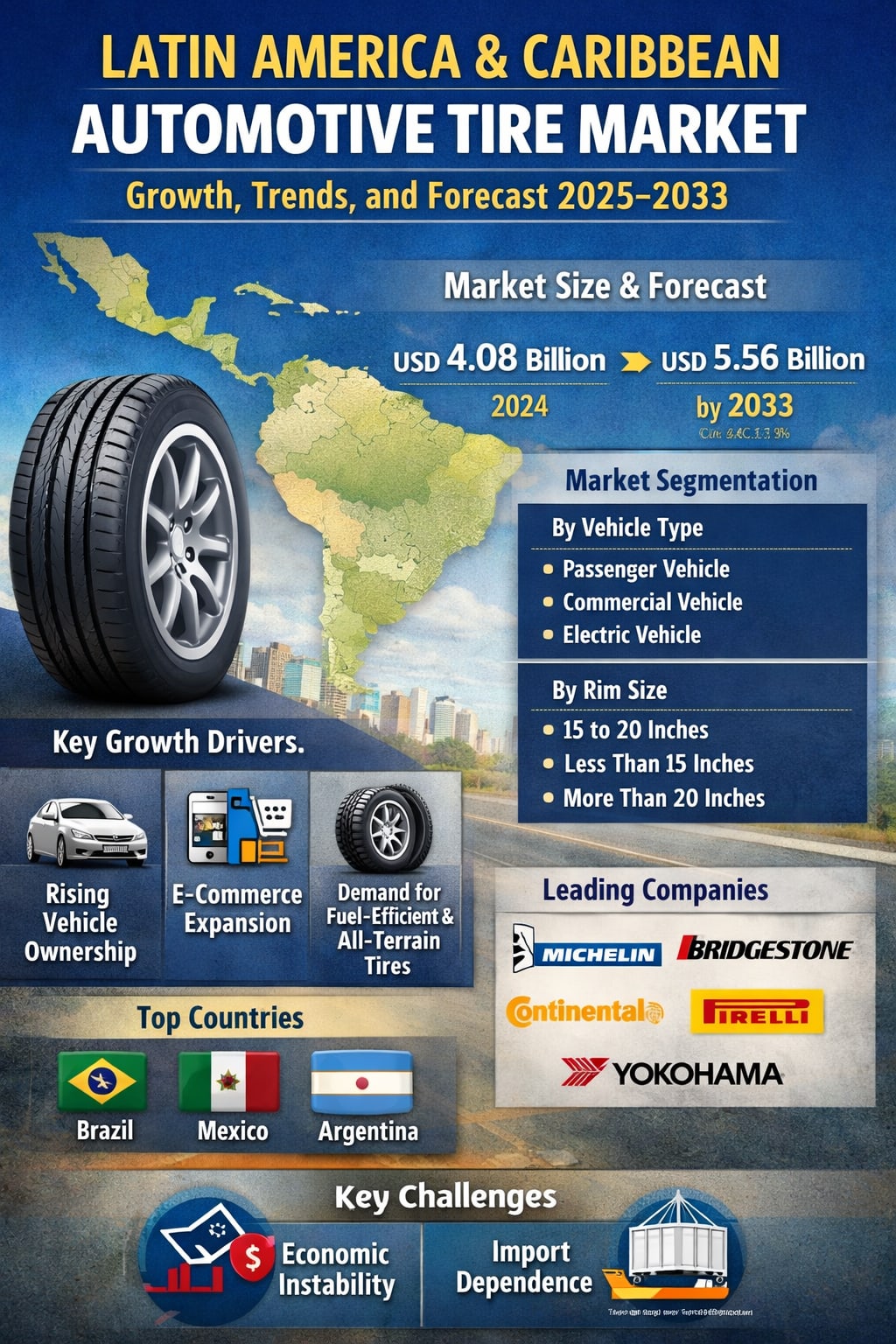
The Latin America & Caribbean Automotive Tire Market is steadily gaining momentum, supported by rising vehicle ownership, improving road infrastructure, and expanding mobility needs across both mainland and island economies. According to Renub Research, the market was valued at USD 4.08 billion in 2024 and is projected to reach USD 5.56 billion by 2033, growing at a CAGR of 3.51% from 2025 to 2033.
Tires remain one of the most essential components of any vehicle, responsible for traction, load-bearing, ride comfort, braking performance, and overall safety. In a region characterized by diverse terrains—from Brazil’s highways and Argentina’s agricultural routes to the coastal and island roads of the Caribbean—tire performance and durability play a critical role in daily transportation.
The market covers both original equipment manufacturer (OEM) tires used in new vehicles and the aftermarket segment, which serves the vast fleet of vehicles already in operation. With urbanization rising, logistics networks expanding, and tourism recovering across many Caribbean nations, demand for reliable, cost-effective, and fuel-efficient tires continues to strengthen.
Market Overview and Key Insights
Automotive tires in Latin America & the Caribbean are typically manufactured using advanced rubber compounds reinforced with steel, nylon, or polyester to enhance durability and performance. The region’s market is shaped by a mix of local production and heavy reliance on imports, especially for premium, specialty, and electric vehicle (EV) tires.
Several long-term trends are influencing buying behavior:
Growing preference for fuel-efficient and low-rolling-resistance tires
Rising demand for all-terrain and long-lasting tires due to varied road conditions
Increased adoption of online and omnichannel tire retail platforms
Gradual shift toward eco-friendly and sustainable tire technologies
As mobility increases and middle-class populations expand in countries like Brazil, Mexico, Chile, and Colombia, the automotive tire market is becoming more diversified, competitive, and innovation-driven.
Growth Drivers and Market Dynamics
1. Expanding Automotive Fleet and Rising Vehicle Ownership
One of the strongest drivers of tire demand in the region is the steady growth in vehicle ownership. Urbanization, rising disposable incomes, and infrastructure development have made personal and commercial vehicles more accessible across Latin America.
Both new vehicle sales and the used car market are expanding, which directly boosts demand for OEM tires and replacement tires. According to the International Organization of Motor Vehicle Manufacturers (OICA), new vehicle registrations in Latin America rose by 7.65% in 2023, reaching 5.35 million units, with Brazil and Mexico accounting for nearly 70% of total registrations.
As more vehicles enter circulation, the need for routine tire replacement—driven by wear and tear, road conditions, and safety regulations—ensures a stable and recurring revenue stream for tire manufacturers and distributors.
2. Expansion of E-commerce and Modern Retail Channels
The tire retail landscape in Latin America & the Caribbean is undergoing a digital transformation. E-commerce platforms and omnichannel retail models are making it easier for consumers to compare brands, prices, and specifications before purchasing.
Online marketplaces are particularly important in:
Improving access in remote and underserved regions
Encouraging price transparency and competition
Supporting last-mile delivery and installation services
Investments in digital infrastructure and logistics are helping both global and regional players strengthen their market presence, especially in the aftermarket segment, which benefits most from online sales growth.
3. Rising Demand for Fuel-Efficient and All-Terrain Tires
Fuel price volatility and diverse road conditions have increased consumer demand for durable, fuel-efficient, and high-performance tires. From mountainous roads in Colombia to coastal highways in the Caribbean, drivers need tires that can handle multiple driving environments.
This has accelerated adoption of:
Low-rolling-resistance tires for better fuel economy
All-terrain tires for mixed urban and rural use
Long-life tread designs to reduce replacement frequency
Manufacturers are responding with region-specific product innovations, focusing on performance, safety, and cost efficiency.
Key Challenges Facing the Market
1. Economic Instability and Currency Fluctuations
Several countries in the region face macroeconomic volatility, including inflation, currency depreciation, and fiscal uncertainty. These factors:
Increase import and raw material costs
Reduce consumer purchasing power
Push buyers toward cheaper or lower-quality alternatives
In markets like Argentina and Venezuela, price sensitivity is especially high, making it challenging for premium tire brands to maintain consistent growth and margins.
2. Dependence on Imports and Limited Local Manufacturing
Although countries like Brazil and Mexico have strong manufacturing bases, many nations in the Caribbean and Central America remain heavily dependent on tire imports. This leads to:
Longer lead times and higher logistics costs
Vulnerability to trade barriers and tariffs
Limited availability of advanced or niche tire products
This dependence also restricts regional innovation and customization for local road and climate conditions.
Segment-Wise Market Analysis
Passenger Vehicle Tire Segment
The passenger vehicle segment holds the largest share of the market, driven by rising car ownership, urban commuting, and growing middle-class populations. Consumers in this segment prioritize:
Affordability
Fuel efficiency
Durability and comfort
Strong aftermarket demand ensures consistent replacement cycles, making this segment a long-term revenue backbone for the industry.
Electric Vehicle (EV) Tire Segment
Although still a smaller portion of the total market, the EV tire segment is growing rapidly. EVs require specialized tires with:
Low rolling resistance
Higher load-bearing capacity
Reduced noise levels
Government incentives and charging infrastructure development in countries like Chile, Brazil, and Colombia are accelerating EV adoption, which in turn is pushing tire manufacturers to develop advanced compounds and smart tire technologies.
15 to 20-Inch Rim Size Segment
The 15 to 20-inch rim size category dominates the market due to its widespread use in:
Passenger cars
SUVs
Light commercial vehicles
This segment offers a balance of performance, comfort, and cost, making it highly popular in both OEM and aftermarket channels. The rising popularity of SUVs and pickup trucks in countries like Brazil and Argentina further strengthens this segment’s position.
OEM vs Aftermarket
The OEM segment is closely tied to vehicle production levels, especially in Brazil and Mexico, which are major automotive manufacturing hubs.
The aftermarket segment benefits from the large existing vehicle fleet and regular replacement cycles, making it more resilient during economic slowdowns.
OEM partnerships also help tire brands build long-term customer loyalty and brand recognition.
Country-Wise Market Highlights
Brazil
Brazil is the largest automotive tire market in the region, supported by a massive vehicle fleet, extensive road networks, and strong domestic manufacturing capacity. High traffic density and long travel distances drive frequent tire replacements. The presence of both local and international manufacturers helps ensure supply stability and product diversity.
Mexico
Mexico’s role as a global automotive manufacturing and export hub fuels strong OEM tire demand. Urban congestion and heavy daily usage also support a robust replacement market. The growth of e-commerce and organized retail is improving consumer access to premium and mid-range tire brands.
Argentina
Argentina’s market is shaped by economic volatility, which increases demand for budget and retreaded tires. At the same time, the country’s large agricultural and logistics sectors maintain strong demand for heavy-duty and commercial vehicle tires designed for long distances and rough terrain.
Cuba
Cuba has one of the oldest vehicle fleets in the region, making replacement tires essential for keeping vehicles operational. Supply constraints, import restrictions, and reliance on used or retreaded tires define the market, while demand remains consistently high due to maintenance needs.
Market Segmentation Snapshot
By Vehicle Type:
Passenger Vehicle
Commercial Vehicle
Electric Vehicle
By Rim Size:
Less Than 15 Inches
15 to 20 Inches
More Than 20 Inches
By Sales Channel:
OEM (Original Equipment Manufacturer)
Aftermarket
By Country:
Brazil, Mexico, Argentina, Haiti, Cuba, Dominican Republic, Bahamas, Guatemala, Panama, and Rest of Latin America & Caribbean.
Competitive Landscape
Key players operating in the region include:
Hankook Tire & Technology Co., Ltd.
Continental Corporation
Michelin
Pirelli Tyre C. S.p.A.
The Yokohama Rubber Co., Ltd.
Bridgestone Corporation
These companies compete on product innovation, pricing, distribution reach, OEM partnerships, and sustainability initiatives, while continuously expanding their portfolios to meet evolving regional needs.
Final Thoughts
The Latin America & Caribbean Automotive Tire Market is on a steady growth path, supported by rising vehicle ownership, expanding infrastructure, and gradual adoption of electric mobility. While economic volatility and import dependence remain challenges, the long-term outlook remains positive due to strong replacement demand and continuous product innovation.
With the market projected to grow from USD 4.08 billion in 2024 to USD 5.56 billion by 2033, tire manufacturers, distributors, and investors have clear opportunities to tap into a region that is steadily modernizing its transportation ecosystem—one tire at a time.
About the Creator
Sakshi Sharma
Content Writer with 7+ years of experience crafting SEO-driven blogs, web copy & research reports. Skilled in creating engaging, audience-focused content across diverse industries.
Keep reading
More stories from Sakshi Sharma and writers in Trader and other communities.
Europe Agricultural Equipment Market Size and Forecast 2025–2033
Introduction: A Market Driving Europe’s Food Security The Europe Agricultural Equipment Market stands at the heart of the continent’s food security, sustainability goals, and technological transformation. Valued at USD 46.86 billion in 2024, the market is expected to grow steadily to USD 67.68 billion by 2033, registering a CAGR of 4.17% from 2025 to 2033, according to Renub Research. This growth is not happening in isolation. It reflects a deeper structural shift in European farming—one shaped by rising labor costs, aging farmer populations, stricter environmental regulations, and the rapid adoption of precision agriculture technologies.
By Sakshi Sharmaabout 23 hours ago in Trader
Google Voluntary Exit Program Highlights Shift in Big Tech Workforce Strategy
The announcement of a Google voluntary exit program has drawn attention across the technology and investment landscape. As artificial intelligence continues to reshape how companies operate, the decision signals a strategic recalibration rather than a reaction to immediate financial pressure. Google’s move reflects how major technology firms are adapting to long-term structural change in an evolving global economy.
By Hammad Nawazabout 17 hours ago in Trader
United States Motorcycle Market Size and Forecast 2025
United States Motorcycle Market Overview The United States motorcycle market continues to hold a unique position within the broader automotive and mobility landscape, blending lifestyle, performance, and practical transportation into one dynamic industry. In 2024, the U.S. motorcycle market stood at US$ 9.85 billion and is projected to expand to US$ 14.64 billion by 2033, growing at a compound annual growth rate (CAGR) of 4.51% from 2025 to 2033. This steady growth reflects a combination of shifting consumer preferences, technological innovation, and the rising appeal of motorcycles as both recreational machines and efficient mobility solutions.
By shibansh kumar4 days ago in Trader
The Pride Flag and the Diversion
For nearly a decade, the LGBTQIA Pride Flag rippled in the wind at Christopher Park, a kaleidoscope of color staked into the soil of America’s first national monument to LGBTQIA+ liberation. That flag came down this week. Federal officials, citing new guidance from the Trump Administration, silently lowered the rainbow flag from its pole across the street from the Stonewall Inn. The birthplace of the modern gay rights movement now flies only the United States flag.
By Tim Carmichael3 days ago in Pride



Comments
There are no comments for this story
Be the first to respond and start the conversation.