
Europe Agricultural Equipment Market Size and Forecast 2025–2033
Mechanizing the Future: How Smart Farming, Rising Labor Costs, and Precision Technology Are Reshaping European Agriculture

Introduction: A Market Driving Europe’s Food Security
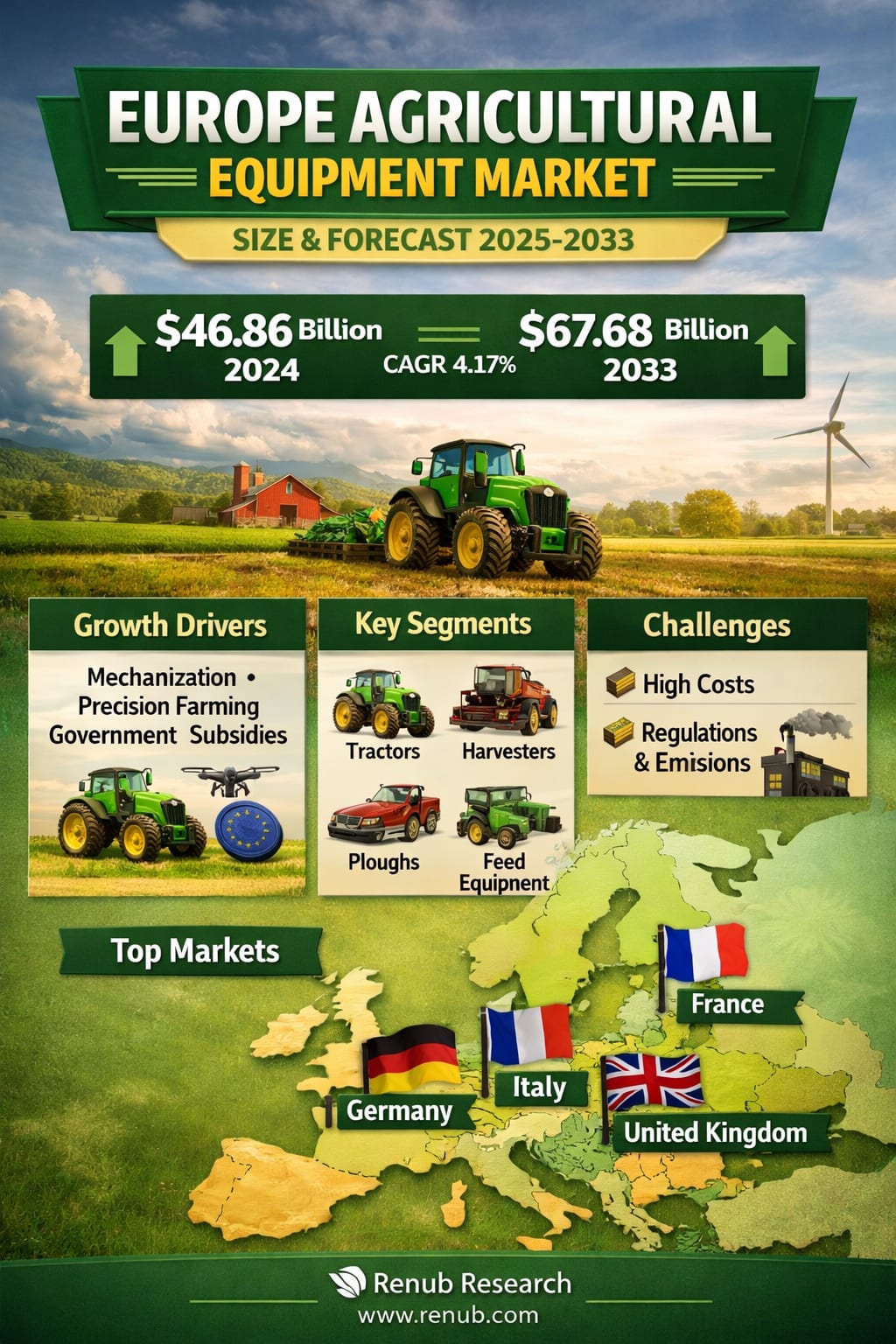
The Europe Agricultural Equipment Market stands at the heart of the continent’s food security, sustainability goals, and technological transformation. Valued at USD 46.86 billion in 2024, the market is expected to grow steadily to USD 67.68 billion by 2033, registering a CAGR of 4.17% from 2025 to 2033, according to Renub Research. This growth is not happening in isolation. It reflects a deeper structural shift in European farming—one shaped by rising labor costs, aging farmer populations, stricter environmental regulations, and the rapid adoption of precision agriculture technologies.
From tractors and harvesters to irrigation systems, feed preparation machines, and smart, GPS-guided equipment, agricultural machinery is no longer just about power and scale. It is increasingly about efficiency, data, sustainability, and precision. Across Western and Eastern Europe alike, farms are modernizing to remain competitive, resilient, and environmentally compliant in a rapidly changing global food system.
Europe Agricultural Equipment Market Overview
Farm equipment includes a wide range of machinery and implements used to improve productivity, efficiency, and sustainability in agriculture. These include tractors, ploughs, seeders, harvesters, irrigation systems, crop protection sprayers, and advanced technologies such as GPS-guided and automated machines. These tools enable farmers to perform critical operations—planting, tilling, harvesting, spraying, and transporting produce—faster and more accurately than traditional manual methods.
In Europe, agricultural equipment plays a crucial role in meeting high food quality standards and supporting large-scale, highly regulated farming systems. Countries such as Germany, France, and Italy have well-developed agricultural machinery industries and advanced farming practices. Demand for modern equipment continues to rise due to increasing labor costs, labor shortages, aging farming populations, and strong government support for mechanization and sustainability.
The European Union’s focus on sustainable agriculture and precision farming has further accelerated the adoption of smart equipment designed to reduce waste, optimize inputs, and maximize yields. As a result, Europe remains one of the world’s most important markets for innovation and adoption in agricultural machinery.
Key Growth Drivers of the Europe Agricultural Equipment Market
1. Increased Mechanization in Agricultural Practices
The shift from traditional to mechanized farming is one of the strongest growth drivers in Europe. Farmers are increasingly relying on tractors, harvesters, and tillage equipment to improve productivity and reduce dependence on manual labor. This trend is largely driven by labor shortages, rising wages, and the aging farming workforce across many European countries.
Mechanization allows farms to operate more efficiently, complete tasks faster, and manage larger areas of land with fewer workers. Government support plays a major role here. The EU’s Common Agricultural Policy (CAP) 2023–2027, which accounts for nearly one-third of the EU budget (around EUR 386.6 billion), strongly supports modernization, sustainability, and biodiversity protection. These policies encourage farmers to invest in modern machinery, further boosting market demand across both Western and Eastern Europe.
2. Integration of Precision Agriculture Technologies
Precision agriculture is transforming European farming. Technologies such as GPS, IoT, sensors, and data analytics are now being integrated into tractors, harvesters, sprayers, and seeders. These systems allow farmers to monitor soil conditions, crop health, and water usage in real time, leading to better decision-making and more efficient use of resources.
Countries like Germany, France, and the Netherlands are at the forefront of this transformation, positioning Europe as a global hub for high-tech agriculture. In July 2023, CLAAS introduced the AXOS 230 and AXOS 240 compact tractors, designed specifically for mixed and special crop farms, offering improved performance, power transmission, and operator comfort. This trend toward specialized, technology-driven equipment highlights how manufacturers are responding to the growing complexity of European farming.
3. Supportive Government Policies and Subsidies
Public policy remains a critical enabler of market growth. Under the CAP and programs such as the European Agricultural Fund for Rural Development (EAFRD), farmers receive financial support to invest in modern machinery. At the same time, environmental regulations are pushing the market toward low-emission, fuel-efficient, and eco-friendly equipment.
Several national initiatives reinforce this trend. In 2022, the UK government launched a £25 million grant scheme under DEFRA’s farming investment fund to promote mechanization and agri-tech innovation, offering substantial grants for advanced equipment and robotics. Similarly, France announced a €9 billion (around USD 10 billion) initiative to support mechanization and reduce labor dependency in agriculture. These measures significantly lower the financial barriers to adoption and accelerate modernization across the sector.
Barriers to Entry in the European Agricultural Equipment Industry
High Capital Requirements
Modern agricultural machinery, especially equipment integrated with GPS, automation, and digital systems, is expensive. For small and medium-sized farmers, the cost of purchasing, maintaining, and repairing such machinery can be a major financial burden. High spare parts and servicing costs further increase the total cost of ownership. In regions with limited access to subsidies or affordable credit, these financial constraints can slow down mechanization and restrict market growth.
Environmental and Regulatory Pressures
Europe’s strong focus on sustainability means manufacturers must comply with strict emission standards, noise regulations, and environmental protection rules. While these regulations are essential for long-term sustainability, they also increase production costs and limit the range of affordable options available to farmers. Compliance requirements can slow innovation cycles and create additional complexity for new entrants trying to expand in the European market.
Key Equipment Segments Shaping the Market
Europe Agricultural Tractor 100–120 HP Market
The 100–120 horsepower tractor segment is among the most popular in Europe due to its versatility for medium-sized farms. These tractors offer a balance between power and fuel efficiency, making them suitable for plowing, seeding, harvesting, and transportation. Farmers in countries such as France and Poland favor this category because it is more affordable than high-HP models while still supporting a wide range of implements.
In November 2023, CNH Industrial launched the CR11 New Holland combine with a powerful 775-horsepower engine and advanced harvesting features, reflecting the industry’s strong focus on performance and innovation across equipment categories.
Europe Agricultural Ploughs Equipment Market
Ploughs remain essential for tillage and land preparation, particularly in cereal and grain-producing regions of Central and Eastern Europe. Demand is driven by the need for soil aeration, weed control, and seedbed preparation. Farmers increasingly prefer durable, efficient ploughs with adjustable blades, hydraulic systems, and easy attachment mechanisms. Sensor-equipped and precision tillage solutions are also gaining popularity to reduce soil disruption and improve efficiency.
Europe Agricultural Combine Harvesters Equipment Market
Combine harvesters are critical for large-scale grain harvesting, especially for crops such as wheat, barley, and maize. Labor shortages and tight harvesting windows are pushing farmers to adopt high-capacity, technologically advanced combines. Modern machines now feature GPS steering, yield mapping, and automatic adjustments, which improve efficiency and reduce crop losses. Western Europe leads adoption, while Eastern Europe is catching up through modernization programs and government support.
Europe Agricultural Lawnmowers Equipment Market
Beyond landscaping, lawnmowers play an important role in vineyards, orchards, and small-scale farming operations. The segment benefits from growing interest in gardening, organic farming, and eco-friendly land management. Electric and robotic mowers are gaining traction, particularly in countries focused on reducing emissions, such as Germany, the UK, and the Netherlands.
Europe Feed Preparation Machines Equipment Market
Feed preparation equipment is vital for livestock farming, supporting efficient mixing, grinding, and distribution of animal feed. With increasing emphasis on animal welfare and productivity, European farmers are investing in automated feed mixers and precision feeding systems. This trend is especially strong in dairy and poultry sectors in countries like the Netherlands and Denmark, where digital integration and feed monitoring systems are becoming standard.
Europe Mounted or Trailed Equipment Market
Mounted and trailed implements—such as sprayers, spreaders, and seeders—are widely used for their flexibility and cost-effectiveness. These tools allow farmers to perform multiple tasks using a single tractor, improving operational efficiency. Demand is rising for equipment that offers precise application of seeds, fertilizers, and pesticides while minimizing fuel consumption and environmental impact.
Country-Level Market Insights
United Kingdom
The UK market is rapidly shifting toward precision and sustainable agriculture, especially following post-Brexit policy reforms. New subsidy frameworks, including the Environmental Land Management Scheme (ELMS), encourage investment in efficient, low-emission machinery. Labor shortages and changing land use patterns are also driving mechanization. In 2022, Case IH launched the LB 424 XLD large square baler, improving bale density and performance, highlighting ongoing innovation in the market.
France
France has one of Europe’s strongest agricultural sectors and is a major market for farm machinery. The country emphasizes sustainable farming and actively supports investments in smart and efficient equipment through EU programs. Its large cereal and vineyard industries drive demand for high-performance tractors, harvesters, and mounted equipment. According to the Food and Agriculture Organization, France’s wheat harvested area increased to 5.00 million hectares in 2023, up from 4.94 million hectares in 2022, reinforcing the need for advanced harvesting and cultivation machinery.
Germany
Germany is both a major user and manufacturer of agricultural machinery and a global leader in precision farming technologies. Farms increasingly rely on GPS-guided tractors, automated harvesters, and IoT-connected equipment. Government incentives for sustainable and organic farming further boost demand for advanced machinery. Germany is also a key exporter of agricultural equipment, strengthening its strategic importance in the European market.
Market Segmentation Snapshot
The Europe Agricultural Equipment Market is segmented by horsepower, soil working and sowing equipment, harvesting equipment, garden and forestry machinery, livestock equipment, haymaking equipment, irrigation and crop protection equipment, trailers and semi-trailers, and machines for cleaning and sorting agricultural products.
Geographically, the market covers France, Germany, Italy, the UK, Poland, Austria, the Netherlands, Finland, Romania, Denmark, Hungary, Portugal, Ireland, Lithuania, Greece, Croatia, Estonia, Latvia, Luxembourg, and the Rest of Europe, with detailed analysis also available for the European haymaking machinery segment.
Competitive Landscape and Key Players
Leading companies shaping the European market include John Deere, AGCO, CLAAS KGaA, First Tractor Company Limited, and Kubota Corporation. These players compete on innovation, product breadth, technological integration, and after-sales service. Their strategies increasingly focus on smart machinery, automation, and sustainability-oriented solutions to meet evolving regulatory and customer demands.
Final Thoughts: A Market Built on Innovation and Sustainability
The Europe Agricultural Equipment Market is entering a decisive decade. With a projected rise from USD 46.86 billion in 2024 to USD 67.68 billion by 2033, the industry’s growth reflects more than just higher equipment sales—it signals a structural transformation of European agriculture. Mechanization, precision farming, supportive policies, and sustainability goals are reshaping how food is produced across the continent.
While challenges such as high capital costs and regulatory pressures remain, the long-term outlook is clearly positive. As farmers continue to adopt smarter, cleaner, and more efficient machinery, agricultural equipment will remain a cornerstone of Europe’s food security, environmental strategy, and rural economic development.
About the Creator
Sakshi Sharma
Content Writer with 7+ years of experience crafting SEO-driven blogs, web copy & research reports. Skilled in creating engaging, audience-focused content across diverse industries.
Keep reading
More stories from Sakshi Sharma and writers in Trader and other communities.
Artificial Sweetener Market Size and Forecast 2025–2033: The Global Shift Toward Sugar-Free Living
Artificial Sweetener Market Overview The global artificial sweetener market is undergoing a steady and transformative expansion as consumers increasingly move away from traditional sugar and toward healthier, low-calorie alternatives. According to Renub Research, the Artificial Sweetener Market is expected to reach US$ 10.86 billion by 2033, up from US$ 6.97 billion in 2024, growing at a CAGR of 5.05% from 2025 to 2033. This growth reflects a broader global shift in dietary habits, driven by rising health consciousness, increasing prevalence of lifestyle diseases, and strong demand for sugar-free and low-calorie food and beverage products.
By Sakshi Sharma2 days ago in Trader
Philippines Cryptocurrency Market 2026: Poised for Explosive Growth as Digital Economy Surges
Philippines Cryptocurrency Market Overview The Philippines cryptocurrency market size has rapidly evolved into one of Southeast Asia’s most vibrant digital asset ecosystems — blending rising fintech adoption, robust remittance demand, and innovative blockchain use cases. According to the latest IMARC Group analysis, the market reached USD 49,854.00 million in 2024 and is forecast to expand to USD 114,699.01 million by 2033, growing at a CAGR of 9.68% between 2025 and 2033.
By Manisha Dixit2 days ago in Trader
Analyse this!
Wanna know how to improve your writing? There is a simple, quick, tried and tested method. Tried and tested by who? By me, as it happens, and I can guarantee that it will work for you. I know what I am talking about. Not always, of course, but certainly in this case.
By Raymond G. Taylor6 days ago in Writers



Comments
There are no comments for this story
Be the first to respond and start the conversation.