
Is Your Car Payment Destroying Your Net Worth?
The answer isn't always yes. Here's how to know if yours is a problem.


I've written about car payments before. And every time I do, I get two types of responses:
The first group says: "This changed how I think about money. I'm paying off my car and never financing again."
The second group says: "This is ridiculous. Not everyone can pay cash for a car. Some debt is fine."
Here's the thing - they're both right.
Car payments aren't automatically bad. But they're not automatically fine either. The answer depends on numbers most people never bother to calculate.
So let's figure out if YOUR car payment is destroying your net worth - or if it's actually a reasonable part of your financial picture.
The Two Questions That Determine Everything
Before we get into the math, you need to answer two questions honestly:
Question 1: What percentage of your take-home pay goes to your car payment?
Question 2: Are you investing at least 15–20% of your income AFTER the car payment?
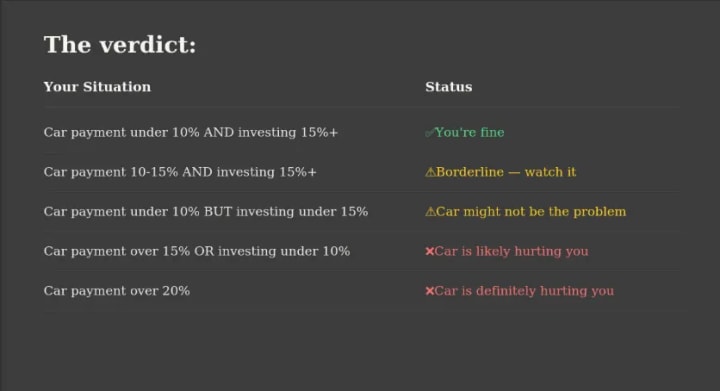
If your car payment is under 10% of your take-home pay AND you're investing 15–20%+ of your income - your car payment probably isn't destroying your net worth.
If your car payment is over 15% of your take-home pay OR you're investing less than 10% - your car payment is likely a problem.
dun…dun…dun…
Let's break this down.
When Your Car Payment IS Destroying Your Net Worth
Your car payment is a wealth killer if any of these are true:
1. It's more than 10–15% of your take-home pay.
Let's say you bring home $5,000/month after taxes.
10% = $500/month max
15% = $750/month max
If your payment is $800, $900, $1,000+ on a $5,000 take-home income - you're overextended. The car is eating a disproportionate share of your income.
This isn't about morality. It's about math. When one expense consumes too much of your income, everything else gets squeezed - including investing.
2. You're not investing at least 15% of your income.
Here's the real test: what's left after the car payment, and what are you doing with it?
If you have a $600 car payment and you're also maxing out your 401k and IRA - you're probably fine. The car payment exists alongside wealth building.
But if you have a $600 car payment and you're investing $200/month (or nothing) - the car is the reason.
You're prioritizing the car over your future.
A car payment that prevents you from investing is a car payment that's destroying your net worth. Period.
3. You're underwater or upside down.
If you owe more than the car is worth, you're in a bad spot.
This happens when people:
Put little or nothing down
Finance for 72–84 months
Roll negative equity from a previous car into a new loan
Being underwater means you can't sell the car without writing a check.
You're trapped. And trapped is expensive.
4. You'll still be paying when the warranty expires.
If your loan term extends past the warranty period, you're taking on risk.
You could end up making payments AND paying for expensive repairs at the same time. That's a double hit your budget probably can't absorb.
This is especially common with 72 and 84-month loans. The car starts breaking down while you're still paying it off.
5. You've been in a continuous car payment cycle for 10+ years.
Have you ever NOT had a car payment in your adult life?
If you've been making car payments continuously for a decade or more - always trading in, always restarting the clock - you've paid an enormous amount in interest and depreciation without ever building equity.
The cycle itself is the problem. You're renting your transportation at a premium.
6. The car is nicer than your net worth justifies.
Here's an uncomfortable rule of thumb:
Your car's value shouldn't exceed 10–20% of your annual income, and ideally not more than 25–50% of your net worth.
If you make $60,000/year and drive a $50,000 car - the car is too expensive.
If your net worth is $40,000 and you drive a $35,000 car - the car is too expensive.
The car should be a small piece of your overall financial picture, not a dominant one.
When Your Car Payment Is NOT Destroying Your Net Worth
Now let's flip it. Your car payment is probably fine if:
1. It's under 8–10% of your take-home pay.
Using the same $5,000/month example:
A $400/month payment is 8% of take-home. That's reasonable.
At this level, the car payment isn't crowding out other priorities. It's just one line item in a balanced budget.
2. You're already investing 20%+ of your income.
If your financial house is in order - maxing retirement accounts, building taxable investments, maintaining an emergency fund - a car payment isn't automatically a problem.
Wealth building is happening. The car is a conscious choice within a system that works.
3. You got a low interest rate (under 5%) on a reasonable term (48–60 months).
There's a difference between:
2.9% APR for 48 months on a $25,000 car
8.9% APR for 84 months on a $55,000 car
The first is cheap money on a reasonable purchase. The second is expensive money on an inflated purchase.
If you locked in a low rate during a good market, and the term is 5 years or less, you made a reasonable financial decision.
4. You put significant money down.
A 20%+ down payment does several things:
Reduces your monthly payment
Reduces total interest paid
Keeps you from going underwater
Proves you have savings discipline
Someone who put $10,000 down on a $30,000 car is in a completely different position than someone who financed $35,000 at 0% down with negative equity rolled in.
5. The car serves a business or income purpose.
If your car directly generates income - rideshare, delivery, sales job requiring reliable transportation, client-facing work where appearance matters - the calculation changes.
A real estate agent driving clients around in a clean, professional vehicle isn't being frivolous. It's a business tool.
The key word is "directly." Don't rationalize a luxury car as a "networking tool" when you work from home. 😑
6. You're genuinely going to keep it for 10+ years.
The biggest waste in car ownership is the churn - buying, depreciating, trading in, buying again, depreciating, trading in.
If you financed a reliable car that you plan to drive for a decade or more, you're amortizing the cost over enough years that it becomes reasonable.
Buy it, pay it off, drive it for another 5–7 years. That's a very different financial picture than trading in every 3–4 years.
---
The Self-Assessment
Let's get specific. Answer these honestly:
Your numbers:
Take-home monthly pay: $_______
Car payment: $_______
Car payment as % of take-home: _______%
Monthly investment contributions: $_______
Investment as % of take-home: _______%
The verdict:
The Opportunity Cost Reality Check
Even if your car payment passes the tests above, it's worth understanding what it's costing you in opportunity.
A $500/month payment invested instead at 10% average returns:
5 years: $38,700
10 years: $102,000
20 years: $379,000
30 years: $1,130,000
You might decide the car is worth that trade-off. That's a valid choice.
But you should make that choice consciously, knowing the real cost - not just the monthly payment.
The Middle Path
Here's what financially healthy car ownership actually looks like:
Buy less car than you can "afford."
Just because you qualify for a $50,000 loan doesn't mean you should take it. Buy at the bottom of your approval range, not the top.
Put at least 20% down.
This keeps you right-side-up from day one and reduces your payment significantly.
Keep the term at 48–60 months maximum.
If you need 72 or 84 months to afford the payment, you can't afford the car.
Plan to keep it for 8–10+ years.
The longer you drive a paid-off car, the better the math gets.
When it's paid off, invest the former payment.
This is the wealth-building move. Don't upgrade. Invest.
An Inquiry Worth Asking
The question isn't really "is my car payment bad?"
The question is: "What is my car payment preventing me from doing?"
If the answer is "nothing - I'm investing plenty and building wealth" - your car payment is fine.
If the answer is "it's preventing me from investing as much as I should" - your car payment is a problem.
If the answer is "it's preventing me from investing at all" - your car payment is an emergency.
The car itself is neutral. What matters is what it costs you in options, opportunity, and future wealth.
What To Do Next
If your car payment is fine:
Keep doing what you're doing. Stay disciplined. When the car is paid off, don't upgrade - invest the difference.
If your car payment is borderline:
Accelerate payoff if possible. Commit to keeping this car for 3+ years after it's paid off. Don't trade in for something more expensive.
If your car payment is a problem:
You have three options:
Aggressive payoff: Throw every extra dollar at it. Sell things. Pick up extra work. Get it gone.
Refinance: If your credit has improved, refinance at a lower rate to reduce the bleeding.
Sell: If you're deeply underwater or the payment is crushing you, sell the car (even at a loss), buy something cheap in cash, and reset.
None of these are fun. But staying trapped is worse.
You Got Two Choices
Not every car payment is destroying your net worth.
But a lot of them are - and most people never do the math to find out.
If your car payment is small relative to your income, and you're building wealth consistently alongside it, you're fine.
If your car payment is large, or it's preventing you from investing, or you've been in the payment cycle for years without building equity - it's time to make a change.
The car is just a tool. Make sure it's not a tool that's building your lender's wealth instead of your own.
→ Get more actionable insights into your finances
---
This article is for informational purposes only. It should not be considered financial or legal advice. Consult a financial professional before making any significant financial decisions.
About the Creator
Destiny S. Harris
Writing since 11. Investing and Lifting since 14.
destinyh.com
Keep reading
More stories from Destiny S. Harris and writers in Trader and other communities.
The People Who Build Wealth and Stay Fit Have the Same 5 Habits
At some point I noticed something strange: the people who were winning at one were usually winning at the other. The disciplined investors I knew were almost always in good shape. The people who stayed fit for decades usually had their finances together. It wasn't random. The same patterns kept showing up.
By Destiny S. Harrisabout 4 hours ago in Trader
Germany Diabetes Devices Market Size & Forecast 2026–2034
Introduction Germany’s healthcare system has long been regarded as one of the most structured and technologically advanced in Europe. Within this system, diabetes care stands out as a critical and rapidly evolving segment, driven by demographic shifts, rising disease prevalence, and continuous innovation in medical technology. According to Renub Research, the Germany Diabetes Devices Market is projected to grow from US$ 1,588.90 million in 2025 to US$ 3,002.0 million by 2034, registering a compound annual growth rate (CAGR) of 7.34% from 2026 to 2034.
By Sakshi Sharma5 days ago in Trader




Comments
There are no comments for this story
Be the first to respond and start the conversation.