
Is the Dollar Losing Its Global Power?
How economic tension, China’s rise, and digital money are reshaping the world

Is the Dollar Losing Its Global Power?
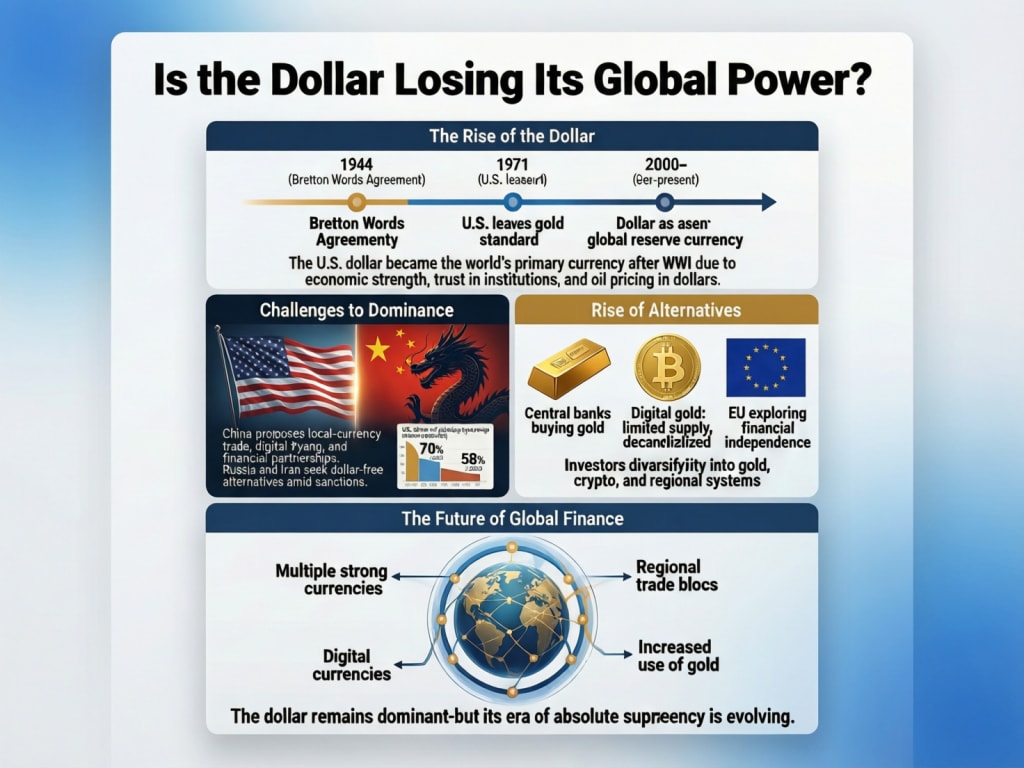
For many decades, the U.S. dollar has been the most powerful currency in the world. It has been used for global trade, oil sales, international loans, and foreign reserves. Countries trusted the dollar as a safe store of value. But today, many experts are asking an important question: Is the dollar entering its last strong phase?
Across global markets, signs of change are becoming clearer. Currency fluctuations are increasing, trade tensions are rising, and confidence in traditional systems is slowly weakening. These changes do not mean the dollar will collapse overnight, but they suggest that its dominance is being challenged.
Why the Dollar Became So Powerful
After World War II, the U.S. economy was strong while much of the world was rebuilding. The dollar became the center of the global financial system. Even after the U.S. left the gold standard in 1971, the dollar stayed dominant because of trust, strong institutions, and America’s political and military influence.
Oil was priced in dollars, global trade used dollars, and central banks held dollars as reserves. This system gave the United States huge advantages, including the ability to borrow cheaply and influence global finance.
What Is Changing Now
Today, the global environment is very different. The world is more divided, and major powers are competing openly. The United States and China are at the center of this competition.
China is working hard to reduce dependence on the dollar. It promotes trade in local currencies, builds financial partnerships, and supports alternatives to dollar-based systems. Countries like Iran and Russia also seek ways to trade without using the dollar, especially due to sanctions.
As a result, the dollar still dominates, but cracks are appearing.
Global Markets and Uncertainty
Financial markets react quickly to political tension. Wars, sanctions, and trade conflicts create instability. Investors move money rapidly between currencies, stocks, gold, and digital assets.
The U.S. Federal Reserve plays a key role here. Interest rate decisions affect the value of the dollar worldwide. When rates rise, the dollar often strengthens. When rates fall or political pressure increases, confidence can weaken.
Some investors now see the dollar as strong in the short term but risky in the long term.
China, Europe, and Financial Independence
China wants greater control over its financial future. It supports digital payment systems, trade agreements, and long-term investments that reduce reliance on the dollar.
Europe also talks about financial independence. While it still depends heavily on the dollar, it is exploring ways to strengthen its own systems and protect itself from global shocks.
This does not mean countries are rejecting the dollar completely—but they want options.
Gold, Bitcoin, and “Digital Gold”
As trust in traditional systems weakens, investors look for safety. Gold remains a popular choice. Central banks around the world are increasing gold reserves, seeing it as protection against currency instability.
Bitcoin and cryptocurrencies are also entering the discussion. Some call Bitcoin “digital gold” because it has limited supply and works outside government control. Supporters say it protects value in uncertain times. Critics say it is too volatile.
Still, the idea is clear: people are searching for alternatives.
Is the Dollar Really Ending?
The dollar is not collapsing tomorrow. It remains the world’s strongest currency, backed by a powerful economy and institutions. However, its absolute dominance may slowly decline.
Instead of one single global currency, the future may include:
- Multiple strong currencies
- Regional trade systems
- Digital currencies
- Greater use of gold and technology
- This shift would change how global power works.
What This Means for the World
A weaker dollar could help U.S. exports but reduce global confidence. For other countries, it could mean more freedom—but also more risk. A world without one clear financial leader can become unstable if cooperation fails.
The key lesson is balance. Strong systems need trust, fairness, and stability. When politics, conflict, and pressure replace cooperation, even the strongest currencies face challenges.
The dollar may still lead—but the world is clearly preparing for a future where it is no longer alone.
About the Creator
Wings of Time
I'm Wings of Time—a storyteller from Swat, Pakistan. I write immersive, researched tales of war, aviation, and history that bring the past roaring back to life
Keep reading
More stories from Wings of Time and writers in Trader and other communities.
Who Benefits Most If the Dollar Declines?
Who Benefits Most If the Dollar Declines? The US dollar has been the backbone of the global financial system for decades. It is used in international trade, energy markets, foreign reserves, and global lending. But if the dollar slowly loses its dominance, the effects will not be equal. Some countries and groups could benefit significantly, while others may face serious challenges.
By Wings of Time 8 days ago in Trader
Australia Asphalt Pavers Market: Paving the Way to USD 119M by 2033
The Australia asphalt pavers market is set on a steady growth trajectory, with current demand underpinned by ongoing infrastructure spending and increasing adoption of efficient, mobile paving solutions. According to the latest research from IMARC Group, the market was valued at USD 67.76 million in 2024 and is expected to reach USD 119.08 million by 2033, growing at a CAGR of 5.8% between 2025 and 2033.
By Rashi Sharmaabout 14 hours ago in Trader



Comments
There are no comments for this story
Be the first to respond and start the conversation.