
Indonesia Ready-to-Drink Tea and Coffee Market Size and Forecast 2025–2033
Convenience, Culture, and Changing Tastes Are Brewing a Billion-Dollar Beverage Opportunity

Introduction: A Market on the Move
Indonesia’s beverage landscape is undergoing a quiet but powerful transformation. Once dominated by freshly brewed tea and coffee consumed at home or in cafés, the market is now rapidly embracing ready-to-drink (RTD) tea and coffee products that fit modern, fast-paced lifestyles. Convenience, evolving consumer tastes, and smart product innovation are reshaping how Indonesians hydrate, energize, and refresh themselves throughout the day.
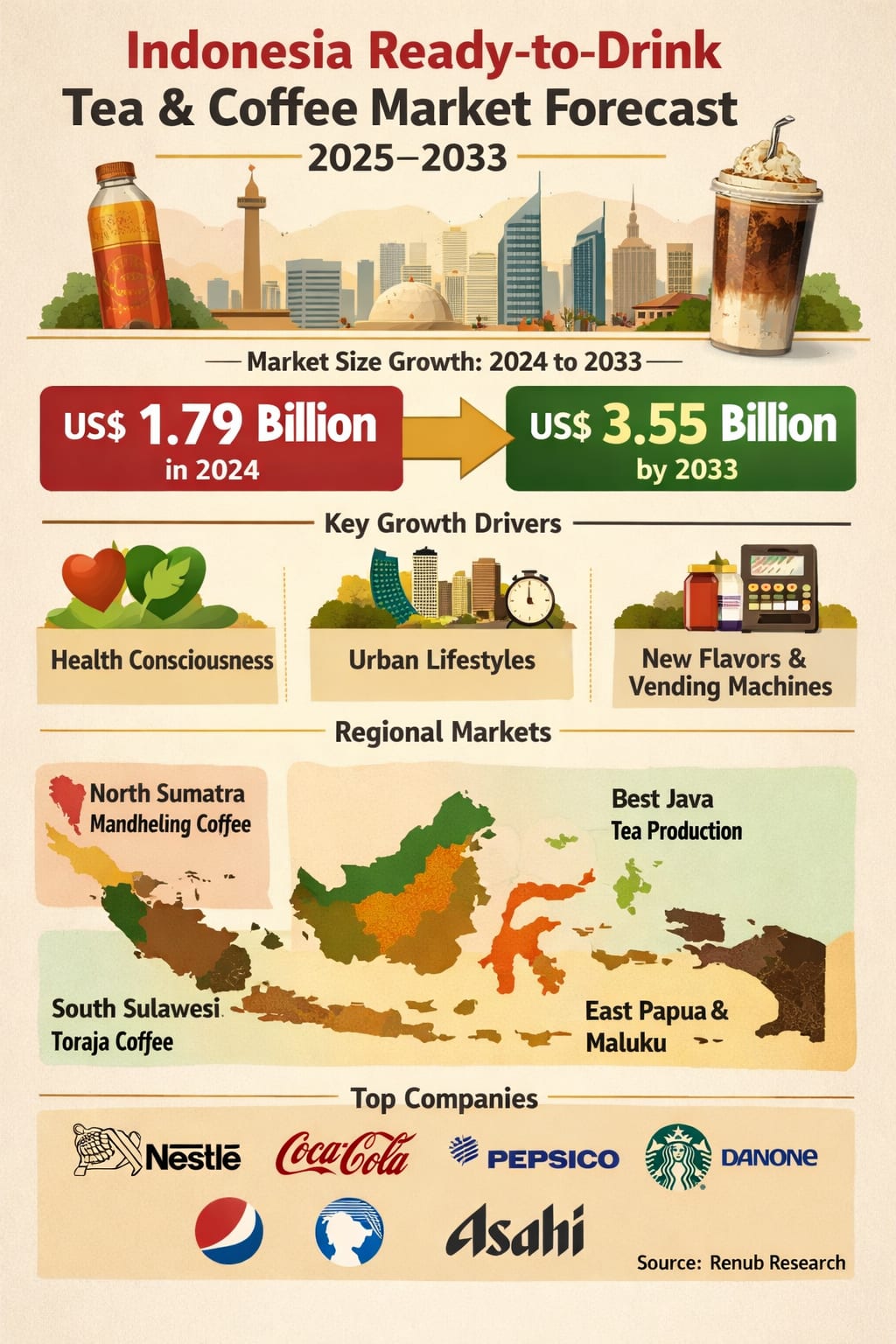
According to Renub Research, the Indonesia Ready Drink Tea and Coffee Market is expected to reach US$ 3.55 billion by 2033, up from US$ 1.79 billion in 2024, growing at a CAGR of 7.90% from 2025 to 2033. This strong growth reflects more than just rising consumption—it signals a structural shift in how beverages are purchased, consumed, and marketed across the country.
Some of the key drivers behind this expansion include the installation of RTD tea and coffee vending machines in public places and transit hubs, rising disposable incomes, and the continuous introduction of new flavors and functional variants. Together, these forces are pushing RTD beverages from being a convenience option to a mainstream daily choice.
Market Overview: Where Tradition Meets Modern Convenience
Indonesia has a deep-rooted tea and coffee culture. From traditional tea breaks to world-famous coffee varieties, beverages have always played a central role in daily life. What’s changing is how these drinks are consumed. Urbanization, longer working hours, and a younger, more mobile population are making on-the-go consumption the new normal.
RTD tea continues to enjoy strong popularity due to its refreshing taste, cultural familiarity, and wide flavor variety. At the same time, RTD coffee is rapidly gaining ground, particularly among younger consumers influenced by global café culture and premium coffee trends. These products bridge the gap between café-style experiences and everyday convenience.
Brands are responding with innovative packaging, bold branding, and localized flavors, while also experimenting with health-focused formulations such as low-sugar, herbal-infused, and functional beverages. The result is a highly dynamic, competitive, and fast-evolving market.
Key Growth Drivers
1. Increasing Health Consciousness
Health awareness is playing a major role in shaping consumer preferences in Indonesia’s RTD tea and coffee sector. More consumers are actively seeking beverages that align with a healthier lifestyle, pushing demand for low-sugar, natural, and functional drinks.
Antioxidant-rich green teas, herbal infusions, and beverages with added vitamins or plant-based ingredients are gaining traction. On the coffee side, lighter formulations, dairy-free options, and functional blends are becoming more common. Brands are reformulating products and highlighting health benefits in their marketing, turning “better-for-you” beverages into one of the most powerful growth engines of the market.
2. Attractive Branding and Packaging
In a crowded retail environment, packaging and branding are no longer optional—they are decisive. Consumers are drawn to products that stand out visually while also communicating values such as sustainability, premium quality, or health benefits.
Sleek bottle designs, modern graphics, and eco-friendly packaging materials are increasingly being used to differentiate products. Strong branding builds trust and loyalty, while smart packaging highlights unique selling points like local flavors, functional benefits, or ethical sourcing. In Indonesia’s competitive RTD space, packaging has become both a marketing tool and a brand statement.
3. Urbanization and Busy Lifestyles
Rapid urbanization and increasingly hectic routines are reshaping consumption habits across Indonesia. Students, office workers, and commuters are looking for quick, easy, and portable refreshment options. RTD tea and coffee fit perfectly into this lifestyle, offering grab-and-go convenience without any preparation.
This shift has encouraged brands to focus on portability, availability, and multi-channel distribution, ensuring products are accessible in convenience stores, supermarkets, vending machines, and online platforms. As urban populations continue to grow, this lifestyle-driven demand is expected to remain a core growth pillar.
Challenges Facing the Market
1. Intense Competition and Market Saturation
The Indonesian RTD tea and coffee market is highly competitive, with numerous local and international brands fighting for shelf space and consumer attention. Frequent product launches and aggressive pricing strategies often lead to price pressure and shrinking margins.
Standing out in such a crowded market requires continuous innovation, strong branding, and targeted marketing—all of which demand significant investment. Smaller players, in particular, may struggle to keep pace, making long-term differentiation and customer loyalty harder to achieve.
2. Supply Chain Disruptions and Raw Material Sourcing
Climate change and unpredictable weather patterns are affecting coffee and tea production across Southeast Asia. Indonesia, being both a major producer and consumer, is especially vulnerable. Fluctuating yields, rising raw material costs, and supply uncertainties can impact pricing strategies, profit margins, and long-term planning.
For RTD coffee producers, securing consistent, high-quality beans at stable prices is becoming increasingly challenging. This may push companies to explore alternative sourcing strategies, diversify suppliers, or adjust formulations to remain competitive.
Regional Market Insights
North Indonesia
North Indonesia, particularly North Sumatra, plays a significant role thanks to its famous coffee varieties like Mandheling and Lintong. Local production supports a steady supply of quality beans for RTD manufacturers while also boosting the regional economy.
Urban centers such as Medan are seeing rising demand for convenient beverage options, especially among younger consumers. Improved retail infrastructure and online platforms are making RTD tea and coffee more accessible, while brands continue to introduce new flavors tailored to local tastes.
South Indonesia
In regions like South Sumatra and South Sulawesi, the RTD tea and coffee market is growing steadily, driven by urbanization, a youthful population, and increasing digital adoption. Local coffee varieties such as Gayo and Toraja are being leveraged to create regionally appealing products.
The tropical climate also supports strong demand for cold, refreshing beverages. With the expansion of modern retail and e-commerce, brands are adopting multi-channel strategies to boost reach and visibility, while focusing on innovation and health-conscious formulations.
East Indonesia
East Indonesia, including Papua and Maluku, is experiencing gradual growth in RTD tea and coffee consumption. Although not major production hubs, these regions benefit from national distribution networks and rising urbanization in cities like Jayapura and Ambon.
Younger, tech-savvy consumers are driving demand for convenient, on-the-go beverages, with a noticeable shift toward lower-sugar and functional options. As retail infrastructure and e-commerce penetration improve, accessibility and product variety are expected to increase further.
West Indonesia
West Indonesia, particularly West Java and Banten, remains a key market due to strong tea production and dense urban populations in cities like Bandung and Bogor. Busy lifestyles and growing health awareness are fueling demand for RTD beverages that offer both refreshment and functional benefits.
Brands are активно introducing low-sugar, herbal-infused, and flavor-forward options to match regional preferences. The continued expansion of modern retail and online channels is making these products more widely available across the region.
Market Segmentation
By Product Category:
Tea
Coffee
By Packaging Type:
Glass Bottle
PET Bottle
Canned
Others
By Distribution Channel:
Supermarkets/Hypermarkets
Convenience Stores
Online
Others
By Region:
Ready to Drink Tea Market:
North
South
East
West
Ready to Drink Coffee Market:
North
South
East
West
Competitive Landscape and Company Analysis
The Indonesian RTD tea and coffee market features a strong mix of global giants and regional players. Leading companies compete across four key dimensions: overview, key persons, recent developments and strategies, and financial insights.
Major players include:
Nestlé SA
The Coca-Cola Company
PepsiCo
Starbucks Corporation
Monster Beverage
Danone S.A.
Asahi Group Holdings
Unilever Plc
These companies are investing heavily in product innovation, brand building, and distribution expansion. Strategies such as launching localized flavors, introducing health-focused variants, improving packaging sustainability, and strengthening digital and retail partnerships are shaping the competitive landscape.
Future Outlook: A Market with Long-Term Momentum
With a projected market size of US$ 3.55 billion by 2033 and a CAGR of 7.90%, Indonesia’s RTD tea and coffee sector is set for sustained, long-term growth. The combination of demographic shifts, lifestyle changes, health trends, and continuous innovation creates a strong foundation for expansion.
While challenges such as intense competition and supply chain risks remain, companies that can balance brand strength, product differentiation, and operational efficiency will be best positioned to win. As consumers continue to prioritize convenience without sacrificing taste or health, RTD beverages are likely to become an even more integral part of daily life in Indonesia.
Final Thoughts
Indonesia’s ready-to-drink tea and coffee market is no longer just about convenience—it’s about lifestyle, identity, and evolving consumer values. The journey from US$ 1.79 billion in 2024 to US$ 3.55 billion by 2033 reflects a deeper shift in how beverages are consumed across the country.
For brands, the opportunity lies in staying agile: innovating with flavors, investing in health-focused formulations, strengthening distribution, and building emotional connections with consumers. For investors and industry watchers, this market represents one of the most exciting growth stories in Southeast Asia’s FMCG landscape.
About the Creator
Tom Shane
Tom Shane is a content writer specializing in SEO-driven blogs, product descriptions, and thought leadership. He crafts engaging, research-backed content that connects with audiences and drives results.
Contract Catering Market Expands with AI Integration and Changing Corporate Dining Needs
Contract Catering Market Overview The Contract Catering Market involves outsourced food service solutions provided to institutions such as corporate offices, hospitals, educational institutions, defense organizations, and industrial facilities. These services are designed to deliver cost-effective, high-quality, and customized meal solutions while allowing organizations to focus on their core operations. The market is experiencing steady growth due to increasing demand for organized food services, rising workplace culture focusing on employee well-being, and expanding healthcare and education infrastructure. Additionally, growing emphasis on food safety, nutritional standards, and operational efficiency is encouraging businesses to adopt professional contract catering services. The integration of digital technologies and artificial intelligence is further transforming service quality, supply chain management, and customer satisfaction across the industry.
By James Smith5 days ago in Trader
Schizophrenia Drugs Market Size and Forecast 2025–2033: Innovation, Access, and the Future of Mental Health Treatment
Introduction The global conversation around mental health has shifted dramatically over the past decade. Conditions that were once misunderstood or stigmatized are now increasingly recognized as critical public health priorities. Among these, schizophrenia stands out as one of the most complex and challenging psychiatric disorders to diagnose, treat, and manage over the long term. As healthcare systems, governments, and pharmaceutical companies invest more resources into mental health, the market for schizophrenia drugs is entering a new phase of growth and transformation.
By Sakshi Sharma3 days ago in Trader



Comments
There are no comments for this story
Be the first to respond and start the conversation.