
Schizophrenia Drugs Market Size and Forecast 2025–2033: Innovation, Access, and the Future of Mental Health Treatment
As awareness, diagnosis, and pharmaceutical innovation rise, the global schizophrenia drugs market moves toward more personalized, effective, and patient-friendly therapies.

Introduction
The global conversation around mental health has shifted dramatically over the past decade. Conditions that were once misunderstood or stigmatized are now increasingly recognized as critical public health priorities. Among these, schizophrenia stands out as one of the most complex and challenging psychiatric disorders to diagnose, treat, and manage over the long term. As healthcare systems, governments, and pharmaceutical companies invest more resources into mental health, the market for schizophrenia drugs is entering a new phase of growth and transformation.
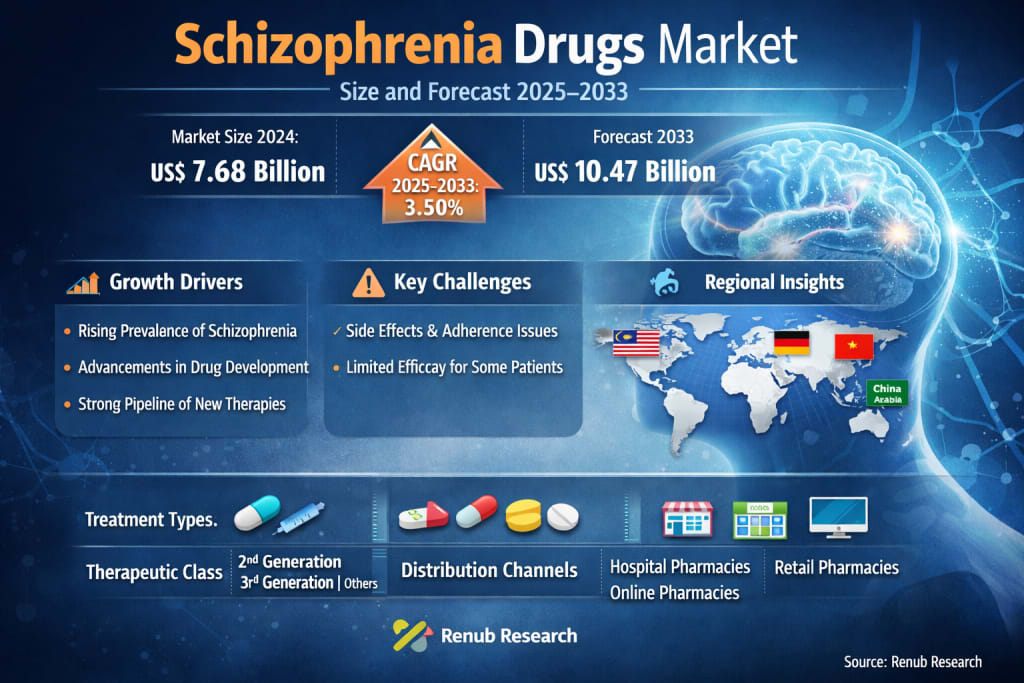
According to Renub Research, the Schizophrenia Drugs Market is expected to reach US$ 10.47 billion by 2033, up from US$ 7.68 billion in 2024, growing at a CAGR of 3.50% from 2025 to 2033. This steady expansion reflects not only the rising incidence of schizophrenia and related mental health conditions worldwide, but also the increasing focus on early diagnosis, long-term disease management, and the development of more effective and better-tolerated therapies.
Socioeconomic, environmental, and genetic factors all play a role in the growing number of diagnosed cases. At the same time, improvements in healthcare infrastructure and mental health awareness campaigns are helping more patients access treatment. Together, these trends are reshaping the global schizophrenia drugs market into a more dynamic, innovation-driven, and patient-centric space.
Global Schizophrenia Drugs Market Overview
Schizophrenia is a serious, chronic mental disorder that affects how a person thinks, feels, and behaves. It belongs to a broader group of psychotic disorders characterized by disruptions in perception, thought processes, and emotional responsiveness. Patients often experience symptoms such as hallucinations, delusions, disorganized thinking, and impaired social functioning. When these symptoms persist for more than six months and significantly interfere with daily life, a diagnosis of schizophrenia is typically made.
Although schizophrenia cannot be completely cured, it can be effectively managed with timely and appropriate treatment. Antipsychotic medications remain the cornerstone of therapy, and most patients require lifelong treatment, even during periods when symptoms are less severe. These drugs primarily work by regulating dopamine and other neurotransmitters in the brain, helping to reduce psychotic symptoms and stabilize mood and behavior.
The current state of the schizophrenia drugs market highlights a clear need for better treatments—medications that not only control symptoms more effectively but also minimize side effects and reduce the risk of relapse. Newer therapies aim to strike this balance, allowing patients to maintain a better quality of life, stay adherent to treatment, and participate more fully in society.
As the number of diagnosed patients continues to rise, major pharmaceutical companies are expected to expand their presence in this space, investing in research, development, and commercialization of next-generation antipsychotic drugs.
Rising Prevalence and Demographic Shifts
One of the most important forces driving market growth is the increasing prevalence of schizophrenia and related mental health disorders, combined with the rapid expansion of the global geriatric population. Older adults are more susceptible to late-onset schizophrenia and other cognitive and psychiatric conditions, which further increases demand for long-term pharmacological treatment.
According to the World Health Organization, schizophrenia affected around 24 million people worldwide in 2022. This number is expected to rise steadily as populations age and diagnostic capabilities improve. The United Nations’ World Population Ageing Highlights 2020 report notes that 727 million people were aged 65 or older in 2020, accounting for 9.3% of the global population, and this figure is projected to grow significantly in the coming decades.
In addition, estimates from the American Psychiatric Association and the National Institute of Mental Health suggest that the lifetime risk of developing schizophrenia ranges between 0.3% and 0.7%. With the global population of people aged 65 and above expected to reach 1.5 billion by 2050, the pool of patients requiring diagnosis, treatment, and long-term care is set to expand substantially. This demographic shift alone creates a strong and sustained demand for schizophrenia medications worldwide.
Key Growth Drivers in the Schizophrenia Drugs Market
1. Increasing Prevalence of Schizophrenia
The rising number of diagnosed cases remains the single most important driver of market growth. Better awareness, improved screening, and reduced stigma in many regions are encouraging more people to seek medical help. As a result, healthcare systems are identifying and treating more patients than ever before. This trend, combined with aging populations and urbanization-related stress factors, continues to push demand for antipsychotic medications and supportive therapies.
2. Advancements in Drug Development
The schizophrenia drugs market is benefiting significantly from ongoing innovation in pharmaceutical research. New formulations such as long-acting injectables and depot drugs are making treatment more convenient and improving patient adherence. These therapies reduce the need for daily dosing and help ensure more consistent drug levels in the body, which can lower relapse rates.
Another major trend is the move toward personalized medicine, where treatments are tailored based on genetic profiles, biomarkers, or individual patient characteristics. This approach has the potential to improve efficacy while reducing unwanted side effects. In addition, atypical or second- and third-generation antipsychotics are designed to offer better tolerability compared to older drugs, making them more appealing to both patients and healthcare providers.
Together, these innovations are not only improving clinical outcomes but also expanding the overall market by increasing acceptance and long-term use of modern therapies.
3. Strong Pipeline of New Drugs
The future of the schizophrenia drugs market looks promising due to a robust pipeline of novel therapies currently in development. Researchers are exploring treatments that target new biological pathways, including glutamate signaling and immune system modulation, in addition to traditional dopamine-focused approaches.
There is also growing interest in combination therapies that address multiple symptom clusters—such as positive symptoms, negative symptoms, and cognitive impairments—simultaneously. These multi-target approaches could significantly improve patient outcomes and quality of life.
As these innovative drugs move closer to regulatory approval and commercialization, they are expected to provide more effective alternatives to existing treatments, further boosting market growth over the forecast period.
Challenges Facing the Schizophrenia Drugs Market
1. Side Effects and Patient Adherence
Despite significant progress, side effects remain a major challenge in schizophrenia treatment. Many antipsychotic drugs, especially older ones, are associated with weight gain, sedation, metabolic disturbances, and movement disorders such as tardive dyskinesia. These side effects can severely impact a patient’s willingness and ability to stay on long-term therapy.
Even newer medications, while generally better tolerated, can still cause issues such as sleep disturbances, cognitive dulling, or metabolic changes. Poor adherence to medication regimens reduces treatment effectiveness and increases the risk of relapse, hospitalization, and overall healthcare costs. Addressing this challenge requires not only better drug formulations but also improved patient education, monitoring, and support systems.
2. Limited Efficacy for Some Patients
Another significant hurdle is the limited efficacy of existing treatments for certain patient groups, particularly those with treatment-resistant schizophrenia. For these individuals, standard antipsychotic medications may fail to adequately control symptoms such as hallucinations, delusions, or cognitive deficits.
This unmet medical need highlights the importance of continued research into new mechanisms of action and more personalized treatment strategies. Until more effective options become widely available, this limitation will continue to restrain the full potential of the schizophrenia drugs market.
Regional Market Insights
United States Schizophrenia Drugs Market
The United States represents one of the largest and most advanced markets for schizophrenia medications. High disease prevalence, strong research infrastructure, and a robust pipeline of innovative therapies—particularly long-acting injectables—support steady market growth. Rising awareness of mental health issues and improved insurance coverage for psychiatric care are also expanding access to treatment.
However, challenges such as high drug costs, side effects, and the need for more personalized treatment approaches remain. Despite these issues, ongoing innovation and a strong focus on improving patient outcomes are expected to keep the U.S. market on a positive growth trajectory.
Germany Schizophrenia Drugs Market
Germany is one of the leading markets in Europe, supported by a strong healthcare system and high awareness of mental health conditions. The demand for newer antipsychotics with improved safety profiles and long-acting formulations is increasing. Government-backed healthcare programs ensure broad access to prescription medications, although cost pressures and treatment-resistant cases remain challenges. The introduction of novel therapies targeting new biological pathways is expected to further drive market growth.
China Schizophrenia Drugs Market
China’s market is expanding rapidly due to increasing awareness, better diagnostic practices, and a growing focus on mental health. The adoption of newer-generation antipsychotics and long-acting injectables is on the rise. However, stigma, uneven access to healthcare in rural areas, and treatment costs continue to pose barriers. Government efforts to strengthen mental health infrastructure and insurance coverage are expected to improve access and support long-term market expansion.
Saudi Arabia Schizophrenia Drugs Market
In Saudi Arabia, the market is growing steadily as healthcare infrastructure improves and awareness of mental health issues increases. Government reforms and expanded insurance coverage are enhancing access to treatment. While stigma and high drug costs remain concerns, the increasing availability of advanced therapies and long-acting injectables is expected to support continued growth in the coming years.
Schizophrenia Drugs Market Segmentation
By Treatment (2 viewpoints):
Oral
Injectable
By Therapeutic Class (3 viewpoints):
Second Generation
Third Generation
Others
By Distribution Channel (4 viewpoints):
Hospital Pharmacies
Retail Pharmacies
Online Pharmacies
By Country (18 viewpoints):
United States, Canada, Mexico, Brazil, United Kingdom, Germany, France, Italy, Spain, Netherlands, China, Japan, India, South Korea, Australia, South Africa, United Arab Emirates, Rest of the World.
Company Analysis (Covered from 4 Viewpoints: Overview, Key Persons, Business Strategy, Financial Insights)
H. Lundbeck
Pfizer Inc.
AbbVie
AstraZeneca
Bristol Myers Squibb
Eli Lilly
GlaxoSmithKline
Johnson & Johnson
Novartis AG
Takeda Pharmaceuticals
These companies are actively investing in research, strategic partnerships, and product innovation to strengthen their positions in the global schizophrenia drugs market.
Final Thoughts
The global schizophrenia drugs market is entering a period of steady and meaningful growth, driven by rising prevalence, demographic changes, and continuous innovation in drug development. With the market projected to grow from US$ 7.68 billion in 2024 to US$ 10.47 billion by 2033 at a CAGR of 3.50%, the coming years will likely see a stronger focus on personalized medicine, long-acting therapies, and treatments targeting new biological pathways.
While challenges such as side effects, patient adherence, and limited efficacy for some patients remain, the expanding pipeline of novel therapies offers real hope for improved outcomes. As awareness continues to rise and healthcare systems place greater emphasis on mental health, the schizophrenia drugs market is poised to play a crucial role in shaping the future of psychiatric care worldwide.
About the Creator
Sakshi Sharma
Content Writer with 7+ years of experience crafting SEO-driven blogs, web copy & research reports. Skilled in creating engaging, audience-focused content across diverse industries.
Keep reading
More stories from Sakshi Sharma and writers in Trader and other communities.
Radiofrequency Ablation Device Market Size and Forecast 2025
Introduction: A Market Heating Up with Innovation The global healthcare industry is in the middle of a major transformation, driven by the demand for safer, faster, and more cost-effective treatments. Among the technologies benefiting from this shift is radiofrequency ablation (RFA)—a minimally invasive technique that uses heat generated by radiofrequency energy to destroy abnormal tissue. From treating cardiac arrhythmias and tumors to managing chronic pain, RFA has become an essential tool in modern medicine.
By Sakshi Sharmaabout 16 hours ago in Trader
Are You Investing With Conviction - Or Mimicking Strangers on the Internet?
Let me ask you something uncomfortable. That ETF you bought - why did you buy it? That stock in your portfolio - can you explain the business model? The competitive advantage? Why it's worth what you paid?
By Destiny S. Harrisa day ago in Trader


Comments
There are no comments for this story
Be the first to respond and start the conversation.