
India Diesel Genset Market Size and Forecast 2025–2033
Powering Progress: How Diesel Gensets Continue to Anchor India’s Backup Energy Needs

India Diesel Genset Market: A Market on a Steady Growth Path
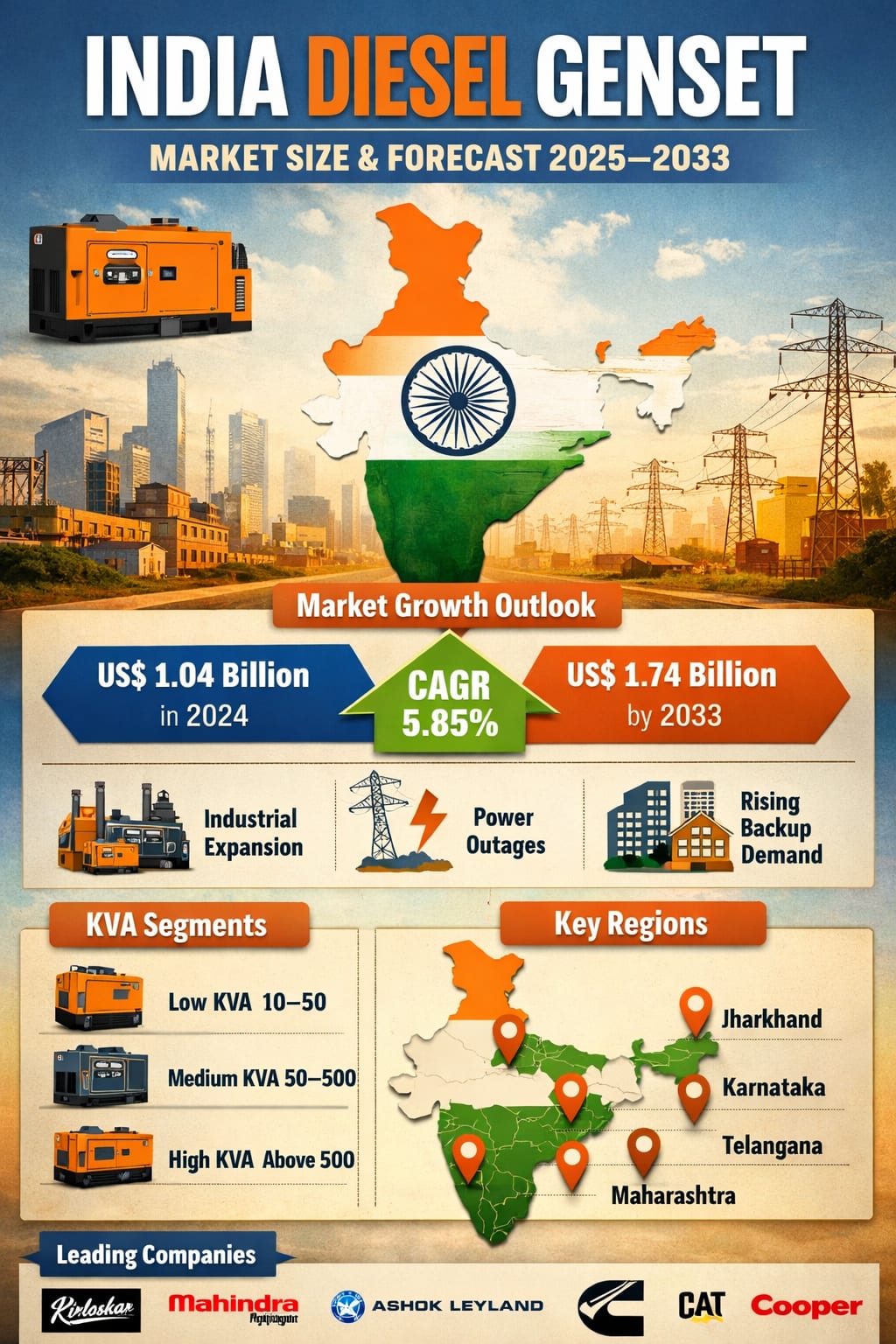
India’s diesel genset market is poised for consistent expansion over the coming decade, reflecting the country’s ongoing struggle with power reliability alongside rapid industrial and infrastructure growth. According to Renub Research, the India diesel genset market is expected to grow from US$ 1.04 billion in 2024 to around US$ 1.74 billion by 2033, registering a compound annual growth rate (CAGR) of 5.85% between 2025 and 2033.
This growth story is rooted in some very practical realities. Despite major investments in power generation and transmission, many parts of India—particularly Tier 2 and Tier 3 cities, industrial belts, and rural regions—still face voltage fluctuations, scheduled and unscheduled outages, and grid instability. For industries, commercial establishments, and even residential complexes, uninterrupted power is no longer a luxury; it is a necessity. Diesel generator sets, or gensets, continue to fill this crucial gap by providing reliable backup and, in some cases, primary power.
At the same time, India’s economic momentum is driving demand from multiple fronts. Infrastructure projects, data centers, manufacturing hubs, hospitals, metro rail systems, and commercial real estate developments all require dependable standby power solutions. While renewable energy and battery storage systems are gaining ground, diesel gensets remain the most practical, scalable, and immediately deployable solution for many users, especially where high loads and long operating hours are involved.
India Diesel Genset Market Overview
A diesel genset is essentially a combination of a diesel engine and an electric generator used to convert fuel into electrical energy. These systems are widely valued for their durability, efficiency, and ability to deliver stable power over long operating hours. In India, diesel gensets have become a backbone of backup power infrastructure across industrial, commercial, and even residential segments.
One of the main reasons for their popularity is the persistent issue of power outages and inconsistent grid supply, particularly outside major metropolitan centers. Manufacturing units, construction sites, hospitals, hotels, telecom towers, and office complexes rely on gensets to keep critical operations running without interruption. Diesel gensets are preferred over many alternatives because they can handle heavy loads, are relatively fuel-efficient for high-capacity applications, and offer a long service life.
In recent years, technological improvements have also reshaped the market. Modern diesel gensets are quieter, more fuel-efficient, and significantly cleaner than older models. With the introduction of stricter emission norms such as CPCB IV+, manufacturers have invested heavily in cleaner engines, advanced exhaust after-treatment systems, and smart control technologies. As India’s economy continues to expand and the demand for uninterrupted power grows, diesel gensets are expected to remain a vital part of the country’s energy ecosystem—especially as part of hybrid and smart power solutions.
Key Drivers of Growth in the India Diesel Genset Market
Industrial and Infrastructure Expansion
One of the strongest growth engines for the diesel genset market in India is the country’s ongoing industrialization and infrastructure development. Sectors such as manufacturing, construction, mining, oil & gas, and data centers require reliable power to avoid costly downtime. In many regions, grid power alone is not sufficient to guarantee continuous operations, making diesel gensets an essential backup solution.
Government initiatives like “Make in India,” smart city projects, highway construction, metro rail expansion, and large-scale industrial corridors are further boosting demand. These projects depend on consistent power supply not only during construction but also during operation. As a result, medium to high-capacity gensets—particularly in the 75 KVA to 1,000 KVA range—are seeing strong demand for both standby and continuous power applications.
The government’s large infrastructure spending plans, including significant allocations in recent Union Budgets, underline how critical reliable power is to economic growth. Manufacturers are responding by introducing more efficient, lower-emission, and digitally enabled gensets that align with both performance needs and regulatory requirements.
Rising Commercial and Residential Backup Power Demand
India’s rapid urbanization and rising electricity consumption are also reshaping the diesel genset market. Commercial buildings such as offices, malls, hotels, hospitals, and educational institutions increasingly treat backup power as a basic infrastructure requirement rather than an optional add-on. Elevators, fire safety systems, emergency lighting, security systems, and IT infrastructure all depend on uninterrupted power.
In Tier 2 and Tier 3 cities, where power cuts are still relatively common, the demand for gensets is even stronger. Small and medium enterprises (SMEs), retail outlets, and residential complexes are investing in compact and fuel-efficient gensets, typically in the 15 KVA to 125 KVA range. For many of these users, diesel gensets remain the most cost-effective and reliable option for backup power, especially where renewable integration is limited or grid stability is weak.
The scale of India’s power reliability challenge highlights why this market continues to grow. Millions of hours of electricity outages across urban and rural areas every year translate directly into lost productivity and inconvenience, reinforcing the need for dependable backup solutions.
Technological Innovation and Hybrid Solutions
Technology is playing a transformative role in the evolution of the diesel genset industry. Today’s gensets are no longer just mechanical machines; they are increasingly smart, connected systems. Advanced control panels, real-time monitoring, and remote diagnostics allow operators to optimize performance, reduce downtime, and manage fuel consumption more efficiently.
The integration of Internet of Things (IoT) technologies enables predictive maintenance, helping users identify potential issues before they lead to failures. This not only reduces operating costs but also extends equipment life. At the same time, hybrid solutions—combining diesel gensets with solar power or battery storage—are gaining popularity, especially in telecom, commercial buildings, and remote installations. These systems help reduce fuel consumption, lower emissions, and improve overall energy efficiency.
Compliance with CPCB IV+ emission norms has also pushed manufacturers to innovate. Newer models feature cleaner engines, advanced after-treatment systems, and improved combustion technologies. Together, these advancements are making diesel gensets more efficient, more environmentally responsible, and better suited to modern energy needs.
Challenges Facing the India Diesel Genset Market
Environmental Regulations and Emission Standards
One of the biggest challenges for the industry is the tightening regulatory environment. The introduction of CPCB IV+ emission norms has significantly raised the bar for diesel genset manufacturers. While these regulations are essential for reducing air pollution, they also increase production costs due to the need for cleaner engines and sophisticated exhaust treatment systems.
These higher costs can be passed on to end-users, potentially slowing adoption in price-sensitive segments such as small businesses and residential consumers. Moreover, diesel engines continue to face scrutiny for their contribution to air pollution, particularly in densely populated urban areas. At the same time, government policies promoting renewable energy and cleaner power sources are encouraging users to explore alternatives like solar, gas-based gensets, and battery storage systems.
Balancing regulatory compliance, cost competitiveness, and performance remains a complex challenge for market players.
Volatility in Diesel Prices and High Operating Costs
Fuel cost is another critical factor shaping the market. Diesel prices in India are subject to fluctuations, and any increase directly impacts the operating cost of gensets. For users who rely on gensets for extended periods, especially in areas with frequent power cuts, this can significantly raise the total cost of ownership.
In addition to fuel, maintenance expenses—such as oil changes, filter replacements, and periodic servicing—add to the lifecycle cost. While modern gensets are more fuel-efficient than older models, they still tend to be more expensive to operate over the long term compared to hybrid or renewable solutions. This cost sensitivity, particularly among small businesses and residential users, can limit wider adoption in certain segments.
Segment Insights: Understanding Where Growth Is Coming From
India Medium KVA Diesel Genset Market
The medium KVA segment, typically ranging from 75 KVA to 375 KVA, serves a broad base of commercial, institutional, and industrial users. Hospitals, schools, mid-sized factories, and commercial buildings often prefer this category because it offers a practical balance between power output and fuel consumption.
This segment is benefiting from urbanization, expanding commercial infrastructure, and the growing need for reliable standby power. Manufacturers are enhancing these gensets with digital control systems, noise-reduction technologies, and cleaner engines to meet regulatory and customer expectations. The adoption of hybrid configurations and remote monitoring is further improving efficiency and reliability, making the medium KVA segment a stable growth pillar for the overall market.
India High KVA Diesel Genset Market
High KVA gensets—generally above 375 KVA—are critical for large-scale applications such as data centers, mining operations, heavy manufacturing, oil & gas facilities, and major infrastructure projects. These users cannot afford downtime, as even short power interruptions can result in significant financial losses.
With India’s rapid expansion in data centers, digital infrastructure, and smart manufacturing, demand for high-capacity backup power is rising steadily. Manufacturers in this segment are focusing on advanced synchronization, load management systems, better fuel efficiency, and CPCB IV+ compliance. As industrial activity and digitalization deepen, high KVA gensets are set to remain an essential part of India’s industrial power backbone.
India Industrial Diesel Genset Market
Industrial users represent the core demand base for diesel gensets in India. Sectors such as cement, steel, textiles, chemicals, and heavy engineering depend heavily on uninterrupted power for continuous production processes. Gensets in the 250 KVA to 1,000 KVA range are especially popular due to their robustness, scalability, and ability to handle heavy loads.
With the increasing adoption of automation and Industry 4.0 technologies, the cost of power interruptions is rising, making reliable backup systems more critical than ever. As India continues to strengthen its manufacturing base, industrial diesel gensets are expected to see steady, long-term demand.
Regional Market Highlights
Jharkhand Diesel Genset Market
Jharkhand’s genset market is driven largely by mining, power, and heavy industries. The state’s rich mineral resources require continuous power for extraction and processing, often in areas where grid reliability is limited. Urban centers like Ranchi, Dhanbad, and Jamshedpur also contribute to demand from SMEs and commercial establishments. With ongoing industrial development and infrastructure investment, Jharkhand’s genset market is expected to grow at a steady pace.
Karnataka Diesel Genset Market
Karnataka, led by cities such as Bengaluru, Mysuru, and Mangaluru, is a major hub for IT, manufacturing, and real estate. Data centers, IT parks, hospitals, and commercial complexes rely heavily on backup power systems. The growing adoption of smart monitoring and low-emission gensets, combined with continued infrastructure development, supports a strong outlook for the state’s genset market.
Telangana Diesel Genset Market
Telangana’s rapid industrialization, especially around Hyderabad, has made it one of the fastest-growing regional markets for diesel gensets. Technology parks, high-rise buildings, shopping complexes, and healthcare facilities are key demand drivers. The expansion of industrial parks and data centers is further boosting demand, particularly for medium and high-capacity gensets.
Maharashtra Diesel Genset Market
Maharashtra holds one of the largest shares of the Indian genset market, supported by its diverse industrial base and large urban population. Cities like Mumbai and Pune have high demand from commercial real estate, financial institutions, hospitals, and data centers. Industrial clusters in Pune and Aurangabad also rely on medium and high-capacity gensets, ensuring sustained market growth.
Tamil Nadu Diesel Genset Market
Tamil Nadu’s strong manufacturing presence in textiles, automotive, and electronics makes it a key market for diesel gensets. Chennai, Coimbatore, and Tiruppur are major demand centers. The growth of IT, healthcare, and construction sectors, along with the adoption of CPCB IV+ compliant and hybrid gensets, positions the state as a leader in advanced genset adoption.
Market Segmentation Snapshot
By KVA Range:
Low KVA (10–50)
Medium KVA (50–500)
High KVA (Above 500)
By End-User:
Commercial
Industrial
By States:
West Bengal, Odisha, Jharkhand, Gujarat, Maharashtra, Andhra Pradesh, Karnataka, Tamil Nadu, Telangana, Uttar Pradesh, Punjab, Haryana, and Others.
Key Companies Covered:
Kirloskar Oil Engine, Mahindra & Mahindra Ltd., Ashok Leyland, Cummins India Ltd., Caterpillar Inc., Cooper Corporation.
Final Thoughts
The India diesel genset market is not just growing—it is evolving. While environmental regulations and fuel cost concerns are pushing the industry toward cleaner and more efficient technologies, the fundamental need for reliable backup power remains as strong as ever. With the market expected to rise from US$ 1.04 billion in 2024 to US$ 1.74 billion by 2033, at a CAGR of 5.85%, diesel gensets will continue to play a critical role in supporting India’s industrial growth, urban expansion, and digital transformation.
As hybrid systems, smart monitoring, and cleaner engines become more mainstream, diesel gensets are likely to remain an essential—if increasingly optimized—part of India’s energy landscape for years to come.
About the Creator
Sakshi Sharma
Content Writer with 7+ years of experience crafting SEO-driven blogs, web copy & research reports. Skilled in creating engaging, audience-focused content across diverse industries.
Keep reading
More stories from Sakshi Sharma and writers in Trader and other communities.
Agricultural Tractors Market Size and Forecast 2025–2033
Introduction: The Engine Behind Modern Farming Agriculture is undergoing one of the most significant transformations in its history. From small family farms to vast commercial operations, the pressure to produce more food with fewer resources has never been greater. At the center of this transformation stands a familiar but increasingly sophisticated machine: the agricultural tractor.
By Sakshi Sharmaabout 10 hours ago in Trader
JPMorgan Equity Income Fund Class R6: A Comprehensive Guide for Income-Focused Investors
Overview of JPMorgan Equity Income Fund Class R6 The JPMorgan Equity Income Fund Class R6 is a professionally managed mutual fund designed for investors who want a balance between regular income and long-term capital appreciation. Offered by JPMorgan Asset Management, this fund primarily invests in U.S. equity securities with a strong emphasis on dividend-paying companies. Class R6 shares are typically available through institutional platforms and employer-sponsored retirement plans, making them a cost-efficient option for long-term investors.
By Hammad Nawazabout 9 hours ago in Trader



Comments
There are no comments for this story
Be the first to respond and start the conversation.