
Agricultural Tractors Market Size and Forecast 2025–2033
Mechanizing the Future: How Tractors Are Powering the Next Era of Global Agriculture

Introduction: The Engine Behind Modern Farming
Agriculture is undergoing one of the most significant transformations in its history. From small family farms to vast commercial operations, the pressure to produce more food with fewer resources has never been greater. At the center of this transformation stands a familiar but increasingly sophisticated machine: the agricultural tractor.
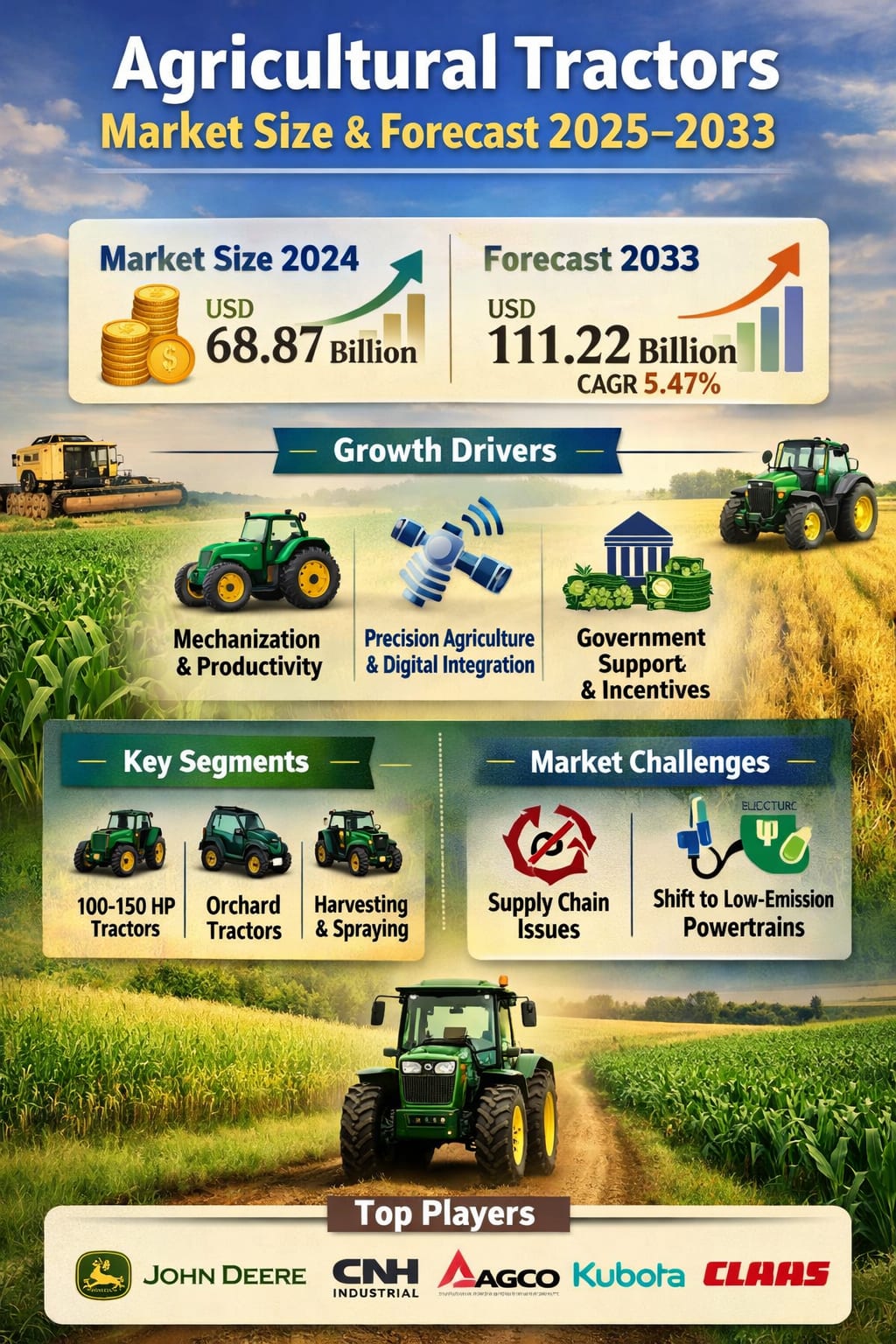
According to Renub Research, the global agricultural tractors market is expected to reach around USD 68.87 billion by 2024 and then expand at a compound annual growth rate (CAGR) of 5.47% from 2025 to 2033, ultimately reaching approximately USD 111.22 billion by 2033. This growth is being driven by rising global food demand, rapid technological advancement, and strong government support for farm mechanization across both developed and developing economies.
More than just farm vehicles, tractors have become multi-purpose productivity platforms—integrating digital tools, precision agriculture systems, and advanced powertrains. As farming becomes more data-driven and efficiency-focused, the tractor’s role is evolving from simple mechanical muscle to a smart, connected backbone of modern agriculture.
Agricultural Tractors Market Overview
Agricultural tractors are powerful motorized vehicles designed to perform a wide range of farming operations, including plowing, tilling, planting, harvesting, hauling, and operating numerous implements such as seeders, sprayers, and balers. Their ability to mount and power different attachments makes them indispensable across almost every type of farming system.
Globally, tractors play a crucial role in food production. In developed economies, they enable large-scale, high-efficiency farming across thousands of hectares. In developing regions, they are central to the transition from labor-intensive, manual farming to mechanized agriculture, significantly improving productivity, consistency, and food security.
Beyond fieldwork, tractors are also used in livestock management, material transport, land maintenance, and infrastructure support within rural economies. The integration of GPS guidance, telematics, and precision farming tools has further expanded their utility, allowing farmers to make data-driven decisions that improve yields, reduce input costs, and minimize environmental impact.
Growth Drivers in the Agricultural Tractors Market
Mechanization and Farm Productivity Needs
One of the strongest forces behind tractor demand is the global push to increase agricultural productivity. Farmers face rising labor shortages, climate uncertainty, and tighter planting and harvesting windows. Mechanization helps address all three by enabling faster, more precise, and more reliable field operations.
Tractors allow timely soil preparation, seeding, fertilization, and harvesting—critical factors when weather patterns are unpredictable. They also support conservation tillage and advanced farming practices that improve long-term soil health and sustainability.
As farms consolidate in many regions, larger and more versatile tractors are replacing multiple smaller machines. At the same time, government subsidies, rural credit programs, and mechanization incentives are lowering the barriers to purchase, especially in emerging markets. In India—the world’s largest tractor market—sales exceeded 900,000 units in 2023, supported by strong policy backing and rural mechanization initiatives.
Precision Agriculture and Digital Integration
Modern tractors are no longer just power units—they are becoming mobile data platforms. Precision agriculture technologies such as GPS guidance, auto-steering, variable-rate application, and integrated telematics are now key buying factors for many farmers.
These features reduce overlaps in field operations, optimize input use, and improve yield consistency, delivering measurable returns on investment. Telematics systems also enable remote diagnostics, predictive maintenance, and fleet management, helping large farms and contractors reduce downtime and operating costs.
Manufacturers are responding by offering factory-fitted digital architectures, sensor-ready platforms, and software ecosystems. In October 2024, for example, the FAO launched Kosovo’s Digital Agriculture Programme, highlighting the growing global focus on digitally transforming agriculture and integrating data-driven tools into everyday farming operations.
Replacement Cycle and Fleet Modernization
In many regions, tractor fleets are aging, leading to higher maintenance costs, lower fuel efficiency, and reduced reliability. As these machines reach the end of their service lives, farmers are increasingly opting for newer models that offer better emissions performance, improved uptime, and lower total cost of ownership.
Stricter safety and emissions regulations are also accelerating replacement cycles, as retrofitting older machines is often less economical than upgrading. New tractors with advanced engines, transmissions, and hydraulics provide clear operational and financial benefits, encouraging trade-ins and fleet renewal.
In September 2025, initiatives such as the Atlas of Climate Adaptation in South Asian Agriculture (ACASA) further underscored the need for climate-smart, efficient agricultural systems—indirectly supporting demand for modern, capable farm machinery.
Challenges in the Agricultural Tractors Market
Volatility of Input Costs and Supply Chain Disruptions
Tractor manufacturers and buyers alike are exposed to fluctuating prices for steel, electronics, tires, and semiconductors. Sudden cost increases can squeeze margins for OEMs or push retail prices higher, weakening farmers’ purchasing power.
Supply chain disruptions also extend lead times, sometimes forcing customers to delay purchases or turn to the used-equipment market. For smaller manufacturers and dealers, inventory financing becomes more complex during uncertain periods. While companies are diversifying suppliers and increasing local sourcing, these strategies often raise short-term operational complexity and working capital needs.
Shift to Low-Emission and Alternative Powertrains
Environmental regulations and sustainability goals are pushing the industry toward cleaner powertrains. Meeting tighter emissions standards requires advanced engine and after-treatment systems, increasing R&D and production costs.
At the same time, electric and hydrogen-powered tractors are being explored, but challenges remain—especially for heavy-duty, long-duration fieldwork. Energy density, charging or refueling infrastructure, and total lifecycle costs are still significant hurdles. Farmers, naturally cautious, are reluctant to adopt unproven technologies without strong service support and clear economic benefits.
As a result, manufacturers must manage parallel development paths: improving diesel technology while investing in alternative powertrains. This dual strategy increases complexity and capital requirements across the value chain.
Key Market Segments and Applications
100 HP to 150 HP Farm Tractors Market
The 100–150 HP segment is widely regarded as the industry’s workhorse category. These tractors offer a balance of power, versatility, and efficiency, making them suitable for tillage, planting, baling, and medium-scale hauling across grain, dairy, and mixed farms.
This segment is often the entry point for precision agriculture technologies, as farmers upgrading from smaller tractors seek GPS guidance and telematics without moving into ultra-high-horsepower classes. Manufacturers are increasingly offering features once reserved for larger models—such as advanced transmissions, cab suspension, and high-capacity hydraulics—driving steady replacement demand and premium pricing.
Agricultural Orchard Tractors Market
Orchard and vineyard tractors are designed for narrow rows, low clearance, and delicate ground conditions. Their compact frames, adjustable wheelbases, and high maneuverability help minimize crop damage while maximizing efficiency in tight spaces.
These tractors often support specialized implements for pruning, spraying, and harvesting. Because power requirements are lower, electrified or hybrid variants are gaining interest in this segment, offering reduced noise and emissions—especially valuable in enclosed crop environments.
Harvesting, Spraying, and Specialized Applications
Harvesting operations require tractors with high torque, strong PTO performance, and robust cooling systems to handle balers, forage harvesters, and grain carts. Comfort, reliability, and quick implement coupling are critical during long, high-pressure harvest seasons.
Spraying applications, on the other hand, emphasize speed control, stability, hydraulic capacity, and electronic integration. With increasing regulatory and environmental pressure, demand is rising for tractors that can support precision spraying systems with variable-rate control and GPS synchronization.
Regional Market Highlights
United States
The U.S. tractor market is defined by a wide range of farm sizes and high technology adoption. Large row-crop farms demand high-horsepower machines, while livestock and specialty farms rely on compact and mid-range models. Strong dealer networks, financing options, and aftermarket support heavily influence purchasing decisions.
In August 2025, Case IH expanded its portfolio with new models and technology solutions focused on improving uptime and productivity, highlighting the ongoing push toward fleet modernization and digital integration in the U.S. market.
China
China’s tractor market spans everything from small walk-behind units to high-horsepower machines for large grain belts. Government support for mechanization and rural modernization continues to drive demand. In June 2025, China introduced its first fully autonomous electric tractor, the Honghu T70, signaling strong momentum toward smart and autonomous farming solutions.
Australia and Brazil
Australia’s vast farms favor high-horsepower, durable tractors designed for long hours in harsh conditions. In October 2025, autonomous tractor retrofit technologies were introduced to the market, reflecting growing interest in automation.
Brazil, powered by large-scale soy, maize, and sugarcane production, remains a strong growth market. Local manufacturing, strong demand for heavy-duty tractors, and expanding mechanized farming practices continue to support long-term market expansion.
Competitive Landscape
Major players shaping the global agricultural tractors market include:
John Deere
CNH Industrial
AGCO Corporation
Kubota Corporation
Mahindra & Mahindra
Claas KGaA mbH
Escorts Ltd.
Titan Machinery Inc.
These companies compete across multiple dimensions: product innovation, digital integration, dealer networks, financing solutions, and after-sales service. Increasingly, tractors are being sold not just as machines, but as part of broader ecosystems that include software, data services, and long-term support packages.
Final Thoughts: A Market Built for the Long Term
The agricultural tractors market is not just growing—it is evolving. With the market projected to expand from USD 68.87 billion to USD 111.22 billion by 2033 at a CAGR of 5.47%, the industry is being reshaped by mechanization, digital farming, sustainability goals, and changing farm economics.
Tractors are becoming smarter, cleaner, and more connected, positioning them as central pillars of future food production systems. While challenges such as cost volatility and powertrain transitions remain, the long-term outlook is firmly positive. For farmers, manufacturers, and policymakers alike, the tractor will continue to be more than a machine—it will be a strategic investment in productivity, resilience, and food security.
About the Creator
Sakshi Sharma
Content Writer with 7+ years of experience crafting SEO-driven blogs, web copy & research reports. Skilled in creating engaging, audience-focused content across diverse industries.
Keep reading
More stories from Sakshi Sharma and writers in Trader and other communities.
North America Dietary Supplement Market Size and Forecast 2025–2033
North America Dietary Supplement Market Outlook The North America Dietary Supplement Market is entering a powerful growth phase, reflecting a broader shift in how consumers approach health, wellness, and preventive care. According to Renub Research, the market was valued at around US$ 40.32 billion in 2024 and is forecast to reach approximately US$ 67.05 billion by 2033, expanding at a compound annual growth rate (CAGR) of 5.82% during 2025–2033.
By Sakshi Sharma3 days ago in Trader
Vinyl Flooring Market Size, Share, Trends, Growth Drivers and Forecast 2034
Vinyl Flooring Market Outlook 2025–2034: Trends, Growth Drivers, and Future Opportunities The vinyl flooring market is experiencing robust expansion as consumers and commercial users increasingly prefer durable, cost-effective, and aesthetically versatile flooring solutions. Vinyl flooring, known for its water resistance, resilience, and ease of maintenance, has emerged as a leading alternative to traditional materials such as wood, ceramic, and stone. With rapid urbanization, rising construction activities, and evolving interior design preferences, vinyl flooring is becoming a staple across residential, commercial, and industrial spaces worldwide.
By Kim Soo hyun7 days ago in Trader




Comments
There are no comments for this story
Be the first to respond and start the conversation.