
Global Dairy Market Size & Forecast 2025–2033: Nutrition, Innovation, and the Next Growth Wave
From everyday milk to premium cheese and functional yogurt, the global dairy industry is entering a decade of transformation driven by health trends, urbanization, and technology.

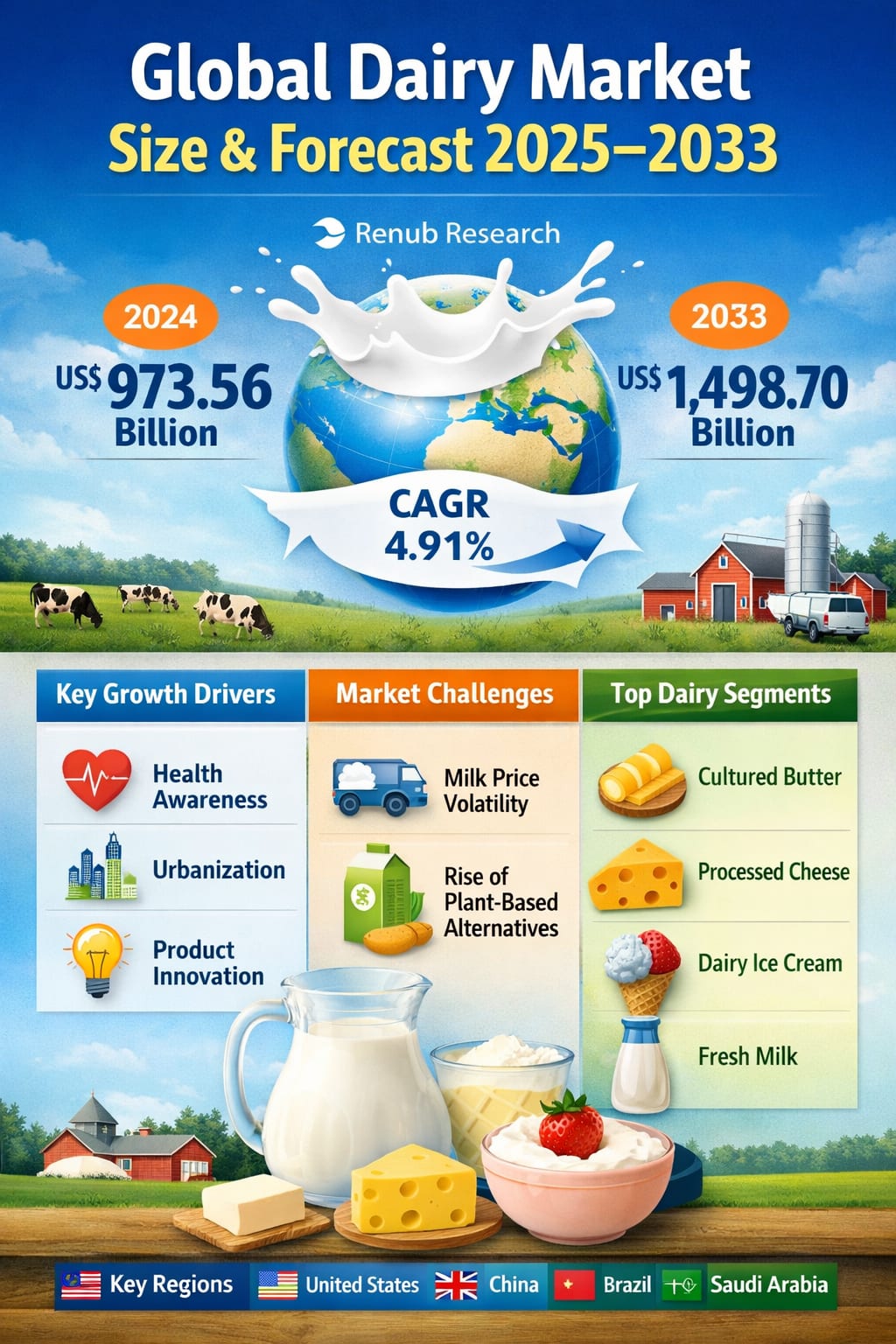
Introduction: A Market Built on Everyday Nutrition
The global dairy market is one of the most deeply rooted segments of the food and beverage industry, touching daily lives across cultures, continents, and income groups. From a glass of fresh milk at breakfast to cheese on pizza, butter in baking, and yogurt as a health snack, dairy products remain essential in modern diets.
According to Renub Research, the global dairy market is expected to grow from US$ 973.56 billion in 2024 to US$ 1,498.70 billion by 2033, registering a compound annual growth rate (CAGR) of 4.91% from 2025 to 2033. This steady and impressive expansion reflects rising consumer demand, greater health awareness, urbanization, and continuous innovation in processing, packaging, and distribution.
Dairy includes products derived primarily from the milk of cows, goats, and sheep—such as milk, cheese, yogurt, butter, and cream. For centuries, these products have been valued for their rich nutritional profile, offering calcium, protein, vitamin D, and vitamin B12. Today, dairy continues to evolve, adapting to modern lifestyles, new dietary preferences, and shifting consumer expectations.
While plant-based alternatives like almond, soy, and oat milk are gaining popularity, traditional dairy remains a dominant global food category, supported by its taste, versatility, and strong nutritional positioning.
Global Dairy Market Outlook: Tradition Meets Transformation
Dairy products are staples in nearly every culture—cheese varieties in Europe, yogurt across the Middle East and South Asia, and milk-based dishes throughout Latin America and Africa. What makes dairy unique is its ability to fit into both traditional diets and modern, convenience-driven lifestyles.
In recent years, the market has seen strong momentum from:
Growing awareness of nutrition and balanced diets
Rising disposable incomes in emerging economies
Expansion of modern retail and cold-chain infrastructure
Innovation in flavors, formulations, and packaging
At the same time, the industry is adapting to challenges such as sustainability concerns, price volatility, and competition from plant-based alternatives. The result is a dynamic, evolving global market that balances heritage with innovation.
Key Growth Drivers in the Global Dairy Market
1. Increasing Health Awareness and Nutritional Demand
Health and nutrition have become central to consumer decision-making. Dairy products are widely recognized as reliable sources of calcium, protein, and essential vitamins, supporting bone health, muscle development, and overall well-being.
The rising incidence of lifestyle-related issues such as osteoporosis and vitamin D deficiency has encouraged higher consumption of milk, yogurt, and fortified dairy products. At the same time, consumers are increasingly choosing low-fat, probiotic, lactose-free, and high-protein options that align with their wellness goals.
Convenient formats—such as yogurt drinks, cheese snacks, and fortified milk—are gaining popularity among busy urban consumers. In many middle-income economies, improving purchasing power and changing dietary habits are also boosting per capita intake of animal-sourced foods, including dairy.
Beyond basic nutrition, dairy is increasingly positioned as a functional food, supporting gut health, immunity, and overall fitness—further strengthening its role in daily diets.
2. Expanding Middle-Class Population and Urbanization
Urbanization and the growth of the global middle class are powerful forces behind dairy market expansion. As more people move to cities and adopt modern lifestyles, demand for packaged, branded, and ready-to-consume dairy products continues to rise.
Higher disposable incomes enable consumers to explore premium offerings such as organic milk, flavored yogurts, specialty cheeses, and value-added dairy desserts. The rapid spread of supermarkets, hypermarkets, and online grocery platforms has also improved accessibility and product variety, especially in metropolitan areas.
Younger consumers, in particular, are embracing Western-style diets and snack habits, where cheese, yogurt, and milk-based beverages play a growing role. In countries like India, China, and several African nations, government support for local dairy production is strengthening supply chains and improving availability.
With urban populations expected to keep expanding over the coming decades, the long-term demand outlook for dairy remains strong and resilient.
3. Innovation in Product Diversification and Technology
Innovation is reshaping the global dairy industry at every level—from farm to factory to retail shelf. Manufacturers are investing in:
Protein-fortified and low-sugar products
Plant-enriched and hybrid dairy options
Smart packaging to improve freshness and shelf life
Advanced cold-chain logistics to reach new markets
Automation, digital monitoring, and improved processing technologies are helping producers maintain consistent quality while reducing costs. Flavor innovation—ranging from exotic fruits to regional taste profiles—is also attracting younger and more experimental consumers.
A notable example is Actus Nutrition’s acquisition of a 99,000 sq. ft. processing facility from Foremost Farms USA in April 2025, strengthening its position in dairy nutraceuticals and expanding production capacity. Such moves highlight how investment and innovation continue to fuel industry growth.
Key Challenges Facing the Global Dairy Market
1. Fluctuating Milk Prices and Supply Chain Constraints
One of the most persistent challenges in the dairy industry is price volatility in raw milk. Weather conditions, feed costs, and seasonal production cycles all influence supply and input costs, creating uncertainty for producers and processors alike.
In many developing markets, limited cold-chain infrastructure and logistical constraints can affect product quality, increase waste, and disrupt distribution. Smaller dairy farmers are particularly vulnerable during periods of low prices, which can lead to inconsistent supply and financial stress.
On a global scale, trade policies, geopolitical tensions, and currency fluctuations can further impact pricing structures and profitability, adding another layer of complexity to the market.
2. Growing Popularity of Plant-Based Alternatives
Plant-based milk and dairy alternatives represent a growing competitive threat. Products made from almond, soy, oat, and rice are increasingly popular among consumers concerned about lactose intolerance, vegan lifestyles, and environmental sustainability.
Aggressive marketing by plant-based brands, often highlighting ethical and ecological benefits, has shifted perceptions—especially among younger, urban consumers. Concerns around animal welfare and carbon emissions have also encouraged some shoppers to reduce or replace traditional dairy consumption.
While dairy remains nutritionally strong, this competitive pressure is pushing traditional producers to innovate, diversify, and communicate their value more effectively.
Spotlight on Key Dairy Segments
Cultured Butter Market
Cultured butter is gaining traction as consumers seek premium, naturally fermented products with richer flavor profiles. Made through bacterial fermentation of cream, it offers a tangy taste and smoother texture compared to regular butter. Its association with artisanal cooking, probiotics, and minimal processing makes it popular among gourmet chefs and health-conscious buyers alike.
Processed Cheese Market
Processed cheese continues to thrive thanks to its convenience, affordability, and long shelf life. Widely used in fast food, ready meals, and home cooking, it benefits from globalized eating habits and the expansion of quick-service restaurants. Fortified and improved formulations are helping it stay competitive with natural cheese.
Double Cream Market
With its high fat content and rich taste, double cream is firmly positioned in the premium and indulgence category. Growing interest in baking, desserts, and gourmet cooking has supported demand, particularly in hospitality and catering. Organic and locally sourced variants are also gaining attention.
Dairy Ice Cream Market
Dairy ice cream remains a strong growth segment, driven by flavor innovation, premiumization, and healthier variants such as low-fat or sugar-free options. Artisan brands, seasonal launches, and new textures continue to refresh consumer interest, especially in developing markets with rising disposable incomes.
Fresh Milk Market
Fresh milk remains the backbone of the global dairy industry. Its nutritional value and everyday use keep demand strong across all regions. Fortified and lactose-free variants are helping producers reach wider consumer groups, while modern retail and home delivery models ensure consistent access.
Flavored Yogurt Market
Flavored yogurt has successfully positioned itself as both a tasty snack and a functional health food. With benefits linked to gut health and immunity, and with a wide variety of flavors and formats, it appeals strongly to students, professionals, and fitness-focused consumers.
Supermarkets and Hypermarkets as Key Distribution Channels
Supermarkets and hypermarkets continue to dominate dairy distribution thanks to their wide assortment, strong cold-chain infrastructure, and consumer convenience. Promotional activities, private labels, and exclusive brand partnerships further strengthen their role in driving dairy sales worldwide.
Regional Market Highlights
United States
The U.S. dairy market is shaped by advanced technology, product innovation, and sustainability initiatives. Demand is rising for organic, lactose-free, and high-protein products. In March 2024, Amul (GCMMF) partnered with Michigan Milk Producers Association, enabling Amul’s fresh milk products to enter the U.S. market and highlighting growing international collaboration.
United Kingdom
UK consumers increasingly favor premium, traceable, and environmentally responsible dairy products. In November 2024, Tesco, Arla, and Müller launched the Future Dairy Partnership to focus on sustainability, emissions reduction, and animal welfare—signaling a strong industry push toward ethical production.
China
China’s dairy market is expanding rapidly due to urbanization, rising incomes, and health awareness. In November 2024, Arla reaffirmed China as a key market, expanding beyond infant formula into liquid milk, high-protein drinks, butter, and cheese, with strong double-digit growth in some segments.
Brazil
Brazil benefits from a strong agricultural base and growing domestic demand. In June 2025, Future Cow, a São Paulo-based startup, raised funding to expand animal-free whey and casein production, showing how innovation and alternative proteins are also shaping the broader dairy ecosystem.
Saudi Arabia
Saudi Arabia’s dairy market is evolving through technological modernization and self-sufficiency goals. In April 2025, the country launched a major dairy industrial cluster in Al-Kharj, reinforcing its ambition to become a regional hub for dairy and food manufacturing.
Market Segmentation Overview
By Product Type:
Butter (Cultured, Uncultured), Cheese (Natural, Processed), Cream (Double, Single, Whipping), Dairy Desserts, Milk (Fresh, Flavored, Powdered, UHT, Condensed), Yogurt (Flavored, Unflavored), Sour Milk Drinks
By Distribution Channel:
Off-Trade (Convenience Stores, Online Retail, Specialist Retailers, Supermarkets & Hypermarkets, Others), On-Trade
By Region:
North America, Europe, Asia Pacific, Latin America, Middle East & Africa
Key Companies:
Nestlé, Danone, Lactalis, Fonterra, Arla Foods, Yili, Mengniu, Unilever, Saputo, Dairy Farmers of America, and others.
Final Thoughts: A Market Poised for Steady, Sustainable Growth
The global dairy market stands at a fascinating crossroads of tradition and transformation. Backed by strong fundamentals—nutrition, everyday consumption, and cultural relevance—it continues to grow steadily. At the same time, innovation in products, technology, and sustainability is reshaping how dairy is produced, marketed, and consumed.
With the market projected to reach US$ 1,498.70 billion by 2033, dairy will remain a cornerstone of the global food industry. Companies that successfully balance health trends, sustainability, affordability, and innovation will be best positioned to thrive in this competitive and evolving landscape.
About the Creator
BTC USD Surge: How to Predict the Next Big Price Move
The BTC USD market is fast-moving and full of surprises. Traders are always searching for clues about the next price jump or drop. While experts share tips, some important truths remain hidden. In this article, we reveal insights about BTC USD that can help you stay ahead of the curve and make smarter trading decisions.
By hamza mirza4 days ago in Trader
Europe Retinal Surgery Devices Market Size & Forecast 2026–2034
Market Snapshot The Europe Retinal Surgery Devices Market is expected to witness steady and sustained growth over the forecast period, expanding from US$ 820.33 million in 2025 to US$ 1,668.76 million by 2034, registering a compound annual growth rate (CAGR) of 8.21% during 2026–2034.
By shibansh kumar6 days ago in Trader
Field of the Fallen
Sunlight danced softly across the frost-crusted fields, making the little blades of grass sparkle like emeralds. The faraway chirrup of a songbird was the only disruption to the quiet of the morning. An icy chill, the last vestige of the dying winter, clung to the air, settling in a thick white mist at the far side of the open field. The heavy stench of decay hung in that mist, punctuation by the sharp tang of freshly spilled blood.
By A. J. Schoenfeld8 days ago in Fiction




Comments
There are no comments for this story
Be the first to respond and start the conversation.