
Europe Respiratory Care Devices Market Size and Forecast 2025–2033
Rising Respiratory Burden, Smart Technologies, and Homecare Demand Reshape Europe’s Breathing Care Industry

Introduction: A Market Built Around Every Breath
Breathing is the most basic human function, yet for millions of people across Europe, it is also a daily medical challenge. From asthma and chronic obstructive pulmonary disease (COPD) to sleep apnea and post-infection respiratory complications, respiratory disorders continue to place a heavy burden on patients, healthcare systems, and national economies. In this context, respiratory care devices have moved from being niche hospital tools to essential components of modern healthcare delivery.
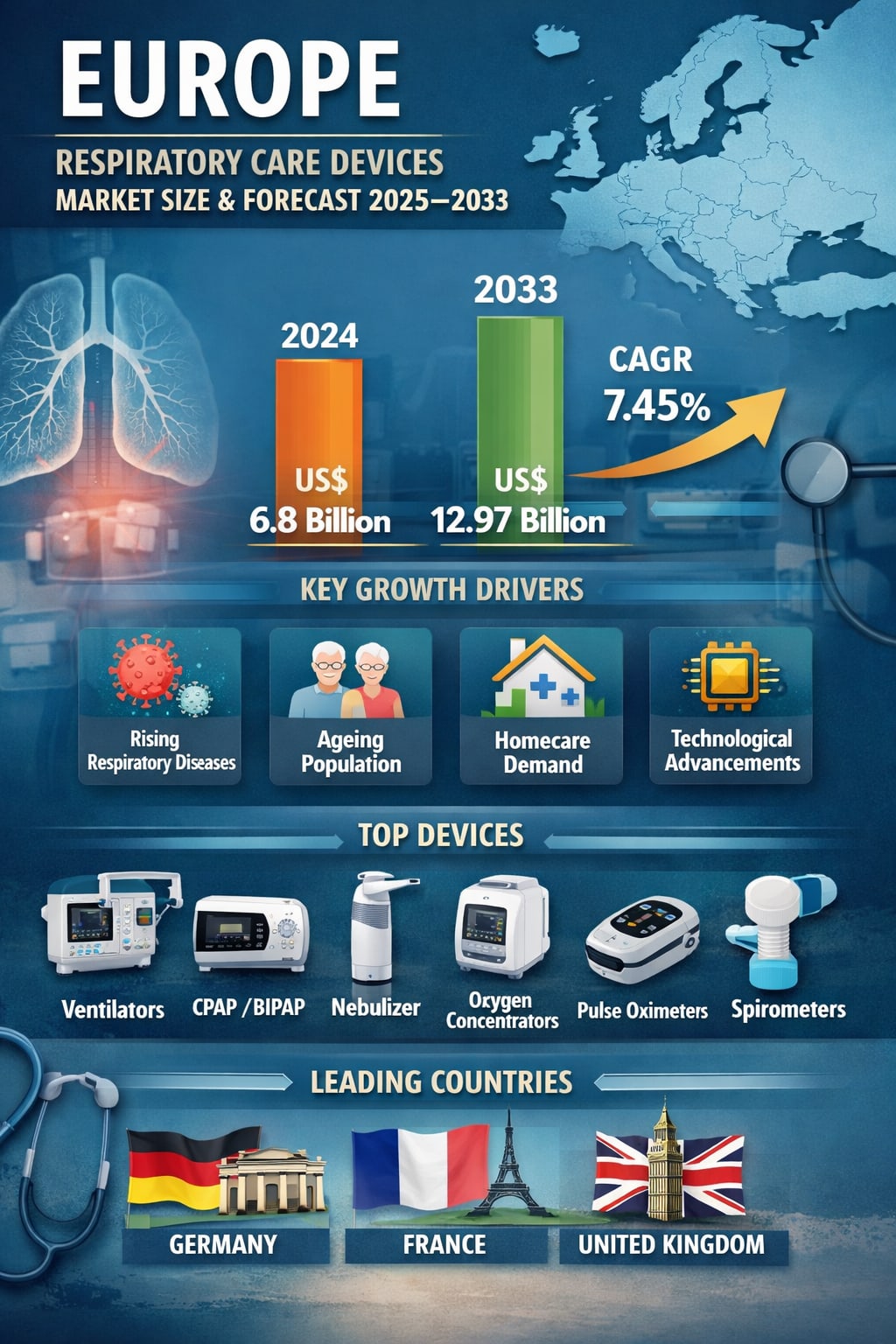
According to Renub Research, the Europe Respiratory Care Devices Market is expected to grow from US$ 6.8 billion in 2024 to US$ 12.97 billion by 2033, registering a compound annual growth rate (CAGR) of 7.45% during 2025–2033. This robust expansion reflects a convergence of powerful forces: rising respiratory disease prevalence, an aging population, increasing air pollution, rapid technological innovation, expanding homecare adoption, and heightened post-COVID-19 awareness about lung health.
Supported by strong healthcare infrastructure and favorable government initiatives across many European countries, respiratory care devices are no longer limited to intensive care units. They are increasingly found in outpatient clinics, community health centers, and private homes—signaling a structural shift in how respiratory conditions are monitored, managed, and treated.
Market Overview: What Are Respiratory Care Devices?
Respiratory care devices are medical tools designed to diagnose, monitor, and treat conditions affecting breathing and lung function. These include a wide range of equipment such as ventilators, nebulizers, oxygen concentrators, CPAP and BiPAP machines, inhalers, pulse oximeters, and spirometers. They are used for both acute and chronic conditions, including asthma, COPD, sleep apnea, respiratory distress syndrome, cystic fibrosis, and post-surgical or post-infection respiratory complications.
Traditionally, many of these devices were confined to hospitals and specialized clinics. However, technological progress has dramatically changed this landscape. Modern respiratory devices are becoming smaller, smarter, more portable, and easier to use, making them suitable for long-term homecare. Features such as digital connectivity, remote monitoring, automation, and AI-assisted analytics are improving patient comfort, treatment adherence, and clinical outcomes.
Across Europe, the respiratory care devices market is benefiting from this technological transformation. At the same time, healthcare systems are increasingly focused on reducing hospital stays, cutting long-term costs, and improving quality of life for patients with chronic respiratory diseases—goals that align perfectly with the wider adoption of advanced respiratory care solutions.
Key Growth Drivers Shaping the European Market
Rising Prevalence of Respiratory Diseases
One of the most powerful growth engines for the European respiratory care devices market is the increasing prevalence of respiratory disorders. Conditions such as asthma, COPD, and obstructive sleep apnea are becoming more common across the region due to a mix of environmental, lifestyle, and demographic factors.
Air pollution, smoking, urbanization, and occupational exposure to harmful particles continue to damage respiratory health, while longer life expectancy increases the number of people living with chronic lung diseases. In countries like Germany, asthma affects a significant portion of both children and adults, highlighting the scale of the issue. As more patients require long-term management, the demand for diagnostic, monitoring, and therapeutic devices—such as inhalers, CPAP machines, nebulizers, and oxygen concentrators—continues to rise.
Healthcare systems are increasingly dependent on these devices to manage the growing clinical load, reduce hospital readmissions, and provide continuous care for chronic patients. This structural demand is creating sustained market opportunities for manufacturers across Europe.
Technological Advancements and Digital Integration
Technology is transforming respiratory care from a reactive, hospital-centered model into a proactive, connected, and patient-centric ecosystem. Innovations such as smart inhalers, portable nebulizers, AI-enabled ventilators, and cloud-based monitoring platforms are reshaping how respiratory conditions are diagnosed and managed.
A notable example is the collaboration between MAGNET GROUP and KoKo, LLC, aimed at enhancing lung function diagnostics and spirometry through advanced software integration. Such partnerships underline a broader industry trend: combining medical hardware with digital intelligence to improve accuracy, usability, and clinical decision-making.
Telemedicine and remote monitoring are also playing a growing role, particularly in homecare settings. Patients can now share real-time data with healthcare providers, enabling early intervention, better therapy adjustments, and improved long-term outcomes. These technological shifts are not only improving patient care but also expanding the commercial potential of respiratory care devices across Europe.
Aging Population and Chronic Care Needs
Europe’s demographic profile is changing rapidly, and this shift is having a direct impact on healthcare demand. According to European Commission data, more than one-fifth of the EU population is now aged 65 or above, and this proportion continues to grow. Aging is closely linked with declining lung function and a higher prevalence of chronic diseases, including COPD, sleep apnea, and other respiratory conditions.
Older adults often require long-term respiratory support, including oxygen therapy, non-invasive ventilation, and continuous monitoring. At the same time, many prefer to receive care at home rather than in institutional settings. This combination of medical need and lifestyle preference is accelerating the adoption of user-friendly, portable, and home-compatible respiratory devices.
As a result, the aging population is not just increasing the number of patients—it is also reshaping the types of devices in demand, favoring solutions that emphasize comfort, simplicity, and remote connectivity.
Challenges Facing the Market
High Cost of Advanced Devices
Despite strong growth prospects, cost remains a significant barrier in the European respiratory care devices market. Advanced equipment such as ventilators, CPAP systems, and portable oxygen concentrators often come with high upfront prices and ongoing maintenance expenses. For elderly patients, low-income households, and even some public healthcare systems, these costs can limit access and delay adoption.
Budget constraints in publicly funded healthcare systems can also slow procurement cycles and restrict large-scale deployment of new technologies. While long-term cost savings from reduced hospitalizations are well recognized, the initial investment hurdle remains a key challenge for broader market penetration.
Regulatory and Compliance Pressures
Europe’s regulatory environment, particularly under the EU Medical Device Regulation (MDR), has become more stringent in recent years. While these rules are designed to enhance patient safety, product quality, and post-market surveillance, they also increase compliance costs and extend approval timelines for manufacturers.
Smaller and mid-sized companies, in particular, may struggle with the financial and administrative burden of meeting these requirements. This can slow innovation, delay product launches, and limit competition—potentially affecting patient access to new and improved respiratory care solutions.
Country-Level Market Insights
Germany: Innovation and Strong Clinical Demand
Germany represents one of the largest and most technologically advanced respiratory care markets in Europe. The country’s aging population and high prevalence of asthma, COPD, and sleep apnea continue to drive strong demand for respiratory devices. Germany is also a hub for medical innovation, with ongoing investments in digital health and wearable monitoring technologies.
Research initiatives, such as projects focused on wearable respiratory monitoring for chronic conditions, highlight the country’s commitment to next-generation healthcare solutions. Leading players like Philips Healthcare, ResMed, and Drägerwerk AG play a major role in advancing device functionality and clinical integration within the German healthcare system.
France: High Asthma Burden and Growing Homecare Adoption
France’s respiratory care devices market is expanding steadily, supported by a high prevalence of asthma and other chronic respiratory conditions. Studies have shown that France has one of the highest asthma prevalence rates in Europe, creating sustained demand for inhalers, nebulizers, oxygen therapy devices, and diagnostic tools.
The country’s strong hospital infrastructure, combined with a growing emphasis on homecare, is driving adoption of portable and easy-to-use devices. Technological innovation and patient-centric design are improving treatment adherence and outcomes, while established medical device companies continue to invest in the French market.
United Kingdom: Focus on Safety, Innovation, and Accessibility
In the UK, the respiratory care devices market is shaped by an aging population, rising respiratory disease incidence, and a strong focus on healthcare safety and quality standards. The introduction of new respiratory protection and treatment products reflects ongoing efforts to enhance both patient and healthcare worker safety.
The growing popularity of home-based care, supported by digital health solutions, is further expanding the market. Major global players such as Philips Healthcare, ResMed, and Drägerwerk are actively strengthening their presence, contributing to wider access and improved technological capabilities across the UK.
Segmentation Analysis: Understanding the Market Structure
By Application
The Europe respiratory care devices market serves a wide range of clinical needs, including:
Chronic Obstructive Pulmonary Disease (COPD)
Obstructive Sleep Apnea
Asthma
Respiratory Distress Syndrome
Cystic Fibrosis
Others
Among these, COPD and sleep apnea represent particularly large and fast-growing segments due to their chronic nature and strong links to aging and lifestyle factors.
By Device Type
The market is segmented into:
Therapeutic Devices
Monitoring Devices
Diagnostic Devices
Consumables & Accessories
Therapeutic and monitoring devices are gaining special traction as healthcare systems emphasize continuous care, early intervention, and long-term disease management.
By Product Type
Key product categories include:
Respiratory Consumables
Nebulizers
Oxygen Concentrators
Polysomnography Devices
Pulse Oximeters
Mechanical Ventilators
Spirometers
Others
Portable oxygen concentrators, CPAP systems, and pulse oximeters are among the fastest-growing segments, driven by homecare trends and digital integration.
By End User
Major end-user segments are:
Hospitals
Home Care
Ambulatory Care
While hospitals remain a core market, home care is emerging as the most dynamic growth area, supported by aging populations, patient preference, and cost-efficiency goals.
Country Coverage
The market analysis spans major European countries including France, Germany, Italy, Spain, the United Kingdom, Belgium, the Netherlands, Russia, Poland, Greece, Norway, Romania, Portugal, and the Rest of Europe, reflecting a diverse yet interconnected regional landscape.
Competitive Landscape and Key Players
The European respiratory care devices market is highly competitive, with global and regional players focusing on innovation, product expansion, and strategic partnerships. Key companies include:
Medtronic Plc
Koninklijke Philips
General Electric Company
Masimo Corporation
ResMed Inc
Becton, Dickinson and Company
Chart Industries Inc
Getinge AB
These companies compete across four main dimensions: company overview, key leadership, recent developments, and financial performance. Investment in R&D, digital health integration, and patient-centric design remains central to maintaining competitive advantage.
Market Outlook: Breathing New Life into European Healthcare
With Renub Research forecasting growth from US$ 6.8 billion in 2024 to US$ 12.97 billion by 2033, the Europe respiratory care devices market is clearly entering a phase of sustained expansion. The combination of demographic shifts, rising disease burden, technological progress, and healthcare system reform is creating a fertile environment for innovation and investment.
While challenges such as high device costs and regulatory complexity remain, the long-term fundamentals are strong. As respiratory health continues to gain prominence in public health agendas, and as care increasingly moves beyond hospital walls, respiratory care devices will play an ever more central role in Europe’s healthcare ecosystem.
Final Thoughts
The Europe respiratory care devices market is no longer just about treating critical patients in intensive care units. It is about enabling millions of people to breathe better, live more independently, and manage chronic conditions with dignity and confidence. With strong growth momentum, expanding homecare adoption, and rapid technological evolution, the sector is set to become one of the most important pillars of Europe’s medical device industry over the next decade.
For manufacturers, healthcare providers, and policymakers alike, the message is clear: the future of respiratory care in Europe is not only bigger—it is smarter, more connected, and more patient-centered than ever before.
About the Creator
Tom Shane
Tom Shane is a content writer specializing in SEO-driven blogs, product descriptions, and thought leadership. He crafts engaging, research-backed content that connects with audiences and drives results.
Indian Stock Market Live Feb 9: Sensex and Nifty Start Higher Amid Positive Global Signals
The Indian stock market began trading on a positive note on February 9, with benchmark indices Sensex and Nifty opening higher, reflecting optimism driven by favorable global cues. Early gains were supported by strength in Asian markets, a positive overnight close on Wall Street, and stable macroeconomic indicators. Investors appeared encouraged by easing global concerns and steady institutional activity, leading to buying interest across key sectors.
By Hammad Nawaz4 days ago in Trader
Australia Hormone Replacement Therapy Market — Growth, Forecast & Strategic Insights
The Australia hormone replacement therapy market is experiencing steady expansion as demographic trends and healthcare innovations drive increased adoption of hormonal therapies. According to IMARC Group, the market was valued at USD 202.37 million in 2025 and is projected to grow to USD 317.45 million by 2034, representing a compound annual growth rate (CAGR) of 5.13% from 2026 to 2034.
By Amélie Belle3 days ago in Trader
The Pride Flag and the Diversion
For nearly a decade, the LGBTQIA Pride Flag rippled in the wind at Christopher Park, a kaleidoscope of color staked into the soil of America’s first national monument to LGBTQIA+ liberation. That flag came down this week. Federal officials, citing new guidance from the Trump Administration, silently lowered the rainbow flag from its pole across the street from the Stonewall Inn. The birthplace of the modern gay rights movement now flies only the United States flag.
By Tim Carmichael2 days ago in Pride




Comments
There are no comments for this story
Be the first to respond and start the conversation.