
Business Intelligence Software Market – Forecast & Growth Trends 2025–2033
How Data-Driven Decision Making, Cloud Analytics, and AI Are Powering the Next Decade of Business Intelligence

Introduction: The Age of Intelligent Decisions
In today’s hyper-competitive digital economy, data is no longer just an operational by-product—it is a strategic asset. Organizations across the globe are under constant pressure to make faster, smarter, and more accurate decisions. This is where Business Intelligence (BI) software steps in, transforming raw, fragmented data into meaningful insights that guide strategy, operations, and growth.
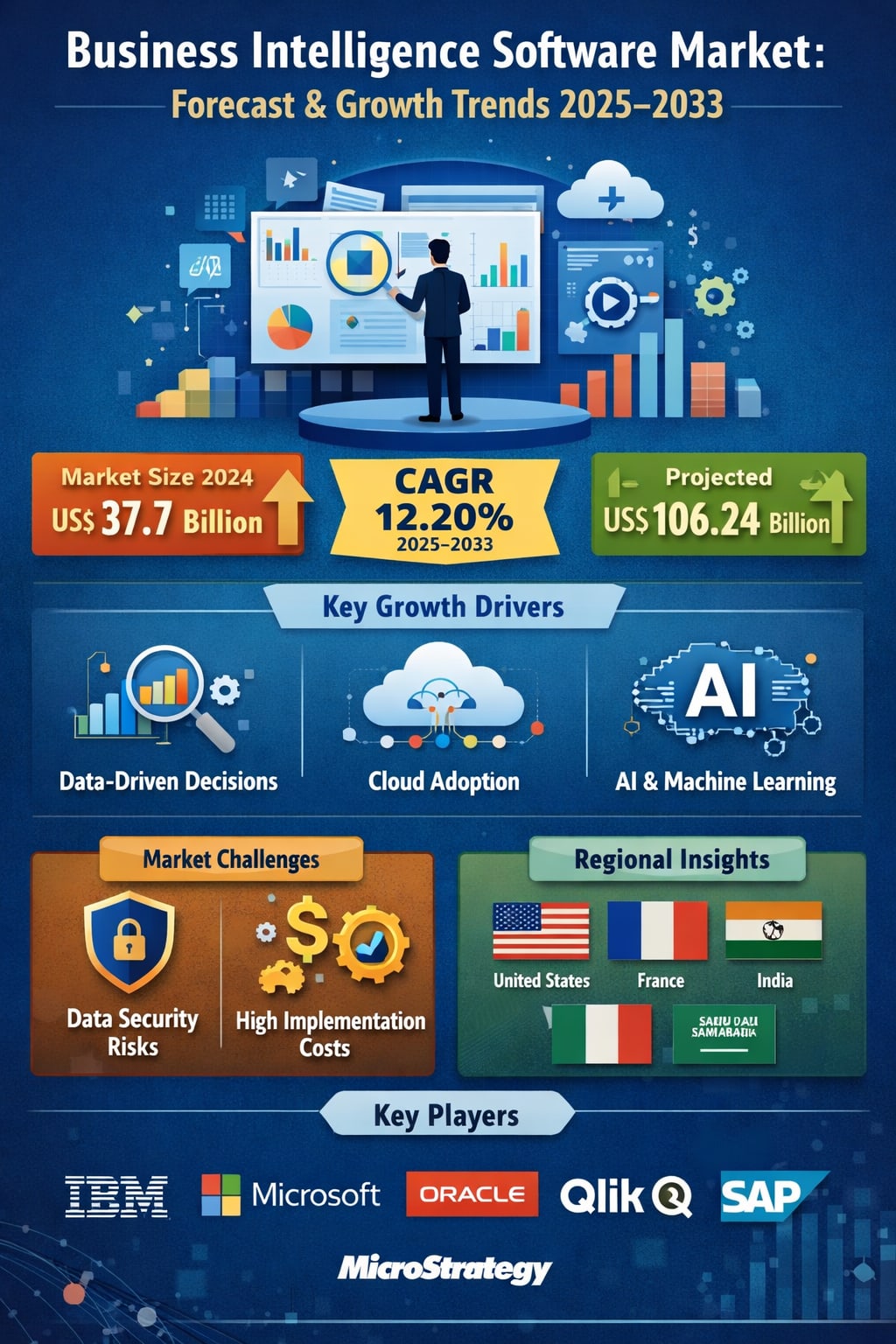
According to Renub Research, the Business Intelligence Software Market was valued at US$ 37.7 billion in 2024 and is projected to reach US$ 106.24 billion by 2033, registering a compound annual growth rate (CAGR) of 12.20% during the forecast period from 2025 to 2033. This impressive expansion is being driven by the growing demand for data-driven decision-making, real-time analytics, and cloud-based applications across industries seeking to improve operational efficiency, customer understanding, and competitive positioning.
From boardrooms to shop floors, BI tools are increasingly becoming indispensable. As companies navigate volatile markets, shifting consumer behaviors, and rapid technological change, the ability to convert data into actionable intelligence is no longer optional—it is essential.
Business Intelligence Software Market Outlook
Business Intelligence (BI) software refers to a suite of tools and applications designed to collect, process, analyze, and visualize large volumes of data to support strategic and tactical decision-making. These platforms transform unstructured and structured data from multiple sources—databases, spreadsheets, enterprise systems, and cloud services—into clear, interactive dashboards, reports, and visualizations.
BI software is widely used across industries to identify business trends, track key performance indicators (KPIs), and forecast future outcomes. Executives, analysts, and managers rely on these tools to make faster and more confident decisions. For example, a retail company can use BI software to analyze sales performance by region or product category, while a healthcare organization can examine patient data to improve service delivery and operational efficiency.
Modern BI platforms also incorporate advanced features such as data mining, real-time analytics, and predictive modeling. Popular solutions in the market include Microsoft Power BI, Tableau, Qlik, Looker, SAP BI, and MicroStrategy, among others. Together, these tools enable organizations to streamline operations, enhance customer experiences, reduce costs, and gain a sustainable competitive edge by turning complex data into strategic insight.
Key Growth Drivers in the Business Intelligence Software Market
1. Rising Demand for Data-Driven Decision Making
One of the most powerful forces behind the growth of the BI software market is the explosive increase in data generation across industries. Every digital interaction—whether it is an online purchase, a customer service call, or a machine sensor reading—creates valuable data. However, data on its own has little value unless it can be analyzed and interpreted effectively.
Business Intelligence software allows organizations to analyze massive datasets, uncover hidden patterns, and make informed decisions quickly. Companies that successfully adopt BI tools can identify market trends earlier, optimize internal processes, and improve customer engagement, ultimately boosting profitability and efficiency.
In June 2024, MicroStrategy launched an update enabling businesses to layer AI-powered data insights on top of any web and mobile application. This development highlights how BI platforms are evolving beyond traditional reporting tools into intelligent decision-support systems, further accelerating their adoption across industries.
2. Faster Digital Transformation and Cloud Adoption
The global shift toward digital operations has significantly accelerated the adoption of cloud-based BI solutions. Cloud BI offers organizations scalability, flexibility, and cost efficiency by eliminating the need for heavy on-premises infrastructure. Businesses can access real-time analytics, collaborate across locations, and scale their data capabilities as needed—all with lower upfront investment.
This is particularly beneficial for small and medium-sized enterprises (SMEs), which can now leverage advanced analytics without bearing the high costs traditionally associated with enterprise-grade BI systems. Cloud deployment also simplifies integration with existing systems and enables faster updates, helping organizations respond quickly to changing market conditions.
In November 2022, GoodData announced the general availability of GoodData Cloud on Amazon Web Services (AWS). The platform focuses on API-first architecture, ease of adoption, and interoperability with modern data stacks, allowing organizations worldwide to deploy scalable analytics solutions while meeting local compliance requirements. Such developments continue to strengthen the appeal of cloud-based BI platforms.
3. Integration of Artificial Intelligence and Machine Learning
The integration of Artificial Intelligence (AI) and Machine Learning (ML) into BI software has fundamentally changed how organizations analyze data. Traditional BI focused mainly on descriptive analytics—what happened and why. Today’s AI-powered BI platforms go further by offering predictive and prescriptive analytics, helping organizations anticipate future trends and recommend actions.
AI-driven BI tools can automatically detect anomalies, forecast outcomes, and generate insights without requiring deep technical expertise from users. This not only improves decision quality but also democratizes data access across organizations, enabling non-technical users to benefit from advanced analytics.
As AI technologies continue to mature, their deeper integration into BI platforms is expected to unlock new levels of operational efficiency, strategic foresight, and business agility, further fueling market growth over the coming decade.
Challenges in the Business Intelligence Software Market
1. Data Security and Privacy Concerns
As organizations collect and analyze increasing volumes of sensitive data, concerns around data security and privacy have become more critical than ever. Regulations such as GDPR in Europe and CCPA in the United States impose strict requirements on how data is stored, processed, and shared.
The risk of data breaches, unauthorized access, and compliance failures can slow down BI adoption, particularly in sectors such as healthcare, finance, and government. Organizations must invest in robust security frameworks, encryption, access controls, and data governance policies to ensure data integrity and regulatory compliance. Balancing data accessibility with security remains a key challenge for the industry.
2. High Implementation and Maintenance Costs
Although BI software delivers significant long-term value, the initial costs of implementation can be substantial. Expenses related to software licensing, infrastructure, system integration, and employee training can be a barrier, especially for smaller organizations with limited budgets.
Integrating BI tools with legacy systems often requires specialized skills and additional investment. While cloud-based solutions have reduced some of these costs, the total cost of ownership remains an important consideration for many businesses evaluating BI adoption.
Market Segmentation Insights
Cloud Business Intelligence Software Market
Cloud BI has become one of the most dynamic segments of the BI market. By offering on-demand access to analytics tools over the internet, cloud BI eliminates the need for extensive on-premises infrastructure. Organizations benefit from real-time data processing, easy scalability, and enhanced collaboration across geographies.
The flexibility of cloud BI supports rapid innovation and helps businesses stay responsive to market changes. As more organizations embrace hybrid and remote work models, cloud-based analytics platforms are expected to play an even more central role in enterprise decision-making.
Mobile Business Intelligence Software Market
The widespread adoption of smartphones and tablets has driven growing demand for mobile BI solutions. These tools allow users to access dashboards, reports, and key metrics anytime and anywhere, enabling faster and more informed decisions.
Mobile BI is particularly valuable for executives, sales teams, and field workers who need real-time insights while on the move. However, ensuring data security on mobile devices and managing integration with diverse data sources remain important challenges that vendors and organizations must address.
Large Enterprise Business Intelligence Software Market
Large enterprises operate across multiple regions and generate massive volumes of data from complex operations. They require robust, scalable BI solutions capable of handling advanced analytics, multiple data sources, and high user volumes.
Features such as predictive analytics, customized dashboards, and enterprise-wide data governance are critical in this segment. Investment in sophisticated BI platforms enables large organizations to drive strategic initiatives, optimize processes, and maintain competitiveness in global markets.
IT & Telecom Business Intelligence Software Market
The IT and telecom sectors generate enormous amounts of data daily, ranging from network performance metrics to customer usage patterns. BI software helps these industries analyze this data to improve service quality, enhance customer satisfaction, and optimize operations.
By using BI tools, companies can identify usage trends, predict system failures, and design targeted marketing campaigns. In fast-paced industries where real-time insights are crucial, BI has become an indispensable operational and strategic tool.
Regional Market Perspectives
United States Business Intelligence Software Market
The United States remains one of the most mature and competitive BI markets globally. High adoption across industries such as finance, healthcare, retail, and manufacturing is driven by strong demand for data-driven decision-making and regulatory compliance.
In September 2024, Zoho Corporation released a major update to Zoho Analytics, introducing over 100 improvements, including enhanced AI and ML capabilities for diagnostic insights, predictive analysis, and automated report generation. The update also added a custom ML model-building studio, OpenAI integration, and third-party BI extensions, reinforcing the U.S. market’s focus on innovation and advanced analytics.
France Business Intelligence Software Market
France’s BI market is growing steadily, supported by digital transformation initiatives and rising cloud adoption. French organizations are investing in BI solutions to improve operational efficiency and gain competitive advantages, while also ensuring compliance with strict data protection regulations such as GDPR.
The emphasis on secure, compliant, and high-performance analytics platforms continues to shape the development and adoption of BI tools in the French market.
India Business Intelligence Software Market
India represents one of the fastest-growing BI markets, fueled by rapid digitalization and the expansion of SMEs seeking affordable analytics solutions. Cloud-based and mobile BI platforms are particularly popular, offering scalable and cost-effective options for businesses of all sizes.
In July 2023, HCLTech announced HCLTech Advantage Analytics, an AI-driven BI solution built on Snowflake’s Data Cloud, designed to enhance customer experiences and business outcomes. Government initiatives, improved digital infrastructure, and rising data literacy are expected to sustain strong market growth in the coming years.
Saudi Arabia Business Intelligence Software Market
Saudi Arabia’s BI market is expanding in line with the country’s Vision 2030 strategy, which emphasizes economic diversification and digital transformation. Industries such as oil and gas, banking, finance, and healthcare are increasingly adopting BI solutions to improve efficiency and decision-making.
In April 2024, Informatica launched its AI-driven Intelligent Data Management Cloud (IDMC) in Saudi Arabia with a new Point of Delivery in Riyadh, strengthening its regional presence and supporting the kingdom’s push toward cloud-first, data-driven operations.
Competitive Landscape and Key Players
The global Business Intelligence software market is highly competitive, with leading players focusing on innovation, AI integration, cloud expansion, and strategic partnerships. Major companies covered in the market include:
IBM Corporation
Microsoft
Oracle
Sisense Ltd
QlikTech International AB
SAP SE
Board International
MicroStrategy Incorporated
Each of these companies is analyzed across four key viewpoints: Overview, Key Persons, Recent Developments & Strategies, and Revenue Analysis, reflecting their strategic positioning and market influence.
Final Thoughts: The Future of Business Intelligence
The Business Intelligence Software Market is entering a transformative phase. With the market projected to grow from US$ 37.7 billion in 2024 to US$ 106.24 billion by 2033, the role of BI in shaping business strategy is set to become even more critical. The convergence of cloud computing, artificial intelligence, and real-time analytics is redefining how organizations understand and use data.
While challenges such as data security and implementation costs remain, the long-term benefits of smarter, faster, and more informed decision-making far outweigh these hurdles. As businesses continue to navigate uncertainty and competition, BI software will remain a cornerstone of digital transformation and sustainable growth.
In the decade ahead, organizations that successfully embrace advanced BI platforms will not only gain clearer insights into their operations and markets—but also secure a decisive edge in an increasingly data-driven world.
About the Creator
Mexico Wearable Medical Devices Industry: Key Drivers and Growth Rate | CAGR 18.20%
Overview Report- Wearable medical devices are electronic health-monitoring tools worn on the body to track vital parameters such as heart rate, blood glucose, oxygen levels, sleep patterns, and physical activity. In Mexico, the growing burden of chronic diseases such as diabetes, cardiovascular disorders, and obesity is driving demand for continuous monitoring solutions.
By Ashutosh Srivastava2 days ago in Trader




Comments
There are no comments for this story
Be the first to respond and start the conversation.