
India Air Conditioner Market Trends & Growth Outlook (2025–2033)
Rising Heat, Rising Demand: How India’s Cooling Industry Is Entering a Decade of Transformation

Introduction
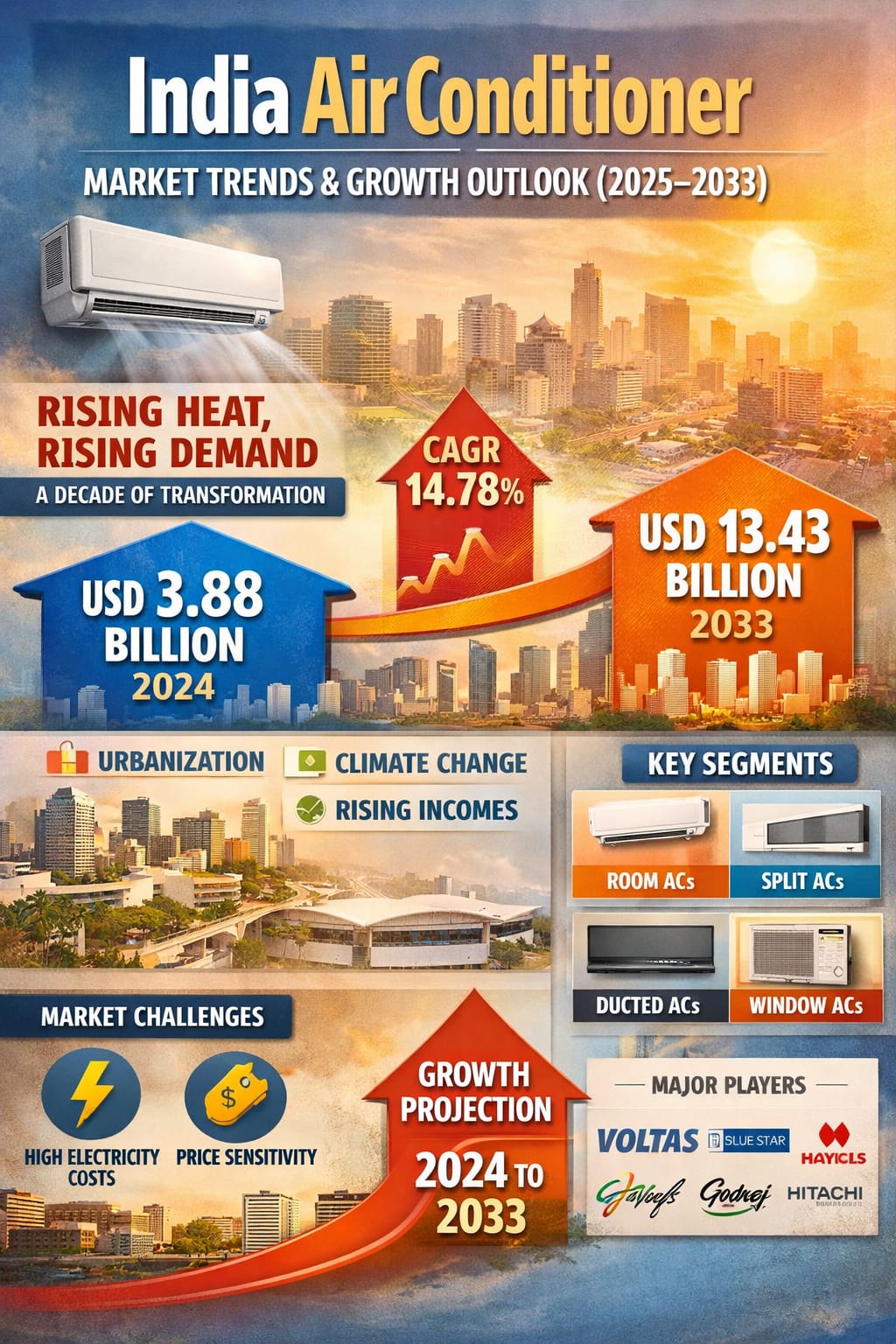
India’s air conditioner market is no longer a niche consumer appliance segment—it is fast becoming one of the most dynamic pillars of the country’s consumer durables industry. According to Renub Research, the India Air Conditioner Market was valued at USD 3.88 billion in 2024 and is projected to grow strongly to USD 13.43 billion by 2033, registering an impressive CAGR of 14.78% during 2025–2033. This sharp rise reflects a deeper structural shift in how Indian households and businesses view cooling—not as a luxury, but as a necessity.
Rising average temperatures, longer and harsher summers, rapid urbanization, expanding middle-class incomes, and increasing awareness of energy-efficient appliances are all combining to reshape demand across residential, commercial, and institutional segments. From metro cities to Tier-II and Tier-III towns, air conditioners are steadily becoming a standard part of modern Indian living.
The market today spans a wide range of product categories and technologies, including room, ducted, ductless, and centralized systems; split and window ACs; and multiple capacity segments such as 1 ton, 1.5 ton, and 2 ton units. On the demand side, applications range from homes and retail stores to hospitality, healthcare, transportation infrastructure, and large commercial buildings. Distribution channels have also diversified, with online platforms now playing a crucial role alongside supermarkets and specialty stores.
India Air Conditioner Market Overview
An air conditioner is an electronic appliance designed to regulate indoor temperature, humidity, and air quality by removing heat and moisture from the air. Using a refrigeration cycle that involves components such as compressors, condensers, and evaporators, AC systems deliver consistent and efficient cooling across different environments.
In India, air conditioners are widely used in homes, offices, shopping complexes, hospitals, hotels, and transportation hubs to provide relief from extreme heat and humidity. The country’s long and increasingly intense summer seasons have made cooling solutions more essential than ever, especially in urban and semi-urban regions.
Over the past decade, the popularity of air conditioners has surged due to rising disposable incomes, improved electrification, and better access to financing options. Consumers are also becoming more conscious of energy efficiency, leading to strong demand for inverter ACs, smart ACs, and models using eco-friendly refrigerants. Urban infrastructure growth, the expansion of commercial real estate, and the rise of organized retail and hospitality sectors have further accelerated adoption.
With climate change intensifying heatwaves and pushing temperatures to new extremes, the Indian air conditioner market is entering a phase of long-term structural growth rather than short-term cyclical expansion.
Key Growth Drivers of the India Air Conditioner Market
Increasing Disposable Incomes and Lifestyle Changes
India’s rapid urbanization and the steady expansion of its middle class are among the most powerful drivers of air conditioner demand. As more people move to cities in search of better employment opportunities and living standards, their exposure to modern lifestyles and appliances increases. Dual-income households and higher disposable incomes have made comfort-oriented products like air conditioners more accessible.
In addition, changing consumer aspirations—especially among younger buyers—are pushing ACs from being perceived as premium items to becoming mass-market essentials. Digital media, influencer marketing, and easy access to product information have further accelerated this shift, particularly in Tier-I and Tier-II cities. Over time, this lifestyle transformation is expected to significantly deepen AC penetration across both residential and commercial segments.
Climate Change and Rising Need for Cooling
India has witnessed some of its most extreme summers in recent years, with record-breaking heatwaves across states such as Rajasthan, Uttar Pradesh, and Maharashtra. Prolonged summer seasons and rising humidity levels are making cooling solutions indispensable for everyday comfort and productivity.
In 2024, the country experienced one of its hottest summers in over a decade, with hundreds of heatwave days reported and temperatures crossing 50°C in parts of Rajasthan. The India Meteorological Department also warned of an early and severe summer in 2025. These climatic realities are pushing households, schools, offices, hospitals, and commercial spaces to invest more aggressively in reliable air conditioning systems.
As climate volatility becomes a long-term trend rather than a temporary anomaly, demand for air conditioners is likely to remain structurally strong across the country.
Government Push for Energy Efficiency and Inverter Technology
Government initiatives to promote energy-efficient appliances have played a crucial role in shaping consumer behavior. The Bureau of Energy Efficiency (BEE) star rating system has increased awareness about power consumption and long-term operating costs, encouraging buyers to choose more efficient models.
This policy environment has also pushed manufacturers to innovate, especially in inverter technology. Inverter ACs, which adjust compressor speed based on cooling demand, consume less electricity and offer more consistent temperature control. As electricity costs remain a concern for many households, the appeal of energy-efficient and environmentally friendly models continues to grow.
Together, regulatory support and rising environmental awareness are accelerating the shift toward smarter, greener cooling solutions in India.
Challenges Facing the Market
High Electricity Costs and Infrastructure Constraints
Despite strong demand growth, high electricity prices remain a significant barrier to wider AC adoption, especially in Tier-III cities and rural areas. Air conditioners are still perceived as power-intensive appliances, and concerns about monthly electricity bills often delay or discourage purchases.
In many regions, inconsistent power supply, voltage fluctuations, and weaker grid infrastructure also limit regular usage. Although inverter technology has helped reduce consumption, operating costs remain a key consideration for price-sensitive consumers. These factors continue to cap penetration levels in less developed markets.
Price Sensitivity and Intense Competition
The Indian air conditioner market is highly price-sensitive, with consumers placing strong emphasis on upfront cost. While premium models offer advanced features and better efficiency, their higher prices restrict adoption among a large segment of buyers.
At the same time, competition among domestic and international brands is fierce. Aggressive pricing, frequent discounts, and promotional offers are common, putting pressure on profit margins. The presence of unorganized and low-cost alternatives further intensifies competition, making it challenging for companies to balance affordability, innovation, and profitability.
Segment Insights
India Room Air Conditioner Market
The room air conditioner segment is witnessing strong growth, driven by urban housing expansion and rising middle-class demand. These units are popular for bedrooms and living rooms due to their ease of installation and availability in energy-efficient variants. Brands are increasingly introducing smart and inverter-based models to attract first-time buyers and tech-savvy consumers. In early 2025, Haier Appliances India launched its colorful Kinouchi range, highlighting how design and performance are becoming equally important in this segment.
India Ducted Air Conditioner Market
Ducted air conditioners are gaining traction in commercial spaces such as hotels, malls, and office buildings. Although initial installation costs are high, these systems offer efficient and uniform cooling for large areas. With the growth of smart buildings and commercial infrastructure, this segment is expected to see steady long-term expansion.
India Split Air Conditioner Market
Split ACs dominate the Indian market due to their high cooling efficiency, low noise levels, and modern aesthetics. The widespread adoption of inverter technology has further strengthened their appeal, even in smaller cities. Features such as app-based controls, voice commands, and energy monitoring are increasingly becoming standard offerings.
India Window Air Conditioner Market
Window ACs continue to hold a significant share in cost-sensitive and older housing segments. Their simpler installation and lower upfront cost make them attractive to budget-conscious buyers. Manufacturers are improving their energy efficiency and adding basic smart features to keep this segment relevant.
India 1.5 Ton and 1 Ton Air Conditioner Markets
The 1.5-ton segment remains the most popular, ideal for average-sized urban rooms and offering a balance between performance and power consumption. The 1-ton segment, on the other hand, is growing among small households and first-time buyers, especially in Tier-III markets, due to its affordability and lower energy requirements.
Application and Channel Trends
The residential segment is the fastest-growing application area, driven by lifestyle changes and rising temperatures. Meanwhile, hospitality, healthcare, retail, and infrastructure projects continue to generate strong commercial demand.
On the distribution side, online channels are expanding rapidly, supported by platforms like Amazon and Flipkart. Consumers increasingly prefer to compare features, read reviews, and take advantage of seasonal discounts online. At the same time, supermarkets and specialty stores remain important for hands-on product experience and after-sales service support.
Regional Outlook
North India sees peak seasonal demand due to extremely hot summers, particularly in states like Delhi, Punjab, and Uttar Pradesh. South India, with its hot and humid climate throughout the year, enjoys more consistent demand, driven by IT hubs, hospitality growth, and urban expansion. Western and Eastern regions are also witnessing steady adoption as urbanization and infrastructure development continue.
Competitive Landscape
The Indian air conditioner market is highly competitive, with major players such as Voltas Limited, Blue Star Limited, Havells India Limited, Whirlpool of India Limited, Godrej & Boyce, MIRC Electronics, and Johnson Controls-Hitachi. These companies compete on technology, energy efficiency, pricing, distribution reach, and after-sales service, while continuously expanding their product portfolios to meet evolving consumer needs.
Final Thoughts
The India Air Conditioner Market is entering a defining decade. With the market expected to grow from USD 3.88 billion in 2024 to USD 13.43 billion by 2033 at a CAGR of 14.78%, cooling solutions are becoming a core part of India’s modern lifestyle and infrastructure.
Rising temperatures, urban growth, improving incomes, and policy-driven energy efficiency are reshaping both demand and supply. While challenges such as electricity costs and price sensitivity remain, ongoing innovation in inverter technology, smart features, and eco-friendly designs is steadily lowering barriers to adoption.
About the Creator
Australia’s Supply Chain Management Software Market 2026: Digital Optimization, Business Agility & The Future of Commerce
Australia Supply Chain Management Software Market Overview The Australia supply chain management (SCM) software market is entering a strong growth phase as enterprises modernize operations and prioritize digital resilience. According to IMARC Group, The Australia supply chain management software market size reached USD 646.8 Million in 2025. Looking forward, IMARC Group expects the market to reach USD 1,550.3 Million by 2034, exhibiting a growth rate (CAGR) of 9.89% during 2026-2034. The steady rise reflects increasing demand for automation, predictive analytics, and end-to-end visibility across logistics and procurement networks.
By Amyra Singha day ago in Trader



Comments
There are no comments for this story
Be the first to respond and start the conversation.