
India Solar Energy Market Set to Surge: Capacity to Reach 284.14 GW by 2033
Strong government policies, falling technology costs, and rising power demand are powering India’s solar revolution through 2033

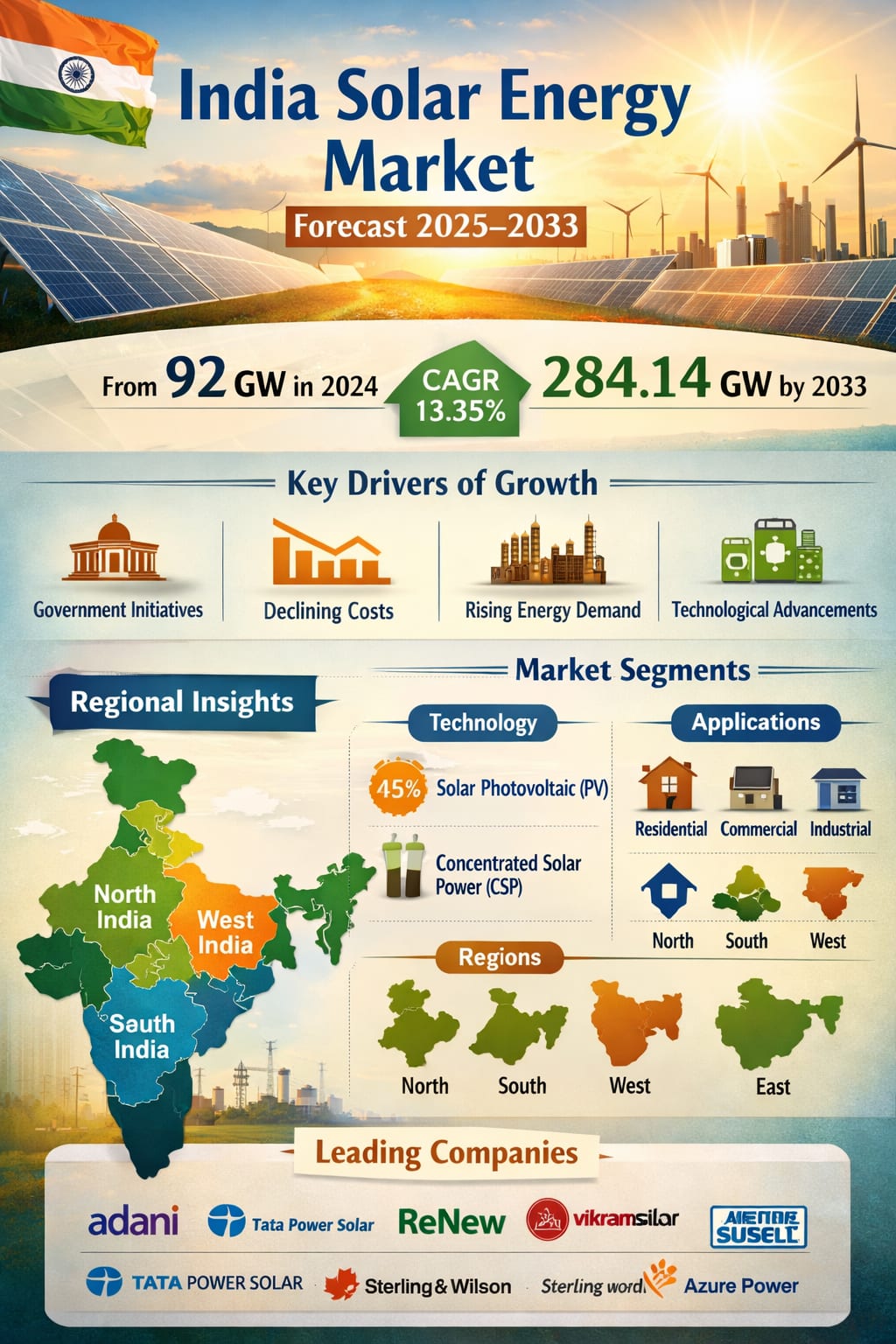
India Solar Energy Market Size and Forecast 2025–2033
India Solar Energy Market is expected to reach 284.14 Giga Watt by 2033 from 92 Giga Watt in 2024, with a CAGR of 13.35% from 2025 to 2033. Government initiatives, declining solar technology costs, rising energy demand, growing environmental consciousness, supportive laws, technological breakthroughs, and the move towards clean and renewable energy sources are all factors driving the growth of the Indian solar energy industry.
The report India Solar Energy Market & Forecast covers by Technology (Solar Photovoltaic, Concentrated Solar Power), Application (Residential, Commercial, Industrial), Region (East India, West India, North India, South India) and Company Analysis, 2025–2033.
India Solar Energy Market: Industry Overview
Driven by ambitious climate commitments and a growing focus on sustainable development, India has emerged as one of the world’s fastest-growing solar energy markets. Thanks to its geographical advantage, the country receives abundant sunlight for most of the year, making it ideal for large-scale solar deployment. This natural advantage, combined with proactive government policies, has turned solar energy into a cornerstone of India’s clean energy transition.
Initiatives such as the National Solar Mission, Production Linked Incentive (PLI) schemes for domestic solar manufacturing, and supportive regulations like net metering and subsidies have significantly accelerated adoption. At the same time, the steadily declining cost of solar panels, inverters, and balance-of-system components has made solar power increasingly attractive across residential, commercial, and industrial segments. Rising tariffs for conventional electricity have further strengthened the business case for switching to solar.
States such as Rajasthan, Gujarat, Tamil Nadu, and Karnataka have taken the lead in solar deployment, supported by both rooftop installations and utility-scale solar parks. The integration of advanced technologies, including energy storage systems, smart inverters, and digital monitoring tools, is improving efficiency, reliability, and grid stability. As energy demand continues to rise and environmental concerns become more urgent, solar energy is expected to play a decisive role in shaping India’s energy-secure and low-carbon future.
According to IRENA, India’s installed solar PV capacity increased from 49.3 GW in 2021 to approximately 62.8 GW in 2022, representing around 31% year-on-year growth. This expansion was driven mainly by large utility-scale projects, reflecting the government’s strong focus on capacity additions. The Indian government continues to pursue ambitious targets for solar photovoltaic installations, reinforcing the sector’s long-term growth outlook.
In August 2022, NTPC commissioned a photovoltaic solar facility near Hazira in Surat. With the 56 MW Kawas solar PV project, NTPC expanded its solar footprint to 68,454 MW of commercial and group-installed capacity. Projects like these are expected to further increase the share of solar PV in India’s overall solar energy market during the forecast period.
Growth Drivers for the India Solar Energy Market
Government Initiatives and Policy Support
Strong and consistent policy backing has been one of the most important catalysts for the growth of India’s solar energy sector. The National Solar Mission laid the foundation for large-scale adoption by setting clear targets and providing a stable policy framework. Meanwhile, the Production Linked Incentive (PLI) scheme aims to boost domestic manufacturing of solar cells and modules, reducing dependence on imports and strengthening supply chain resilience.
In addition, many state governments offer tax incentives, capital subsidies, and net metering policies, particularly for rooftop and decentralized solar systems. Policies supporting solar parks, open access solar projects, and renewable purchase obligations (RPOs) have further improved market visibility and investor confidence. Together, these measures help reduce regulatory uncertainty, attract long-term investments, and create a favorable environment for sustained growth across the solar value chain.
Rising Electricity Demand
India’s rapid urbanization, industrial expansion, and population growth are driving a sharp increase in electricity consumption across all sectors. As the country works toward its long-term economic goals, energy demand is expected to rise substantially in the coming years. Relying solely on conventional power sources to meet this demand would not only strain resources but also worsen environmental challenges.
Solar energy offers a clean, scalable, and increasingly cost-effective solution to bridge this growing energy gap. With falling technology costs and faster project execution timelines, solar power is now one of the most competitive sources of new electricity generation in India. This makes it an attractive option for commercial and industrial users seeking cost savings, as well as for households looking to reduce their power bills and carbon footprint.
Grid Modernization and Storage Solutions
The modernization of India’s power grid and the growing adoption of energy storage technologies are playing a crucial role in enhancing the reliability and flexibility of solar energy. Since solar power generation is inherently intermittent, advanced grid infrastructure is needed to manage fluctuations in supply and demand.
Investments in smart grids, digital substations, automated load management, and real-time monitoring systems are helping improve grid stability and support higher levels of renewable energy integration. At the same time, the rapid development of battery energy storage systems (BESS) allows excess solar power to be stored and used during periods of low sunlight or peak demand. These advancements are transforming solar energy from a daytime-only solution into a more dependable, round-the-clock power source.
Challenges in the India Solar Energy Market
Land Acquisition Issues
One of the most persistent challenges facing India’s solar sector is the acquisition of land for large-scale projects. Utility-scale solar installations require vast areas, often in rural or semi-arid regions where land ownership can be fragmented or legally complex. High land costs near urban and industrial hubs further complicate project economics.
In many cases, developers also face delays due to lengthy approval processes, local opposition, and regulatory hurdles. Disputes over compensation, environmental concerns, and community displacement can slow down project execution and increase overall costs. Addressing these issues will require clearer land policies, streamlined approval mechanisms, and stronger stakeholder engagement at the local level.
Financing and Investment Barriers
Although the solar sector has attracted significant investment in recent years, access to affordable and long-term financing remains a challenge, especially for small and mid-sized developers. Solar projects typically involve high upfront capital expenditure, and securing loans at competitive interest rates is not always easy.
Concerns around payment delays by distribution companies (DISCOMs), tariff uncertainty, and regulatory risks also make some investors cautious. In the rooftop and decentralized solar segments, the creditworthiness of off-takers can further complicate financing. Overcoming these barriers will require innovative financial instruments, stronger risk mitigation mechanisms, and greater involvement from green finance institutions and government-backed guarantee programs.
Regional Outlook
North India Solar Energy Market
North India is witnessing rapid growth in solar installations, supported by strong solar radiation levels, supportive policies, and the development of large-scale projects. States such as Rajasthan, Punjab, and Uttar Pradesh are leading contributors to this expansion. Rajasthan, in particular, stands out due to massive capacity additions and landmark projects like the Bhadla Solar Park, one of the largest solar parks in the world.
Punjab and Uttar Pradesh are also expanding their solar footprints through a mix of rooftop and utility-scale projects. Government initiatives such as the PM Surya Ghar Muft Bijli Yojana have further accelerated residential adoption. With abundant land availability, strong solar insolation, and favorable policy frameworks, North India is set to remain a key driver of the country’s solar growth story.
South India Solar Energy Market
South India continues to play a pivotal role in India’s renewable energy transition, supported by progressive policies, significant investments, and favorable climatic conditions. States such as Tamil Nadu, Karnataka, and Andhra Pradesh are at the forefront of solar capacity additions and power generation.
Tamil Nadu recently achieved a record 6,561 MW of solar power generation, surpassing its previous peak, and now has a total installed solar capacity of 9,414 MW. Karnataka accounts for a significant share of open access solar installations, reflecting strong participation from the commercial and industrial segments. Andhra Pradesh is also attracting major investments, including large-scale green energy projects that combine solar, wind, and hybrid solutions. These developments underline South India’s strategic importance in India’s clean energy roadmap.
West India Solar Energy Market
West India is a cornerstone of India’s solar landscape, with Rajasthan, Gujarat, and Maharashtra leading in capacity additions. In 2024, these three states accounted for more than 70% of India’s utility-scale solar installations, highlighting their dominant position in the market.
Rajasthan’s Bhadla Solar Park remains one of the largest in the world, while Gujarat’s Khavda Renewable Energy Park is expected to become the world’s biggest renewable energy project by area. Maharashtra is also expanding its solar capacity through large power purchase agreements and partnerships with leading renewable energy developers. Together, these states are setting the pace for large-scale solar deployment in India.
India Solar Energy Market Segmentation
By Technology
Solar Photovoltaic (PV):
Solar PV dominates the Indian solar market due to its modular nature, declining costs, and wide applicability across rooftop and utility-scale projects. Continuous improvements in module efficiency and manufacturing scale are expected to further strengthen this segment.
Concentrated Solar Power (CSP):
Although smaller in market share compared to PV, CSP offers advantages such as integrated thermal storage and potential for stable power output. However, higher costs and land requirements have limited its adoption so far.
By Application
Residential:
Driven by rising electricity tariffs, government subsidies, and net metering benefits, rooftop solar adoption among households is gaining momentum.
Commercial:
Commercial establishments are increasingly turning to solar to reduce operating costs, meet sustainability goals, and improve energy security.
Industrial:
Energy-intensive industries are adopting large-scale and open access solar solutions to hedge against power price volatility and reduce carbon emissions.
By Region
East India
West India
North India
South India
Each region contributes uniquely based on resource availability, policy support, and industrial demand patterns.
Competitive Landscape and Company Analysis
The Indian solar energy market features a mix of established players and fast-growing companies. Key players covered in the market analysis include:
Adani Solar
Emmvee Solar
Mahindra Susten Pvt. Ltd.
Sterling and Wilson Pvt. Ltd.
Tata Power Solar Systems Ltd.
Vikram Solar Limited
ReNew Power Pvt. Ltd.
NTPC Ltd.
Azure Power Global Ltd.
Each company is evaluated across four key dimensions: Overview, Key Persons, Business Strategy, and Financial Insight. These players are actively expanding their project portfolios, investing in manufacturing capacity, and exploring new technologies such as energy storage and hybrid renewable solutions to strengthen their market positions.
Final Thoughts
India’s solar energy market is entering a decisive growth phase. With capacity expected to rise from 92 GW in 2024 to 284.14 GW by 2033, the sector is set to become a central pillar of the country’s energy system. Strong policy support, falling technology costs, rising power demand, and rapid improvements in grid and storage infrastructure are creating a powerful momentum for long-term expansion.
While challenges such as land acquisition and financing constraints remain, ongoing reforms and innovative business models are steadily addressing these issues. As India continues its transition toward a cleaner and more resilient energy future, solar power will not only help meet growing electricity needs but also play a crucial role in reducing carbon emissions, enhancing energy security, and supporting sustainable economic growth.
About the Creator
Australia Superannuation Market 2026: Set to Nearly Double to USD 150 Billion by 2033 on Strong Policy & Demographic Tailwinds
Australia Superannuation Market Overview The Australia superannuation market is on track for significant expansion as the nation’s retirement savings system continues to attract capital, adapt to demographic shifts, and benefit from supportive policy frameworks. According to IMARC Group, the market reached USD 80.0 billion in 2024 and is projected to grow to USD 150.0 billion by 2033, exhibiting a compound annual growth rate (CAGR) of 7.22 % between 2025 and 2033.
By Amyra Singh4 days ago in Trader




Comments
There are no comments for this story
Be the first to respond and start the conversation.