
Global Online Travel Market Size and Forecast 2025–2033
How Digital Platforms, Mobile Booking, and Changing Travel Habits Are Reshaping the Global Travel Industry

Introduction
The global travel industry has undergone a dramatic transformation over the past decade, driven largely by the rapid rise of digital platforms and mobile technologies. What was once a process dominated by physical travel agencies, phone calls, and paper tickets has now become a seamless, app-driven experience where travelers can plan, compare, and book entire journeys within minutes. At the center of this shift is the online travel market, a sector that continues to expand as consumer behavior, technology, and global mobility evolve together.
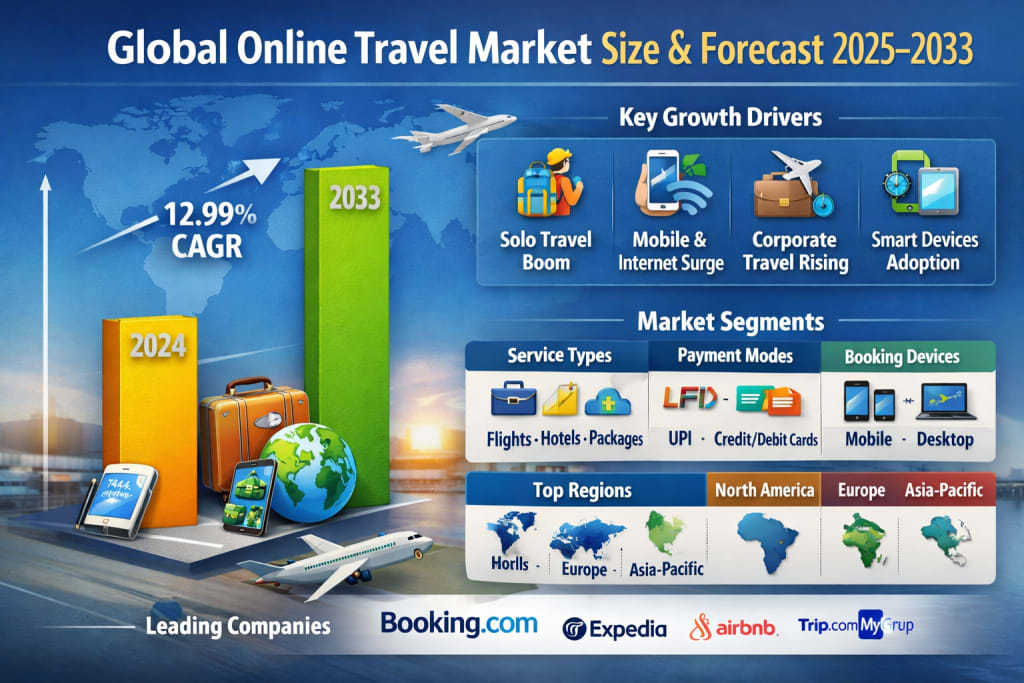
According to Renub Research, the Online Travel Market is expected to reach US$ 2,235.43 billion by 2033, up from US$ 744.64 billion in 2024, growing at a compound annual growth rate (CAGR) of 12.99% from 2025 to 2033. This impressive growth trajectory reflects not only the recovery of global tourism after recent disruptions, but also deeper structural changes in how people discover, plan, and purchase travel services.
Some of the key factors driving this expansion include the growing popularity of solo travel, easy access to high-speed internet, the rising number of corporate travelers, and the increasing penetration of smartphones and smart devices worldwide. Together, these trends are pushing travel companies to innovate, personalize, and digitize their offerings at an unprecedented pace.
Online Travel Market Overview
Online travel agencies (OTAs) and digital booking platforms aim to make trip planning simpler, faster, and more transparent for consumers. From booking flights and hotels to arranging vacation packages and local transportation, these platforms offer a one-stop solution for travelers who value convenience and choice. The ability to compare prices, read reviews, and access exclusive online deals has significantly increased consumer confidence in digital travel bookings.
Mobile websites and applications have become especially important in this ecosystem. Young professionals and frequent travelers, in particular, rely heavily on smartphones to research destinations, monitor prices, and confirm reservations on the go. This mobile-first behavior has encouraged travel companies to invest heavily in user-friendly apps, seamless payment systems, and personalized recommendations.
Social media has also emerged as a powerful force shaping travel decisions. Travelers now routinely explore destinations through Instagram, YouTube, blogs, and review platforms before making a purchase. They also share their own travel experiences online, influencing friends, family, and followers in the process. Online travel service providers actively use these platforms to promote destinations, advertise exclusive offers, and build brand loyalty, further accelerating market growth over the forecast period.
Growth Drivers for the Online Travel Market
Growing Interest in Studying at Foreign Universities
One of the notable trends supporting online travel market revenue is the increasing inclination toward studying abroad. Students are increasingly seeking international education opportunities to gain access to higher-quality institutions, improve employability, and experience cultural enrichment. This global mobility of students creates sustained demand for flights, accommodation, and travel-related services, much of which is now booked online.
China and India, the world’s two most populous countries, account for some of the largest numbers of students studying overseas. In 2021, more than 1 million Chinese students were enrolled abroad, according to UNESCO data. India followed with approximately 508,000 students studying overseas. The United States remained the most popular destination, hosting over 833,000 international students, followed by the UK with nearly 601,000, Australia with around 378,000, Germany with more than 376,000, and Canada with about 318,000.
Online travel platforms are increasingly catering to this segment by offering customized student travel packages, flexible booking options, and budget-friendly accommodation solutions. The growing internationalization of education, combined with digital booking convenience, continues to fuel cross-border travel demand within the online travel market.
Growth in Mobile and Internet Adoption
The rapid expansion of internet access and smartphone usage has been one of the most powerful enablers of the online travel industry. As more people gain access to affordable mobile devices and reliable connectivity, travel planning and booking have become easier and more accessible than ever before.
As of April 2024, around 5.44 billion people—approximately 67.1% of the global population—were using the internet. Social media usage stood at 5.07 billion people, representing 62.6% of the world’s population. Moreover, about 60% of all online time spent by consumers worldwide in the third quarter of 2023 occurred on mobile devices.
These figures highlight why mobile-first strategies have become essential for travel companies. Travelers can now research destinations, compare prices, read reviews, and make bookings anytime and anywhere. This constant connectivity not only streamlines the travel planning process but also encourages more spontaneous and frequent travel purchases.
Competitive Rates and Attractive Offers
Intense competition among online travel platforms has led to aggressive pricing strategies and a steady stream of promotional offers. Discounted packages, flash sales, last-minute deals, and bundled services are commonly used to attract and retain customers. The transparency of online pricing also empowers consumers to compare multiple platforms instantly, ensuring they get the best possible value.
Loyalty programs and rewards schemes play an increasingly important role in customer retention. In July 2023, for example, Expedia Group revamped its loyalty program to allow users to earn and redeem benefits across Expedia, Hotels.com, and Vrbo. Members of this unified program earn rewards based on their bookings and receive benefits such as elite status and cashback-style credits.
Financial institutions are also contributing to market growth by offering travel-related incentives through credit cards and reward programs. In March 2024, Wells Fargo introduced a transferable travel rewards program that allows cardholders to convert points into multiple travel loyalty programs. Additionally, in April 2023, Expedia introduced a new feature powered by ChatGPT to enhance vacation planning through more personalized, conversational interactions. Such innovations demonstrate how technology and incentives are being combined to improve user experience and drive platform loyalty.
Challenges in the Online Travel Market
High Development Costs and Data Security Concerns
Despite its strong growth outlook, the online travel market faces significant challenges, particularly in the areas of data privacy and cybersecurity. Travel platforms handle vast amounts of sensitive personal and financial information, making them attractive targets for cybercriminals. Data breaches, fraud, and identity theft can severely damage a company’s reputation and erode customer trust.
In addition, compliance with strict data protection regulations, such as GDPR in Europe, adds complexity and cost to operations. Companies must continuously invest in secure infrastructure, monitoring systems, and compliance frameworks, which increases development and operational expenses.
Providing Personalized Services at Scale
Modern travelers increasingly expect personalized experiences, from tailored itineraries to customized recommendations. Delivering this level of personalization across millions of users is a complex task. It requires sophisticated use of artificial intelligence, machine learning, and big data analytics, as well as a careful balance between automation and human support.
While personalization can significantly enhance customer satisfaction and conversion rates, implementing it at scale remains a challenge. Travel companies must continue to innovate while ensuring that personalization efforts remain cost-effective, scalable, and respectful of user privacy.
Online Travel Market Overview by Regions
The online travel market shows notable regional differences. North America and Europe currently hold strong positions due to high internet penetration, strong purchasing power, and digitally savvy consumers. Asia-Pacific represents the fastest-growing region, driven by expanding middle-class populations, rising smartphone adoption, and increasing demand for both domestic and international travel.
Latin America and the Middle East are also witnessing steady growth as digital payment systems improve and more consumers shift toward online bookings. Africa, while still a smaller market, is gradually evolving thanks to improving infrastructure and increasing mobile connectivity.
Country-Level Insights
United States Online Travel Market
The United States hosts one of the world’s largest and most mature online travel markets. High internet penetration, widespread smartphone usage, and a strong e-commerce culture have made digital travel bookings the norm. Major players such as Expedia, Booking.com, and Airbnb dominate the landscape, offering everything from flights and hotels to vacation rentals and experiences.
Growth in the U.S. market is being driven by demand for mobile apps, personalized travel experiences, and last-minute booking options. The adoption of technologies such as voice search and AI-driven recommendations is further enhancing customer convenience. Despite challenges related to competition and cybersecurity, the U.S. market continues to evolve with a strong focus on seamless, user-friendly digital experiences.
Germany Online Travel Market
Germany is Europe’s largest tourism market, supported by a strong economy and high consumer confidence. Traditionally, many German travelers have preferred offline booking channels, particularly through established tour operators. However, online and mobile bookings are growing rapidly.
Mobile technology is playing a key role in this transition. Despite relatively lower online travel penetration compared to some other European countries, Germany’s high smartphone adoption rate and the rollout of 5G are expected to accelerate digital engagement. Emerging technologies such as voice-based services and augmented reality are also likely to influence the future of travel planning in the country.
India Online Travel Market
India’s online travel market has expanded significantly due to rising internet penetration, widespread smartphone usage, and growing disposable incomes. Leading platforms such as MakeMyTrip, Cleartrip, and OYO offer a wide range of services, including flights, hotels, and holiday packages, catering to both domestic and international travelers.
In August 2023, Skyscanner launched a Hindi-language interface to make travel services more accessible to non-English-speaking users. The same month, MakeMyTrip, in collaboration with the Indian Ministry of Tourism, unveiled the “Travellers’ Map of India,” highlighting more than 600 lesser-known destinations to promote regional tourism. These initiatives reflect the industry’s focus on localization, accessibility, and personalized experiences in a highly diverse and fast-growing market.
Saudi Arabia Online Travel Market
Saudi Arabia’s online travel sector is growing rapidly, supported by government initiatives such as Vision 2030, which aims to boost tourism and diversify the economy. Increasing internet access, rising smartphone adoption, and improving digital payment infrastructure are all contributing to market expansion.
Platforms offering flights, hotel bookings, and holiday packages serve both domestic and international travelers, with particularly strong demand for religious travel related to Hajj and Umrah, as well as luxury tourism. As digital services continue to improve, the Saudi online travel market is attracting both regional and global players.
Online Travel Market Segmentation
By Type:
Package
Direct
By Service Type:
Transportation
Vacation Packages
Travel Accommodation
By Payment Mode:
UPI
E-Wallets
Debit/Credit Cards
Other
By Gender:
Male
Female
By Booking Device:
Mobile/Tablet
Desktop
By Countries:
North America: United States, Canada
Europe: France, Germany, Italy, Spain, United Kingdom, Belgium, Netherlands, Turkey
Asia Pacific: China, Japan, India, South Korea, Thailand, Malaysia, Indonesia, Australia, New Zealand
Latin America: Brazil, Mexico, Argentina
Middle East & Africa: Saudi Arabia, UAE, South Africa
Rest of the World
Key Players Analysis
The global online travel market is highly competitive, with major players focusing on technology, user experience, and global expansion. Key companies include:
Airbnb
Expedia
Booking Holdings
TripAdvisor Inc.
Trip.com Group Ltd
MakeMyTrip Limited
Hostelworld Group PLC
Trivago N.V.
Despegar.com Corp
Lastminute.com Group
All key players are analyzed across four viewpoints: Overview, Key Persons, Recent Developments & Strategies, and Revenue Analysis.
Final Thoughts
The global online travel market is entering a new phase of growth, shaped by digital innovation, mobile-first consumers, and changing travel behaviors. With the market projected to grow from US$ 744.64 billion in 2024 to US$ 2,235.43 billion by 2033, the sector is clearly positioned as one of the most dynamic segments of the global digital economy.
While challenges related to data security and large-scale personalization remain, continuous advancements in AI, mobile technology, and digital payments are likely to strengthen the market’s foundations. As travelers increasingly seek convenience, transparency, and tailored experiences, online platforms will remain at the center of how the world plans and experiences travel in the years ahead.
About the Creator
Tokenized Stocks: Opening Access to High-Growth Tech and Renewable Energy Markets
High share prices among leading semiconductor companies can create significant capital barriers for investors seeking diversified exposure. This digital transition lowers the threshold for participation, allowing capital to flow into high-value assets regardless of share price.
By Aurang Zebabout 10 hours ago in Trader
Russia Tequila Market Size and Forecast 2025–2033
Russia Tequila Market Overview The Russia tequila market is gradually transforming from a niche imported spirits segment into a recognizable and steadily growing category within the country’s broader alcoholic beverages industry. According to industry estimates, the Russia tequila market is expected to reach US$ 172.02 million by 2033, up from US$ 131 million in 2024, registering a compound annual growth rate (CAGR) of 3.08% during 2025–2033.
By Sakshi Sharma3 days ago in Trader



Comments
There are no comments for this story
Be the first to respond and start the conversation.