
Global Oatmeal Market Size and Forecast 2025–2033: A Healthy Staple Finds Its Moment
From heart health to convenience eating, why oatmeal is becoming a global breakfast essential

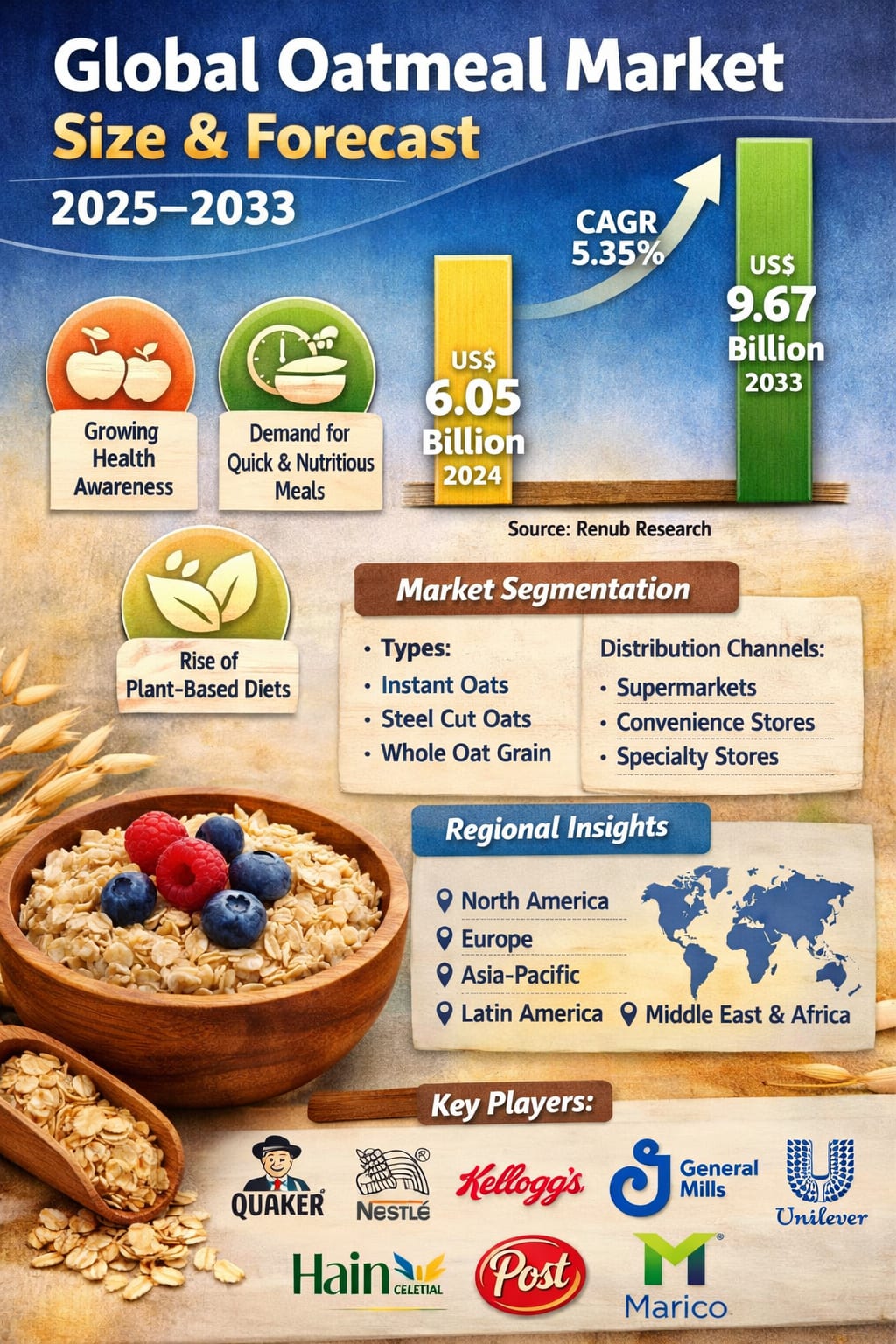
Global Oatmeal Market Overview
The global oatmeal market is steadily carving out a stronger position in the everyday diets of consumers around the world. According to Renub Research, the oatmeal market is expected to reach US$ 9.67 billion by 2033, up from US$ 6.05 billion in 2024, growing at a CAGR of 5.35% from 2025 to 2033. This growth reflects more than just a shift in breakfast habits—it signals a broader transformation in how consumers think about health, convenience, and nutrition.
Oatmeal, made from ground or processed oats, has long been recognized as a nutritious, filling, and versatile food. Traditionally consumed as a warm porridge, it has evolved into a product category that spans instant cups, steel-cut oats, flavored sachets, organic variants, and even ready-to-eat and frozen options. Its reputation as a heart-healthy, fiber-rich food—particularly due to beta-glucan—has positioned oatmeal as a staple for people seeking better digestion, sustained energy, and improved cholesterol management.
What is especially interesting about the current market phase is how oatmeal has moved beyond being just a “diet food” or a “fitness breakfast.” It is now embraced by families, working professionals, students, and older consumers alike. The product’s adaptability—whether paired with fruits, nuts, seeds, honey, or savory toppings—has helped it stay relevant in a food landscape that is increasingly driven by personalization and lifestyle choices.
The growth of the oatmeal market is being fueled by several converging trends: rising health consciousness, demand for quick and wholesome meals, expanding interest in plant-based diets, and broader availability of products in emerging economies. Together, these factors are reshaping oatmeal from a simple grain-based meal into a global convenience-health food category with strong long-term potential.
Why Health Consciousness Is Driving Oatmeal Demand
One of the strongest pillars supporting the oatmeal market’s expansion is the global rise in health awareness. Consumers today are far more informed about what they eat and how it affects their long-term well-being. Oatmeal fits neatly into this mindset because it is widely associated with digestive health, weight management, and heart health.
Rich in dietary fiber—especially soluble fiber like beta-glucan—oatmeal helps regulate blood sugar levels, promotes satiety, and supports cholesterol reduction. These benefits make it particularly appealing to people managing lifestyle-related conditions such as obesity, diabetes, and cardiovascular disease. At the same time, its relatively low calorie count and high nutrient density make it a favorite among those looking to maintain or improve their overall fitness.
Beyond the science, there is also a strong perception factor at play. Oatmeal is widely seen as a “clean” and “honest” food—simple, natural, and minimally processed, especially in its whole grain and steel-cut forms. In an era where consumers are increasingly skeptical of ultra-processed foods, this image works strongly in oatmeal’s favor.
As a result, oatmeal is no longer limited to a niche group of health enthusiasts. It has become a mainstream breakfast option, often recommended by nutritionists and embraced by households looking for reliable, everyday nutrition.
The Plant-Based Diet Movement and Oatmeal’s Perfect Fit
Another major growth driver for the oatmeal market is the rapid rise of plant-based, vegetarian, and vegan diets. Across the world, more consumers are reducing their intake of animal products for reasons ranging from health and sustainability to ethics and environmental impact.
Oatmeal is naturally plant-based, making it an easy and accessible choice for these dietary patterns. It provides essential nutrients such as fiber, complex carbohydrates, and important vitamins and minerals, without relying on any animal-derived ingredients. This makes it especially popular among consumers who want simple, affordable, and nutritionally balanced plant-based meals.
Its versatility also plays a big role. Oatmeal can be used in smoothies, baked goods, breakfast bowls, and even savory dishes, allowing it to adapt to a wide range of culinary traditions and taste preferences. With the growing popularity of plant-based milk alternatives like almond, soy, and oat milk itself, oatmeal fits seamlessly into modern, dairy-free breakfast routines.
A notable example of innovation in this space came in August 2022, when Kreatures of Habit, a functional food company, launched Protagonist, a plant-based, gluten-free oatmeal available in multiple nutrient-rich formulations. The brand also introduced additional flavors such as chocolate, blueberry banana, and vanilla, reflecting how companies are actively diversifying offerings to match evolving consumer expectations.
Product Innovation: Keeping Oatmeal Fresh and Relevant
While oatmeal is a traditional food, the market around it is anything but old-fashioned. Product innovation has become a crucial strategy for brands looking to stand out in an increasingly competitive landscape.
Manufacturers are introducing flavored variants such as chocolate, berry, cinnamon, and mixed fruit to appeal to younger consumers and those looking for more excitement in their daily meals. At the same time, there is strong growth in organic, gluten-free, and fortified oatmeal products designed for specific dietary needs and health goals.
Convenience is another major focus area. Single-serve packs, instant oats, and on-the-go cups are catering to busy lifestyles where time is often limited. These formats make it easier for consumers to include oatmeal in their daily routines, whether at home, at the office, or while traveling.
In January 2022, Path of Life introduced two varieties of frozen steel-cut oats: organic apple cinnamon and organic berry steel-cut oatmeal. This kind of innovation shows how companies are experimenting not just with flavors, but also with formats and preparation methods to expand oatmeal’s reach beyond the traditional stovetop or microwave bowl.
These ongoing innovations are helping oatmeal stay relevant in a food market that is increasingly driven by novelty, convenience, and customization.
Challenges: Competition and Price Volatility
Despite its strong growth prospects, the oatmeal market is not without challenges. One of the main obstacles is the increasing availability of alternative grains and breakfast options. Foods such as quinoa, buckwheat, brown rice, and other whole grains offer similar nutritional benefits and, in some cases, cater to specific needs such as gluten-free diets.
These alternatives are gaining popularity, especially among consumers who like to rotate their diets or experiment with new superfoods. In addition, the longer cooking time required for some types of oats, compared to ready-to-eat or instant breakfast products, can be a barrier for highly time-sensitive consumers.
Another significant challenge is price volatility. Oats, like other agricultural commodities, are sensitive to weather conditions, crop yields, and global supply chain disruptions. Poor harvests, droughts, or floods can restrict supply and push prices upward, while surplus production can drive prices down. These fluctuations make it harder for manufacturers to maintain stable pricing and profit margins, and they can also influence consumer purchasing behavior.
Managing these risks will be essential for companies that want to sustain long-term growth in the oatmeal market.
Regional Outlook: A Global Appetite for Oatmeal
The oatmeal market is expanding across multiple regions, with varying growth dynamics shaped by local diets, lifestyles, and economic conditions.
North America remains one of the largest and most mature markets for oatmeal. In the United States, demand is driven by a strong culture of breakfast cereals, rising interest in health and wellness, and continuous product innovation. Consumers are particularly attracted to high-fiber, clean-label, and plant-based products, as well as convenient formats such as instant and ready-to-eat oatmeal. Canada shows similar trends, with a strong focus on health-conscious eating habits.
In Europe, countries like Germany, the United Kingdom, France, Italy, and Spain are seeing steady growth in oatmeal consumption. In Germany, for example, increasing awareness of heart health and digestive wellness is boosting demand for fiber-rich foods like oats. The popularity of organic and plant-based products across Europe is also supporting market expansion, as is the introduction of new flavored and specialty variants.
The Asia-Pacific region represents one of the most promising growth frontiers. In countries such as China and India, changing lifestyles, urbanization, and rising disposable incomes are reshaping breakfast habits. In India, in particular, oatmeal is increasingly seen as a healthy, modern alternative to traditional breakfast options, especially among urban consumers. The growing influence of fitness culture, weight management trends, and plant-based diets is further accelerating adoption. Markets like Japan, South Korea, Australia, and Southeast Asian countries are also showing rising interest in convenient and nutritious breakfast foods.
In Latin America, including Brazil, Mexico, and Argentina, oatmeal consumption is growing as consumer preferences shift toward healthier and more convenient meal options. Meanwhile, in the Middle East & Africa, countries such as Saudi Arabia, the UAE, and South Africa are witnessing gradual but steady growth, supported by urbanization, busy lifestyles, and increasing awareness of nutrition and wellness.
Market Segmentation: Understanding the Structure
The global oatmeal market can be viewed across several key segments that highlight how diverse and flexible this category has become.
By Type, the market includes:
Instant Rolled Oat
Whole Oat Grain
Regular Oats
Steel Cut Oats
Others
By Form, it is divided into:
Conventional
Organic
By Distribution Channel, oatmeal products are sold through:
Hypermarkets
Supermarkets
Specialty Stores
Convenience Stores
Independent Retailers
Others
This wide distribution network reflects oatmeal’s transition from a niche health product to a mainstream grocery item available across both modern retail and traditional trade formats.
Competitive Landscape: Key Players Shaping the Market
The global oatmeal market is supported by a mix of multinational food giants and regionally strong brands. Key players include:
PepsiCo, Inc.
Nestlé S.A.
The Kellogg Company
The Hain Celestial Group, Inc.
Marico Limited
The Unilever Group (Pukka Herbs)
Post Holdings Inc.
General Mills Inc.
These companies compete on product quality, innovation, branding, pricing, and distribution reach. From classic rolled oats to premium organic and functional variants, their strategies reflect the growing segmentation and sophistication of consumer demand. Many of these players are also investing in clean-label positioning, sustainable sourcing, and new product development to strengthen their market positions.
Final Thoughts: A Simple Food with a Strong Future
The global oatmeal market’s projected growth from US$ 6.05 billion in 2024 to US$ 9.67 billion by 2033, at a CAGR of 5.35%, tells a compelling story about changing food priorities worldwide. What was once seen as a humble, traditional breakfast is now at the center of major trends in health, convenience, and plant-based eating.
Rising health consciousness, the expansion of plant-based diets, continuous product innovation, and growing adoption in emerging markets are all working together to push oatmeal into a new phase of global relevance. While challenges such as competition from alternative grains and price volatility remain, the overall outlook for the market is clearly positive.
About the Creator
Keep reading
More stories from shibansh kumar and writers in Trader and other communities.
ATM Managed Services Market Size and Forecast 2025–2033
Introduction The global banking industry is undergoing a steady but powerful transformation. While digital payments, mobile banking, and fintech platforms are rapidly changing how consumers interact with financial institutions, Automated Teller Machines (ATMs) continue to play a crucial role in ensuring financial access—especially in emerging economies and underserved regions. Behind this vast global ATM network, a quieter but highly strategic industry is growing fast: ATM managed services.
By shibansh kumarabout 7 hours ago in Trader
ASX Market Update Today: Gains in Financials and Resources Amid Global Tech News
ASX Market Update Today: Market Shows Mixed but Optimistic Sentiment The ASX market update today reflects cautious optimism as key sectors like financials and resources led the gains, while healthcare and technology stocks showed mixed performance. Investors are closely monitoring domestic economic data alongside global developments that influence sentiment in equity markets.
By Hammad Nawaza day ago in Trader
MicroStrategy Bitcoin Trend: How This Move Is Reshaping Corporate Investment
MicroStrategy Bitcoin has become a trendsetter in corporate finance. The company’s bold decision to hold significant amounts of Bitcoin has captured the attention of investors and businesses worldwide. MicroStrategy Bitcoin is not just about profit it is a strategic move that demonstrates the future of business investments. This article explores why MicroStrategy Bitcoin is changing the rules of corporate finance and what it means for other companies.
By John.doe7983 days ago in Trader
Bartender
On the heels of grief, pain bears down hard. On the heels of death, pain awakens the quiet place between the end of our own life and now. Feeling anything is like seeing a film and in black and white, slow motion, all sound turned off. Just watching. Gritting teeth, awkward smiles and bloody red eyes move around, scanning the others who are feeling something I don't want to feel, but I do. Escapism is all I have ever known. ~
By ROCK aka Andrea Polla (Simmons)2 days ago in Poets



Comments
There are no comments for this story
Be the first to respond and start the conversation.