
ATM Managed Services Market Size and Forecast 2025–2033
How Outsourcing, AI Integration, and Expanding ATM Networks Are Reshaping the Global Banking Infrastructure

Introduction
The global banking industry is undergoing a steady but powerful transformation. While digital payments, mobile banking, and fintech platforms are rapidly changing how consumers interact with financial institutions, Automated Teller Machines (ATMs) continue to play a crucial role in ensuring financial access—especially in emerging economies and underserved regions. Behind this vast global ATM network, a quieter but highly strategic industry is growing fast: ATM managed services.
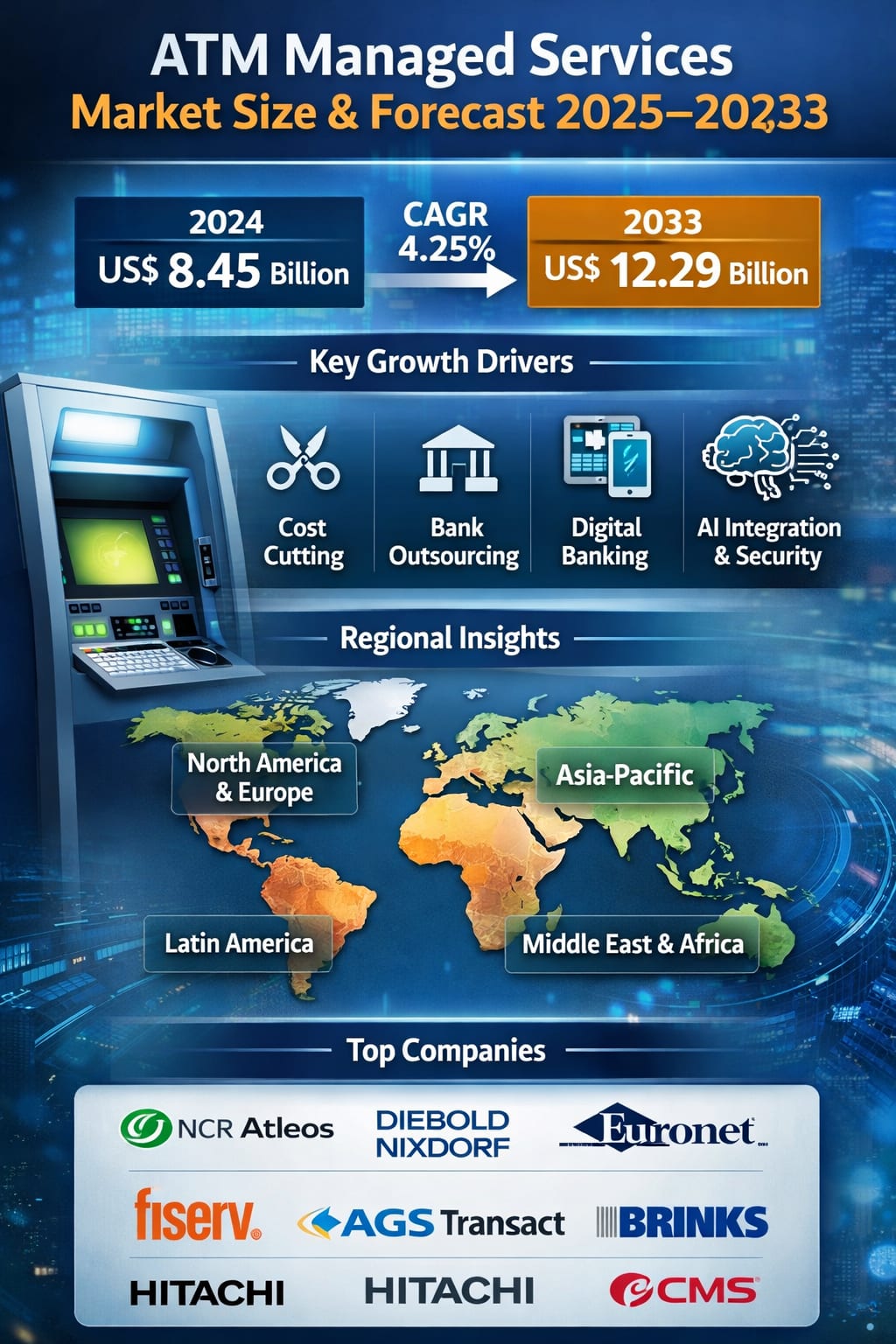
According to Renub Research, the ATM Managed Services Market is expected to reach US$ 12.29 billion by 2033, up from US$ 8.45 billion in 2024, expanding at a compound annual growth rate (CAGR) of 4.25% from 2025 to 2033. This growth is being driven by cost-cutting pressures on banks, rising outsourcing trends, increasing adoption of digital banking, the need for real-time monitoring, artificial intelligence (AI) integration, enhanced security requirements, and expanding ATM usage in developing cities.
ATM managed services allow banks and financial institutions to offload the complexity of operating, maintaining, securing, and replenishing ATM networks to specialized service providers. As competition intensifies and margins remain under pressure, outsourcing ATM operations is no longer just an efficiency measure—it has become a strategic necessity.
Global ATM Managed Services Industry Overview
The global ATM managed services industry has evolved from basic maintenance contracts into comprehensive, end-to-end operational solutions. These services now cover everything from cash replenishment and incident management to network monitoring, security management, predictive maintenance, and compliance support.
Banks today operate in an environment where uptime, customer experience, and security are non-negotiable. Even a short ATM outage can lead to customer dissatisfaction, reputational damage, and lost transaction revenue. Managed service providers help mitigate these risks by using advanced technologies such as artificial intelligence (AI), the Internet of Things (IoT), and predictive analytics to monitor ATM health in real time and resolve issues before they escalate.
Another important factor fueling market expansion is the increasing regulatory pressure on financial institutions. Compliance with security standards, data protection regulations, and operational guidelines requires constant monitoring and technical expertise. By outsourcing ATM operations, banks can rely on specialists who are better equipped to manage these complex requirements efficiently and cost-effectively.
Furthermore, the rise in fraud attempts—such as skimming, card trapping, and cyberattacks—has made security management a top priority. Managed service providers now offer integrated security solutions that combine physical security, software updates, network protection, and real-time threat detection.
All these trends are pushing financial institutions toward long-term partnerships with ATM managed service providers, strengthening the growth outlook for this market.
Key Factors Driving the ATM Managed Services Market Growth
1. Focus on Core Competencies
One of the strongest drivers behind the growth of ATM managed services is the increasing desire of banks to focus on their core business functions. Managing a large ATM network requires significant investment in infrastructure, skilled manpower, logistics, compliance, and technology. These responsibilities can divert attention and resources away from strategic priorities such as digital transformation, customer experience improvement, and product innovation.
By outsourcing ATM operations, financial institutions can delegate tasks like hardware maintenance, software upgrades, cash replenishment, monitoring, and compliance reporting to specialized providers. This not only improves operational efficiency but also enables banks to reallocate resources toward innovation, data analytics, and digital banking platforms.
In an era where customer expectations are rising and competition from fintech players is intensifying, this strategic refocus is becoming a major reason why banks are embracing managed services models.
2. Rising ATM Footprint
Despite the rapid growth of digital payments, ATMs remain essential—particularly in emerging markets and rural areas where cash is still widely used. Governments and financial institutions continue to invest in expanding ATM networks to support financial inclusion and improve access to basic banking services.
However, managing a growing ATM footprint comes with operational and logistical challenges. Each new ATM adds requirements related to installation, connectivity, security, cash loading, maintenance, and monitoring. Managed service providers offer scalable solutions that can handle these complexities across wide geographic areas.
As ATM networks expand in developing economies and secondary cities, the demand for reliable, cost-effective, and scalable ATM managed services continues to rise, making network growth a major catalyst for the market.
3. Technological Advancements
Technology is fundamentally reshaping the ATM managed services landscape. The integration of AI, IoT, and data analytics is enabling service providers to move from reactive maintenance models to proactive and predictive approaches.
With real-time monitoring, service providers can detect hardware issues, connectivity problems, or security threats before they cause service disruptions. Predictive maintenance helps reduce downtime, extend equipment life, and optimize maintenance schedules. AI-driven analytics also improve cash forecasting, ensuring that ATMs are neither overstocked nor understocked.
In addition, advanced security technologies help detect suspicious activity, prevent fraud, and strengthen overall network resilience. These innovations not only reduce operating costs but also significantly enhance customer experience—making technology a central growth driver in this market.
Challenges in the ATM Managed Services Market
Service Reliability and Downtime
In the ATM managed services market, reliability is everything. Customers expect 24/7 access to ATMs, and even short outages can lead to frustration and loss of trust. Ensuring high uptime across large, geographically dispersed ATM networks is a complex task that requires continuous monitoring, fast response times, and skilled technical support.
Hardware failures, software glitches, and network issues can all disrupt service. For banks, such disruptions can result in lost revenue and reputational damage. As a result, service providers must invest heavily in real-time monitoring systems, strong service-level agreements (SLAs), and well-trained support teams to maintain operational continuity.
Cash Management Logistics
Cash management is one of the most complex and resource-intensive aspects of ATM operations. Service providers must accurately forecast cash demand based on transaction history, seasonal trends, and local events. Poor forecasting can lead to cash-outs, which frustrate customers, or excess cash holdings, which increase security risks and operational costs.
Coordinating cash replenishment across large networks—especially in remote or high-risk areas—adds another layer of complexity. Providers must work closely with armored transport services, comply with strict cash-handling regulations, and ensure secure logistics at all times. Balancing cost efficiency, security, and service availability remains a persistent challenge in this market.
ATM Managed Services Market Overview by Regions
The global ATM managed services market shows varied growth patterns across regions, shaped by differences in banking infrastructure, outsourcing maturity, and financial inclusion initiatives.
North America and Europe benefit from advanced banking systems and high outsourcing adoption.
Asia-Pacific is witnessing rapid growth due to expanding ATM networks and rising financial inclusion efforts.
Latin America and the Middle East & Africa are experiencing steady growth, supported by banking sector modernization and digital transformation initiatives.
United States ATM Managed Services Market
The United States represents one of the most mature markets for ATM managed services. The country’s large banking sector, combined with strong cost-efficiency and performance optimization goals, is driving widespread outsourcing of ATM operations.
Banks in the U.S. are increasingly adopting AI-driven monitoring, secure cash management systems, and predictive maintenance solutions to improve uptime and customer experience. Rising concerns around fraud, cybersecurity, and regulatory compliance are also encouraging partnerships with specialized service providers.
As ATM networks continue to evolve and modernize, managed services are expected to remain a critical component of the U.S. banking infrastructure.
Germany ATM Managed Services Market
Germany’s strong and well-regulated banking system is supporting steady growth in the ATM managed services market. Financial institutions are increasingly outsourcing ATM operations to reduce costs, improve service quality, and meet strict regulatory requirements.
The adoption of AI, IoT, and real-time monitoring technologies is enhancing operational efficiency and security. The expansion of smart ATMs and brown-label ATMs is further boosting demand for managed services. Customer experience improvement and compliance assurance remain key priorities driving market growth in Germany.
China ATM Managed Services Market
China’s vast banking network and rapid digital transformation are fueling strong growth in the ATM managed services sector. As ATM networks expand across both urban and rural areas, banks are increasingly relying on specialized service providers to manage operations efficiently and at scale.
Advanced technologies such as AI, IoT, and real-time monitoring systems are being widely deployed to improve performance, security, and user experience. Government initiatives promoting financial inclusion and secure banking practices are further strengthening market demand. In China’s fast-evolving financial landscape, managed services play a crucial role in ensuring reliable and secure ATM operations.
Saudi Arabia ATM Managed Services Market
Saudi Arabia’s ATM managed services market is growing steadily, supported by expanding banking infrastructure and rising adoption of digital banking solutions. Financial institutions are outsourcing ATM operations to improve efficiency, reduce costs, and enhance service reliability.
Government initiatives aimed at boosting financial inclusion, along with increasing debit card usage, are driving higher ATM transaction volumes. The market features a mix of global and local service providers offering services such as cash management, maintenance, and monitoring. As demand for secure and efficient financial services continues to rise, the outlook for ATM managed services in Saudi Arabia remains positive.
Market Segmentation
By Service Type:
ATM Replenishment and Currency Management
Incident Management
Network Management
Security Management
Other Service Types
By ATM Location:
Offsite ATMs
Onsite ATMs
Mobile ATMs
Worksite ATMs
By Region:
North America: United States, Canada
Europe: France, Germany, Italy, Spain, United Kingdom, Belgium, Netherlands, Turkey
Asia Pacific: China, Japan, India, Australia, South Korea, Thailand, Malaysia, Indonesia, New Zealand
Latin America: Brazil, Mexico, Argentina
Middle East & Africa: South Africa, Saudi Arabia, United Arab Emirates
Competitive Landscape
The ATM managed services market is highly competitive, with major global and regional players offering comprehensive service portfolios. Key companies covered in the market include:
NCR Atleos
Diebold Nixdorf, Inc.
Euronet Worldwide, Inc.
Fiserv, Inc.
AGS Transact Technologies Ltd.
Brink’s Incorporated
Hitachi, Ltd.
CMS Info Systems Limited
These companies compete on service reliability, technological innovation, geographic reach, security capabilities, and cost efficiency. Strategic partnerships, technology upgrades, and service expansion remain central to their growth strategies.
Final Thoughts
The global ATM managed services market is entering a phase of steady and strategic growth. With the market projected to rise from US$ 8.45 billion in 2024 to US$ 12.29 billion by 2033, the role of managed services in the banking ecosystem is becoming more critical than ever.
Cost pressures, expanding ATM networks, rising security concerns, and rapid technological advancements are reshaping how financial institutions manage their ATM operations. Outsourcing is no longer just about reducing costs—it is about improving reliability, enhancing customer experience, and staying competitive in an increasingly digital financial world.
As banks continue to balance digital innovation with physical banking infrastructure, ATM managed services will remain a vital pillar supporting operational efficiency, service quality, and long-term growth across global markets.
About the Creator
Keep reading
More stories from shibansh kumar and writers in Trader and other communities.
Global Dialysis Market Size and Forecast 2025–2033
Introduction The global dialysis market is entering a decisive decade of transformation, driven by a sharp rise in chronic kidney disease (CKD), end-stage renal disease (ESRD), aging populations, and rapid technological innovation in renal care. According to Renub Research, the Dialysis Market is expected to reach US$ 171.61 billion by 2033, up from US$ 116.57 billion in 2024, growing at a compound annual growth rate (CAGR) of 4.39% from 2025 to 2033.
By shibansh kumarabout 10 hours ago in Trader
What You Should Know About Crypto Exchange Development in 2026
The crypto industry has moved far beyond its early experimental stage. By 2026, digital assets are no longer just an emerging trend but a structured part of the global financial ecosystem. As adoption grows among individuals and businesses alike, the demand for reliable and well-designed trading platforms continues to rise. Crypto Exchange Development has become a strategic initiative for companies looking to enter or expand within the digital finance space.
By Michal steve4 days ago in Trader
The Pride Flag and the Diversion
For nearly a decade, the LGBTQIA Pride Flag rippled in the wind at Christopher Park, a kaleidoscope of color staked into the soil of America’s first national monument to LGBTQIA+ liberation. That flag came down this week. Federal officials, citing new guidance from the Trump Administration, silently lowered the rainbow flag from its pole across the street from the Stonewall Inn. The birthplace of the modern gay rights movement now flies only the United States flag.
By Tim Carmichael2 days ago in Pride



Comments
There are no comments for this story
Be the first to respond and start the conversation.