
Global Millets Market Size and Forecast 2025–2033
How Ancient Grains Are Powering the Future of Healthy, Sustainable Eating

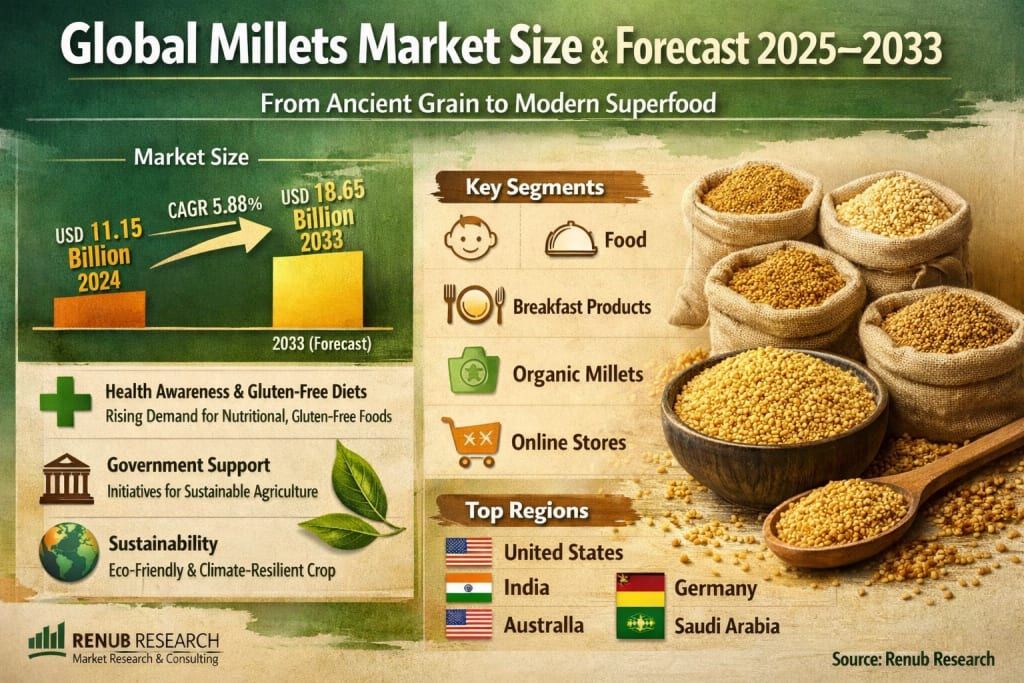
Global Millets Market: A New Age for an Ancient Grain
The Global Millets Market, valued at USD 11.15 billion in 2024, is projected to reach USD 18.65 billion by 2033, growing at a CAGR of 5.88% from 2025 to 2033. This steady and promising growth is being driven by a powerful mix of rising health awareness, increasing demand for gluten-free diets, and strong government support for sustainable and climate-resilient agriculture.
Once considered a “traditional” or even “rural” staple, millets are now stepping into the global spotlight. From health-conscious urban consumers to food manufacturers innovating with clean-label products, millets are being rediscovered as one of the most versatile and nutritious grains available today. Their application is expanding across food, beverages, infant nutrition, and even animal feed, making them a strategic crop for both food security and commercial growth.
According to Renub Research, the market’s expansion reflects not only changing consumer preferences but also a deeper shift toward sustainable, resilient, and nutrition-focused food systems worldwide.
Understanding Millets: Small Grains, Big Impact
Millets are a group of small-seeded cereal grains cultivated mainly in Asia and Africa, known for their ability to grow in harsh climates with minimal water. Popular varieties include pearl millet, finger millet (ragi), foxtail millet, and proso millet. These grains are naturally rich in fiber, protein, iron, calcium, and magnesium, and are completely gluten-free, making them ideal for people with celiac disease or gluten sensitivity.
Beyond basic nutrition, millets are increasingly recognized for their role in preventing lifestyle diseases such as diabetes, obesity, and cardiovascular disorders. Their low glycemic index and high fiber content make them especially attractive to consumers looking for healthier carbohydrate alternatives.
Today, millets are no longer limited to traditional porridges or flatbreads. They are finding their way into snacks, breakfast cereals, bakery items, beverages, and ready-to-eat meals, reflecting their growing acceptance in modern diets around the world.
Key Growth Drivers Shaping the Global Millets Market
Rising Health Awareness and Demand for Nutrient-Dense Foods
One of the strongest forces behind the growth of the global millets market is the surge in health consciousness. Consumers are actively seeking foods that offer functional benefits—better digestion, improved heart health, and blood sugar control—and millets fit perfectly into this narrative.
With non-communicable diseases rising globally, nutritionists and health influencers are increasingly recommending whole grains and gluten-free alternatives. Millets, being naturally rich in fiber and minerals, are gaining a reputation as a “smart carb” for modern lifestyles.
Food companies are also responding to this shift. For example, in 2023, Nestlé India introduced a+ Masala Millet Porridges, combining local grains like bajra and barley with vegetables and spices, showing how traditional ingredients can be reimagined for contemporary consumers.
Strong Government Support and Policy Initiatives
Government initiatives are playing a crucial role in pushing millets back into the mainstream. Countries such as India and several African nations are actively promoting millet cultivation through subsidies, awareness campaigns, and inclusion in public nutrition programs.
India’s declaration of 2023 as the “International Year of Millets” significantly boosted both farmer interest and consumer awareness. Millets have also been rebranded as “Nutri-Cereals” by the Indian government, highlighting their nutritional value.
Additionally, the Production Linked Incentive Scheme for Millet-Based Products (PLISMBP) launched by India’s Ministry of Food Processing Industries, with a budget of Rs. 800 crores (USD 96.8 million) for 2022–23 to 2026–27, is encouraging food processors to invest in millet-based innovations. Such policy support is strengthening supply chains, improving processing capacity, and expanding export potential.
The Rise of Plant-Based and Sustainable Food Movements
Sustainability is no longer a niche concern—it is now a central theme in global food choices. Millets require less water, fewer chemical inputs, and can thrive in dry, climate-stressed regions, making them one of the most environmentally friendly grains available.
As consumers increasingly align their diets with environmental values, millets are gaining favor as a climate-smart crop. This trend is reinforced by the broader growth of organic and sustainable farming worldwide. In 2022, organic agriculture was practiced in 188 countries, covering over 96 million hectares, with global organic food and beverage sales nearing 135 billion euros.
This global shift toward sustainability is creating fertile ground for millet-based products across both developed and developing markets.
Key Challenges Facing the Millets Industry
Limited Consumer Awareness and Outdated Perceptions
Despite their benefits, millets still suffer from an outdated image in some regions, often seen as a “poor man’s food.” In many developed markets, consumers are far more familiar with quinoa, oats, or brown rice, while millets remain underrepresented on shelves and menus.
This perception gap highlights the need for stronger branding, education campaigns, and product innovation. Without appealing, convenient, and tasty product formats, mass adoption—especially in urban and Western markets—will remain limited.
Supply Chain and Processing Constraints
Another major challenge lies in post-harvest infrastructure. In several producing regions, inadequate storage, milling, and processing facilities lead to quality losses, wastage, and price volatility. Millets also have a relatively shorter shelf life compared to some other grains, making large-scale distribution more complex.
Improving logistics, investing in modern processing technologies, and building organized supply chains will be essential for unlocking the full global potential of the millets market.
Market Segmentation Insights
Organic Millets Market
The organic millets segment is gaining strong momentum as consumers increasingly prefer chemical-free and clean-label foods. Certified organic millets are especially popular among health-conscious and premium buyers in North America, Europe, and urban Asia-Pacific.
Retailers and e-commerce platforms are expanding their portfolios to include organic millet flours, grains, and ready-to-eat snacks. For farmers, higher margins and government incentives are making organic millet cultivation an attractive opportunity, positioning this segment for sustained long-term growth.
Regular Millets Market
Regular millets continue to dominate global consumption, particularly in developing economies such as India, Nigeria, and Ethiopia. These millets remain an affordable and reliable staple for millions of households, playing a crucial role in food security and rural nutrition.
With improvements in packaging, branding, and retail distribution, regular millets are increasingly entering modern trade channels and food service outlets, expanding their reach beyond traditional markets.
Application-Based Growth: Infant Food and Breakfast Segments
The infant food segment is emerging as a high-growth area due to millets’ easy digestibility, high nutrient content, and gluten-free nature. Pediatricians often recommend millet-based foods during early weaning stages, especially in Asia and Africa. Companies are now launching fortified millet cereals, porridges, and snacks to meet rising demand for natural baby food.
Similarly, the breakfast segment is witnessing strong traction. Millet-based cereals, muesli, pancakes, and ready-to-cook porridges are gaining popularity among consumers seeking protein-rich, low-carb, and gluten-free morning meals. Busy urban lifestyles and the demand for convenient yet healthy options are accelerating growth in this category.
Distribution Channel Trends
Supermarkets and Hypermarkets
Supermarkets play a key role in mainstreaming millet products, especially in urban areas. They offer better visibility, organized shelving, and branded product choices, ranging from raw grains to value-added snacks and flours. Promotional activities and in-store sampling further help educate consumers and drive trial purchases.
Online Stores
E-commerce has become a game-changer for the global millets market. Online platforms provide access to a wide variety of millet products, including organic, specialty, and niche variants that may not be available in local stores. Subscription models, influencer marketing, and detailed nutritional information are further boosting online sales, a trend that accelerated significantly during and after the COVID-19 pandemic.
Regional Market Highlights
United States
The U.S. millets market is growing steadily, driven by demand for gluten-free, plant-based, and sustainable grains. Food startups and established brands alike are incorporating millets into snacks, breakfast foods, and infant nutrition. The organic segment is particularly strong, aligned with the clean-label movement.
In January 2024, India and the U.S. launched the Indo-US Millets Initiative, involving institutions such as the University of Nebraska’s Daugherty Water for Food Global Institute and the North American Millets Alliance, aiming to boost awareness and research around nutrient-dense millets.
Germany
Germany stands out as a key European market, supported by strong demand for organic, vegan, and health-focused foods. Millets are increasingly used in breads, muesli, and breakfast products. Health food stores and organic retailers are major distribution channels, while imports of certified organic millets from Asia and Africa continue to rise.
India
India remains the largest producer and consumer of millets globally. Government campaigns, public nutrition programs, and rising urban health awareness are driving both production and consumption. Innovation is booming, with millet-based snacks, ready meals, and beverages gaining popularity.
In May 2023, Bonn Group of Industries launched millet-based bread, pizza, and burgers using jowar, bajra, and ragi under the slogan “Go Healthy With Millets,” reflecting how traditional grains are being repositioned for modern consumers.
Saudi Arabia
In Saudi Arabia, demand for millets is rising due to increased focus on health, diabetes-friendly diets, and gluten-free foods. Most millets are imported from India and Africa, with distribution expanding through health stores and online channels. Government efforts to strengthen food security and diversify agricultural imports are expected to further support market growth.
Competitive Landscape
The report evaluates companies across five dimensions: overview, key personnel, recent developments, product portfolio, and revenue. While the competitive landscape listing includes major pharmaceutical and life sciences companies such as Amgen Inc., AstraZeneca, Bayer AG, Pfizer Inc., Novartis AG, Johnson & Johnson, and Eli Lilly, the broader food and agribusiness ecosystem is increasingly active in millet-based product innovation and value chain development.
Final Thoughts: A Resilient Grain for a Resilient Future
The global millets market is no longer just about tradition—it is about nutrition, sustainability, and smart food choices. With the market set to grow from USD 11.15 billion in 2024 to USD 18.65 billion by 2033, millets are firmly positioned as a strategic crop for the future of food.
Driven by health trends, government support, and the global push toward sustainable diets, millets are transitioning from a niche grain to a mainstream superfood. While challenges remain in awareness and infrastructure, continued investment, innovation, and education are likely to unlock the full potential of this ancient grain in modern global markets.
About the Creator
Keep reading
More stories from shibansh kumar and writers in Trader and other communities.
Europe Ultrasound Devices Market Forecast 2025–2033: Technology, Demand, and the Future of Diagnostic Imaging
Introduction Ultrasound technology has long been a cornerstone of modern medical diagnostics, valued for its safety, versatility, and real-time imaging capabilities. Unlike X-rays or CT scans, ultrasound uses high-frequency sound waves rather than ionizing radiation, making it a preferred option for repeated examinations, prenatal care, and point-of-care diagnostics. Over the past decade, Europe has witnessed a steady expansion in the use of ultrasound devices across hospitals, diagnostic centers, and specialty clinics, driven by technological progress and changing healthcare needs.
By shibansh kumara day ago in Trader
Stanislav Kondrashov on Kühne + Nagel, Nuveen, and the Expanding Reach of AI Across Global Markets
Artificial intelligence is no longer confined to research labs or specialist software firms. It has become a force that shapes corporate decisions, share price movements, and strategic alliances across continents. In recent market sessions, that influence has been impossible to ignore.
By Stanislav Kondrashovabout 12 hours ago in Trader




Comments
There are no comments for this story
Be the first to respond and start the conversation.