
Global Intrauterine Devices Market Size & Forecast, 2026–2034
Rising Adoption of Long-Acting Reversible Contraception, Government Support, and Women’s Health Innovation Drive Steady Market Expansion Worldwide

Introduction: A Quiet Revolution in Women’s Healthcare
The global healthcare landscape is witnessing a subtle but powerful shift in how women approach contraception and reproductive planning. Intrauterine devices (IUDs), once surrounded by misconceptions and limited acceptance in many regions, are now increasingly recognized as one of the most reliable, cost-effective, and convenient long-term contraceptive solutions available. As awareness grows and healthcare systems place greater emphasis on preventive care and family planning, the role of IUDs continues to strengthen across both developed and emerging markets.
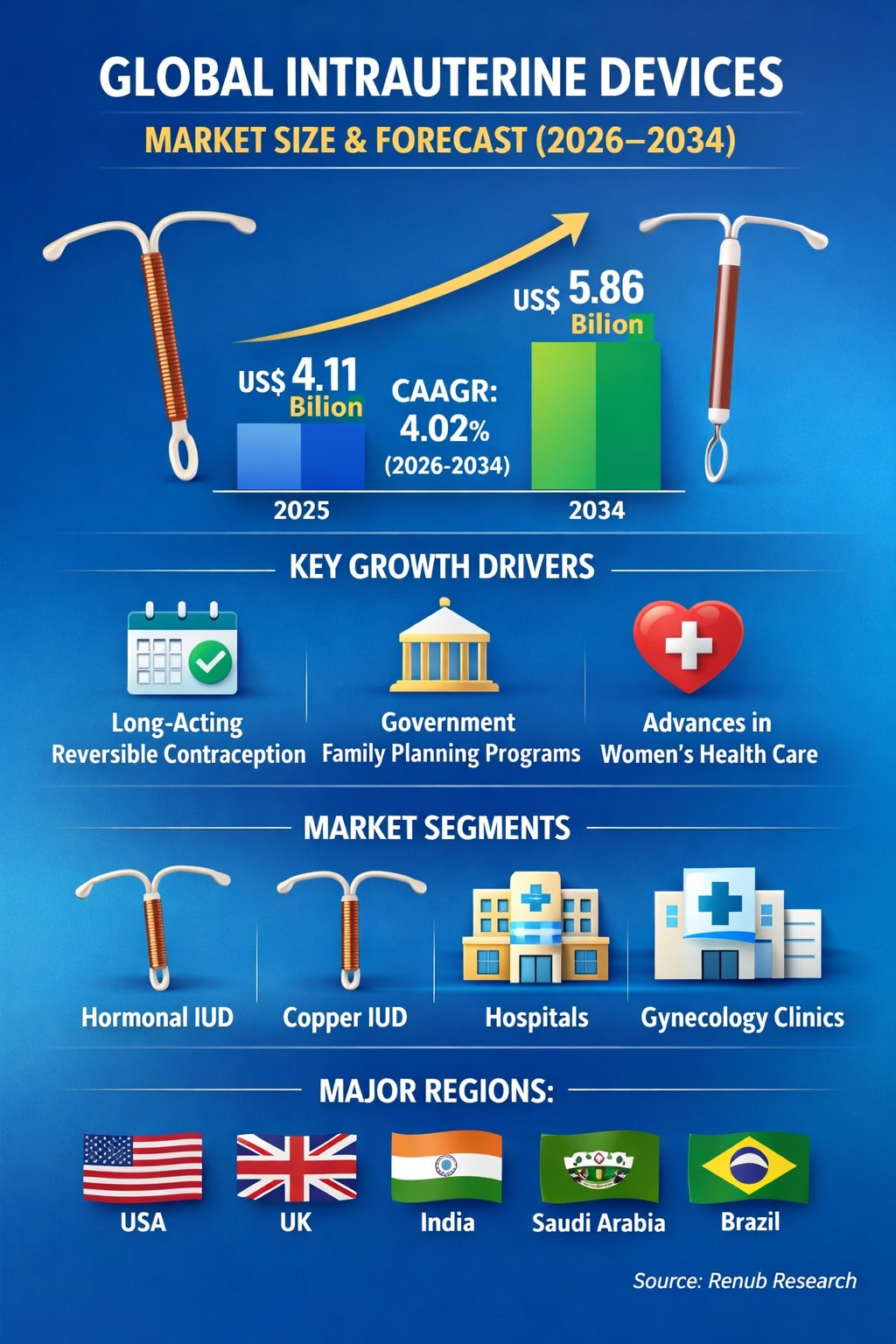
According to Renub Research estimates, the global intrauterine devices market is expected to grow from US$ 4.11 billion in 2025 to US$ 5.86 billion by 2034, registering a compound annual growth rate (CAGR) of 4.02% during 2026–2034. This steady expansion reflects not only rising demand for long-acting reversible contraception (LARC) methods but also broader changes in women’s health awareness, supportive government policies, and continuous innovation in medical device design.
In a world where healthcare decisions are becoming increasingly patient-centric, IUDs represent a “set-and-forget” solution that aligns perfectly with modern lifestyles. Their long duration of action, high efficacy, and reversibility make them an attractive option for millions of women seeking reliable birth control without the daily or monthly burden of short-term methods.
Understanding Intrauterine Devices: A Simple but Powerful Concept
Intrauterine devices are small, T-shaped medical instruments inserted into the uterus to prevent pregnancy. They belong to the category of long-acting reversible contraceptives, meaning they provide extended protection—ranging from three to ten years depending on the type—while still allowing fertility to return quickly once the device is removed.
Broadly, IUDs are divided into two main types: hormonal IUDs and copper IUDs. Hormonal IUDs release progestin, a hormone that thickens cervical mucus, thins the uterine lining, and in some cases suppresses ovulation, making it difficult for sperm to fertilize an egg. Copper IUDs, on the other hand, rely on the natural spermicidal properties of copper, creating an environment in the uterus that prevents fertilization without the use of hormones.
What makes IUDs particularly appealing is their combination of high effectiveness, long-term protection, and cost efficiency. Once inserted, they require minimal maintenance, making them ideal for women who prefer a low-intervention contraceptive method. This convenience, coupled with growing global awareness around family planning and reproductive health, has significantly boosted their acceptance worldwide.
Key Growth Drivers Shaping the Market
Rising Preference for Long-Acting Reversible Contraception
One of the strongest forces driving the intrauterine devices market is the growing global preference for long-acting reversible contraception. Compared to short-term methods such as pills, patches, or injections, IUDs offer years of reliable protection with a single procedure. This reduces the risk of user error and improves overall effectiveness, a factor that both healthcare professionals and patients increasingly value.
Women are also drawn to the “set-and-forget” nature of IUDs, which fits well with busy lifestyles and long-term family planning goals. Importantly, fertility typically returns quickly after removal, making IUDs suitable for women who want flexibility in planning future pregnancies.
Regulatory approvals and product improvements further support this trend. For example, in August 2022, the U.S. FDA approved Bayer AG’s supplemental application to extend the usage duration of the Mirena IUD to eight years, reinforcing confidence in long-term contraceptive solutions and expanding their appeal across different stages of reproductive life.
Government Support and Family Planning Initiatives
Government-backed family planning programs play a crucial role in expanding access to IUDs, especially in developing regions. Many countries promote IUDs as part of national reproductive health strategies due to their cost-effectiveness and long-term benefits. Subsidized distribution, inclusion in public healthcare systems, and awareness campaigns have significantly improved accessibility and acceptance.
International organizations and non-governmental groups also contribute by training healthcare professionals, addressing misconceptions, and educating communities about the safety and benefits of IUDs. These efforts are particularly important in regions where cultural barriers or misinformation have historically limited adoption.
A notable example of industry support came in June 2023, when Pregna International Limited received its first private equity funding of USD 16 million from India Life Sciences Fund III. This investment is expected to accelerate product development and global reach, further strengthening the market’s growth outlook.
Technological Advancements and Women’s Health Awareness
Innovation in IUD design has led to smaller, more flexible, and more comfortable devices, improving both the insertion experience and overall user satisfaction. Enhanced hormone-release systems and better materials have also improved safety and tolerability, encouraging more women to consider IUDs as a long-term option.
At the same time, rising awareness around women’s health and empowerment is influencing contraceptive choices. Women today are more informed and proactive about reproductive health, leading to greater demand for reliable and convenient solutions. In January 2024, Medicines360 partnered with DKT WomanCare to expand access to AVIBELA, a highly effective hormonal IUD with over 99% efficacy, highlighting how collaborations are helping bring advanced contraceptive options to broader populations.
Market Challenges: Barriers That Still Remain
Despite strong growth prospects, the intrauterine devices market faces several challenges. Side effects such as pain, bleeding, and discomfort during or after insertion can discourage some women from choosing IUDs. Additionally, persistent misconceptions—particularly around fertility and long-term health risks—continue to influence perceptions in certain cultures and regions.
Another significant barrier is the need for trained healthcare professionals to insert and remove IUDs. In many low-resource settings, limited access to skilled providers and healthcare infrastructure restricts adoption, even when the devices themselves are affordable or subsidized. Addressing these gaps through training programs and healthcare investments will be essential for sustaining long-term market growth.
Segment Insights: Hormonal vs. Copper IUDs
The hormonal IUD segment is experiencing strong growth due to its dual benefits. In addition to providing effective contraception, these devices are widely used to manage heavy menstrual bleeding, dysmenorrhea, and certain gynecological conditions. This therapeutic advantage makes hormonal IUDs particularly attractive to women seeking both birth control and symptom relief, and to healthcare providers who value their versatility and clinical benefits.
The copper IUD segment, meanwhile, continues to grow steadily as demand rises for non-hormonal contraceptive alternatives. With a lifespan that can extend up to ten years, copper IUDs are among the most cost-effective contraceptive options available. They are also widely recognized as an effective form of emergency contraception, further enhancing their clinical relevance. For women who prefer to avoid hormonal methods, copper IUDs remain a trusted and proven choice.
End-Use Landscape: Where IUDs Are Most Commonly Used
Hospitals remain a primary setting for IUD insertion and removal, especially for first-time users, high-risk cases, and postpartum or post-abortion family planning. The availability of specialized gynecological services and diagnostic facilities makes hospitals a key pillar in expanding IUD adoption worldwide.
Gynecology clinics are rapidly emerging as a preferred channel due to their personalized approach and focus on women’s health. These clinics offer comprehensive counseling, follow-up care, and a comfortable environment, which appeals particularly to urban populations and women seeking tailored healthcare services.
Community healthcare centers and other facilities also play an important role, especially in rural and underserved areas, where government and NGO initiatives aim to broaden access to family planning services.
Regional Perspectives: A Global Market with Local Dynamics
In the United States, high awareness of LARC methods, strong healthcare infrastructure, and supportive insurance coverage have driven widespread adoption of IUDs. Both hormonal and copper devices are commonly prescribed, and continuous innovation keeps the market dynamic. In May 2023, Sebela Pharmaceuticals announced positive Phase 3 results for its new low-dose, hormone-free copper IUD, highlighting ongoing progress in product development.
The United Kingdom benefits from strong public healthcare support and government-backed sexual health programs that promote long-acting contraceptives. Trust in the healthcare system and streamlined access through public services have made the UK a mature and stable market for IUDs. In June 2025, ASPIVIX announced a partnership with AGHealth to introduce its MHRA-approved Carevix device, reflecting continued innovation in women’s healthcare tools.
In India, government-led family planning initiatives and free or low-cost distribution of copper IUDs through public health centers have driven steady growth, particularly in rural and semi-urban areas. At the same time, hormonal IUDs are gaining popularity in urban regions through private hospitals and clinics. Ongoing investments in healthcare infrastructure and professional training continue to support long-term market expansion.
The Saudi Arabian market is also progressing steadily, supported by improvements in healthcare facilities, rising awareness of modern contraceptive methods, and increased private sector participation. While cultural factors still influence adoption patterns, growing healthcare expenditure and urbanization are helping expand access to women’s health services, including IUDs.
Competitive Landscape and Key Players
The global intrauterine devices market features a mix of established pharmaceutical companies and specialized medical device manufacturers. Key players include AbbVie Inc., Bayer AG, Teva Pharmaceuticals, ANI Pharmaceuticals, Mylan NV, CooperSurgical Inc., DKT International, and Melbea AG. These companies focus on product innovation, geographic expansion, partnerships, and regulatory approvals to strengthen their market positions.
Each major player brings unique strengths in terms of product portfolios, research capabilities, and global distribution networks, contributing to a competitive yet innovation-driven market environment.
Market Segmentation Snapshot
By Type:
Hormonal IUD
Copper IUD
By End Use:
Hospital
Gynecology Clinics
Community Healthcare Centers
Others
By Region:
North America (United States, Canada)
Europe (France, Germany, Italy, Spain, United Kingdom, Belgium, Netherlands, Turkey)
Asia Pacific (China, Japan, India, South Korea, Thailand, Malaysia, Indonesia, Australia, New Zealand)
Latin America (Brazil, Mexico, Argentina)
Middle East & Africa (Saudi Arabia, UAE, South Africa)
Final Thoughts: A Market Built on Trust, Innovation, and Empowerment
The global intrauterine devices market is on a steady and sustainable growth path, driven by rising demand for reliable long-acting contraception, supportive government policies, and continuous innovation in women’s healthcare. With the market projected to grow from US$ 4.11 billion in 2025 to US$ 5.86 billion by 2034, IUDs are set to remain a cornerstone of modern family planning strategies worldwide.
As healthcare systems continue to prioritize preventive care and women become more empowered in making informed reproductive choices, the role of IUDs will only become more prominent. Overcoming challenges related to access, education, and cultural perceptions will be key—but the long-term outlook remains clearly positive. In many ways, the evolution of the IUD market reflects a broader shift toward smarter, more patient-centric healthcare solutions for women across the globe.
About the Creator
Tom Shane
Tom Shane is a content writer specializing in SEO-driven blogs, product descriptions, and thought leadership. He crafts engaging, research-backed content that connects with audiences and drives results.
Eon Prime Intelligent Alliance Office: Global Economy at a Turning Point
The global economy stands at a pivotal crossroads. Following years of unprecedented disruption—from the COVID-19 pandemic to geopolitical fragmentation, technological acceleration, and climate-related shocks—the world economic system is undergoing structural transformation rather than cyclical adjustment. The Eon Prime Intelligent Alliance Office (EPIAO), as an independent strategic research body dedicated to long-horizon global analysis, has conducted a comprehensive assessment of current economic conditions, emerging trends, and systemic risks shaping the international order.
By Eon Prime Intelligent Alliance Office7 days ago in Trader
Historical Average Annual Return MSCI World ETF: A Complete Guide for Long-Term Investors
Understanding the MSCI World ETF The MSCI World ETF is a widely popular investment vehicle that tracks the MSCI World Index, providing exposure to hundreds of large- and mid-cap companies across developed markets, including the United States, Europe, Japan, and Canada. By investing in this ETF, investors gain broad global diversification, reducing single-country risks while participating in the growth of global equities.
By Hammad Nawaz7 days ago in Trader
Writing About Writing: The Rainbow Trap
The good thing about living in modern times is that LGBTQ representation in media is increasing. Not just in niche and Independant media, either, but also in mainstream media. Books, movies, TV shows, comics... they're finally catching on that LGBTQ+ people form a significant part of their audience, and deserve to see themselves on screen and in fiction, not just as victims in documentaries and true crime shows.
By Natasja Roseabout 10 hours ago in Writers




Comments
There are no comments for this story
Be the first to respond and start the conversation.