
Global Demand for Premium Red Wines Drives Steady Expansion Through 2034
The market is projected to grow from US$ 362.23 Million in 2025 to US$ 789.98 Million by 2034, registering a CAGR of 9.05% from 2026 to 2034.

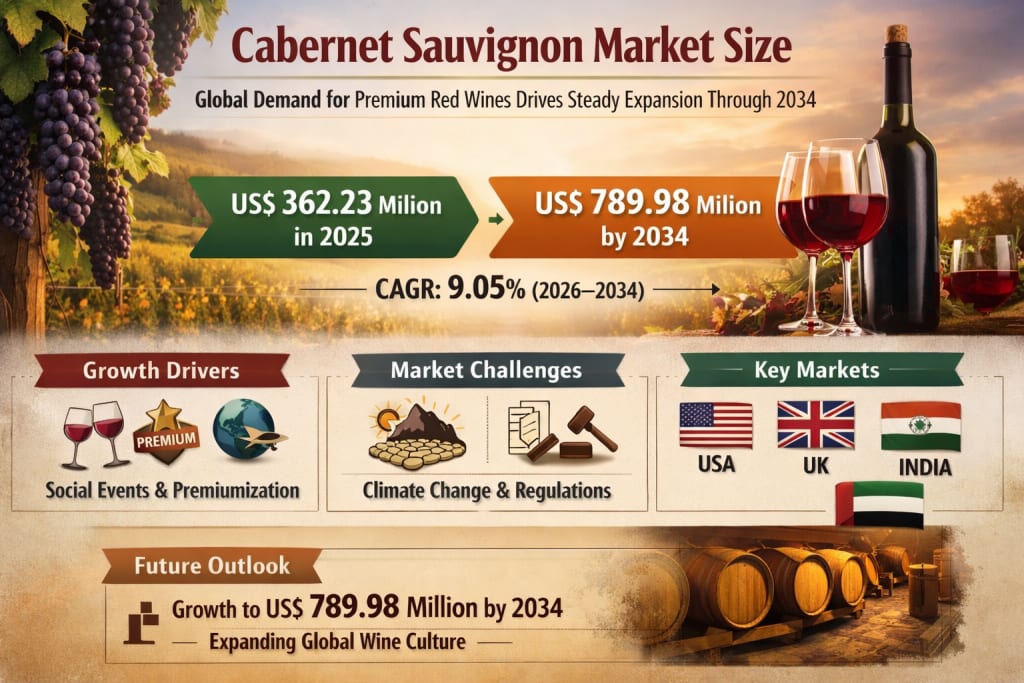
The global Cabernet Sauvignon Market is poised for robust expansion over the next decade, reflecting the continued evolution of global wine culture and the premiumization of alcoholic beverages. According to Renub Research, the market is projected to grow from US$ 362.23 Million in 2025 to US$ 789.98 Million by 2034, registering a CAGR of 9.05% from 2026 to 2034.
This growth trajectory is fueled by rising consumption during social gatherings, increasing consumer preference for premium and high-quality wines, and expanding distribution channels that make Cabernet Sauvignon more accessible worldwide. As one of the most widely planted and recognized red wine grape varieties globally, Cabernet Sauvignon remains a cornerstone of the international premium wine industry.
Cabernet Sauvignon Industry Overview
Cabernet Sauvignon is globally celebrated for its bold structure, deep color, high tannins, and exceptional aging potential. Originating from the Bordeaux region of France, it has grown into a flagship varietal across leading wine-producing regions including Napa Valley, Sonoma, Chile, Australia, Italy, and South Africa.
Its adaptability to diverse climates and soil types enables winemakers to craft distinctive expressions while maintaining consistent quality standards. Whether produced as a single-varietal premium wine or blended with Merlot and Cabernet Franc in traditional Bordeaux-style blends, Cabernet Sauvignon commands strong consumer recognition and higher price positioning.
The industry ecosystem spans viticulture, fermentation and aging, bottling, branding, international trade, and retail. Both large-scale producers and boutique wineries participate actively, leveraging storytelling, terroir-driven branding, and vintage exclusivity to attract discerning consumers.
With growing disposable incomes and rising interest in experiential luxury products, Cabernet Sauvignon continues to dominate premium wine segments in North America, Europe, and emerging Asia-Pacific markets.
Market Growth Drivers
1. Rising Global Wine Consumption and Premiumization
A significant driver of the Cabernet Sauvignon market is the global shift toward premium and luxury wines. Consumers increasingly prioritize quality, origin, and aging potential over volume consumption.
Cabernet Sauvignon’s bold flavor profile, structured tannins, and cellar-worthiness make it particularly attractive to collectors and wine enthusiasts. Developed markets such as the United States and European nations continue to show steady demand, while emerging economies like China and India are witnessing rapid adoption among urban middle-class consumers.
Premiumization encourages wineries to invest in sustainable viticulture, single-vineyard bottlings, limited editions, and innovative packaging — all of which enhance brand value and profitability.
2. Expansion of Wine Tourism and Experiential Marketing
Wine tourism has become a powerful revenue engine for Cabernet Sauvignon producers. Regions like Napa Valley, Bordeaux, and parts of Chile and Australia attract millions of visitors annually for tastings, vineyard tours, and curated culinary pairings.
Experiential marketing strengthens emotional connections between consumers and brands. Social media amplification and influencer engagement further enhance visibility among younger demographics.
Wine clubs, subscription models, and vineyard-exclusive releases convert one-time visitors into long-term customers, reinforcing Cabernet Sauvignon’s premium positioning.
3. Growth in Emerging Markets and Urbanization
Urbanization and exposure to Western lifestyle trends are driving wine adoption in Asia-Pacific, Latin America, and parts of the Middle East.
Consumers in metropolitan centers increasingly view Cabernet Sauvignon as a symbol of sophistication and global culture. Modern retail expansion, duty-free trade, and e-commerce channels have made premium imported wines more accessible than ever before.
As middle-class populations expand and disposable incomes rise, demand for premium red wines continues to strengthen across emerging economies.
Key Market Challenges
Climate Change and Agricultural Risks
Cabernet Sauvignon cultivation is sensitive to climatic variations. Rising temperatures, unpredictable rainfall, droughts, and frost events directly affect grape sugar levels, acidity, and tannin structure.
Traditional regions known for premium production face increasing vulnerability. Adapting to these changes requires investments in irrigation technologies, sustainable farming, pest control, and climate-resilient vineyard practices. Smaller wineries often face greater financial pressure in managing these risks.
Regulatory and Competitive Pressures
Alcoholic beverages remain heavily regulated worldwide. Import tariffs, advertising restrictions, labeling laws, and distribution regulations impact cross-border trade.
Competition is intensifying from other red varietals such as Merlot, Syrah, and Pinot Noir, as well as from craft spirits, hard seltzers, and low-alcohol beverages targeting younger demographics.
Brand authentication and anti-counterfeiting measures are becoming critical, especially in markets where premium wine demand is accelerating.
Regional Market Insights
United States Cabernet Sauvignon Market
The United States remains one of the largest and most mature Cabernet Sauvignon markets globally. California, particularly Napa Valley and Sonoma, dominates domestic production and international recognition.
Consumers display strong preference for premium labels, often purchasing for fine dining, celebrations, and personal collections. Wine tourism and digital wine clubs significantly support market growth.
Despite climate variability and regulatory oversight, rising disposable incomes and entrenched wine culture continue to sustain long-term expansion.
United Kingdom Cabernet Sauvignon Market
The UK represents a mature and import-driven wine market with strong appreciation for premium varietals. Cabernet Sauvignon is widely sourced from France, California, Chile, and Australia.
Supermarkets, specialty wine retailers, and online platforms provide extensive availability. Demand peaks during holidays, fine dining occasions, and gifting seasons.
While Brexit-related trade complexities and import duties pose challenges, the premium wine segment remains resilient.
India Cabernet Sauvignon Market
India’s wine culture is steadily expanding, especially in metropolitan cities such as Mumbai, Delhi, Bengaluru, and Pune. Cabernet Sauvignon ranks among the most preferred red varietals for special occasions and premium dining experiences.
Domestic production in Nashik and Karnataka supports the boutique segment, while imports from France, Australia, Chile, and the U.S. drive premium sales.
High import duties and competition from spirits remain challenges, yet premiumization trends and wine education initiatives suggest long-term growth potential.
United Arab Emirates Cabernet Sauvignon Market
The UAE’s cosmopolitan and affluent consumer base supports strong demand for premium imported wines. Cabernet Sauvignon enjoys popularity within luxury hospitality, fine dining, and tourism sectors.
Retail expansion, hotel wine programs, and curated tasting events contribute to consistent demand.
Although strict regulations and high import duties remain constraints, the UAE’s positioning as a luxury lifestyle hub ensures sustained market growth.
Recent Developments
• In March 2024, Juggernaut Wines introduced its Sonoma Coast Chardonnay, expanding its premium portfolio.
• In April 2023, Bota Box launched a limited-edition Chenin Blanc and Viognier blend, signaling product diversification strategies among key players.
Producers are increasingly focusing on portfolio expansion, sustainability certifications, and limited-release strategies to strengthen competitive positioning.
Market Segmentation
By Grape Type
• Cabernet Franc
• Sauvignon Franc
By Kind
• Young Cabernet
• Old Cabernet
By Flavor Profile
• Eco-Friendly Bell Pepper
• Blackcurrant
• Mint
• Cheddar
• Chocolate
• Vanilla
• Others
By Distribution Channel
• Direct Sales
• Hypermarkets
• Specialty Stores
• Online Retail
• Others
By Geography
North America (U.S., Canada)
Europe (France, Germany, Italy, Spain, UK, Belgium, Netherlands, Turkey)
Asia Pacific (China, Japan, India, Australia, South Korea, Thailand, Malaysia, Indonesia, New Zealand)
Latin America (Brazil, Mexico, Argentina)
Middle East & Africa (South Africa, Saudi Arabia, UAE)
Competitive Landscape
Leading companies covered include:
19 Crimes GBL
Aberdeen Wine Company Pty Ltd.
Amapola Creek Vineyards & Winery
Anakota Winery
Arietta Wine
Bota Box Vineyards
Decoy Co. Ltd.
Disruption Wine Company
Josh Cellars Co. Ltd.
Juggernaut Wine Company
Each company is evaluated across five viewpoints: Overview, Key Persons, Recent Developments, SWOT Analysis, and Financial Insights.
Final Thoughts
The Cabernet Sauvignon market is entering a phase of sustained premium-driven growth. With revenues projected to more than double by 2034, the industry’s expansion reflects shifting consumer preferences toward quality, authenticity, and experiential luxury.
Despite climate-related risks and regulatory complexities, strong brand equity, expanding global distribution, and rising wine culture in emerging markets provide powerful tailwinds.
About the Creator
Luxury Car Market: Innovation, Prestige, and the Future of Premium Mobility
Market Overview Luxury cars are typically characterized by superior build quality, advanced safety systems, innovative infotainment, enhanced comfort, and strong brand identity. These vehicles are positioned at the upper end of the automotive spectrum and cater to affluent consumers seeking exclusivity and performance.
By James Smith4 days ago in Trader
Australia E-Mobility Market: Driving Electrification and Sustainable Mobility
The Australia e-mobility market reached an estimated USD 1,290.91 million in 2024, marking a pivotal shift toward electrified transport solutions across passenger, commercial, and micro-mobility segments. Looking forward, the market is expected to skyrocket to USD 12,949.66 million by 2033, representing a robust compound annual growth rate (CAGR) of 29.20 percent during the 2025–2033 period. This dramatic expansion highlights Australia’s accelerating transition from traditional fossil-fuel-based vehicles to electrified mobility options driven by sustainability goals, government policy, and evolving consumer demand.
By Amélie Belle5 days ago in Trader




Comments
There are no comments for this story
Be the first to respond and start the conversation.