
Proton Therapy Market Size & Forecast 2026–2034
Precision Radiation Redefining the Future of Global Cancer Care

Proton Therapy Market: A New Era of Precision Oncology
The global proton therapy market is entering a decisive phase of growth as healthcare systems worldwide increasingly prioritize precision medicine and patient-centric cancer care. Proton therapy, a highly advanced form of radiation therapy, uses high-energy proton beams to target tumors with remarkable accuracy, minimizing radiation exposure to surrounding healthy tissues. This unique clinical advantage makes proton therapy particularly valuable for treating pediatric cancers, brain tumors, head and neck cancers, and tumors located near critical organs such as the spine, heart, and eyes.
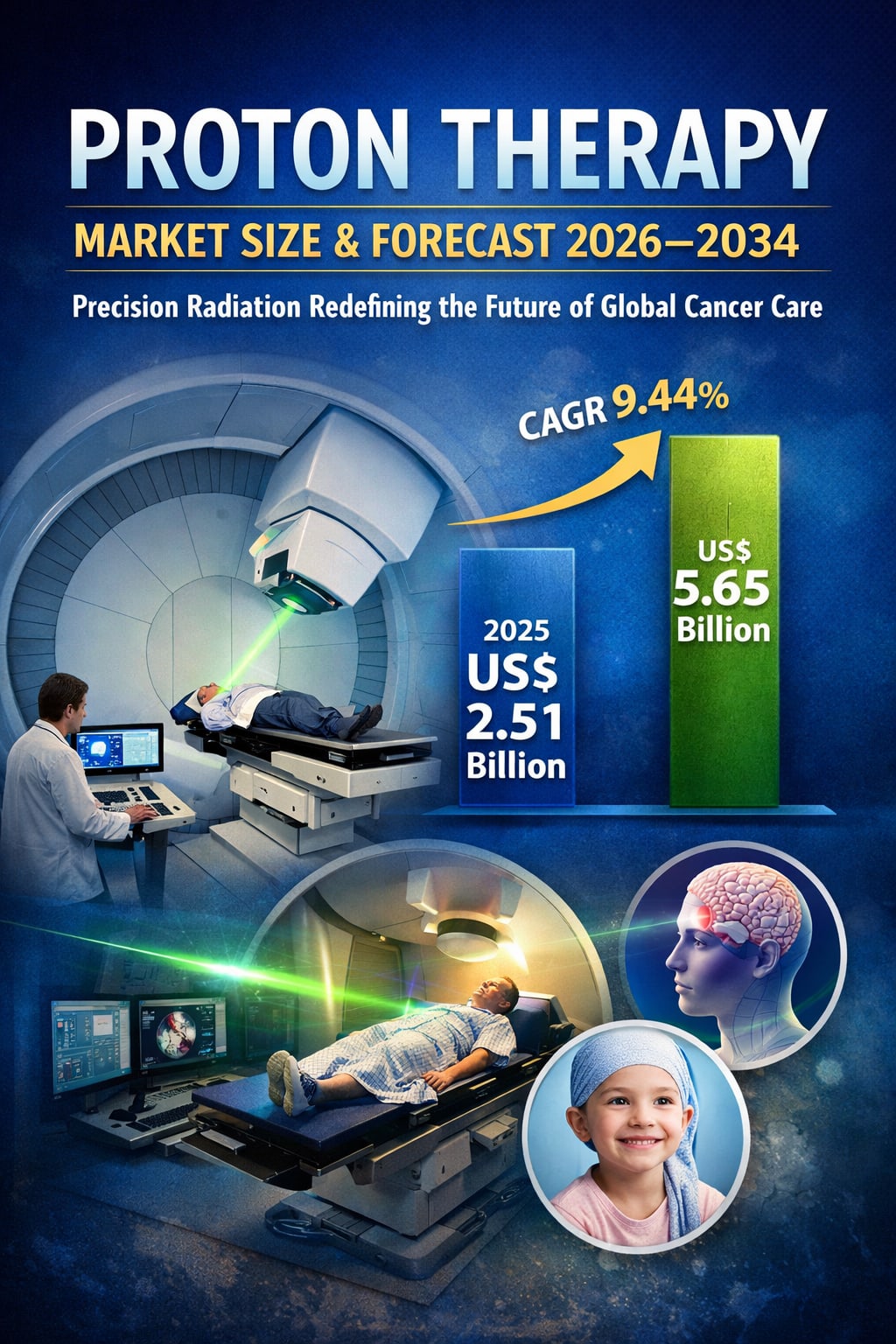
According to Renub Research, the proton therapy market is expected to grow from US$ 2.51 Billion in 2025 to US$ 5.65 Billion by 2034, registering a CAGR of 9.44% during the forecast period 2026–2034. This strong growth trajectory reflects a combination of rising global cancer incidence, rapid technological advancements in radiation therapy systems, and increasing awareness among clinicians and patients about the long-term benefits of precision oncology.
Unlike conventional X-ray radiation therapy, proton therapy allows clinicians to deposit the maximum dose of radiation directly at the tumor site while sharply reducing the exit dose beyond the tumor. This property, known as the Bragg peak effect, significantly reduces collateral damage to healthy tissues and lowers the risk of long-term side effects. As a result, proton therapy is increasingly viewed not just as an alternative, but as a next-generation standard for selected cancer indications.
Over the past decade, many countries have invested heavily in building proton therapy centers as part of broader cancer care modernization strategies. While the technology remains capital-intensive, continuous innovation is steadily improving accessibility, efficiency, and clinical outcomes, positioning proton therapy as a cornerstone of future oncology treatment.
Proton Therapy Market Outlook
Proton therapy represents one of the most sophisticated advances in radiation oncology. It is an evidence-based treatment modality that uses charged particles (protons) instead of photons (X-rays) to destroy cancer cells. The defining advantage of proton therapy lies in its precision: the energy release can be controlled to stop exactly at the tumor site, thereby sparing nearby healthy tissues from unnecessary radiation exposure.
This precision is especially critical in cases involving pediatric patients, where minimizing radiation to developing organs can significantly reduce the risk of long-term complications. Similarly, tumors located near sensitive structures—such as brain tumors, spinal tumors, and head and neck cancers—benefit greatly from the targeted nature of proton therapy.
In recent years, the adoption of proton therapy has accelerated across both developed and emerging healthcare markets. This trend is driven by rising cancer prevalence, growing patient awareness, and continuous improvements in proton therapy systems, including compact designs, enhanced imaging integration, and more efficient treatment planning software. As healthcare systems increasingly shift toward value-based care and long-term patient outcomes, proton therapy is gaining recognition as a clinically and strategically important investment.
Growth Drivers of the Proton Therapy Market
Rising Global Cancer Incidence and Demand for Advanced Treatments
The global cancer burden continues to rise at an alarming pace, making advanced and safer treatment modalities more critical than ever. Cancers such as brain cancer, lung cancer, prostate cancer, and pediatric cancers often require highly precise radiation treatment to avoid damaging surrounding healthy tissues. Traditional radiation therapy, while effective, can sometimes lead to significant side effects due to unavoidable exposure of nearby organs.
Proton therapy addresses this challenge by offering targeted treatment with reduced collateral damage. The growing demand for therapies that improve survival rates while preserving quality of life is a major driver behind the expansion of proton therapy centers worldwide. With global cancer cases expected to increase substantially over the coming decades, the need for advanced radiation technologies is only set to intensify, further strengthening the market outlook for proton therapy.
Technological Advancements in Proton Therapy Systems
Continuous innovation in proton therapy technology is another powerful growth engine for the market. Developments such as pencil beam scanning, compact proton therapy systems, and improved imaging integration have significantly enhanced treatment accuracy and operational efficiency. These advancements are also helping to reduce the physical footprint and overall cost of proton therapy installations, making the technology more accessible to a wider range of hospitals and cancer centers.
Improvements in treatment planning software, automation, and real-time imaging are further boosting clinical outcomes and workflow efficiency. For instance, in June 2025, IBA (Ion Beam Applications SA) announced the launch of the Proton Therapy Academy, a global training and education initiative unveiled at the PTCOG conference in Buenos Aires. Such initiatives highlight the industry’s focus not only on technology, but also on building skilled expertise to support wider adoption.
Growing Focus on Pediatric and Precision Oncology
Proton therapy holds exceptional value in pediatric oncology, where long-term side effects of radiation can significantly impact a child’s growth and development. By minimizing radiation exposure to healthy tissues, proton therapy reduces the risk of secondary cancers and other long-term complications, making it an increasingly preferred option for treating childhood cancers.
At the same time, the broader shift toward precision medicine and personalized oncology care is strengthening the case for proton therapy. Clinical evidence demonstrating improved quality of life and reduced side effects is driving acceptance among oncologists and patients alike. In India, for example, the launch of precision oncology clinics by major healthcare providers underscores the growing emphasis on targeted, patient-centric cancer treatments.
Key Challenges of the Proton Therapy Market
High Capital Investment and Operational Costs
Despite its clinical advantages, proton therapy faces a significant barrier in the form of high capital and operational costs. Building a proton therapy facility requires substantial investment in specialized equipment, large treatment rooms, and extensive radiation shielding. In addition to the initial setup costs, ongoing expenses related to maintenance, skilled workforce training, and technology upgrades further increase the financial burden.
These high costs limit the adoption of proton therapy primarily to large hospital networks and well-funded cancer centers, especially in developed markets. In many regions, reimbursement policies are still evolving, which can make it challenging for providers to justify the investment purely on financial grounds.
Limited Accessibility and Clinical Evidence for Certain Indications
Another challenge is the limited number of proton therapy centers globally, which restricts patient access—particularly in developing countries. Geographic barriers and long waiting lists can delay treatment for patients who might benefit from proton therapy.
While strong clinical evidence exists for pediatric cancers and complex tumors, further large-scale comparative studies are still needed for some adult cancer indications to fully establish proton therapy’s cost-effectiveness versus advanced photon-based therapies. Expanding the evidence base will be crucial for broader reimbursement support and mainstream adoption.
Market by Key Indications
Head & Neck Cancer Proton Therapy Market
Head and neck cancers present a unique clinical challenge due to their proximity to vital structures such as the brain, spinal cord, salivary glands, and eyes. Proton therapy’s ability to deliver highly precise radiation doses makes it particularly suitable for these cases, reducing side effects like dry mouth, swallowing difficulties, and long-term tissue damage. As incidence rates rise and awareness of quality-of-life outcomes increases, proton therapy is becoming an increasingly important option in head and neck oncology.
Prostate Cancer Proton Therapy Market
The prostate cancer segment is witnessing growing interest in proton therapy due to its potential to reduce radiation exposure to nearby organs such as the bladder and rectum. This precision lowers the risk of urinary and bowel complications, which are major concerns for patients undergoing radiation therapy. With an aging male population and rising prostate cancer cases, demand for advanced, minimally invasive treatment options is expected to support steady growth in this segment.
Lung Cancer Proton Therapy Market
Lung cancer treatment often involves tumors located close to critical organs like the heart and spinal cord. Proton therapy allows clinicians to target these tumors more accurately while preserving healthy lung tissue, which is especially important for patients with limited respiratory function or those requiring re-treatment. Advances in motion management and imaging technologies are further enhancing the effectiveness of proton therapy in lung cancer care.
Market by Set-up Type
Single Room Proton Therapy Market
Single room proton therapy systems are gaining rapid popularity due to their smaller footprint and lower installation costs compared to multi-room systems. These compact solutions make proton therapy more accessible to mid-sized hospitals and regional cancer centers. Faster installation, scalability, and improved performance are key factors driving growth in this segment, as healthcare providers seek cost-effective ways to offer advanced cancer treatments.
Regional Market Insights
United States Proton Therapy Market
The United States remains the largest and most advanced proton therapy market globally, supported by a strong healthcare infrastructure and significant investment in oncology research. The country hosts the highest number of operational proton therapy centers, driven by leading academic hospitals and cancer institutes. Rising cancer incidence, supportive reimbursement for specific indications, and ongoing clinical research are all fueling market growth. In January 2024, OncoRay launched the world’s first whole-body MRI-guided proton therapy system, marking a major milestone in real-time tumor tracking during treatment.
United Kingdom Proton Therapy Market
The UK market is expanding steadily, supported by government investment and the National Health Service’s commitment to providing advanced cancer care. Specialized proton therapy centers focus primarily on pediatric and complex cancers. While the number of facilities remains limited, strong public support and positive clinical outcomes are expected to drive further growth. In November 2025, Proton International London announced the availability of private treatment for selected gastrointestinal cancers at its state-of-the-art center.
India Proton Therapy Market
India’s proton therapy market is still in a developing phase but shows strong long-term potential. Rising cancer incidence, particularly head and neck and pediatric cancers, is driving demand for advanced treatments. Medical tourism and private healthcare investments are also contributing to market growth. Although high costs limit widespread adoption, partnerships such as Apollo Hospitals’ agreement with IBA to introduce the Proteus One system highlight the country’s growing commitment to cutting-edge cancer care.
Saudi Arabia Proton Therapy Market
Saudi Arabia is emerging as a promising market for proton therapy under its Vision 2030 healthcare development strategy. Government initiatives to establish specialized cancer centers and partnerships with international institutions are supporting adoption. In December 2023, the Saudi Health Minister inaugurated the Saudi Proton Therapy Center in Riyadh, marking a significant step toward offering precision cancer treatment within the country.
Market Segmentation
By Indication:
Head & Neck Cancer
Sarcoma
Pediatric Cancer
Gastro-intestinal Cancer
Prostate Cancer
Lung Cancer
By Set-up Type:
Single Room
Multi-Room
By Region:
North America (United States, Canada)
Europe (France, Germany, Italy, Spain, United Kingdom, Belgium, Netherlands, Turkey)
Asia Pacific (China, Japan, India, Australia, South Korea, Thailand, Malaysia, Indonesia, New Zealand)
Latin America (Brazil, Mexico, Argentina)
Middle East & Africa (South Africa, Saudi Arabia, United Arab Emirates)
Competitive Landscape
Leading players in the proton therapy market include IBA, Varian Medical Systems, Hitachi Ltd., Mevion Medical Systems, and Mitsubishi Electric Corporation. These companies are actively investing in product innovation, strategic partnerships, and global expansion to strengthen their market positions. Each major company is typically analyzed across five viewpoints: overview, key persons, recent developments and strategies, product portfolio, and financial insights.
Final Thoughts
The global proton therapy market is on a strong growth trajectory, driven by rising cancer incidence, technological innovation, and the increasing shift toward precision oncology. While high costs and limited accessibility remain challenges, continuous advancements in system design, clinical evidence, and healthcare infrastructure are steadily expanding the reach of this powerful treatment modality.
With the market expected to grow from US$ 2.51 Billion in 2025 to US$ 5.65 Billion by 2034 at a CAGR of 9.44%, proton therapy is no longer a niche technology—it is becoming a strategic pillar of modern cancer care. As more countries invest in advanced oncology infrastructure and as awareness continues to rise, proton therapy is poised to play a transformative role in improving cancer treatment outcomes worldwide.
About the Creator
Philippines Event Management Software Market 2026: Hybrid Experiences, Digital Engagement and Smart Event Automation
Philippines Event Management Software Market Overview The Philippines event management software market is expanding steadily as organisations across corporate, education, government and entertainment sectors adopt digital tools to streamline event planning and execution. Event management software platforms enable organisers to manage registrations, ticketing, scheduling, attendee engagement and analytics within unified digital ecosystems. As the Philippines continues to experience strong growth in conferences, corporate training sessions, exhibitions and hybrid events, software solutions are becoming indispensable for operational efficiency and attendee experience enhancement.
By Manisha Dixit5 days ago in Trader
Beginner’s Guide to Stock Market Investing in 2026
Investing in the stock market can seem intimidating for beginners. With countless companies, financial terms, and market movements, it’s easy to feel overwhelmed. However, starting early and learning the fundamentals can pave the way for long-term financial success. This guide provides a simple roadmap for beginners entering the stock market in 2026.
By Hammad Nawaz6 days ago in Trader



Comments
There are no comments for this story
Be the first to respond and start the conversation.