
Europe Retinal Surgery Devices Market Size & Forecast 2026–2034
Advancing Precision Eye Care Amid Rising Retinal Disorders Across Europe

Market Snapshot
The Europe Retinal Surgery Devices Market is expected to witness steady and sustained growth over the forecast period, expanding from US$ 820.33 million in 2025 to US$ 1,668.76 million by 2034, registering a compound annual growth rate (CAGR) of 8.21% during 2026–2034.
This upward trajectory is driven by a growing burden of retinal disorders, rapid population aging across European countries, and continuous advancements in minimally invasive ophthalmic surgical technologies. Improved access to specialized eye care, strong healthcare infrastructure, and increasing adoption of advanced retinal surgical systems further support market expansion across the region.
Overview of the Retinal Surgery Devices Market in Europe
Retinal surgery devices encompass a wide range of specialized medical instruments and systems used for the diagnosis, treatment, and management of retinal disorders. The retina, a delicate light-sensitive tissue located at the back of the eye, plays a crucial role in vision, and damage to this structure can lead to severe visual impairment or blindness.
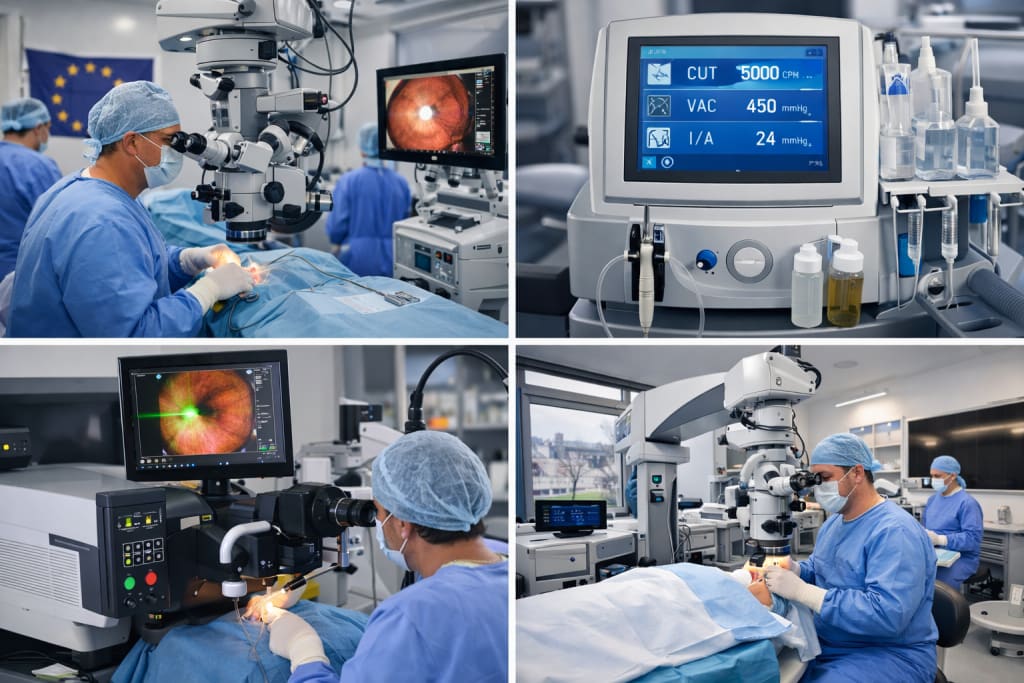
Common conditions treated using retinal surgery devices include retinal detachment, diabetic retinopathy, macular holes, epiretinal membranes, and age-related macular degeneration. The device ecosystem includes vitrectomy machines, vitrectomy packs, retinal lasers, microscopic illumination systems, microsurgical instruments, and related accessories.
Modern retinal surgery devices are engineered to deliver high precision while minimizing tissue trauma. The growing use of minimally invasive techniques has improved surgical accuracy, reduced complication rates, shortened recovery times, and enhanced long-term visual outcomes for patients. As Europe faces a rising prevalence of age-related and metabolic eye diseases, the adoption of advanced retinal surgery devices continues to accelerate.
Key Growth Drivers in the Europe Retinal Surgery Devices Market
Rising Prevalence of Retinal Disorders
The increasing incidence of retinal diseases is the primary force driving market growth. Europe has one of the largest aging populations globally, which directly contributes to higher rates of retinal degeneration and vision-threatening conditions. Diseases such as diabetic retinopathy, retinal detachment, macular holes, and age-related macular degeneration are becoming more common due to longer life expectancy and the growing prevalence of diabetes.
Early screening initiatives and improved diagnostic capabilities are leading to earlier detection of retinal conditions, resulting in increased surgical intervention volumes. As patients are diagnosed at treatable stages, demand for vitrectomy systems, laser devices, and microsurgical tools continues to rise across hospitals and specialty eye centers.
Technological Advancements in Retinal Surgery Devices
Rapid technological innovation has significantly enhanced the effectiveness and safety of retinal surgeries. Modern devices now offer smaller gauge instruments, enhanced fluidics control, improved illumination, and superior visualization systems. Advanced vitrectomy platforms enable faster cutting speeds and higher precision, reducing surgical time and improving patient recovery.
The integration of digital imaging, 3D visualization, and advanced laser technologies has elevated surgical accuracy and workflow efficiency. Frequent product upgrades and continuous innovation by manufacturers are encouraging healthcare providers to replace legacy systems, sustaining long-term demand throughout Europe.
Strong Healthcare Infrastructure and Access to Ophthalmic Care
Europe’s well-developed healthcare infrastructure plays a critical role in supporting market growth. Many European countries offer universal healthcare coverage, ensuring patient access to advanced ophthalmic procedures. Favorable reimbursement policies, government healthcare funding, and investments in specialized eye care facilities facilitate the adoption of high-end retinal surgery devices.
The presence of skilled ophthalmologists, academic medical centers, and structured training programs further strengthens the market. A healthcare focus on early intervention and improved patient outcomes continues to drive investments in advanced retinal surgical technologies.
Challenges Facing the Europe Retinal Surgery Devices Market
High Cost of Advanced Retinal Surgery Devices
Despite strong growth potential, high equipment costs remain a major challenge. Advanced vitrectomy systems, laser platforms, and disposable surgical packs require significant capital investment. Smaller hospitals and clinics, particularly in Eastern and Southern Europe, often face budget constraints that limit access to the latest technologies.
In addition to purchase costs, ongoing expenses for maintenance, consumables, and surgeon training add to the financial burden. Cost-containment measures within public healthcare systems can delay equipment upgrades and slow market penetration in certain regions.
Shortage of Skilled Retinal Surgeons
Retinal surgery requires highly specialized training and expertise. Several European regions face a shortage of ophthalmologists skilled in advanced retinal procedures. This skill gap limits procedure volumes, especially in rural and underserved areas.
While technology continues to advance, effective adoption depends on trained professionals capable of utilizing sophisticated devices. The uneven distribution of skilled retinal surgeons may restrain market growth despite increasing disease prevalence.
Market Segmentation Insights
Europe Retinal Surgery Vitrectomy Packs Market
Vitrectomy packs represent a vital component of the retinal surgery devices market. These disposable packs include essential surgical items used during vitrectomy procedures. Growing emphasis on infection control and regulatory compliance has increased demand for standardized disposable packs across European healthcare facilities.
Rising surgical volumes for diabetic retinopathy and retinal detachment procedures are key contributors to growth in this segment.
Europe Retinal Surgery Instruments & Devices Market
This segment includes forceps, scissors, cannulas, laser systems, and illumination probes. The demand for precise, ergonomic, and minimally invasive instruments is increasing as retinal surgeries become more complex. Advances in materials and design are driving steady growth across European surgical centers.
Europe Diabetic Retinopathy Surgery Devices Market
Diabetic retinopathy remains a leading cause of vision impairment in Europe. Increasing diabetes prevalence and improved screening programs have resulted in higher diagnosis rates and surgical intervention volumes. Laser systems and vitrectomy devices are widely used for advanced cases, fueling sustained demand in this segment.
Europe Retinal Detachment Surgery Devices Market
Retinal detachment is a medical emergency requiring immediate surgical intervention. Devices such as vitrectomy systems, retinal lasers, and cryotherapy equipment are extensively used. Improved awareness and diagnostic accuracy are enabling timely treatment, supporting steady market growth.
End-User Analysis
Hospitals
Hospitals represent the largest end-user segment due to their advanced infrastructure and ability to perform complex retinal surgeries. University hospitals and large medical centers across Europe continue to invest in cutting-edge retinal surgery technologies, supported by government funding and institutional research initiatives.
Eye Clinics
Specialty eye clinics are emerging as key adopters of retinal surgery devices. These facilities focus exclusively on eye care, offering faster diagnosis and specialized treatment. Growing patient preference for reduced waiting times and focused care is driving demand for compact and efficient retinal surgery equipment in this segment.
Country-Level Market Insights
Germany
Germany stands as one of the most technologically advanced retinal surgery devices markets in Europe. The country benefits from robust reimbursement systems, advanced healthcare infrastructure, and a strong presence of skilled retinal surgeons. High prevalence of diabetes and age-related retinal disorders continues to drive demand. German hospitals are early adopters of minimally invasive surgical technologies and precision-driven systems.
France
France holds a significant share of the European market, supported by a strong public healthcare system and government-led eye care initiatives. Increased screening for retinal disorders and rising adoption of advanced vitrectomy and laser devices are shaping market growth. Ongoing research in rare retinal diseases further strengthens the country’s position.
United Kingdom
The UK market is driven by increasing awareness of retinal disorders and strong support from the national healthcare system. Rising diabetes prevalence and an aging population are increasing surgical volumes. Hospitals are gradually adopting minimally invasive vitrectomy solutions and high-precision visualization tools to enhance surgical outcomes.
Russia
Russia represents an emerging market within Europe. Growth is supported by improving healthcare infrastructure, rising awareness of vision disorders, and increasing diabetes prevalence. Advanced retinal surgical devices are gaining traction in major metropolitan areas, although adoption remains limited in rural regions due to cost and workforce constraints.
Market Segmentation Overview
By Product
Vitrectomy Machines
Vitrectomy Packs
Surgical Instruments
Microscopic Illumination Equipment
Retinal Laser Equipment
Others
By Application
Diabetic Retinopathy
Retinal Detachment
Epiretinal Membrane
Macular Hole
Others
By End User
Hospitals
Eye Clinics
Others
By Country
France, Germany, Italy, Spain, United Kingdom, Belgium, Netherlands, Russia, Poland, Greece, Norway, Romania, Portugal, and Rest of Europe
Competitive Landscape
The market features a strong presence of global and regional players. Each company is analyzed across five viewpoints: overview, key personnel, recent developments, SWOT analysis, and revenue analysis.
Key Companies Covered
Topcon Corporation
Alcon AG
Carl Zeiss
Bausch Health Companies Inc.
Iridex Corporation
Pfizer Inc.
Johnson & Johnson
Essilor International SA
Final Thoughts
The Europe Retinal Surgery Devices Market is poised for robust growth through 2034, driven by rising retinal disease prevalence, technological advancements, and strong healthcare infrastructure. While challenges such as high device costs and surgeon shortages remain, continued innovation, training initiatives, and supportive healthcare policies are expected to unlock long-term opportunities. As Europe prioritizes vision health for its aging population, retinal surgery devices will play a critical role in shaping the future of ophthalmic care.
About the Creator
Keep reading
More stories from shibansh kumar and writers in Trader and other communities.
European Food Processing Automation Market Size & Forecast 2026–2034
Market Overview The Europe Food Processing Automation Market is undergoing a structural transformation as food manufacturers increasingly turn to smart, automated solutions to enhance efficiency, maintain regulatory compliance, and address workforce shortages. According to Renub Research, the market is projected to expand from US$ 7.09 billion in 2025 to US$ 12.12 billion by 2034, registering a compound annual growth rate (CAGR) of 6.14% during 2026–2034.
By shibansh kumara day ago in Trader
MSCI World 2025 Rendite: Global Market Trends, Chiyoda Integre Co, and Gold Price Today
MSCI World 2025 Rendite: A Global Investment Indicator The MSCI World 2025 Rendite represents the expected returns of the MSCI World Index in 2025. Covering large and mid-cap stocks from 23 developed markets, this index provides a comprehensive snapshot of global equity performance and is a benchmark for international investors.
By Hammad Nawaz5 days ago in Trader



Comments
There are no comments for this story
Be the first to respond and start the conversation.