
United Kingdom Energy Drinks Market Trends & Summary (2025–2033)
How Innovation, Convenience, and Health-Conscious Choices Are Reshaping Britain’s Energy Drink Industry

Introduction: A Market That Keeps Britain Moving
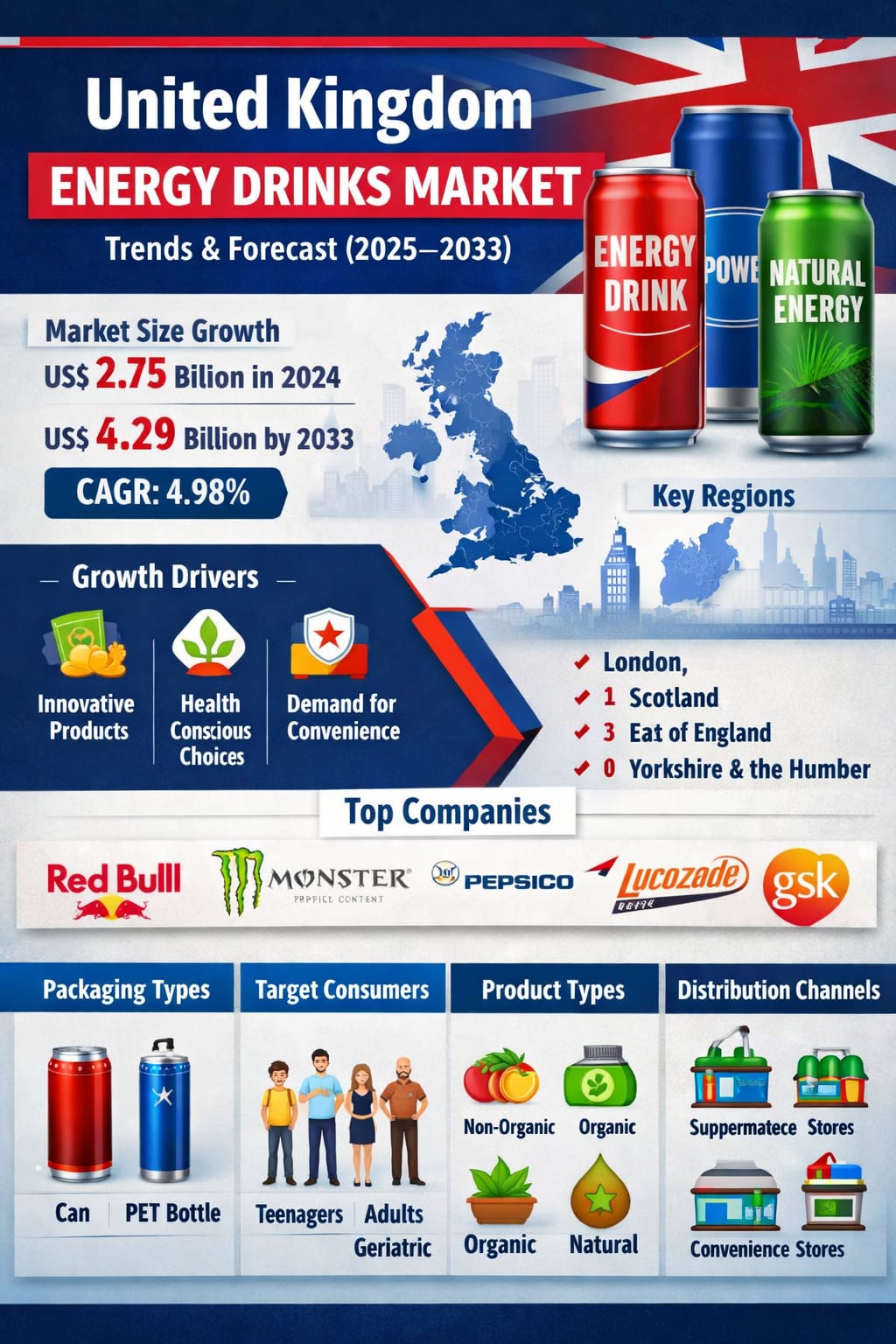
The United Kingdom energy drinks market is entering a dynamic phase of transformation, driven by evolving consumer lifestyles, innovation in product formulations, and expanding retail access. According to Renub Research, the UK Energy Drinks Market is expected to reach US$ 4.29 billion by 2033, up from US$ 2.75 billion in 2024, registering a compound annual growth rate (CAGR) of 4.98% from 2025 to 2033.
This steady growth reflects more than just rising consumption—it signals a broader shift in how British consumers think about energy, performance, and convenience. Once primarily associated with extreme sports and nightlife, energy drinks are now firmly embedded in everyday routines. Students rely on them during exam periods, professionals reach for them during long workdays, and fitness enthusiasts use them to enhance workouts.
At the same time, the market is being reshaped by health concerns, regulatory pressure, and a strong push toward cleaner labels, lower sugar content, and more “natural” formulations. This tension—between performance and wellness—is defining the next chapter of the UK energy drinks industry.
United Kingdom Energy Drinks Market Overview
The UK energy drinks industry has grown significantly over the past decade, supported by busy urban lifestyles, a strong convenience culture, and the widespread availability of products across both physical and digital retail channels. Younger consumers, particularly those aged between 18 and 34, remain the core audience, but usage is gradually expanding across broader age groups.
Major global brands such as Red Bull, Monster, and PepsiCo’s Rockstar continue to dominate shelf space and consumer mindshare. However, the market is no longer just a playground for giants. Smaller and niche brands are increasingly carving out space by targeting specific consumer needs—such as low-sugar, organic, natural, or functional formulations that go beyond simple energy boosts.
Energy drinks are now positioned not only as stimulants but also as functional beverages—products that promise mental focus, physical stamina, and lifestyle alignment. This shift has helped the category remain resilient, even as concerns about sugar, caffeine, and overall health have grown louder.
Regulatory scrutiny, especially around marketing to minors and sugar content, has added pressure on manufacturers. In response, companies are reformulating products, launching sugar-free or reduced-calorie variants, and investing in transparent labeling. Despite these challenges, the market continues to expand, supported by innovation and the enduring demand for convenient energy solutions.
Innovation Spotlight: New Products Shaping the Market
Product innovation is one of the strongest forces driving the UK energy drinks market forward. In July 2024, UK-based brand Tenzing launched Super Natural Energy, promoted as the strongest natural energy drink in the world. Its Fiery Mango variant notably increased caffeine content to 60 mg per 100 ml, offering a stronger kick while still emphasizing natural positioning.
Similarly, in April 2024, Acti+ introduced a new range of renewable energy drinks in the UK, including flavors such as Strawberry & Dragon Fruit and Peach & Apricot. These drinks were designed with nootropics, essential vitamins, minerals, and no added sugar—clearly targeting consumers who want both performance and perceived health benefits.
Another notable development came in 2024 when Hell Energy launched Hell Energy AI, claiming it to be the first energy drink created with artificial intelligence in the UK. From recipe formulation to can design and flavor testing, AI was involved throughout the development process. The drink features a tutti-frutti and berry flavor blend, extra vitamins and amino acids, and no preservatives—highlighting how technology is becoming part of the product innovation story.
Key Growth Drivers of the UK Energy Drinks Market
1. Developments in Product Offerings
Continuous innovation in flavors, formulations, and packaging is helping brands stand out in an increasingly competitive landscape. Consumers are showing strong interest in low-calorie, sugar-free, and naturally sweetened options, pushing companies to rethink traditional high-sugar recipes.
Ingredients such as ginseng, guarana, and green tea extract are becoming more common, appealing to consumers who want a “cleaner” energy boost. Packaging is also evolving, with more focus on sustainability, portability, and convenience—such as resealable cans and environmentally friendly materials.
In 2024, Lucozade announced plans to launch the Blucozade range, including Lucozade Alert Blue Rush, Lucozade Sport Blue Force, and Lucozade Energy Blue Burst, signaling that even established brands are doubling down on flavor innovation and product diversification.
2. Developments in Production Technology
Advancements in manufacturing and quality control are enabling brands to scale production while maintaining consistency and improving product quality. New processing techniques help preserve the functional ingredients in energy drinks, enhancing both taste and performance benefits.
Automation and AI-powered quality assurance systems are increasingly being adopted, improving efficiency and reducing waste. Packaging technology is also advancing, allowing for more durable, sustainable, and consumer-friendly solutions. These improvements not only reduce production costs but also give companies more flexibility to experiment with new product formats and formulations.
3. Rising Demand for Convenience
Perhaps the most powerful driver of all is the growing demand for convenience. UK consumers are living faster, more fragmented lives, and they want products that fit seamlessly into busy schedules. Energy drinks offer a quick, portable, no-preparation solution for maintaining energy throughout the day.
Students, office workers, delivery drivers, and fitness enthusiasts all rely on these beverages as an easy performance boost. The ability to consume an energy drink on the go—without waiting, mixing, or brewing—makes it especially appealing in today’s time-pressed environment. This convenience factor continues to anchor energy drinks as a staple in the modern beverage landscape.
Challenges Facing the UK Energy Drinks Market
1. Sugar Content and Health Concerns
One of the biggest challenges is the growing backlash against high sugar consumption. Health-conscious consumers are increasingly aware of the risks associated with excessive sugar intake, and government policies—such as sugar taxes—have added financial and reputational pressure on manufacturers.
As a result, companies are racing to expand their sugar-free, low-calorie, and naturally sweetened portfolios. However, reformulating energy drinks is not easy. Brands must balance taste, effectiveness, and consumer expectations while maintaining the energy-boosting impact that defines the category.
2. Competition from Alternative Beverages
Traditional energy drinks are also facing stiff competition from alternative functional beverages such as herbal teas, cold brew coffee, yerba mate, and natural energy tonics. These products are often perceived as healthier, cleaner, and more sustainable sources of energy.
Consumers who are wary of artificial ingredients, high caffeine levels, or excessive sweetness are increasingly exploring these alternatives. As demand for clean-label and wellness-focused drinks grows, energy drink companies must work harder to defend their market share and reposition their products as both effective and responsible.
Regional Overview of the UK Energy Drinks Market
The UK energy drinks market spans multiple regions, each with its own consumption patterns and growth drivers.
London
London represents one of the largest and most dynamic energy drink markets in the country. The city’s fast-paced lifestyle, dense population of young professionals and students, and vibrant nightlife scene all contribute to strong demand. While global giants dominate, smaller brands offering natural or sugar-free options are gaining traction. Rising health awareness and regulatory pressure, however, are forcing brands to continuously innovate.
East of England
Cities such as Cambridge, Norwich, and Ipswich are driving growth in this region, supported by large student populations and active professional communities. Convenience and portability are key factors here, with growing interest in healthier, low-sugar alternatives alongside established brands.
Scotland
In Scotland, particularly in cities like Glasgow and Edinburgh, energy drink consumption is rising among students and working professionals. Fitness and wellness trends are boosting demand for natural and functional options, while health concerns and marketing regulations are pushing brands toward cleaner formulations.
Yorkshire and the Humber
Major cities including Leeds, Sheffield, and Bradford are seeing steady growth in energy drink consumption, especially among young adults and gym-goers. While international brands lead the market, interest in healthier alternatives is clearly increasing, driven by greater awareness of sugar and caffeine-related health issues.
Other important regions include the South East, North West, South West, West Midlands, East Midlands, and Others, each contributing to the overall expansion of the national market.
Market Segmentation
By Packaging Type
Can
PET Bottle
By Product
Non-organic
Organic
Natural
By Target Consumer
Teenagers
Adults
Geriatric Population
By Distribution Channel
Supermarkets/Hypermarkets
Convenience Stores
Specialist Stores
Online Retail Stores
Other
By Region
London
South East
North West
East of England
South West
Scotland
West Midlands
Yorkshire and the Humber
East Midlands
Others
Competitive Landscape and Key Players
The UK energy drinks market is highly competitive, with both multinational corporations and niche players battling for consumer attention. The key companies covered in the market analysis include:
Suntory Holdings Limited
Red Bull GmbH
Monster Energy Company
The Coca-Cola Company
GlaxoSmithKline PLC
Global Trade Holdings Co., Ltd.
PepsiCo Inc.
Max Muscle Nutrition
TSI Consumer Goods GmbH
Nestlé SA
All major players are analyzed from four viewpoints: company overview, key personnel, recent developments, and revenue performance. This competitive intensity is pushing brands to invest heavily in innovation, marketing, and product differentiation.
Final Thoughts: The Future of Energy in the UK
The United Kingdom energy drinks market is on a clear growth trajectory, moving from US$ 2.75 billion in 2024 to an expected US$ 4.29 billion by 2033. While convenience and performance remain at the heart of the category, the future will be shaped by how successfully brands balance energy, health, and responsibility.
Innovation in ingredients, packaging, and production technology will continue to redefine what an energy drink looks like. At the same time, rising competition from alternative beverages and increasing regulatory scrutiny will force companies to be more transparent, more sustainable, and more consumer-centric.
In short, the next decade will not just be about selling energy—it will be about selling smarter, cleaner, and more conscious energy to a UK consumer base that is increasingly informed and selective.
About the Creator
Europe Books Market Size and Forecast 2026–2034
Europe Books Market Overview The Europe books market is projected to expand steadily over the coming decade, increasing from US$ 44.68 billion in 2025 to US$ 62.29 billion by 2034. According to Renub Research, this growth reflects a compound annual growth rate (CAGR) of 3.76% during 2026–2034, driven by strong educational demand, rising audiobook consumption, expanding online retail channels, and continuous content innovation by publishers across major European economies.
By shibansh kumar7 days ago in Trader




Comments
There are no comments for this story
Be the first to respond and start the conversation.