
Global Cotton Market Size and Forecast 2025–2033: Steady Growth in a Changing Textile World
From farm fields to fashion runways, cotton remains a backbone of the global textile economy—here’s how the market is evolving through 2033.

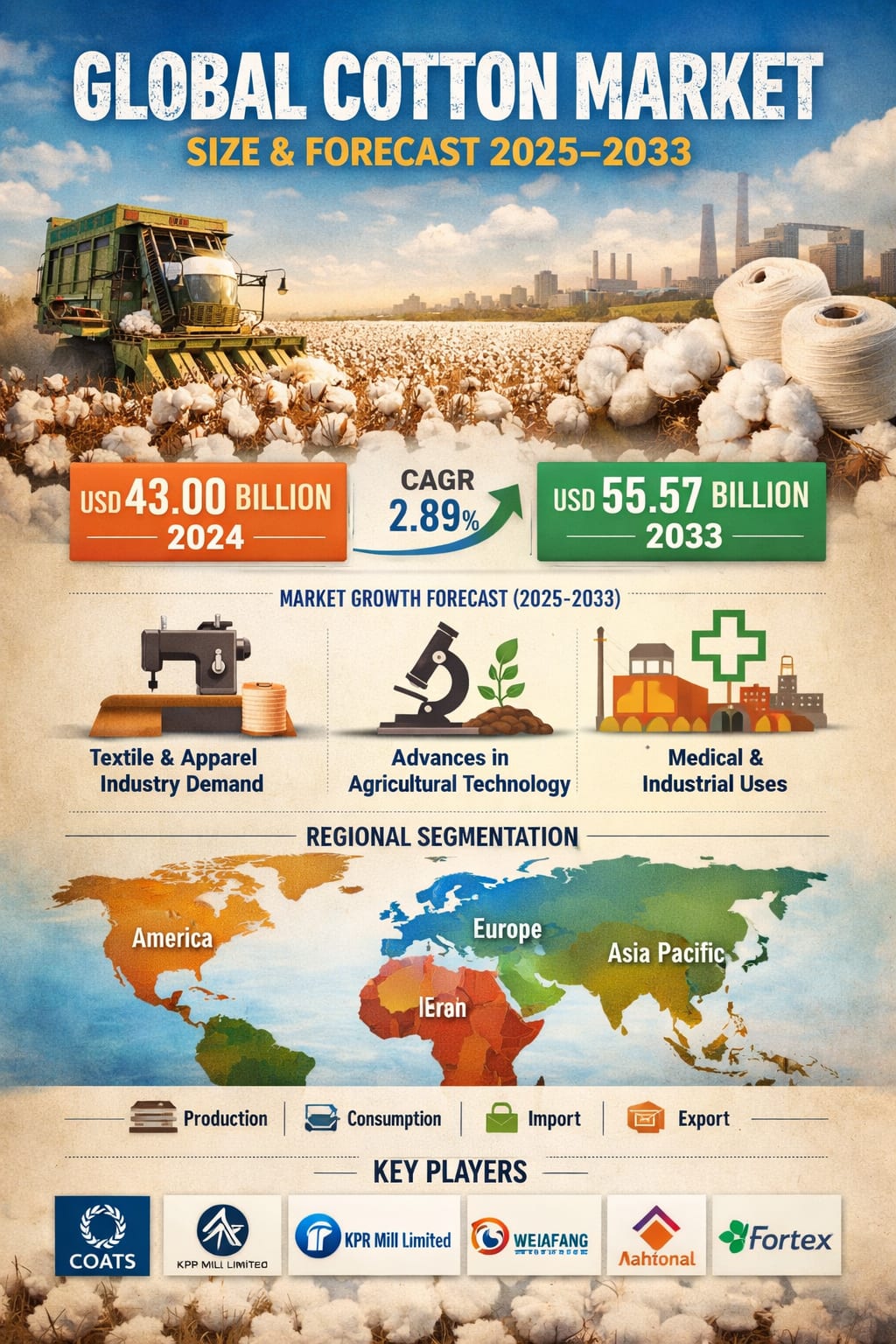
Global Cotton Market Overview
The size of the global cotton market was valued at USD 43.00 billion in 2024 and is projected to reach USD 55.57 billion by 2033, expanding at a compound annual growth rate (CAGR) of 2.89% during the period from 2025 to 2033. This steady growth trajectory is being supported by rising demand from the textile and apparel industry, improvements in agricultural productivity, and the expanding use of cotton in medical and industrial applications.
Cotton is a fluffy, soft natural fiber that grows around the seeds of the cotton plant, primarily from the genus Gossypium. It is one of the oldest and most widely used natural fibers in the world, prized for its breathability, comfort, durability, and versatility. After harvesting, cotton is spun into yarn or thread and used extensively in clothing, home textiles such as bed sheets and towels, and a wide range of industrial and medical products including bandages, gauze, and specialty papers.
The global importance of cotton lies in both its agricultural and industrial relevance. It is cultivated across multiple continents, with China, India, the United States, Pakistan, and Brazil among the leading producers. Beyond fashion, cotton plays a crucial role in healthcare, personal care, and several technical textile applications. Its biodegradable and natural characteristics have also strengthened its position at a time when sustainability and eco-friendly materials are gaining attention worldwide.
The Global Cotton Market & Forecast report covers the market by Production, Consumption, Import & Export, across key Regions (America, Europe, Asia Pacific, Middle East & Rest of the World), along with Company Analysis for 2025–2033.
Growth Drivers for the Global Cotton Industry
Increasing Demand from the Textile and Apparel Sector
The global textile and apparel industry remains the largest consumer of cotton, and it continues to be the primary engine of market growth. As fashion markets expand across Asia, Africa, and Latin America, the demand for affordable, comfortable, and breathable fabrics continues to rise. Cotton’s natural feel and versatility make it a preferred choice for both casual and formal wear.
The rapid spread of fast fashion, combined with rising disposable incomes in emerging economies, has further boosted cotton consumption. At the same time, many consumers are increasingly favoring natural fibers over synthetic alternatives due to comfort and environmental considerations. This shift in consumer preference keeps cotton at the center of global apparel production.
Strategic moves by industry players also reflect this trend. For instance, RSWM acquired Ginni Filaments in December 2023 to enhance productivity and expand its product portfolio for premium clients, underlining how companies are strengthening their positions in cotton-based textiles.
Government Support and Subsidies
Cotton cultivation benefits from significant government support in major producing countries such as the United States, India, and China. These supports often come in the form of subsidies, minimum support prices, research funding, and infrastructure development programs aimed at stabilizing farmer incomes and ensuring consistent production.
In many developing economies, cotton is closely linked with rural livelihoods, and governments actively promote it through irrigation projects, seed development programs, and farmer training initiatives. Such policies help improve yields, reduce risks, and stabilize supply chains.
On the international front, trade-related support mechanisms also help keep cotton competitively priced in global markets. For example, in May 2022, the USDA invested USD 50 million to support worsted wool clothing manufacturers and Pima cotton dress shirt manufacturers under its Pandemic Assistance for Producers program, highlighting the strategic importance of cotton-linked industries.
Agricultural Technology Advances
Technological progress in agriculture is transforming the cotton industry. Innovations such as genetically modified (GM) seeds, precision farming, drip irrigation systems, and advanced pest management techniques have significantly improved yields and crop quality. These methods help farmers produce more cotton using fewer resources, reducing losses caused by pests and unpredictable weather patterns.
Countries like India and the United States are increasingly adopting technology-driven farming practices. Digital tools, satellite data, and mobile applications are now being used to guide decisions related to irrigation, fertilization, and harvesting schedules. This shift toward smarter agriculture is making cotton production more efficient, scalable, and competitive on a global level.
Reflecting this push, in April 2024, India’s Union Textiles Ministry announced plans to introduce a new Cotton Technology Mission aimed at improving quality and yields through best agricultural practices.
Global Cotton Market Challenges
Climate Change and Water Shortage
Despite its importance, cotton production faces serious environmental challenges. Cotton is a water-intensive crop, and climate change is increasing the frequency of droughts, irregular rainfall patterns, and heatwaves in key producing regions. Countries such as India and Pakistan, which already struggle with water stress, are particularly vulnerable.
As water resources become scarcer, traditional cultivation methods are becoming less sustainable and more expensive. These environmental pressures not only threaten supply stability but also push producers to invest in water-saving technologies and alternative farming practices, increasing overall production costs.
Unpredictable Global Pricing and Trade Policies
The cotton market is highly sensitive to global commodity price fluctuations and trade policy changes. Shifts in demand, export restrictions, tariffs, and modifications to subsidy programs can quickly alter global trade flows and profitability.
Geopolitical tensions, such as trade disputes between major economies, have previously disrupted cotton exports and influenced international prices. Additionally, currency fluctuations and speculative trading add another layer of uncertainty. This volatility makes long-term planning difficult, especially for smaller producers and traders operating with limited financial buffers.
Global Cotton Production Market
Cotton production is concentrated in a few key countries, with India, China, the United States, Brazil, and Pakistan accounting for a large share of global output. India leads in terms of cultivated area, while the United States is known for high yields and technologically advanced farming practices.
Production levels are influenced by a mix of seasonal conditions, government policies, export demand, and global prices. The adoption of mechanized harvesting and biotech seeds continues to improve both quality and efficiency. However, environmental conditions remain a critical variable, making production volumes susceptible to climate-related risks.
In the United States, upland cotton accounted for about 99% of production in 2023, with Texas contributing roughly 40% of total output, highlighting the regional concentration of production within major exporting countries.
Global Cotton Consumption Market
The textile and garment industries dominate global cotton consumption, particularly in Asia. China, India, Bangladesh, and Vietnam host some of the world’s largest textile manufacturing hubs, relying heavily on cotton for yarn and fabric production.
Rising global population, increasing urbanization, and growing fashion awareness are supporting long-term demand. Moreover, the expanding middle class in emerging economies is driving higher consumption of apparel and home textiles, further reinforcing cotton’s role in the supply chain.
China alone accounted for 27.2% of global cotton imports in 2023, despite its strong domestic production base. Over the forecast period, its consumption patterns are expected to evolve in line with trends toward eco-friendly textiles and more technologically advanced manufacturing processes.
Global Cotton Import Market
Cotton imports are essential for countries with large textile industries but limited domestic production capacity. China, Bangladesh, Vietnam, and Turkey are among the world’s largest importers, sourcing raw cotton to feed their rapidly growing garment and textile sectors.
Import demand is shaped by price competitiveness, fiber quality, and trade agreements. Any supply disruption or price spike in major exporting countries can have immediate effects on importing nations. As global supply chains become more interconnected, many textile-producing countries are also diversifying their sourcing strategies to reduce risk.
According to the USDA, in 2023, the top importers of U.S. cotton were China, Pakistan, and Vietnam, together accounting for 52% of U.S. cotton export volume. This highlights the strategic importance of stable trade relationships in the cotton ecosystem.
Global Cotton Export Market
The global export landscape is dominated by the United States, Brazil, and Australia, which supply large volumes of raw cotton to textile-producing nations. The U.S. benefits from strong logistics, consistent quality, and well-established trade networks. Brazil’s growing acreage and competitive pricing have helped it expand its presence, particularly in Asian markets, while Australia is known for premium-quality cotton favored by high-end textile manufacturers.
Export trends are influenced by currency movements, global demand cycles, and trade policies. According to ITC Trade Map data, Greece was Europe’s leading cotton exporter in 2022, exporting 268,300 metric tons worth USD 662.6 million, with Turkey accounting for over half of its export value.
Regional Market Insights
United States Cotton Market
The United States is one of the world’s leading producers and exporters of cotton, with major cultivation in states such as Texas, Georgia, and Mississippi. High levels of mechanization, advanced seed technology, and strong research support contribute to consistent quality and productivity.
Most U.S. cotton is exported, with key markets including China, Vietnam, and Turkey. In January 2023, U.S. textile exports increased by 4.05%, reaching USD 1.89 billion, reflecting healthy global demand for textile products linked to cotton.
United Kingdom Cotton Market
The UK does not produce cotton but remains a significant importer for its textile and retail sectors. Demand is increasingly driven by interest in organic and sustainably sourced cotton, in line with the country’s strong focus on ethical sourcing. Post-Brexit trade realignments continue to shape supplier relationships and import patterns.
Germany Cotton Market
Germany is a major European consumer of cotton-based products, supported by its strong fashion, home textile, and automotive textile sectors. Sustainability is a key theme, with growing demand for certified organic and Fairtrade cotton. In July 2024, TURNS GmbH and Tailorlux GmbH partnered to enhance traceability in recycled cotton products, highlighting the market’s shift toward circular and transparent supply chains.
China Cotton Market
China is both the world’s largest cotton consumer and one of the largest producers, with the Xinjiang region accounting for around 80% of national production in 2023. Cotton is grown on approximately 2.7 million hectares, and the industry supports millions of jobs across farming and textile manufacturing. Despite strong domestic output, China remains a major importer due to the sheer scale of its textile industry.
Middle East Markets: Saudi Arabia and UAE
Saudi Arabia and the UAE do not produce cotton on a large scale due to climatic conditions, but both are important consumer and import markets. Rising incomes, expanding retail sectors, and government-led industrial diversification initiatives are boosting demand for cotton-based garments and home textiles. The UAE, in particular, serves as a regional hub for textile trade and re-exports.
Cotton Market Segmentation
By Market Type:
Production
Consumption
Import
Export
By Region:
America: United States, Canada, Mexico, Brazil
Europe: United Kingdom, Germany, France, Italy, Spain, Netherlands
Asia Pacific: China, Japan, India, South Korea, Australia
Middle East & Africa: South Africa, United Arab Emirates
Rest of the World
Competitive Landscape
Key companies operating in the global cotton and textile ecosystem include:
Aarti International Limited
Coats Group plc
Damodar Group
Fortex
Huafang Group
KPR Mill Limited
Maharaja Shree Umaid Mills Limited
Nahar Spinning Group
Nitin Spinners Ltd.
Weiqiao Textile Company Limited (Shandong Weiqiao Pioneering Group)
These companies are analyzed based on company overview, sales performance, and recent developments and strategies, reflecting a competitive environment focused on capacity expansion, sustainability, and product innovation.
Final Thoughts
The global cotton market may not be the fastest-growing commodity sector, but its steady, reliable expansion underscores its enduring importance in the world economy. With the market expected to grow from USD 43.00 billion in 2024 to USD 55.57 billion by 2033, cotton will continue to play a central role in textiles, apparel, and a wide range of industrial and medical applications.
While challenges such as climate change, water scarcity, and price volatility remain, advancements in agricultural technology, strong government support, and sustained demand from the global fashion and textile industry provide a solid foundation for long-term stability. In a world increasingly focused on sustainability and natural materials, cotton’s relevance looks set to endure well beyond 2033.
About the Creator
Tom Shane
Tom Shane is a content writer specializing in SEO-driven blogs, product descriptions, and thought leadership. He crafts engaging, research-backed content that connects with audiences and drives results.


Comments
There are no comments for this story
Be the first to respond and start the conversation.