
Clinical Chemistry Analyzer Market Trends & Summary
How Rising Chronic Diseases, Aging Populations, and Smart Diagnostics Are Reshaping the Global Lab Testing Industry

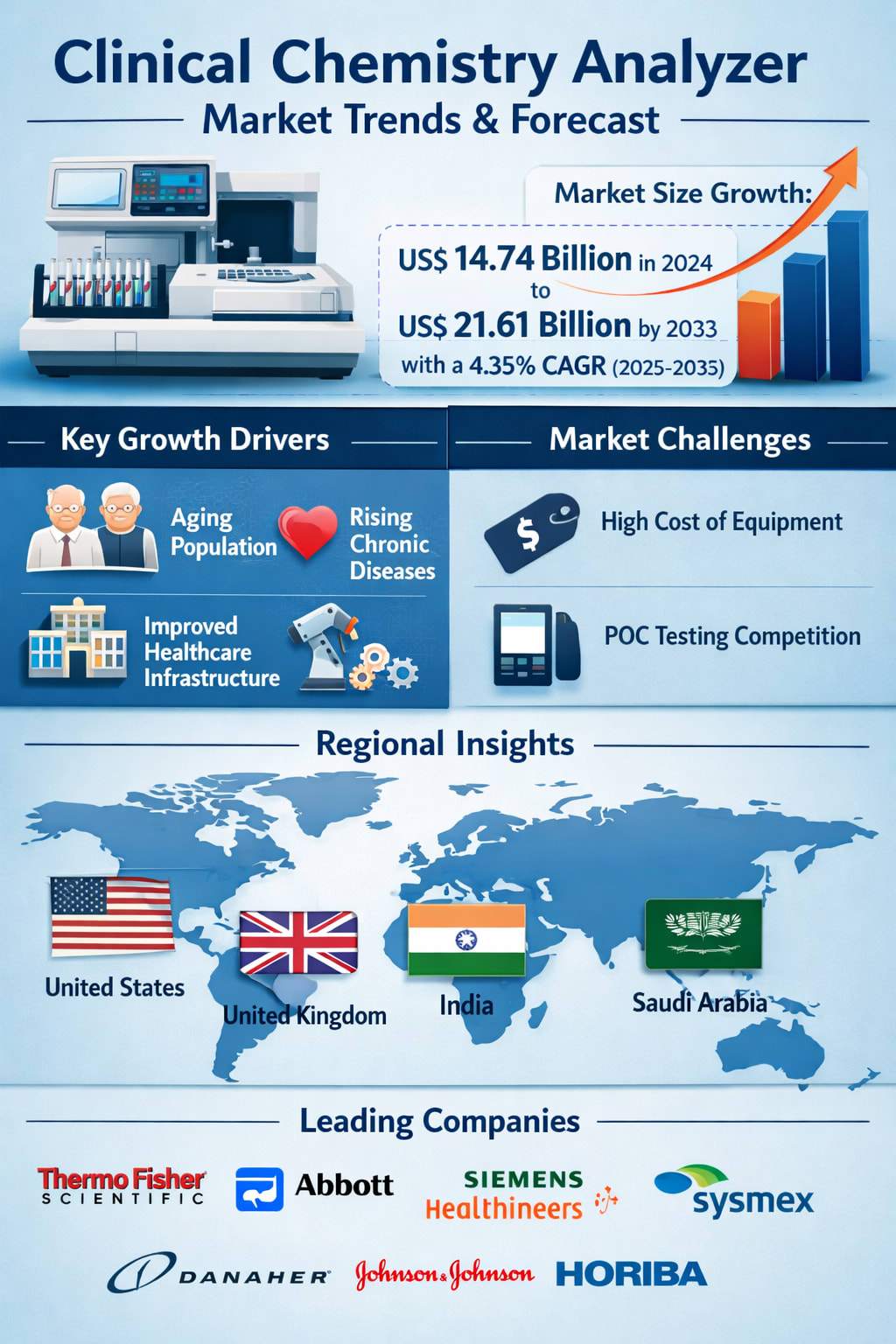
The Global Clinical Chemistry Analyzer Market at a Glance
The Clinical Chemistry Analyzer Market is expected to reach US$ 21.61 billion by 2033, growing from US$ 14.74 billion in 2024, at a compound annual growth rate (CAGR) of 4.35% from 2025 to 2033. This steady expansion reflects the growing importance of laboratory diagnostics in modern healthcare systems, especially as chronic diseases such as diabetes, cardiovascular disorders, and kidney disease continue to rise worldwide.
Clinical chemistry analyzers are automated laboratory instruments used to measure the chemical components of biological fluids such as blood, serum, urine, and cerebrospinal fluid. These systems quantify substances including glucose, electrolytes, enzymes, hormones, lipids, and proteins using techniques such as spectrophotometry, immunoassays, and electrochemistry. The results generated by these analyzers play a central role in disease diagnosis, treatment monitoring, and long-term patient management.
As healthcare systems increasingly prioritize early diagnosis, preventive care, and personalized treatment, the demand for fast, accurate, and high-throughput diagnostic solutions continues to grow. Clinical chemistry analyzers sit at the heart of this transformation, enabling clinicians to make timely, evidence-based decisions that improve patient outcomes and optimize healthcare resources.
Industry Overview: Why Clinical Chemistry Analyzers Matter
Clinical chemistry analyzers are a cornerstone of modern laboratory medicine. From routine health checkups to complex disease management, these systems provide critical biochemical data that supports nearly every medical specialty. Conditions such as diabetes, liver disease, renal disorders, thyroid dysfunction, and metabolic abnormalities rely heavily on laboratory values generated by these analyzers for both diagnosis and ongoing monitoring.
The growing global burden of chronic diseases is a key driver behind rising test volumes. According to global health estimates, chronic illnesses account for the majority of deaths worldwide, and their prevalence continues to increase due to aging populations, sedentary lifestyles, and dietary changes. Diabetes alone affects hundreds of millions of adults globally and requires continuous monitoring of glucose levels, lipid profiles, kidney function, and other biochemical markers—most of which are measured using clinical chemistry analyzers.
In parallel, healthcare systems are shifting toward preventive care models. Routine screening programs, annual health checkups, and early detection initiatives all depend on reliable laboratory diagnostics. This trend further reinforces the essential role of clinical chemistry analyzers in both developed and emerging healthcare markets.
Key Growth Drivers Shaping the Market
1. Rising Aging Population
One of the most powerful long-term drivers of the clinical chemistry analyzer market is the aging global population. Older adults are more likely to suffer from chronic and age-related conditions such as diabetes, cardiovascular disease, osteoporosis, and kidney disorders. These conditions require frequent laboratory testing to monitor disease progression, adjust treatments, and prevent complications.
As life expectancy increases worldwide, healthcare systems are facing a growing demand for routine and specialized diagnostic tests. Clinical chemistry analyzers enable laboratories to handle this rising workload efficiently by offering high-throughput testing, consistent accuracy, and faster turnaround times. The combination of demographic aging and increased healthcare utilization makes this segment a stable and reliable growth engine for the market.
2. Rising Prevalence of Chronic Diseases
The global surge in chronic diseases such as diabetes, hypertension, cancer, and metabolic disorders has significantly increased the demand for biochemical testing. These conditions often require lifelong monitoring, with patients undergoing regular blood and urine tests to track key biomarkers.
Clinical chemistry analyzers are central to this process. They provide clinicians with real-time insights into a patient’s metabolic state, organ function, and treatment response. As lifestyles become more sedentary and urbanization continues, the incidence of these diseases is expected to rise further, ensuring sustained demand for advanced diagnostic platforms.
In addition, the shift toward value-based healthcare models emphasizes early diagnosis and proactive disease management. This further boosts the need for reliable, repeatable, and scalable laboratory testing solutions.
3. Improved Healthcare Infrastructure in Emerging Markets
Healthcare infrastructure is rapidly improving in many developing and emerging economies. Governments and private healthcare providers are investing heavily in hospitals, diagnostic laboratories, and research institutes to expand access to quality medical services.
As these facilities modernize, there is a growing demand for advanced diagnostic equipment, including clinical chemistry analyzers. The expansion of the middle class, increased health awareness, and wider insurance coverage are also encouraging more people to seek routine medical testing. Together, these trends are creating strong growth opportunities for manufacturers of clinical chemistry analyzers in Asia-Pacific, Latin America, the Middle East, and parts of Africa.
4. Technological Advancements and Automation
Technological innovation continues to reshape the clinical chemistry analyzer landscape. Modern systems are increasingly automated, capable of running multiple tests simultaneously, and integrated with laboratory information systems. Automation reduces human error, improves consistency, and significantly shortens turnaround times.
Artificial intelligence, data analytics, and smart workflow management tools are also being integrated into newer platforms, helping laboratories optimize efficiency and manage growing test volumes. These innovations make advanced analyzers more attractive to hospitals and large diagnostic chains, further supporting market expansion.
Challenges Facing the Clinical Chemistry Analyzer Market
High Cost of Equipment
One of the most significant barriers to wider adoption is the high cost of clinical chemistry analyzers and their ongoing maintenance. Advanced systems require substantial upfront investment, along with recurring expenses for reagents, consumables, servicing, and calibration.
For smaller hospitals, clinics, and diagnostic centers—especially in low- and middle-income countries—these costs can be prohibitive. Budget constraints may delay purchasing decisions or force facilities to rely on older, less efficient equipment. This cost barrier limits market penetration in resource-constrained settings and slows the pace of technology upgrades in some regions.
Competition from Emerging Diagnostic Technologies
Another major challenge comes from the rapid growth of point-of-care (POC) testing devices and other decentralized diagnostic solutions. POC devices offer quick results, portability, and ease of use, making them particularly attractive in emergency departments, outpatient clinics, and remote or resource-limited settings.
While traditional clinical chemistry analyzers remain superior for high-volume, comprehensive testing, POC technologies are steadily capturing market share in scenarios where speed and convenience are prioritized. As healthcare providers increasingly seek faster decision-making tools, manufacturers of conventional analyzers must continue to innovate to maintain their competitive edge.
Regional Market Insights
United States
The United States represents one of the largest and most mature markets for clinical chemistry analyzers. A strong healthcare infrastructure, high diagnostic testing volumes, and widespread adoption of advanced laboratory technologies support steady market growth. The rising prevalence of chronic diseases, combined with an aging population, continues to drive demand for routine and specialized biochemical testing.
Technological advancements in automation, miniaturization, and digital integration are further enhancing the capabilities of laboratory systems. However, the market also faces challenges such as high equipment costs, regulatory compliance requirements, and competition from point-of-care testing solutions. Despite these hurdles, the U.S. market remains a key revenue generator and innovation hub for the global industry.
United Kingdom
The UK clinical chemistry analyzer market is growing at a steady pace, supported by increasing demand for accurate and efficient diagnostic testing across hospitals and diagnostic laboratories. Chronic diseases such as diabetes, cardiovascular disorders, and kidney conditions are major drivers of routine laboratory testing volumes.
The emphasis on early diagnosis, preventive healthcare, and healthcare system efficiency is encouraging greater adoption of automated laboratory solutions. At the same time, budgetary pressures, regulatory requirements, and competition from alternative diagnostic technologies pose ongoing challenges. Even so, continued investment in healthcare modernization is expected to sustain market growth.
India
India is one of the fastest-growing markets for clinical chemistry analyzers, driven by a rapidly expanding healthcare sector and a rising burden of chronic diseases. Increasing awareness of preventive healthcare, growth in diagnostic chains, and improvements in healthcare infrastructure are all contributing to higher demand for advanced laboratory equipment.
Technological progress, including automation and digital connectivity, is making modern analyzers more accessible and efficient. However, challenges such as high capital costs, uneven healthcare access in rural areas, and regulatory complexities still limit broader adoption. Despite these constraints, the long-term outlook for the Indian market remains highly positive.
Saudi Arabia
Saudi Arabia’s clinical chemistry analyzer market is expanding rapidly, supported by rising healthcare expenditure, a growing prevalence of lifestyle-related diseases, and large-scale healthcare reforms under Vision 2030. The country is investing heavily in modern hospitals, diagnostic centers, and digital health infrastructure.
The adoption of advanced diagnostic technologies, including automated and AI-enabled analyzers, is improving testing accuracy and efficiency. While high upfront costs and the need for skilled personnel remain challenges, the strong focus on preventive healthcare and early diagnosis continues to fuel market growth.
Market Segmentation Overview
By Product Type
Analyzers
Reagents
Others
By Test Type
Basic Metabolic Panel
Liver Panel
Renal Profile
Lipid Profile
Thyroid Function Panel
Electrolyte Panel
Specialty Chemical Tests
By End User
Hospitals
Diagnostic Laboratories
Research Laboratories & Institutes
Others
By Country (24-Market Coverage)
United States, Canada, Germany, United Kingdom, France, Italy, Netherlands, Spain, China, South Korea, Japan, India, Indonesia, Malaysia, Argentina, Brazil, Mexico, Colombia, Saudi Arabia, South Africa, Israel, Australia, UAE, and Rest of the World.
Competitive Landscape and Company Analysis
The global clinical chemistry analyzer market is characterized by the presence of several large multinational players with strong research, manufacturing, and distribution capabilities. Key companies profiled in the market include:
Thermo Fisher Scientific
Abbott Laboratories
Siemens Healthineers
Danaher Corporation
Johnson & Johnson
Sysmex ADR
HORIBA, Ltd.
Hitachi
Hologic, Inc.
These companies compete across multiple dimensions, including product innovation, automation, assay menus, global reach, and service support. Market analysis typically evaluates each player from four perspectives: company overview, key leadership, recent developments, and financial performance. Continuous investment in R&D, strategic partnerships, and geographic expansion remains central to maintaining competitive advantage in this evolving market.
The Road Ahead: What the Future Holds
Looking ahead, the clinical chemistry analyzer market is poised for steady and sustainable growth through 2033. The projected rise from US$ 14.74 billion in 2024 to US$ 21.61 billion by 2033 underscores the enduring importance of laboratory diagnostics in global healthcare.
While challenges such as high costs and competition from point-of-care technologies persist, the fundamental drivers—aging populations, rising chronic disease prevalence, expanding healthcare infrastructure, and ongoing technological innovation—remain firmly in place. Laboratories will continue to seek solutions that improve efficiency, accuracy, and throughput, ensuring that clinical chemistry analyzers remain a core component of diagnostic medicine.
Final Thoughts
The clinical chemistry analyzer market stands at the intersection of technology, medicine, and public health. As healthcare systems worldwide grapple with the growing burden of chronic disease and the need for early, accurate diagnosis, these instruments play a vital role in shaping patient outcomes and healthcare efficiency.
With steady growth expected over the next decade, driven by demographic shifts, infrastructure development, and continuous innovation, clinical chemistry analyzers will remain indispensable tools in modern medicine. For healthcare providers, policymakers, and industry players alike, this market represents not just a business opportunity, but a critical pillar of future-ready healthcare systems.
About the Creator
Mexico Wealth Management Market Growth, Outlook and Industry Analysis
Market Overview — Mexico Wealth Management Market The Mexico Wealth Management Market has emerged as a dynamic segment within the country’s broader financial services industry, driven by rising affluence, expanding investor sophistication, and an increasingly diversified financial ecosystem. Wealth management in Mexico encompasses a wide range of services — from traditional financial planning and asset allocation to advanced portfolio construction, tax planning, legacy planning, and digital advisory solutions. This market serves a diverse client base, including high-net-worth individuals (HNWIs), mass affluent investors, and retail clients seeking tailored investment strategies and long-term financial security. The sector also includes both traditional human advisory models and hybrid or automated (robo-advisory) platforms that cater to different investor needs.
By Kim Soo hyun3 days ago in Trader
Analyse this!
Wanna know how to improve your writing? There is a simple, quick, tried and tested method. Tried and tested by who? By me, as it happens, and I can guarantee that it will work for you. I know what I am talking about. Not always, of course, but certainly in this case.
By Raymond G. Taylor4 days ago in Writers


Comments
There are no comments for this story
Be the first to respond and start the conversation.