
Global Agricultural Micronutrients Market Trends & Summary (2025–2033)
Precision Farming, Soil Health, and High-Yield Crops Drive a Market Set to Nearly Double by 2033

A Market Rooted in the Future of Food Security
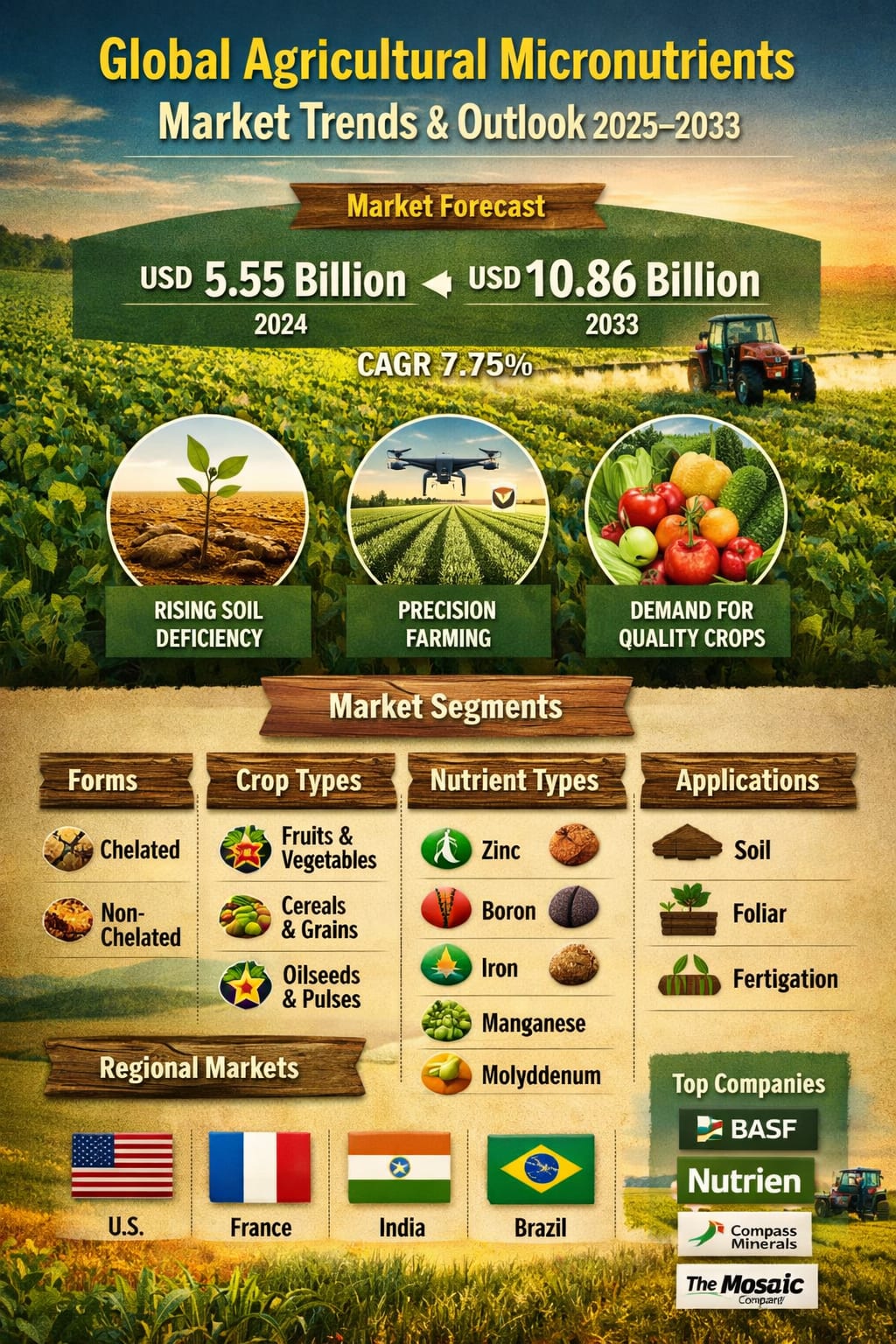
The Global Agricultural Micronutrients Market is entering a decisive growth phase as modern agriculture increasingly focuses on productivity, sustainability, and nutritional quality. Valued at USD 5.55 billion in 2024, the market is projected to rise to USD 10.86 billion by 2033, expanding at a CAGR of 7.75% during 2025–2033, according to Renub Research.
This growth reflects more than just rising fertilizer sales. It signals a broader transformation in global farming—one shaped by soil health challenges, climate stress, precision agriculture, and the urgent need to produce more food on limited arable land. As farmers worldwide face declining soil fertility and increasing pressure to improve yields, micronutrients are no longer optional inputs; they are becoming essential tools for sustainable crop production.
Understanding Agricultural Micronutrients: Small Quantities, Big Impact
Crop micronutrients are essential elements required by plants in small quantities, yet they play a critical role in plant growth, metabolism, enzyme activity, and disease resistance. Key micronutrients include zinc, boron, iron, manganese, copper, molybdenum, and chlorine. Unlike macronutrients such as nitrogen, phosphorus, and potassium, micronutrients are needed in trace amounts—but without them, crops cannot reach their full yield or quality potential.
Over the past decade, intensive farming practices, monocropping, soil erosion, and unbalanced fertilizer use have accelerated micronutrient depletion in many agricultural regions. As a result, deficiencies—especially of zinc, iron, and boron—are becoming increasingly common, directly affecting crop productivity and food quality.
At the same time, climate change, water stress, and shrinking farmland are forcing farmers to become more efficient with every input they apply. This has made micronutrient-enriched fertilizers and targeted nutrient management strategies a cornerstone of modern, high-performance agriculture.
Market Outlook: Why Micronutrients Are Gaining Momentum
The agricultural micronutrients market is benefiting from three powerful, interconnected trends:
Rising demand for high-yielding and high-quality crops
Growing adoption of precision and sustainable farming practices
Increasing awareness of soil health and long-term productivity
As global food demand continues to rise, farmers are under pressure to produce more per hectare while using fewer resources. Micronutrients help bridge this gap by improving nutrient use efficiency, crop resilience, and overall yield stability.
In addition, consumers are becoming more conscious of nutritional quality, pushing food producers to focus not just on volume, but also on crop quality, shelf life, and nutrient density—all areas where micronutrients play a vital role.
Key Growth Drivers Shaping the Market
🌾 Rising Soil Nutrient Deficiency
One of the strongest drivers of the agricultural micronutrients market is the widespread degradation of soil quality. Years of intensive cultivation, excessive use of chemical fertilizers, and soil erosion have led to significant micronutrient deficiencies across major agricultural regions.
Elements such as zinc, iron, and boron are increasingly lacking in soils, directly limiting crop yields and quality. To counter this, farmers are turning to micronutrient-fortified fertilizers to restore soil balance and sustain productivity.
With the global population continuing to grow, food security has become inseparable from soil health. According to FAO projections, global demand for agricultural goods is set to rise significantly, reinforcing the need for nutrient-balanced soils and efficient crop nutrition strategies.
🚜 Precision Farming and Modern Agricultural Practices
The rise of precision farming is reshaping how nutrients are applied in the field. Technologies such as soil testing, GPS-guided equipment, data-driven nutrient planning, smart irrigation, and fertigation systems allow farmers to deliver micronutrients exactly where and when crops need them.
This targeted approach reduces waste, improves nutrient uptake efficiency, and enhances crop performance—all while supporting environmentally responsible farming.
A notable example of this trend is the collaboration announced in March 2025 between Krukowiak, a major Polish agricultural machinery manufacturer, and xFarm Technologies, a Swiss leader in farm digitalization. Their joint project aims to improve the sustainability and precision of sprayers and controllers, strengthening the adoption of precision agriculture across Europe.
As these technologies become more accessible, demand for high-quality, application-specific micronutrient formulations is expected to accelerate.
🥦 Growing Demand for High-Quality and Nutritious Crops
Modern consumers are no longer satisfied with just higher yields—they want better-quality, more nutritious, and safer food. Micronutrients play a key role in improving crop taste, appearance, shelf life, and nutritional content.
The expansion of organic farming, fortified foods, and premium produce markets is pushing farmers to invest in better crop nutrition programs. Initiatives like the FAO–CIMMYT Vision for Adapted Crops and Soils (VACS), launched in July 2024, highlight the global focus on resilient, climate-adapted, and nutrient-rich crops grown in healthy soils.
This shift toward quality-driven agriculture is directly supporting the long-term growth of the micronutrients market.
Challenges Facing the Global Market
💰 High Costs and Limited Awareness Among Small Farmers
Despite their benefits, micronutrients—especially chelated formulations and precision application technologies—can be costly for small-scale farmers, particularly in developing regions. Limited awareness about correct usage and long-term benefits also leads to underutilization or improper application.
To address this, many governments and agricultural organizations are rolling out subsidies, training programs, and awareness campaigns aimed at promoting balanced nutrient management and sustainable farming practices.
🌍 Regulatory and Environmental Concerns
The agricultural input sector is subject to strict regulatory frameworks, and micronutrients are no exception. Different countries have varying standards for product approval, which can slow down innovation and market entry.
Additionally, concerns over heavy metal contamination in certain fertilizers have led to tighter environmental regulations. This is pushing manufacturers to focus on cleaner, safer, and more sustainable micronutrient solutions, which, while positive in the long run, can increase development and compliance costs in the short term.
Segment Insights: Where Growth Is Concentrated
🧪 Chelated vs. Non-Chelated Micronutrients
Chelated micronutrients are gaining strong traction due to their higher bioavailability and stability in soil. By binding micronutrients to organic molecules, chelation prevents nutrient lock-up and improves plant absorption—making these products especially popular for high-value crops like fruits, vegetables, and ornamentals.
Non-chelated micronutrients remain widely used due to their lower cost, particularly in large-scale staple crop farming, but the long-term trend favors chelated formulations for efficiency and sustainability.
🌽 By Crop Type: Fruits & Vegetables Lead the Way
The fruits and vegetables segment represents one of the largest consumers of agricultural micronutrients. These crops require precise and balanced nutrition to achieve optimal size, color, taste, and disease resistance.
Meanwhile, oilseeds and pulses are also driving demand, supported by rising global consumption of plant-based proteins and edible oils. Micronutrients like zinc, iron, and molybdenum are essential for improving root development, protein synthesis, and seed quality in these crops.
🧬 By Nutrient Type: Zinc and Iron in the Spotlight
Zinc is critical for enzyme activity and chlorophyll formation. Its deficiency leads to stunted growth and reduced yields, making zinc-enriched fertilizers increasingly popular in deficient regions.
Iron plays a central role in photosynthesis and energy transfer. Chelated forms such as Fe-EDTA and Fe-DTPA are widely used to prevent chlorosis and improve plant vigor.
Other important nutrients—boron, manganese, and molybdenum—continue to see steady demand, especially in soil health management programs.
💧 By Application: Soil, Foliar, and Fertigation
Soil application remains the most common method, especially for long-term soil fertility improvement.
Foliar application is gaining popularity for its quick correction of deficiencies during critical growth stages.
Fertigation is emerging as a high-growth segment, particularly in greenhouse farming, drip irrigation systems, and high-value crops, thanks to its precision and efficiency.
Regional Outlook: A Truly Global Market
🇺🇸 United States
The U.S. remains a leading market due to widespread adoption of soil testing, precision agriculture, and sustainable farming practices. In February 2024, Helena Agri-Enterprises expanded the label for its Zypro soil amendment, demonstrating continued innovation in nutrient management solutions.
🇫🇷 France
France’s strong focus on viticulture, fruits, and cereals, combined with government support for sustainable and organic farming, is driving steady growth in micronutrient usage—especially chelated products for high-quality crop production.
🇮🇳 India
India is one of the fastest-growing markets, supported by government subsidies, awareness programs, and widespread zinc and iron deficiencies in soil. In May 2023, Aries Agro Limited launched the “100 Days Drone Yatra” initiative to promote drone-based micronutrient spraying, highlighting how technology is reshaping nutrient application in the country.
🇧🇷 Brazil
As a global powerhouse in soybeans, coffee, and sugarcane, Brazil’s nutrient-poor tropical soils make micronutrient supplementation essential. The country’s growing adoption of precision agriculture and large-scale commercial farming continues to fuel demand, supported by innovations like Elicit Plant’s EliZon bio-solution launched in September 2024.
Competitive Landscape: Key Players to Watch
The global agricultural micronutrients market is shaped by major players including:
BASF SE
Compass Minerals
Coromandel International
Deepak Fertilizers
Nouryon
Nufarm
Nutrien Ltd.
The Mosaic Company
Yara International
These companies compete across product innovation, regional expansion, sustainability initiatives, and advanced formulations, offering solutions tailored to different crops, soils, and farming systems.
Final Thoughts: Small Nutrients, Massive Impact
The story of the Global Agricultural Micronutrients Market is ultimately a story about the future of farming. As the market grows from USD 5.55 billion in 2024 to USD 10.86 billion by 2033, it reflects a deeper shift toward smarter, more sustainable, and more resilient agriculture.
In a world facing climate uncertainty, soil degradation, and rising food demand, micronutrients are proving that small inputs can deliver big results. For farmers, agribusinesses, and policymakers alike, investing in balanced crop nutrition is no longer just good practice—it’s a strategic necessity for feeding the future.
About the Creator
NASDAQ 100 Trends: How Smart Investors Capitalize on Market Moves
The NASDAQ 100 is one of the most watched stock indexes in the world. It includes 100 of the largest companies on the Nasdaq exchange, mostly from technology, retail, and healthcare sectors. For many investors, the NASDAQ 100 acts as a market thermometer. Smart investors pay close attention because the index shows where growth opportunities are. Understanding NASDAQ 100 trends helps them make informed decisions before the market shifts. They will explore the strategies top investors use to capitalize on these moves.
By hamza mirzaabout 20 hours ago in Trader
Super Bowl LX Recap: A Team Called Hawks
Sixty. The Super Bowl turned 60! Still amazes me that this was the sixtieth Super Bowl played in NFL history. It seems like yesterday that I watched Super Bowl XXVII, the first SB I ever watched. The QB who won Super Bowl XXVII has since called a few SBs, and will call next year's game, but that's another story. Super Bowl LX took place at Levi's Stadium in Santa Clara, California, the home stadium of the San Francisco 49ers. However, it was one of their division foes who represented the NFC, as the Seattle Seahawks faced off against the New England Patriots.
By Clyde E. Dawkins3 days ago in Unbalanced




Comments
There are no comments for this story
Be the first to respond and start the conversation.