
GCC Hydroponics Market Trends & Summary (2025–2033)
How water scarcity, food security goals, and agri-tech investments are reshaping farming across the Gulf

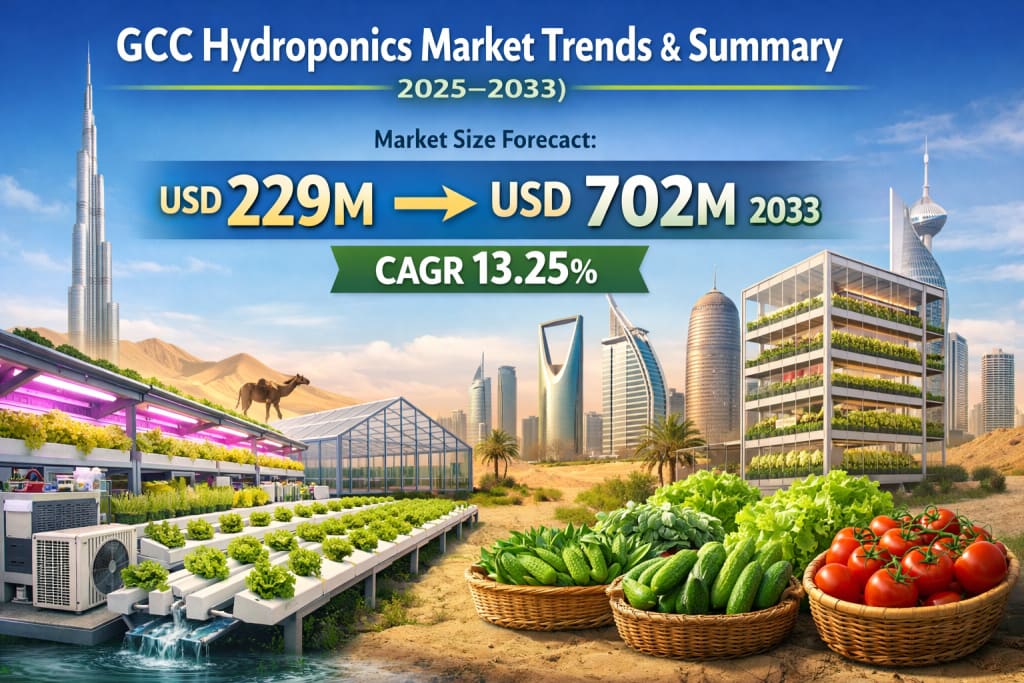
GCC Hydroponics Market Size & Forecast
According to Renub Research, the GCC Hydroponics Market was valued at USD 229.24 million in 2024 and is projected to reach USD 702.48 million by 2033, expanding at a robust CAGR of 13.25% from 2025 to 2033. This impressive growth trajectory is being driven by rising demand for sustainable agriculture solutions, increasing pressure on water resources, and proactive government policies supporting modern farming techniques.
In a region defined by desert climates and limited arable land, hydroponics offers a powerful alternative to conventional agriculture. By growing plants in nutrient-rich water solutions instead of soil, hydroponic systems can cut water usage by up to 90% while delivering higher yields and consistent quality. For the GCC—where food imports dominate and climate conditions are harsh—this technology is not just innovative, it is strategic.
GCC Hydroponics Market Outlook
Hydroponics has emerged as one of the most promising answers to the Gulf’s long-standing agricultural challenges. Traditional farming in the GCC is constrained by extreme heat, poor soil quality, and severe water scarcity. Hydroponics, by contrast, enables crops to grow in controlled environments where temperature, humidity, and nutrients can be precisely managed.
This method is particularly well-suited for leafy greens, herbs, tomatoes, cucumbers, and peppers, all of which are in high demand across the region’s urban centers, hospitality sector, and retail food chains. The ability to grow crops year-round—regardless of external weather conditions—has made hydroponics increasingly attractive for both governments and private investors.
Urban agriculture, commercial greenhouses, and vertical farming projects are now becoming common sights in countries such as the UAE and Saudi Arabia. These nations are investing heavily in hydroponic systems to reduce dependence on food imports and strengthen domestic food supply chains. As sustainability remains high on the policy agenda, hydroponic farming is expected to expand rapidly across the GCC over the next decade.
Key Growth Drivers in the GCC Hydroponics Market
1. Water Conservation and Sustainability Initiatives
Water scarcity is one of the most pressing challenges facing the GCC. Conventional agriculture consumes vast amounts of water—an increasingly unsustainable practice in a region with limited freshwater resources. Hydroponics offers a compelling solution by using significantly less water while maintaining high productivity.
Governments across Saudi Arabia, the UAE, and other GCC countries are actively promoting water-efficient farming methods as part of broader sustainability strategies. With population growth, urbanization, and industrial development placing additional pressure on water supplies, the need for resource-efficient agriculture has never been more urgent.
According to regional infrastructure estimates, water demand in the GCC is expected to rise sharply in the coming years, prompting billions of dollars in investments in water and wastewater projects. In this context, hydroponics aligns perfectly with long-term environmental and economic goals.
2. Government Support and Agri-Tech Investments
Policy support is playing a decisive role in accelerating the adoption of hydroponics. Initiatives such as Saudi Arabia’s Vision 2030 and the UAE’s National Food Security Strategy are explicitly designed to boost local food production and reduce reliance on imports.
Governments are offering subsidies, funding research programs, and forming partnerships with global agri-tech companies to build advanced farming ecosystems. The private sector is responding in kind. For example, regional and international investors have poured significant capital into vertical farming and controlled-environment agriculture projects across the Gulf.
High-profile developments—such as large-scale vertical farms, agri-tech parks, and food innovation hubs—are helping to turn the GCC into a testing ground for next-generation agricultural technologies. These investments are not only expanding production capacity but also building local expertise in hydroponic systems and smart farming solutions.
3. Rising Demand for Fresh, Locally Produced Food
Consumer preferences in the GCC are changing rapidly. With growing awareness of health, nutrition, and food safety, demand for fresh, pesticide-free, and locally grown produce is increasing across supermarkets, restaurants, and hotels.
Hydroponic farming makes it possible to grow crops close to urban centers, reducing transportation costs, minimizing supply chain disruptions, and ensuring fresher produce reaches consumers. The “farm-to-table” trend, once limited to niche markets, is now becoming mainstream in major Gulf cities.
Population growth further strengthens this demand. With the GCC population projected to rise significantly in the coming decades, ensuring a stable, local, and sustainable food supply is becoming a strategic priority. Hydroponics offers a scalable and climate-resilient solution to meet these needs.
Market Challenges
High Initial Setup Costs
Despite its long-term benefits, hydroponics requires substantial upfront investment. Setting up controlled-environment greenhouses, installing LED grow lights, HVAC systems, irrigation infrastructure, and automated control systems can be capital-intensive. This can act as a barrier, particularly for small and medium-sized farmers or new market entrants.
Shortage of Skilled Manpower
Hydroponic farming is technology-driven and requires expertise in nutrient management, climate control, and system maintenance. The GCC currently faces a shortage of skilled agronomists and technicians specialized in hydroponics. As a result, many projects rely on foreign experts, increasing operational costs and highlighting the need for local training and capacity-building programs.
GCC Hydroponics Market Overview
Overall, the GCC hydroponics market is on a strong growth path, supported by rising investment in sustainable agriculture, food security initiatives, and advanced farming technologies. The market spans commercial greenhouses, vertical farms, and controlled-environment agriculture facilities, all catering to the region’s growing appetite for fresh, high-quality, and chemical-free produce.
The UAE and Saudi Arabia currently lead the market, but countries such as Qatar, Bahrain, Kuwait, and Oman are also stepping up investments in modern farming solutions.
Segment Analysis
By Type
Aggregate Systems:
Aggregate systems—using substrates such as sand, perlite, or rock wool—are widely used in the GCC due to their strong water retention and efficient nutrient delivery. These systems are especially popular for crops like tomatoes, cucumbers, and lettuce, making them suitable for large-scale commercial production.
Liquid Systems:
Liquid systems, including Nutrient Film Technique (NFT) and Deep Water Culture (DWC), are gaining popularity, particularly in vertical farming setups. These systems allow faster plant growth and efficient nutrient absorption, supporting high-density urban farming projects.
By Crop Type
Tomatoes:
Tomatoes are among the most commercially important hydroponic crops in the GCC. Hydroponic cultivation improves yield, quality, and shelf life, meeting strong demand from households, restaurants, and the food processing industry.
Herbs:
Herbs such as basil, mint, and coriander thrive in hydroponic environments and offer quick growth cycles. The hospitality and foodservice sectors rely heavily on fresh herbs, making this segment a high-growth opportunity.
Lettuce, Cucumbers, Peppers, and Others:
These crops benefit from controlled-environment farming, ensuring consistent supply, uniform quality, and reduced exposure to pests and diseases.
By Equipment
HVAC Systems:
Climate control is essential in the GCC’s extreme heat. Advanced HVAC systems help maintain optimal temperature and humidity, protecting crops and maximizing yields.
LED Grow Lights:
Energy-efficient LED lighting enables year-round cultivation and supports vertical farming models, especially in urban areas.
Irrigation Systems:
Smart irrigation and automated nutrient dosing systems are critical for efficient water use and consistent crop performance.
Material Handling & Control Systems:
Automation and digital control platforms are increasingly being adopted to improve efficiency, reduce labor costs, and enhance production reliability.
Country-Level Insights
Saudi Arabia
Saudi Arabia is making significant strides in hydroponic farming under its Vision 2030 program. Large-scale commercial projects are being launched to improve food security and reduce import dependence. Initiatives linked to futuristic developments and agri-food innovation platforms are positioning the country as a major player in advanced agriculture.
United Arab Emirates (UAE)
The UAE leads the regional hydroponics market, with numerous vertical farms and high-tech greenhouses already in operation. Government-backed agri-tech strategies, investment platforms, and innovation hubs are accelerating market growth. Strong consumer demand for premium, locally grown produce further supports expansion.
Qatar
Qatar is investing in hydroponics as part of its broader food security strategy. Research initiatives and partnerships with agri-food companies are encouraging the development of indoor farming and sustainable crop production systems.
Bahrain
Bahrain is gradually adopting hydroponic farming to overcome limited arable land and water constraints. Government support and private sector partnerships are helping establish new sustainable farming facilities.
Oman and Kuwait
Both countries are exploring controlled-environment agriculture and hydroponics as part of their long-term sustainability and food security plans, although their markets are still at an earlier stage of development compared to the UAE and Saudi Arabia.
GCC Hydroponics Market Segmentation
By Type:
Aggregate Systems
Liquid Systems
By Crop Type:
Tomatoes
Herbs
Lettuce
Cucumbers
Peppers
Others
By Equipment:
HVAC
LED Grow Light
Irrigation Systems
Material Handling
Control Systems
Others
By Region:
Saudi Arabia
UAE
Qatar
Oman
Kuwait
Bahrain
Competitive Landscape
Companies in this market are typically analyzed across five dimensions:
Overview, Key People, Recent Developments, Product Portfolio, and Revenue.
Key Players Include:
AeroFarms
AmHydro
Freight Farms
Green Sense Farms Holdings Inc
LumiGrow
Unrivaled Brands Inc
BrightFarms
The Scotts Company LLC
Hydrodynamics International
Signify Holding
These companies are driving innovation in lighting, climate control, automation, and vertical farming systems, helping to shape the future of hydroponics in the GCC and beyond.
Conclusion
The GCC hydroponics market is moving from experimentation to large-scale commercialization. With a projected rise from USD 229.24 million in 2024 to USD 702.48 million by 2033, the sector reflects the region’s urgent push toward sustainable, water-efficient, and technology-driven agriculture.
Backed by strong government support, rising consumer demand for fresh local produce, and growing private investment in agri-tech, hydroponics is set to become a cornerstone of the Gulf’s food security strategy. While challenges such as high initial costs and skills shortages remain, the long-term outlook is undeniably strong.
About the Creator
Nykaa Shares Rally as Analysts Predict Up to 26% Potential Gains
Shares of Nykaa, India’s leading beauty and personal care e-commerce company, have recently shown strong bullish momentum, attracting investor attention. Analysts believe that the stock has the potential to gain up to 26% from current levels, citing robust financial performance, strategic initiatives, and market growth.
By Hammad Nawaza day ago in Trader
Should We Not Try to Get Too Political?
Here's something you often hear people say, "I try not to get too political." I understand the sentiment and I sympathize with it... while at the same exact time, I completely disagree with the notion. Whether it's referring to social media or wherever, it's kind of unavoidable. You can attempt to sidestep it, not engage, leave the less important things for actual politicians to discuss... you can want it to not take over your life, your conversations, your relationships, and that makes perfect sense.
By Stephen Kramer Avitabile6 days ago in Writers




Comments
There are no comments for this story
Be the first to respond and start the conversation.