
GCC Wires and Cables Market Size and Forecast 2025–2033
Infrastructure Boom, Renewable Energy Push, and Digital Transformation Power Strong Growth Across Saudi Arabia, UAE, and Qatar

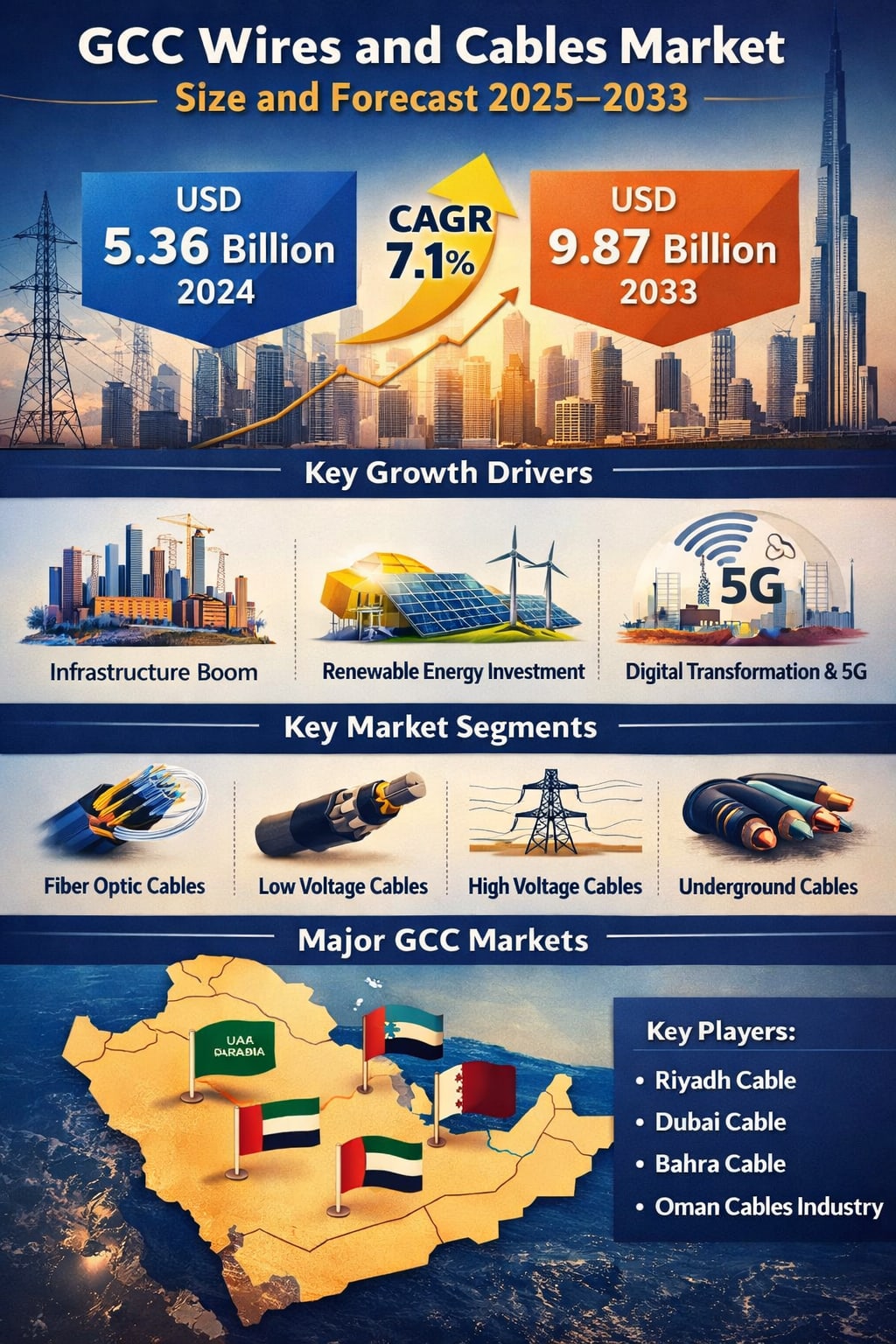
GCC Wires and Cables Market Overview
The GCC Wires and Cables Market was valued at USD 5.36 billion in 2024 and is expected to reach USD 9.87 billion by 2033, growing at a CAGR of 7.1% during 2025–2033. This strong growth trajectory is driven by rapid infrastructure development, rising investments in renewable energy, and the continuous expansion of power transmission and digital communication networks across the Gulf region, particularly in Saudi Arabia, the UAE, and Qatar.
Wires and cables are the backbone of modern infrastructure. While a wire typically consists of a single conductor, a cable is made up of multiple conductors bundled together and insulated for safety and durability. These products are indispensable in residential, commercial, industrial, and utility applications—ranging from basic lighting systems and household appliances to complex power grids, data centers, and high-speed communication networks.
In the GCC, the importance of wires and cables has grown significantly over the past decade. Mega infrastructure projects, smart city initiatives, metro rail networks, airports, oil & gas facilities, and high-rise commercial buildings all require massive volumes of reliable cabling. At the same time, the region’s push toward renewable energy, digitalization, and electrification is creating sustained demand for high-performance, specialized cables. With governments allocating substantial budgets to utilities, transport, and digital infrastructure, the GCC wires and cables market is positioned for long-term, stable growth.
Growth Drivers in the GCC Wires & Cables Market
Rise in Infrastructure and Construction Projects
The GCC region is in the middle of a historic construction boom. Landmark projects such as Saudi Arabia’s NEOM, large-scale urban developments in the UAE, and Qatar’s post–World Cup infrastructure expansion are transforming the region’s physical landscape. These developments require extensive wiring for power distribution, lighting, communication, automation, and safety systems.
Rapid urbanization, population growth, and rising commercial activity are further fueling demand for residential complexes, office buildings, shopping malls, industrial zones, and logistics hubs. Each of these projects depends heavily on low-, medium-, and high-voltage cables. As building standards in the GCC become more focused on safety, efficiency, and sustainability, the demand for high-quality, durable, and fire-resistant cables continues to rise, making construction one of the most powerful growth engines for the market.
Renewable Energy Integration and Grid Expansion
GCC governments are accelerating their shift toward renewable energy as part of long-term economic diversification strategies. Flagship projects such as the Mohammed bin Rashid Al Maktoum Solar Park in the UAE and Saudi Arabia’s renewable energy initiatives under Vision 2030 are reshaping the region’s power landscape.
The integration of large-scale solar and wind projects into national grids requires advanced power transmission infrastructure, including high-voltage and extra-high-voltage cables. These cables are essential for transmitting electricity over long distances with minimal losses and for maintaining grid stability. As more renewable capacity comes online and cross-border grid interconnections expand, the demand for specialized, high-performance power cables is expected to grow steadily throughout the forecast period.
Digital Transformation and 5G Deployment
The GCC is one of the most digitally ambitious regions in the world. Massive investments are being made in data centers, fiber optic networks, cloud infrastructure, and 5G connectivity. Fiber optic cables, in particular, play a critical role in enabling high-speed, high-capacity data transmission required for smart cities, e-government services, fintech, e-commerce, and AI-driven applications.
Countries such as Saudi Arabia, the UAE, Qatar, Bahrain, and Oman have announced aggressive digitalization targets for government services and public infrastructure. The rollout of 5G networks and the rapid growth of IoT ecosystems are further boosting demand for structured cabling, signal cables, and fiber optics. This digital surge is turning the IT and telecommunications sector into one of the fastest-growing end-user segments for wires and cables in the GCC.
Challenges in the GCC Wires and Cables Market
Volatility of Raw Material Prices
Copper, aluminum, and polymers are key raw materials used in cable manufacturing, and their prices are highly sensitive to global supply-demand dynamics, geopolitical tensions, and logistics disruptions. Price volatility directly affects production costs and profit margins for manufacturers and suppliers.
In the GCC, where many infrastructure projects operate under strict budgets and timelines, fluctuations in raw material prices can lead to cost overruns, project delays, or pressure on margins. This uncertainty also impacts long-term planning and pricing strategies, making cost management a persistent challenge for the industry.
Regulatory Differences and Standardization Issues
Although GCC countries share many economic and strategic goals, regulatory frameworks and technical standards for cables can still vary from one country to another. Differences in fire safety regulations, voltage ratings, insulation requirements, and certification processes can complicate cross-border trade and regional standardization.
For manufacturers and suppliers, complying with multiple standards increases testing, certification, and administrative costs. These regulatory complexities can slow down project approvals and limit the speed at which new technologies and products are adopted across the region.
Key Market Segments and Trends
GCC Fiber Optic Cables Market
The fiber optic segment is one of the fastest-growing parts of the GCC wires and cables market, driven by rapid digitalization and 5G deployment. Fiber cables enable ultra-high-speed data transmission and are essential for smart city infrastructure, cloud services, and modern telecom networks.
With governments and private players investing heavily in data centers and digital platforms, fiber optics are becoming a strategic asset for the region’s future-ready infrastructure. As legacy networks are upgraded and new digital ecosystems emerge, demand for fiber optic cabling is expected to remain strong throughout the forecast period.
GCC Low Voltage Wires & Cables Market
Low-voltage cables are widely used in residential buildings, commercial spaces, and light industrial applications for power distribution, lighting, and control systems. The steady expansion of housing projects, retail centers, and office buildings across the GCC is supporting consistent growth in this segment.
In addition, low-voltage cables are increasingly used in solar installations and energy-efficient building systems. Growing awareness of fire safety and sustainability is also pushing demand toward flame-retardant and halogen-free low-voltage cables, especially in densely populated urban areas.
GCC High Voltage Wires & Cables Market
High-voltage and extra-high-voltage cables are critical for long-distance power transmission, grid interconnections, and large-scale renewable energy projects. As the GCC expands its power generation capacity and strengthens regional grid networks, this segment is gaining strategic importance.
Utility-scale solar and wind farms, industrial zones, and oil & gas facilities all rely on robust high-voltage cabling to ensure reliable and efficient power supply. The focus on reducing transmission losses and improving grid resilience is further supporting demand in this segment.
GCC Underground Wires & Cables Market
Urban development in the GCC is increasingly favoring underground cabling due to safety, reliability, and aesthetic considerations. Underground cables are less vulnerable to extreme weather conditions and help reduce visual clutter in modern cities.
Mega urban projects, metro rail systems, and smart city developments in cities like Dubai, Riyadh, and Doha are accelerating the adoption of underground cabling. Although the initial installation cost is higher, the long-term benefits in terms of durability and reduced maintenance make underground systems an attractive choice for urban planners.
GCC Building & Construction Wires & Cables Market
The building and construction sector remains the largest end-user of wires and cables in the GCC. Skyscrapers, airports, stadiums, hospitals, hotels, and residential complexes all require extensive electrical and communication cabling.
As building codes become stricter regarding safety, energy efficiency, and sustainability, demand is rising for low-smoke, fire-resistant, and environmentally friendly cables. The growth of smart buildings and automation systems is also increasing the need for advanced, integrated cabling solutions.
GCC IT & Telecommunication Wires & Cables Market
The rapid expansion of IT infrastructure, cloud computing, and telecom networks is driving strong demand for structured cabling systems. Data centers, telecom towers, enterprise networks, and government IT projects all depend on high-quality cabling for reliable, high-speed data transmission.
With the spread of 5G and the growth of IoT applications, telecom operators and enterprises are investing heavily in upgrading legacy cabling systems to support higher bandwidth and lower latency requirements.
Country-Level Insights
Saudi Arabia Wires & Cables Market
Saudi Arabia dominates the GCC wires and cables market due to its massive infrastructure pipeline, industrial expansion, and ambitious Vision 2030 projects such as NEOM and the Red Sea Project. Investments in renewable energy, smart cities, data centers, and manufacturing zones are driving strong demand across all voltage segments.
Localization policies and support for domestic manufacturing are also strengthening the country’s cable industry, improving supply security and boosting competitiveness.
UAE Wires & Cables Market
The UAE is a regional hub for innovation, real estate, and digital infrastructure. Smart city projects, transport networks, renewable energy investments, and large-scale commercial developments in Dubai and Abu Dhabi are key growth drivers.
The country’s strong focus on sustainability, energy efficiency, and digital transformation is increasing demand for fiber optics, solar cables, and high-performance power cables, making the UAE one of the most dynamic markets in the region.
Qatar Wires & Cables Market
Qatar’s market is supported by ongoing investments in transport, energy, and urban development, including projects such as Lusail City and airport expansions. The country’s National Vision 2030 emphasizes economic diversification and digital innovation, which is boosting demand for both power and communication cables.
Qatar’s growing focus on green buildings and sustainable infrastructure is also encouraging the adoption of energy-efficient and environmentally friendly cabling solutions.
Market Segmentation Snapshot
By Cable Type:
Low Voltage Energy
Power Cable
Fiber Optic Cable
Signal and Control Cable
Other Cable Types
By Voltage:
Low Voltage
Medium Voltage
High Voltage
Extra High Voltage
By Installation:
Overhead
Underground
By End User:
Aerospace & Defense
Building & Construction
Oil & Gas
Energy & Power
IT & Telecommunication
Automotive
Others
By Countries:
Saudi Arabia
UAE
Kuwait
Qatar
Oman
Bahrain
Key Players Include:
Riyadh Cable, Al Fanar Electrical Systems, Jeddah Cable, Bahra Cable, Dubai Cable, National Cable Industry, Power Plus Cables, Oman Cables Industry (OCI), Doha Cables, and QICC Cables.
Final Thoughts
The GCC wires and cables market is entering a powerful growth phase, supported by infrastructure megaprojects, renewable energy expansion, and rapid digital transformation. With the market projected to grow from USD 5.36 billion in 2024 to USD 9.87 billion by 2033, the sector offers strong opportunities for manufacturers, suppliers, and investors alike.
While challenges such as raw material price volatility and regulatory differences remain, the long-term fundamentals are solid. As Saudi Arabia, the UAE, Qatar, and other GCC countries continue to invest in future-ready infrastructure, wires and cables will remain a critical foundation of the region’s economic and technological progress.
About the Creator
Sakshi Sharma
Content Writer with 7+ years of experience crafting SEO-driven blogs, web copy & research reports. Skilled in creating engaging, audience-focused content across diverse industries.
Keep reading
More stories from Sakshi Sharma and writers in Trader and other communities.
Asia Air Conditioner (AC) Market Size and Forecast 2025–2033
Asia Air Conditioner Market at a Glance The Asia Air Conditioner (AC) Market was valued at USD 93.59 billion in 2024 and is projected to reach USD 150.64 billion by 2033, growing at a CAGR of 5.43% during 2025–2033. This robust expansion is being fueled by rising temperatures, accelerating urbanization, and the surging demand for energy-efficient cooling systems across residential, commercial, and industrial sectors in major economies such as China, India, Japan, and Southeast Asia.
By Sakshi Sharmaabout 17 hours ago in Trader
Having A House Is Pointless If You Don't Have Any Savings
A house is a luxury, and you do not need luxuries to experience success and fulfillment. Homeownership is often treated as proof that someone has “made it,” but that belief ignores context, timing, and individual financial reality. Success is not defined by what you own, but by how stable, flexible, and prepared you are for the future. For many people, chasing a house too early can actually delay real financial progress.
By Destiny S. Harris6 days ago in Trader
I've Just Realized
The President doesn't understand music. There. It felt very good to write that; it's some thing I just realized today. Oh , yes; he plays it. He TRUMPets it in rallies and meetings, pumps it across the airwaves when he gathers up our minutes waiting for his late arrival.
By Judey Kalchik 4 days ago in Beat



Comments
There are no comments for this story
Be the first to respond and start the conversation.