
Global Voice Biometrics Market Size & Forecast 2026–2034
From passwords to voiceprints: How AI-powered voice authentication is reshaping digital security worldwide

The Rise of Voice as the New Password
In an increasingly digital world, the way people prove who they are is changing fast. Passwords, PINs, and security questions—once the backbone of digital security—are now widely seen as weak, inconvenient, and vulnerable to fraud. As cybercrime becomes more sophisticated and identity theft continues to rise, organizations are searching for authentication methods that are both secure and frictionless.
This is where voice biometrics enters the picture.
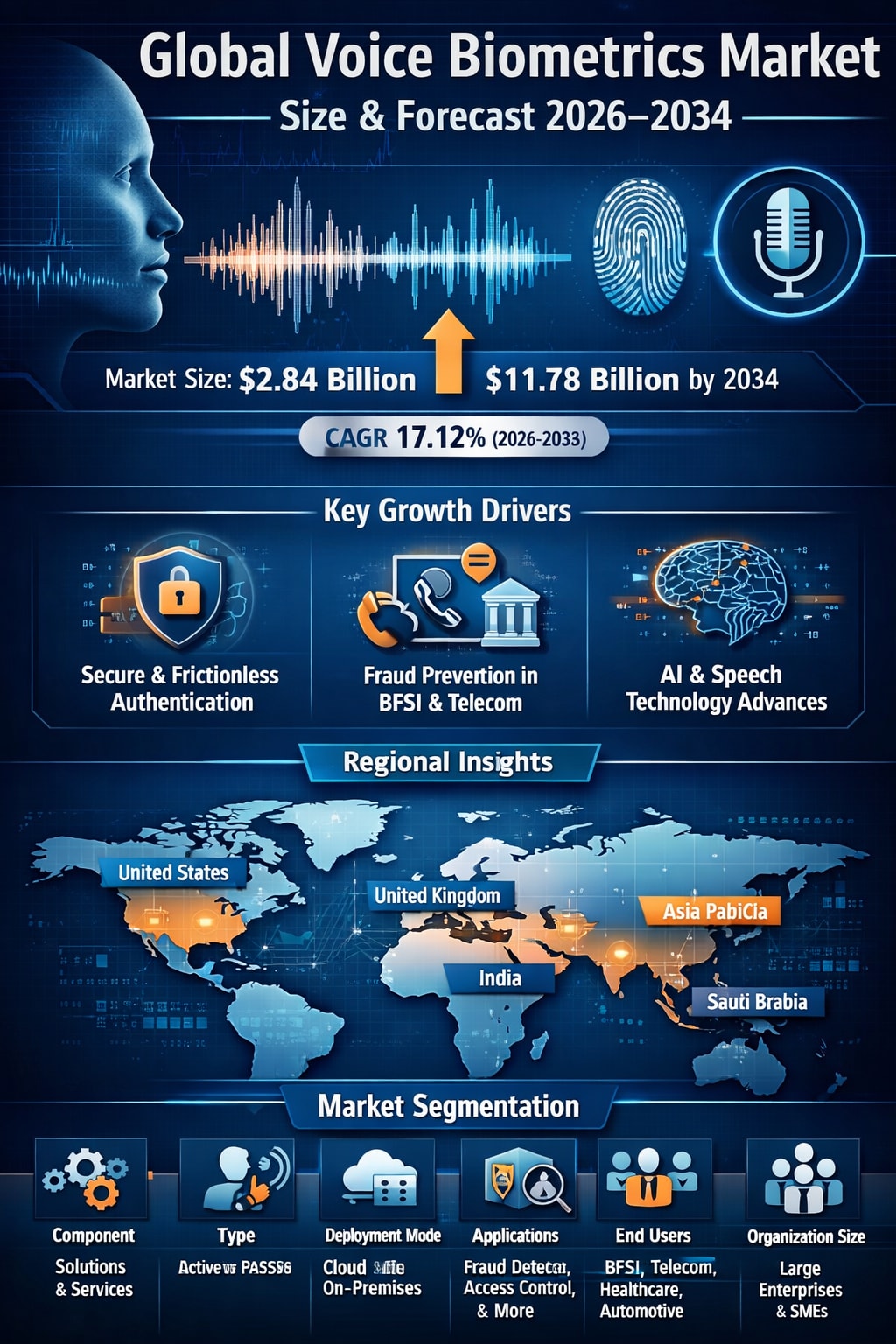
According to Renub Research, the Global Voice Biometrics Market is expected to expand from US$ 2.84 billion in 2025 to US$ 11.78 billion by 2034, growing at a strong CAGR of 17.12% during 2026–2034. This rapid growth is being driven by rising demand for secure and convenient authentication, expanding adoption across banking, telecom, and government sectors, and continuous breakthroughs in artificial intelligence and speech technologies.
Voice biometrics is no longer a futuristic concept. It is already being used in call centers, mobile banking apps, customer service platforms, and even vehicles. As digital interactions multiply, the human voice is quickly becoming one of the most powerful tools for verifying identity—naturally, securely, and without friction.
Understanding Voice Biometrics: More Than Just Speech Recognition
Voice biometrics is a biometric authentication technology that identifies or verifies a person based on the unique characteristics of their voice. Unlike basic voice recognition systems that focus on what is being said, voice biometrics analyzes how it is said—capturing elements such as pitch, tone, rhythm, and vocal patterns to create a unique voiceprint.
This voiceprint works much like a fingerprint or facial scan. It can be used to authenticate users in real time, offering a password-free and hands-free way to confirm identity. This makes voice biometrics particularly valuable for digital channels such as call centers, mobile apps, IVR systems, and remote customer service platforms.
Globally, adoption is accelerating due to the rising threat of identity fraud, data breaches, and cybercrime. Industries such as banking, financial services, insurance, healthcare, and telecom are increasingly deploying voice biometrics to secure customer interactions—especially as remote services, digital banking, and contactless authentication become the norm.
Advancements in AI and machine learning have significantly improved accuracy, reduced error rates, and enabled support for multiple languages and accents. As a result, voice biometrics is now positioned as a truly global and scalable identity solution.
Key Growth Drivers Shaping the Market
1. Rising Demand for Secure and Frictionless Authentication
One of the strongest drivers of the voice biometrics market is the global push for secure yet user-friendly authentication. Traditional methods like passwords and security questions are not only inconvenient but also highly vulnerable to phishing, hacking, and social engineering attacks.
Voice biometrics offers a seamless alternative. Users can be authenticated naturally during a conversation, without needing to remember complex credentials. This is especially valuable in call centers, mobile banking apps, and customer support environments, where reducing friction can significantly improve customer experience.
In January 2026, Clover (by Fiserv) announced a partnership with Wink, integrating advanced identity and payment technologies into its platform—highlighting how the broader ecosystem is moving toward biometric-first identity experiences.
2. Growing Fraud Risks in BFSI and Telecom
Fraud is becoming more frequent, more complex, and more expensive. The banking, financial services, insurance, and telecom sectors are particularly vulnerable to call center fraud, account takeovers, and social engineering attacks.
Voice biometrics helps organizations detect known fraudsters, authenticate genuine customers, and flag suspicious behavior in real time. In telecom, it is being used to combat SIM swap fraud and unauthorized account access. In financial services, it supports secure transactions and reduces operational losses.
For example, in October 2025, Discovery Bank in South Africa introduced an in-app calling feature that allows customers to reach bankers securely without traditional security questions—demonstrating the industry’s shift toward more seamless and secure authentication models.
3. Advances in AI and Speech Analytics
The rapid evolution of artificial intelligence, machine learning, and speech analytics is transforming voice biometrics technology. Modern systems can now accurately analyze voices despite background noise, emotional variations, and different languages or accents.
AI-driven voice biometrics can also detect spoofing attempts, including replay attacks and synthetic or deepfake voices. Continuous learning models further improve accuracy over time, reducing false acceptance and false rejection rates.
In March 2025, Gnani.ai launched a new large language model for speech-to-speech applications, built in partnership with NVIDIA’s AI platform, capable of processing over 30 million voice conversations daily—showcasing how scalable and enterprise-ready voice AI has become.
Challenges That Could Slow Adoption
Privacy and Data Protection Concerns
Voice data is highly sensitive personal information. As a result, privacy, data protection, and regulatory compliance remain major challenges for the market. Regulations like GDPR and varying regional data protection laws can complicate deployment, especially for multinational organizations.
Some consumers are also hesitant to share voice data due to fears of misuse or unauthorized access. To address this, companies must invest in strong encryption, secure storage, and transparent data governance policies—often increasing implementation costs.
Accuracy Issues and Spoofing Risks
Although the technology has improved significantly, voice biometrics systems can still be affected by background noise, illness, aging, or emotional changes in a person’s voice. Differences in microphones and recording environments can also impact performance.
More importantly, the rise of AI-generated voices and deepfakes presents new security challenges. While vendors are actively developing anti-spoofing and liveness detection technologies, organizations must continuously update their systems to stay ahead of evolving threats.
Market Landscape by Segment
Voice Biometrics Solutions Market
This segment includes software platforms and integrated systems for speaker verification, identification, and continuous authentication. These solutions are widely used in contact centers, mobile apps, IVRs, and digital platforms, replacing knowledge-based authentication methods.
Cloud and hybrid deployments are gaining popularity due to faster implementation and easier integration with CRM, IAM, and contact center systems. Vendors compete on accuracy, anti-spoofing capabilities, multilingual support, and compliance features.
Active Voice Biometrics Market
Active voice biometrics requires users to speak a specific phrase for verification. It is commonly used in banking and government services where higher assurance and explicit consent are required. While slightly less frictionless than passive systems, it offers high accuracy and strong spoofing resistance.
On-Premises Voice Biometrics Market
On-premises solutions remain important for organizations with strict data residency, latency, or security requirements—especially in BFSI, government, and defense sectors. Although more expensive than cloud solutions, they provide full control over infrastructure and data.
Large Enterprises Voice Biometrics Market
Large enterprises are major adopters due to their high interaction volumes. Banks, telecom operators, insurers, and global retailers use voice biometrics to reduce fraud, lower call handling times, and improve customer experience. They also demand advanced features such as cross-channel enrollment and global language support.
Fraud Detection and Prevention
Voice biometrics plays a growing role in fraud detection by identifying known fraudsters and analyzing voiceprints against watchlists. When combined with behavioral analytics, it enables real-time risk assessment and faster investigations—helping organizations cut both fraud losses and operational costs.
Automotive Voice Biometrics Market
As vehicles become more connected and software-driven, voice biometrics is emerging as a tool for securing access to in-car systems, personalizing settings, and authenticating payments or remote services. It also supports hands-free interaction, improving safety and usability in shared mobility scenarios.
Regional Market Highlights
United States
The US market is highly advanced, driven by strong adoption in banking, telecom, healthcare, and government sectors. With rising identity fraud and call-center scams, many organizations are replacing traditional authentication methods with voice-based solutions. In June 2024, U.S. Bank joined other major institutions like Wells Fargo and Barclays in testing voice biometrics for app and website access.
United Kingdom
The UK market is growing steadily, especially in BFSI and telecom. Banks are using voice biometrics to meet strict regulatory requirements while improving customer experience. A strong focus on data privacy and compliance under GDPR continues to shape deployment strategies.
India
India is one of the fastest-growing markets due to massive digitalization, a large BPO and contact center industry, and rising fraud risks. Multilingual support is a major advantage in this diverse market. In April 2023, City Union Bank introduced voice biometric login for mobile banking, with plans to extend it to net banking as well.
Saudi Arabia
Saudi Arabia’s market is gaining momentum as part of the country’s broader digital transformation and cybersecurity initiatives. Banks, telecom operators, and government agencies are adopting voice biometrics to secure digital services. In October 2025, Idemia Public Security partnered with SAMI Advanced Electronics to drive innovation in smart mobility and digital identity solutions.
Competitive Landscape
Key players in the global voice biometrics market include:
Aculab PLC
Aware Inc
NICE Ltd
Nuance Communications Inc. (Microsoft Corporation)
OneVault
Phonexia SRO
Verint Systems Inc
These companies compete across multiple dimensions, including technology accuracy, AI capabilities, deployment flexibility, industry focus, and integration with enterprise platforms. Each is evaluated across five viewpoints: overview, key persons, recent developments, product portfolio, and financial insights.
Market Segmentation Snapshot
By Component:
Solutions
Services
By Type:
Active Voice Biometrics
Passive Voice Biometrics
By Deployment Mode:
On-premises
Cloud-based
By Organization Size:
Large Enterprises
Small and Medium-sized Enterprises (SMEs)
By Application:
Fraud Detection and Prevention
Access Control Authentication
Forensic Voice Analysis and Criminal Investigation
Others
By End User:
BFSI
IT and Telecom
Consumer Electronics
Automotive
Government
Healthcare
Others
By Region:
North America, Europe, Asia Pacific, Latin America, Middle East & Africa (with key countries including the US, UK, India, Saudi Arabia, and others)
Final Thoughts: The Voice-Led Future of Digital Identity
The global shift toward digital services has made secure, seamless authentication more important than ever. With the Global Voice Biometrics Market projected to grow from US$ 2.84 billion in 2025 to US$ 11.78 billion by 2034 at a CAGR of 17.12%, it is clear that voice is becoming a core pillar of the future identity ecosystem.
While challenges around privacy, accuracy, and spoofing remain, continuous advancements in AI, speech analytics, and cybersecurity are rapidly strengthening the technology. For industries battling rising fraud and seeking better customer experiences, voice biometrics offers a rare combination of security, convenience, and scalability.
About the Creator
How I Lost $5,000 Doing Options on AT&T
I lost $5,000 trading options on AT&T. And honestly? I deserved to lose it because I had no idea what I was doing. Today I'm gonna break down what options actually are - in the simplest way possible - and then give you the five lessons I learned the hard way so you don't repeat my mistakes.
By Destiny S. Harrisabout 10 hours ago in Trader
Buried for 33 Years: The Dream to Revive One of the Country’s Largest Gold Mines Is Back on the Map
For more than three decades, silence ruled the site where one of the country’s largest gold mines once thrived. Rusted machinery stood frozen in time. Flooded tunnels lay hidden beneath layers of earth. Warning signs faded under wind and rain, quietly marking what many believed was the end of an era.
By Adil Ali Khan2 days ago in Trader
~ Fired ~
— Ai Intrusion ~ Are you Next ~ Is Ai Evolution after your job? — Few workplaces haven't been affected. Ai is in supermarkets, at doctors' offices, and even monitoring farms. I just can't think of anything this machine is not getting into, can you? For instance: Education ~ Law and Tech jobs will one day have a major influence or be taken over by these inanimate machines, with accuracy and vigor. From mechanics' diagnoses to a wide variety of everyday jobs, including fast food workers, with this input having the ability to cut their unnecessary work hours. I'm certain all of us have been touched by this with our short stories and colorful headings, have you? Even comments are very questionable 'Non-Robot' insertions.
By Jay Kantor6 days ago in Journal



Comments
There are no comments for this story
Be the first to respond and start the conversation.