
Exchange-Traded Funds (ETFs): A Beginner’s Guide to Investing
Learn about ETFs and how to invest in them. Discover the benefits, types, strategies, and tips for beginners to grow wealth through exchange-traded funds.

Introduction
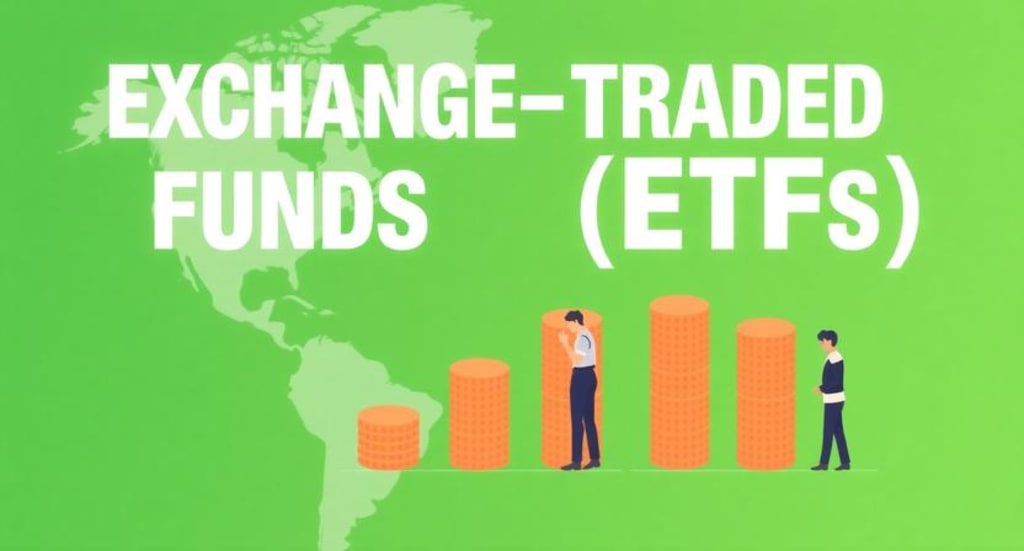
Exchange-Traded Funds (ETFs) have become one of the most popular investment options for both beginners and experienced investors. ETFs are investment funds that trade on stock exchanges, combining the diversification of mutual funds with the flexibility of stocks.
This guide explains what ETFs are, their types, advantages, risks, and strategies to help investors build a diversified and profitable portfolio.
What Are ETFs?
An ETF is a collection of assets—such as stocks, bonds, or commodities—that is traded on a stock exchange. Investors can buy or sell shares of the ETF just like individual stocks. ETFs aim to replicate the performance of an index, sector, or asset class.
For example, an S&P 500 ETF tracks the performance of the S&P 500 index, allowing investors to gain exposure to 500 large-cap US companies through a single investment.
Types of ETFs
1. Equity ETFs
Invest in stocks and can track indexes, sectors, or themes. Examples include technology ETFs or dividend-focused ETFs.
2. Bond ETFs
Invest in fixed-income securities such as government or corporate bonds, offering regular income and stability.
3. Commodity ETFs
Invest in physical commodities like gold, silver, or oil, providing exposure to non-equity assets.
4. Sector and Industry ETFs
Focus on specific industries such as healthcare, energy, or financials, enabling targeted investment strategies.
5. International ETFs
Provide exposure to global markets, allowing investors to diversify across countries and regions.
6. Thematic ETFs
Focus on trends or themes like clean energy, artificial intelligence, or cryptocurrency-related companies.
Benefits of ETFs
1. Diversification
ETFs allow investors to own multiple assets in a single fund, reducing risk and providing broad exposure.
2. Liquidity
ETFs trade like stocks on exchanges, making it easy to buy and sell throughout the trading day.
3. Low Costs
ETFs generally have lower expense ratios than mutual funds, making them cost-effective for long-term investors.
4. Transparency
Most ETFs disclose their holdings daily, giving investors visibility into the underlying assets.
5. Flexibility
Investors can use ETFs for long-term growth, income generation, or short-term trading strategies.
Risks of Investing in ETFs
Market Risk: ETF value can fluctuate based on the underlying assets.
Tracking Error: Some ETFs may not perfectly replicate the performance of their benchmark index.
Liquidity Risk: Certain niche or low-volume ETFs may be harder to trade without affecting price.
Sector or Theme Concentration: Specialized ETFs can carry higher volatility if the sector underperforms.
How to Invest in ETFs
Determine Investment Goals: Decide whether your focus is growth, income, or diversification.
Choose ETF Type: Select equity, bond, commodity, sector, or thematic ETFs based on your strategy.
Check Expense Ratios: Lower costs help maximize long-term returns.
Monitor Holdings: Understand the underlying assets and exposure of your ETF investments.
Use Dollar-Cost Averaging: Invest regularly to reduce the impact of market volatility.
Tips for Beginners
- Start with broad-market ETFs to gain diversified exposure.
- Combine equity and bond ETFs to balance growth and risk.
- Avoid chasing highly volatile or niche ETFs without research.
- Reinvest dividends to compound returns over time.
- Track ETF performance and periodically rebalance your portfolio.
Popular ETF Examples
SPDR S&P 500 ETF (SPY): Tracks the S&P 500 index.
iShares MSCI Emerging Markets ETF (EEM): Provides exposure to emerging market stocks.
Vanguard Total Bond Market ETF (BND): Covers a broad range of US bonds.
Invesco QQQ ETF (QQQ): Tracks Nasdaq-100 companies, focused on technology.
Final Thoughts
ETFs are a versatile investment tool that provides diversification, liquidity, and cost-efficiency. They are suitable for beginners and experienced investors looking to build a balanced portfolio or target specific markets and sectors.
By understanding ETF types, benefits, risks, and strategies, investors can use these funds to achieve long-term financial goals, generate income, and navigate market fluctuations with confidence.
About the Creator
Hammad Nawaz
Hammad here, sharing stock market insights, trading strategies, and tips. Helping traders understand trends, risk, and opportunities in equities, forex, and commodities.
Keep reading
More stories from Hammad Nawaz and writers in Trader and other communities.
Understanding Bonds: A Beginner’s Guide to Fixed-Income Investing
Introduction Bonds are debt securities issued by governments, corporations, or other entities to raise capital. Investors who buy bonds are essentially lending money in exchange for interest payments and the return of principal at maturity.
By Hammad Nawazabout 17 hours ago in Trader
Australia Chicken Poultry Market Trends & Summary (2025–2033)
Introduction The Australia Chicken Poultry Market is entering a decisive growth phase, driven by changing consumer diets, rising health awareness, technological modernization, and a strong push toward sustainability and food safety. According to industry estimates, the market is expected to reach US$ 5.15 billion by 2033, up from US$ 3.03 billion in 2024, growing at a CAGR of 6.08% from 2025 to 2033. This steady expansion reflects not only increasing domestic consumption but also structural shifts in how poultry is produced, processed, distributed, and marketed across the country.
By shibansh kumar3 days ago in Trader



Comments
There are no comments for this story
Be the first to respond and start the conversation.