
European Food Processing Automation Market Size & Forecast 2026–2034
Automation Redefining Europe’s Food Industry Amid Labor Gaps and Safety Demands

Market Overview
The Europe Food Processing Automation Market is undergoing a structural transformation as food manufacturers increasingly turn to smart, automated solutions to enhance efficiency, maintain regulatory compliance, and address workforce shortages. According to Renub Research, the market is projected to expand from US$ 7.09 billion in 2025 to US$ 12.12 billion by 2034, registering a compound annual growth rate (CAGR) of 6.14% during 2026–2034.
This steady growth reflects a broader shift across Europe’s food industry toward automation-driven production models. Rising consumption of processed and packaged foods, escalating labor costs, and increasingly stringent food safety regulations are accelerating investments in automated processing, packaging, and control systems across the region.
European Food Processing Automation Market Outlook
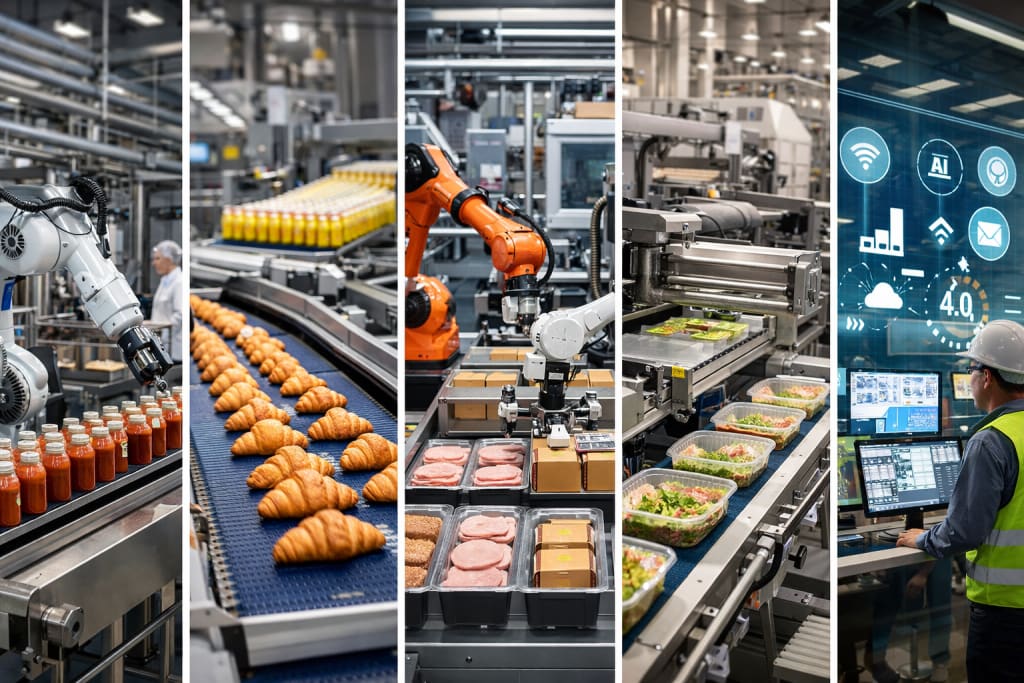
Food processing automation refers to the application of automated machinery, control systems, industrial software, and robotics across food production activities such as sorting, slicing, mixing, heating, cooling, filling, and packaging. These technologies allow food manufacturers to achieve higher production efficiency, consistency, hygiene, and scalability while minimizing human intervention.
In Europe, automation has evolved from a productivity tool into a strategic necessity. Food processors face constant pressure to deliver consistent quality at scale while complying with strict hygiene and traceability regulations. Automation solutions help standardize operations, reduce contamination risks, and ensure uniform output across large production volumes.
Moreover, automation supports sustainability objectives by reducing food waste, optimizing energy use, and improving operational visibility. Supported by Industry 4.0 initiatives and digital manufacturing policies, European food processors are increasingly adopting intelligent automation technologies that integrate data analytics, real-time monitoring, and predictive maintenance.
Key Growth Drivers in the European Market
Rising Demand for Processed and Convenience Foods
One of the most significant drivers of automation adoption is the growing European appetite for processed, packaged, and ready-to-eat foods. Urban lifestyles, dual-income households, and changing dietary habits have increased reliance on foods that offer convenience and extended shelf life.
Food manufacturers are under constant pressure to increase output without compromising taste, texture, or nutritional value. Automation enables continuous, high-speed production while maintaining product consistency. It also supports flexible packaging formats across frozen foods, dairy products, bakery items, and ready meals.
Industry restructuring further reflects this trend. In May 2025, Eisberg, part of the Bell Food Group, announced the sale of its production facilities in Poland, Romania, and Hungary to Green Factory, while retaining operations in Switzerland, Austria, and Spain. The move highlights a growing focus on automation-led efficiency within core European markets, particularly the DACH region.
Stringent Food Safety and Hygiene Regulations
Europe’s strict food safety framework plays a central role in accelerating automation investments. Automated systems significantly reduce direct human contact with food, lowering contamination risks and ensuring compliance with hygiene standards.
Recent regulatory initiatives by the European Commission aim to simplify food and feed safety rules while maintaining high safety benchmarks. These reforms are expected to reduce administrative burdens and operational inefficiencies without compromising food quality. Automation enables manufacturers to meet traceability, documentation, and inspection requirements more efficiently while minimizing manual errors.
Labor Shortages and Rising Operating Costs
Labor availability has emerged as a critical challenge across Europe’s food processing sector. Many processing activities involve repetitive and physically demanding tasks that suffer from high turnover rates. At the same time, wage inflation and skill shortages are increasing operational expenses.
Automation offers a long-term solution by enabling round-the-clock production with minimal workforce dependency. Although the initial investment in automated systems can be substantial, long-term cost savings, productivity gains, and workforce stability make automation financially attractive.
In November 2025, Tetra Pak launched its Factory OS platform, a modular and scalable smart factory solution designed to support AI-ready food and beverage operations. This development underscores the industry’s shift toward digitalized, automation-driven production ecosystems.
Europe Food Processing Distributed Control Systems Market
Distributed Control Systems (DCS) play a vital role in European food processing automation by enabling centralized monitoring and precise control across multiple production stages. From raw material handling to cooking and packaging, DCS platforms ensure process stability, minimize downtime, and enhance traceability.
European food manufacturers increasingly rely on DCS solutions to optimize energy use, maintain consistent product quality, and comply with regulatory standards. These systems are particularly prevalent in dairy processing, beverage manufacturing, and ready-meal production, where continuous operations and accuracy are critical.
Europe Food Processing Automation Hardware Market
Automation hardware forms the backbone of Europe’s food processing automation ecosystem. This segment includes processing machinery, industrial robots, sensors, controllers, actuators, and conveyor systems designed to operate in demanding food-grade environments.
European manufacturers prioritize hygienic design, corrosion-resistant materials, and easy maintenance to meet food safety requirements. Recent advancements include high-precision robotic systems, smart sensors, and vision-based inspection tools that enhance accuracy, reduce waste, and improve overall equipment efficiency.
Europe Dairy Processing Automation Market
The dairy sector represents one of the most automated segments within Europe’s food processing industry. Automation is widely used across milk collection, pasteurization, fermentation, filling, and packaging processes.
High hygiene standards, precise temperature control, and contamination prevention are critical in dairy processing, making automation indispensable. Growing demand for value-added products such as cheese, yogurt, and functional dairy beverages continues to drive investments in advanced automation technologies.
Europe Food Processing Packaging and Re-Packaging Market
Packaging and re-packaging automation plays a crucial role in improving speed, accuracy, and flexibility at the final stages of food production. Automated systems handle filling, sealing, labeling, sorting, and palletizing with minimal human intervention.
Re-packaging solutions are gaining importance due to the growth of private labels, portion control, promotional packaging, and evolving labeling regulations. Automation allows manufacturers to adapt quickly to changing consumer preferences and sustainability requirements while maintaining operational efficiency.
Fully Automatic vs. Semi-Automatic Automation in Europe
Fully Automatic Food Processing Automation
Fully automated production lines are increasingly adopted by large-scale food manufacturers seeking high throughput, consistency, and minimal labor dependence. These systems manage entire production workflows with limited human involvement, ensuring uniform quality and compliance with hygiene standards.
Although capital-intensive, fully automated systems offer long-term advantages through reduced operating costs, higher productivity, and improved scalability.
Semi-Automatic Food Processing Automation
Semi-automatic systems cater primarily to small and medium-sized enterprises that require flexibility and cost control. These systems combine automated equipment with manual oversight, allowing gradual upgrades without complete infrastructure replacement.
Semi-automation is especially popular in specialty foods, artisanal production, and niche markets where customization and product differentiation are essential.
Country-Level Market Insights
France continues to expand automation across dairy, bakery, meat, and beverage processing to enhance quality, traceability, and sustainability.
Germany leads Europe in food processing automation, driven by strong engineering expertise and early adoption of Industry 4.0. Advanced robotics, digital monitoring, and predictive maintenance are widely deployed.
United Kingdom food processors are adopting automation to counter labor shortages, support private labeling, and meet traceability requirements in bakery, meat, and ready-meal segments.
Russia is witnessing gradual automation adoption, particularly in dairy, meat, and grain processing, as local producers seek long-term productivity gains.
Market Segmentation Overview
By Technology:
Distributed Control Systems, MES, VFDs, Valves & Actuators, Electric Motors, Sensors, Industrial Robotics
By Component:
Hardware, Software, Services
By End User:
Dairy, Bakery & Confectionery, Meat & Poultry, Fruits & Vegetables, Beverages
By Application:
Packaging, Palletizing, Sorting, Primary & Secondary Processing
By Automation Level:
Fully Automatic, Semi-Automatic
Competitive Landscape
The European food processing automation market features leading global and regional players including ABB Ltd., Alfa Laval AB, Bosch Rexroth AG, Bühler Holding AG, Emerson Electric Co., FANUC Corp., and Festo SE & Co. KG.
Companies are evaluated across five viewpoints: overview, leadership, recent developments, SWOT analysis, and revenue performance.
Final Thoughts
The European food processing automation market is entering a decisive growth phase as manufacturers respond to labor shortages, regulatory pressures, and evolving consumer preferences. Automation is no longer a competitive advantage—it is becoming a foundational requirement for operational resilience and long-term sustainability.
With continued advancements in robotics, digital control systems, and smart factory solutions, Europe’s food processing industry is well-positioned to achieve higher productivity, enhanced food safety, and scalable growth through 2034.
About the Creator
Keep reading
More stories from shibansh kumar and writers in Trader and other communities.
United States Cannabis Market Size & Forecast 2026–2034
Introduction The United States cannabis market is entering a decisive growth phase, transforming from a once-restricted industry into one of the country’s most dynamic and commercially promising sectors. According to Renub Research–based projections, the U.S. cannabis market is expected to expand from USD 11.73 billion in 2025 to USD 40.41 billion by 2034, registering a strong compound annual growth rate (CAGR) of 14.73% between 2026 and 2034.
By shibansh kumar2 days ago in Trader
Stanislav Kondrashov on Metal Price Collapse, Bitcoin Decline, and the Strategic Role of Critical Minerals
The past week saw an unusual and sharp drop in gold and silver prices, accompanied by continued weakness in Bitcoin. At the same time, a significant policy development in the United States—Project Vault, a new initiative to secure key mineral resources—has raised questions about the evolving relationship between resource policy and market dynamics. Stanislav Kondrashov, a long-time observer of commodity trends and founder of TELF AG, offered a grounded analysis of these shifts.
By Stanislav Kondrashovabout 21 hours ago in Trader
A Letter to the Firestarter
Dear Firestarter, We can all see you, we've been watching you since you began. In case you didn't know we were here before you and we will be here after. We witnessed your rise, your setbacks, your guilt and your lies. We witnessed you start the fire.
By Donny Foley5 days ago in Poets



Comments
There are no comments for this story
Be the first to respond and start the conversation.