
Europe Smart Lock Market Size and Forecast 2025–2033: The Rise of Keyless Security Across Smart Cities
Europe Smart Lock Market to Reach US$ 3,044.34 Million by 2033, Driven by Smart Homes, IoT Integration, and Rising Security Awareness

Europe Smart Lock Market Overview
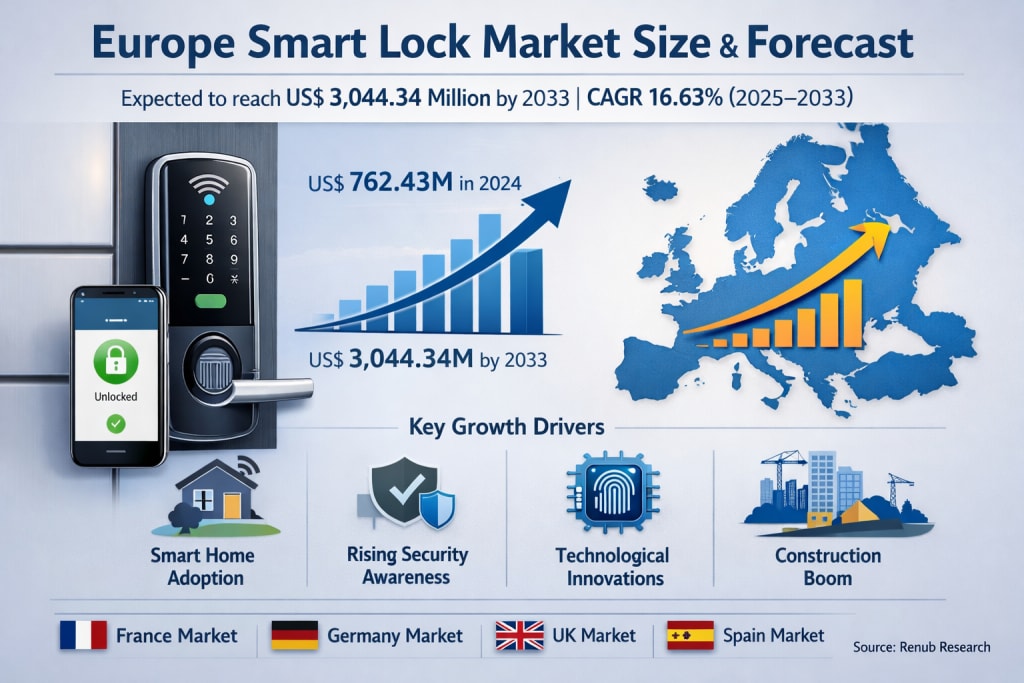
The Europe Smart Lock Market is undergoing a rapid transformation as digital technologies reshape the way people secure their homes, offices, and commercial spaces. According to Renub Research, the Europe Smart Lock Market is expected to reach US$ 3,044.34 million by 2033, up from US$ 762.43 million in 2024, growing at a strong CAGR of 16.63% from 2025 to 2033. This impressive growth trajectory reflects the region’s accelerating adoption of smart home technologies, increasing security awareness, and the deepening integration of Internet of Things (IoT) solutions into everyday life.
A smart lock is an electromechanical locking device that enables users to lock and unlock doors without traditional keys, using digital credentials such as smartphones, key cards, PIN codes, or biometric data. Most modern smart locks operate through Wi-Fi, Bluetooth, or Zigbee connectivity, allowing remote access, real-time monitoring, and seamless integration with smart home ecosystems like Google Assistant, Amazon Alexa, and Apple HomeKit. Features such as activity logs, temporary guest access, auto-locking, and remote control have turned smart locks from a niche gadget into a core component of connected living.
Across Europe, rising urbanization, higher disposable incomes, and a growing preference for convenience-driven lifestyles are pushing consumers and businesses toward smarter security solutions. The real estate and hospitality sectors are also playing a crucial role, as property developers and hotel operators increasingly adopt smart access systems to enhance user experience, streamline operations, and improve security management. Together, these trends are positioning smart locks as a key pillar of Europe’s evolving digital infrastructure.
Why Smart Locks Are Gaining Momentum in Europe
Europe’s digital transformation is not limited to smartphones and smart TVs—it is now reshaping doors, homes, and entire buildings. One of the biggest factors behind the rapid growth of the smart lock market is the rising adoption of smart home automation systems. Consumers increasingly want centralized control over lighting, heating, security cameras, alarms, and access systems, all from a single mobile app or voice assistant. Smart locks fit perfectly into this ecosystem by offering both convenience and enhanced security.
Another important driver is the growing awareness of security risks. Traditional mechanical locks, while reliable, cannot offer real-time alerts, remote access control, or usage tracking. In contrast, smart locks allow users to monitor who enters and exits their property, grant temporary access to guests or service providers, and receive instant notifications in case of suspicious activity. This shift from reactive to proactive security is especially appealing in urban environments, where apartment living and shared spaces are common.
At the same time, technological innovation is continuously improving the performance and reliability of smart locks. Advances in biometric authentication, encrypted communication, cloud connectivity, and mobile app integration are making these devices more secure and user-friendly. The combination of better technology and falling device costs is lowering the barrier to adoption for both residential and commercial users across Europe.
Key Growth Drivers for the Europe Smart Lock Market
1. Rising Adoption of Smart Home Automation Systems
The surge in smart home adoption is one of the strongest growth engines for the smart lock market in Europe. As households increasingly invest in connected devices such as smart thermostats, lighting systems, and security cameras, smart locks naturally become part of this integrated environment. They allow homeowners to control access remotely, create digital keys for family members or guests, and monitor entry activity in real time.
This shift is also being supported by greater consumer awareness and improved affordability of smart home products. What was once considered a premium feature is now becoming mainstream, especially in urban areas and new residential developments. For commercial properties, smart locks offer centralized access management, reduced dependency on physical keys, and better operational efficiency.
2. Rapid Technological Advancements
Technological progress is another major catalyst for market growth. Modern smart locks now offer biometric authentication such as fingerprint and facial recognition, ensuring high-level security without compromising convenience. Bluetooth and Wi-Fi connectivity allow users to control locks through smartphones, while cloud platforms enable remote monitoring and data storage.
The market is also witnessing innovations tailored for specific use cases, such as educational institutions, offices, and hospitality properties. For example, companies are developing advanced lockdown and access control systems designed for high-risk or high-traffic environments. These innovations are expanding the scope of smart lock applications beyond homes into enterprises and critical infrastructure.
3. Growth in Residential and Commercial Construction
Europe’s ongoing residential and commercial construction boom is creating fertile ground for smart lock adoption. New buildings are increasingly designed with smart technologies in mind, including integrated security and access control systems. Developers and builders are prioritizing connected living and working environments to attract tech-savvy buyers and tenants.
Smart locks are also gaining popularity in renovation and retrofit projects, thanks to new designs that can be installed without major door modifications. This makes it easier for property owners to upgrade existing buildings with modern security solutions, further accelerating market penetration.
Challenges Facing the Europe Smart Lock Market
Cybersecurity Concerns
Despite strong growth prospects, cybersecurity remains one of the biggest challenges for the smart lock industry. Because these devices rely on wireless communication and cloud connectivity, they can be vulnerable to hacking, data breaches, and unauthorized access if not properly secured. Concerns about signal interception, software vulnerabilities, and weak encryption can make some consumers hesitant to fully trust digital locks with their home security.
The lack of uniform security standards across manufacturers also adds to this challenge. To maintain consumer trust and ensure long-term market growth, companies must continue investing in robust encryption, regular firmware updates, and transparent data protection practices.
Integration and Compatibility Issues
Another key challenge is integration. Europe’s smart home landscape includes multiple platforms such as Google Home, Amazon Alexa, and Apple HomeKit, each with its own protocols and requirements. Ensuring seamless compatibility across these ecosystems can be complex and costly for manufacturers.
Additionally, many older buildings across Europe were not designed with smart infrastructure in mind. Retrofitting such properties with smart locks and connected systems can be technically challenging and expensive, which may slow adoption in certain segments, especially among less tech-savvy users.
Country-Level Insights
France
France’s smart lock market is benefiting from the country’s growing smart home trend and rising demand for convenient, tech-enabled living. Urban areas, in particular, are seeing increased adoption due to high apartment occupancy rates and the need for flexible access solutions. The hospitality and rental sectors are also embracing smart locks to simplify check-ins and improve guest experience. However, privacy concerns and integration challenges with older buildings remain key issues that need to be addressed.
Germany
Germany is one of the most dynamic markets for smart locks in Europe, driven by strong security awareness, a tech-savvy population, and a robust focus on innovation. The country’s emphasis on energy efficiency, sustainability, and smart city development is further supporting the adoption of digital access systems. Smart locks in Germany are increasingly used in both residential and commercial settings, offering features such as keyless entry, remote control, and integration with broader IoT ecosystems.
United Kingdom
The UK smart lock market is expanding rapidly as consumers and businesses seek more convenient and secure access solutions. Government initiatives promoting smart cities and digital infrastructure are supporting this growth. Recent product launches, especially retrofit smart locks that can be installed without damaging existing doors, are making smart security more accessible to a wider audience. This focus on practicality and user-friendly design is helping accelerate adoption across the country.
Spain
Spain’s smart lock market is gaining momentum thanks to growing awareness of security needs, government support for digital innovation, and the increasing popularity of smart home technologies. Retrofit solutions that allow easy installation without major door modifications are particularly attractive to Spanish consumers. These products combine modern features like remote access and device integration with the familiarity of traditional keys, making the transition to smart security smoother.
Market Segmentation Overview
By Type:
Deadbolt
Lever Handles
Padlock
Others
By Technology:
Bluetooth
Wi-Fi
By Authentication Method:
Keyboard
Touchscreen
App Based
Hybrid
Biometric
Others
By Application:
Residential
Hospitality
Enterprise
Critical Infrastructures
Others
By Country (14 Viewpoints):
France, Germany, Italy, Spain, United Kingdom, Belgium, Netherlands, Russia, Poland, Greece, Norway, Romania, Portugal, Rest of Europe.
Competitive Landscape and Key Players
The Europe smart lock market is highly competitive, with global and regional players focusing on innovation, partnerships, and product differentiation. Companies are investing heavily in R&D to improve security, enhance user experience, and expand compatibility with smart home ecosystems.
Key players analyzed from four viewpoints—Company Overview, Key Persons, Recent Developments & Strategies, and Sales Analysis—include:
Allegion plc
Avent
Assa Abloy
DormaKaba Holding AG
Samsung
Zhejiang Dahua Technology Co. Ltd.
Spectrum Brands Holdings, Inc.
Panasonic Corporation
These companies are shaping the market through continuous innovation, strategic acquisitions, and the expansion of their smart security portfolios across Europe.
Future Outlook: What Lies Ahead?
Looking ahead, the future of the Europe smart lock market appears highly promising. With the market projected to more than triple in value by 2033, smart locks are set to become a standard feature in modern homes, offices, hotels, and public infrastructure. The convergence of smart homes, IoT, AI, and cloud computing will further enhance the capabilities of smart locks, making them more intelligent, secure, and user-centric.
As cybersecurity standards improve and interoperability challenges are gradually addressed, consumer confidence in digital access solutions is expected to grow. At the same time, ongoing urbanization, smart city projects, and the digital transformation of real estate and hospitality sectors will continue to create strong demand for advanced access control systems.
Final Thoughts
The Europe Smart Lock Market is no longer just a niche segment within the broader security industry—it is rapidly becoming a cornerstone of the region’s digital lifestyle. With the market expected to grow from US$ 762.43 million in 2024 to US$ 3,044.34 million by 2033, the shift toward keyless, connected, and intelligent security solutions is clear and irreversible.
Driven by smart home adoption, technological innovation, and expanding construction activity, smart locks are redefining how Europeans think about access, safety, and convenience. While challenges such as cybersecurity and integration remain, the long-term outlook is strongly positive. In a future where homes and cities are increasingly connected, smart locks are set to play a central role in securing Europe’s digital doors.
About the Creator
Disney Stock Analysis: Can Disney Sustain Growth in Streaming, Theme Parks, and Media Empire?
Introduction Disney stock has long been considered a cornerstone of the entertainment and media sector. The Walt Disney Company operates a diverse portfolio that includes theme parks, film studios, media networks, and streaming platforms. For investors, Disney stock offers exposure to a globally recognized brand with multiple revenue streams, strong content franchises, and long-term growth potential. However, challenges in streaming competition, theme park economics, and media consumption trends require careful consideration.
By Hammad Nawaz4 days ago in Trader


Comments
There are no comments for this story
Be the first to respond and start the conversation.