
Australia Anti Venom Market Size and Forecast 2025–2033
Rising Envenomation Cases and Medical Innovation Drive Steady Growth Across the Country

Australia Anti Venom Market Overview
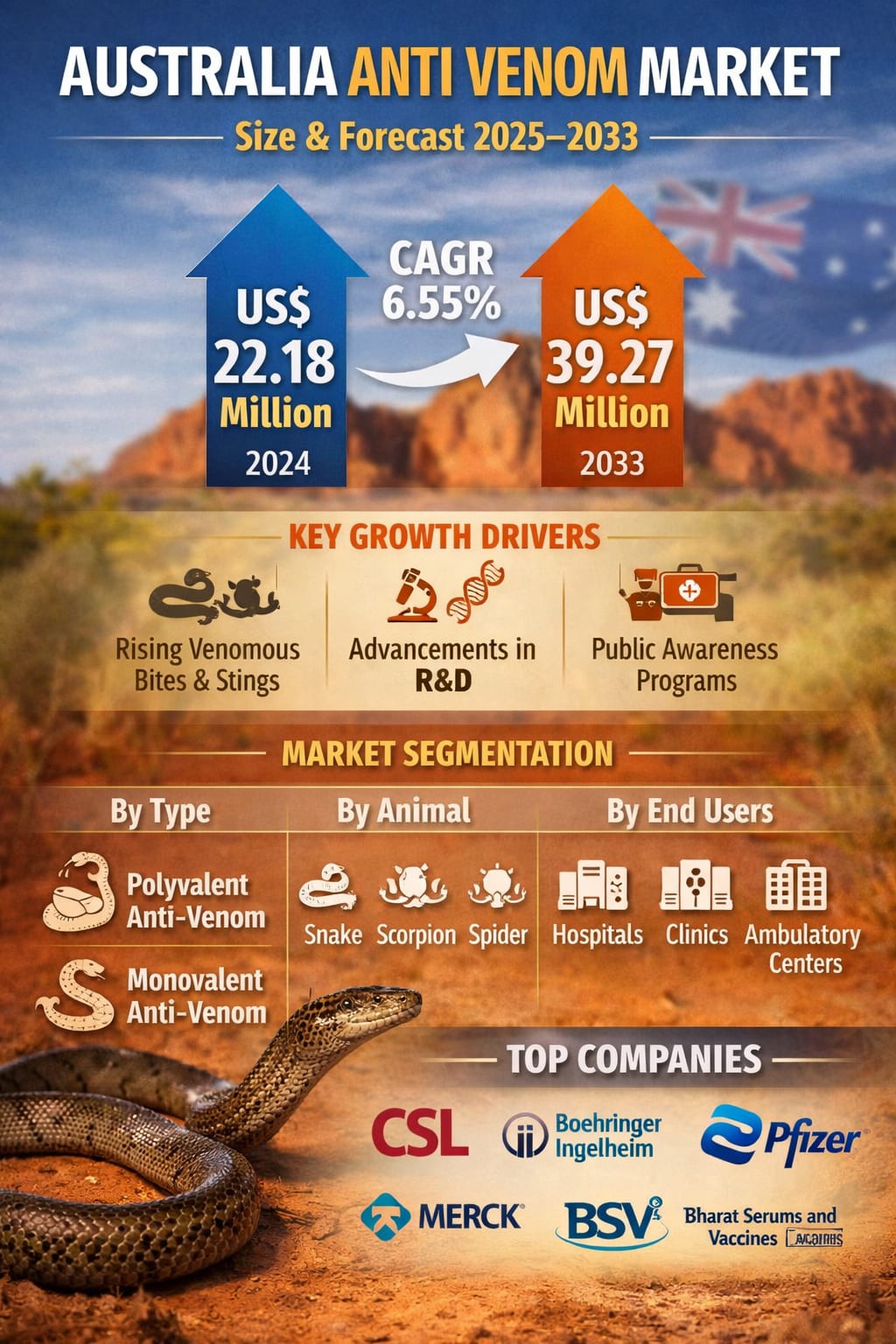
The Australia Anti Venom Market is projected to grow from US$ 22.18 million in 2024 to US$ 39.27 million by 2033, expanding at a compound annual growth rate (CAGR) of 6.55% from 2025 to 2033. This growth reflects the country’s ongoing need for effective treatments against venomous bites and stings, combined with rising healthcare investments, supportive government initiatives, and continuous improvements in biomedical research.
Australia is home to some of the world’s most venomous snakes, spiders, and other creatures. While public awareness and medical response systems have significantly reduced mortality rates over the decades, the risk of envenomation remains a persistent public health concern, especially in rural and remote regions. As a result, antivenom remains a critical, life-saving product within the Australian healthcare system.
The market is shaped not only by clinical demand but also by complex manufacturing processes, strict regulatory standards, and the need for reliable cold-chain logistics. Together, these factors create a highly specialized and strategically important segment of the pharmaceutical and biotechnology industry.
Australia Anti Venom Industry Outlook
Australia’s antivenom industry plays a vital role in protecting public health against the country’s diverse and dangerous fauna. The demand for effective antivenom treatments remains consistently high, particularly in regions where encounters with venomous snakes and spiders are more common.
Antivenom production typically involves collecting venom from target species, immunizing host animals (most commonly horses), and then harvesting and purifying antibodies to create therapeutic products. While this method has remained largely unchanged for decades, it continues to be highly effective and reliable when performed under strict quality controls.
Despite its success, the industry faces notable challenges. High production costs, complex logistics, and the need for species-specific treatments place pressure on manufacturers and healthcare systems alike. At the same time, ongoing research aims to improve efficiency, safety, and accessibility. Scientists are exploring broader-spectrum or “universal” antivenoms, as well as more advanced biotechnological approaches to reduce dependence on traditional animal-based production methods.
As Australia continues to balance public health priorities with innovation, the antivenom sector is expected to remain a strategic and essential component of the national healthcare landscape.
Key Factors Driving the Australia Anti Venom Market
1. High Incidence of Venomous Bites and Stings
Australia is internationally known for its concentration of highly venomous species, including the eastern brown snake, inland taipan, tiger snake, and funnel-web spider. Each year, thousands of people seek medical attention for bites and stings, particularly in rural and semi-rural areas where human-wildlife interaction is more frequent.
Although fatalities are relatively rare due to effective medical treatment, the constant risk of envenomation ensures sustained demand for antivenom products. Hospitals and emergency services must maintain adequate stocks to respond quickly and effectively. This ongoing need forms the backbone of market growth and ensures consistent investment in production, storage, and distribution.
As outdoor activities, farming, and regional development continue across Australia, the exposure risk remains, reinforcing the importance of readily available antivenom therapies.
2. Advancements in Research and Development
Research and development are playing a critical role in shaping the future of the Australian antivenom market. Scientists and pharmaceutical companies are working to improve the safety, effectiveness, and efficiency of existing products while also exploring next-generation solutions.
One major area of interest is the development of broader-spectrum antivenoms that could treat bites from multiple species, reducing the need for highly specific products in emergency situations. This approach could simplify logistics, lower costs, and improve response times in critical care settings.
In parallel, advances in biotechnology and purification techniques are helping manufacturers enhance product consistency and safety profiles. Collaboration between universities, research institutes, government bodies, and pharmaceutical companies continues to support innovation tailored to Australia’s unique ecological environment.
3. Community Engagement and Public Awareness
Community involvement has long been a cornerstone of Australia’s antivenom ecosystem. Venom collection programs, often supported by wildlife parks, researchers, and trained professionals, are essential for maintaining a stable supply of raw materials for antivenom production.
Public awareness campaigns also play a crucial role. Education around snake and spider safety, first aid measures, and the importance of seeking immediate medical care has significantly reduced the severity of outcomes from envenomation incidents. These initiatives not only save lives but also support sustained government and institutional funding for antivenom research and production.
By fostering cooperation between scientists, healthcare providers, and the public, Australia maintains a proactive and resilient approach to managing the risks posed by venomous animals.
Challenges Facing the Australia Anti Venom Market
1. High Production Costs
One of the most significant challenges in the antivenom market is the high cost of production. The traditional manufacturing process—immunizing animals, collecting plasma, and purifying antibodies—is labor-intensive, time-consuming, and requires highly specialized facilities and skilled personnel.
In addition, maintaining a consistent supply of venom from multiple species adds further operational and logistical complexity. These factors collectively drive up costs, which can strain healthcare budgets and limit accessibility, particularly in resource-constrained or remote healthcare settings.
2. Geographic and Logistical Barriers
Australia’s vast geography presents unique logistical challenges. Many envenomation cases occur in remote or rural regions, where access to advanced healthcare facilities can be limited. Antivenoms are often temperature-sensitive and require reliable cold-chain storage and transportation.
Ensuring that remote clinics and hospitals are adequately stocked requires careful planning, significant investment, and strong coordination across supply chains. Delays or shortages in these areas can directly impact patient outcomes, highlighting the importance of ongoing improvements in distribution infrastructure.
Market Segmentation
By Type
Polyvalent Anti-Venom
Monovalent Anti-Venom
Polyvalent antivenoms, which can treat envenomation from multiple species, are particularly valuable in emergency settings where the exact species may not be immediately identified. Monovalent antivenoms, on the other hand, offer high specificity and are used when the offending species is known with certainty.
By Animal Type
Snake
Scorpion
Spider
Others
Snake antivenoms represent the largest share of demand due to the severity and frequency of snakebite incidents in Australia. Spider and scorpion antivenoms also play an important role, especially in regions where species such as the funnel-web spider pose serious medical risks.
By End User
Clinics
Hospitals
Ambulatory Surgical Centers
Others
Hospitals remain the primary end users due to their role in emergency and critical care. However, clinics and ambulatory centers are increasingly important in regional and remote areas, where early intervention can significantly improve outcomes.
Competitive Landscape and Company Analysis
The Australia anti venom market features a mix of global pharmaceutical companies and specialized biological product manufacturers. Key players focus on research, production quality, distribution reliability, and regulatory compliance.
Major companies covered in the market include:
Bharat Serums and Vaccines Limited (BSV)
Boehringer Ingelheim International GmbH
Boston Scientific Corporation
CSL Limited
Merck & Co. Inc.
Merck KGaA
Pfizer Inc.
Haffkine Bio-Pharmaceutical Corporation Limited
Industry Focus Areas:
Overview and strategic positioning
Key leadership and operational structure
Recent developments and product innovations
Revenue analysis and market performance
Company-level competitive analysis
Among these, CSL Limited plays a particularly significant role in the Australian context due to its strong local presence and long-standing involvement in plasma-derived and biological therapies. Global pharmaceutical giants contribute through research capabilities, distribution networks, and technological expertise.
Competition in this market is driven less by volume and more by quality, reliability, regulatory compliance, and scientific credibility.
Future Outlook: 2025–2033
Looking ahead, the Australian anti venom market is expected to maintain steady and resilient growth through 2033. The projected rise from US$ 22.18 million in 2024 to US$ 39.27 million by 2033 reflects not only increasing healthcare demand but also the expanding role of biotechnology in improving treatment outcomes.
Key trends likely to shape the future include:
Greater focus on broad-spectrum and next-generation antivenoms
Continued investment in research and biomanufacturing technologies
Improved distribution networks for rural and remote regions
Stronger public-private collaboration in healthcare preparedness
While challenges related to cost and logistics will remain, the essential nature of antivenom in Australia’s healthcare system ensures that this market will continue to receive strategic attention and long-term investment.
Final Thoughts
The Australia anti venom market stands at the intersection of public health, biotechnology, and national safety. In a country where encounters with venomous animals are a real and ongoing risk, antivenom is not just another pharmaceutical product—it is a critical life-saving therapy.
With the market forecast to grow steadily through 2033, driven by rising demand, scientific innovation, and supportive healthcare policies, the sector is well-positioned for sustainable expansion. Continued focus on accessibility, efficiency, and research will be essential to ensure that every Australian—regardless of location—has timely access to effective treatment when it matters most.
About the Creator
Australia Isobutanol Market: Precision Chemicals Fueling Sustainable Growth
The Australia isobutanol market is steadily building momentum as industrial sectors increasingly adopt this versatile chemical intermediate. According to IMARC Group, the market size reached USD 30.00 million in 2024 and is forecast to grow to USD 47.95 million by 2033, representing a compound annual growth rate (CAGR) of 5.35 % between 2025 and 2033. This growth reflects robust demand from automotive and industrial applications, alongside a broader shift toward bio-based and sustainable solvent solutions.
By Rashi Sharma3 days ago in Trader
Introduction to Mutual Funds: A Beginner’s Guide to Smart Investing
Introduction Mutual funds are one of the most popular investment options for beginners and experienced investors alike. They pool money from multiple investors to invest in a diversified portfolio of stocks, bonds, or other securities. Mutual funds offer a simple way to achieve diversification, professional management, and potential long-term growth without the complexity of managing individual investments.
By Hammad Nawaz5 days ago in Trader
Goodbye, Mr. Duvall
It is turning out to be an interesting year. I was in the middle of teaching a class when a pop-up appeared on the screen announcing the death of Mr. Robert Seldon Duvall (yes, that was his full name). I was in the middle of a discussion on the obsession we have with winning when it comes to sports (the Winter Olympics was a theme), and I felt as though things were coming full circle. We had already lost Gene Hackman last year, and along with that titan, it feels though one particular golden age has closed off to be replaced by...?
By Kendall Defoe 4 days ago in Geeks



Comments
There are no comments for this story
Be the first to respond and start the conversation.