
Europe Sex Reassignment Surgery Market Size & Forecast (2026–2034)
Rising Acceptance, Medical Advancements, and Policy Support Drive Steady Growth Across Europe

Market Overview
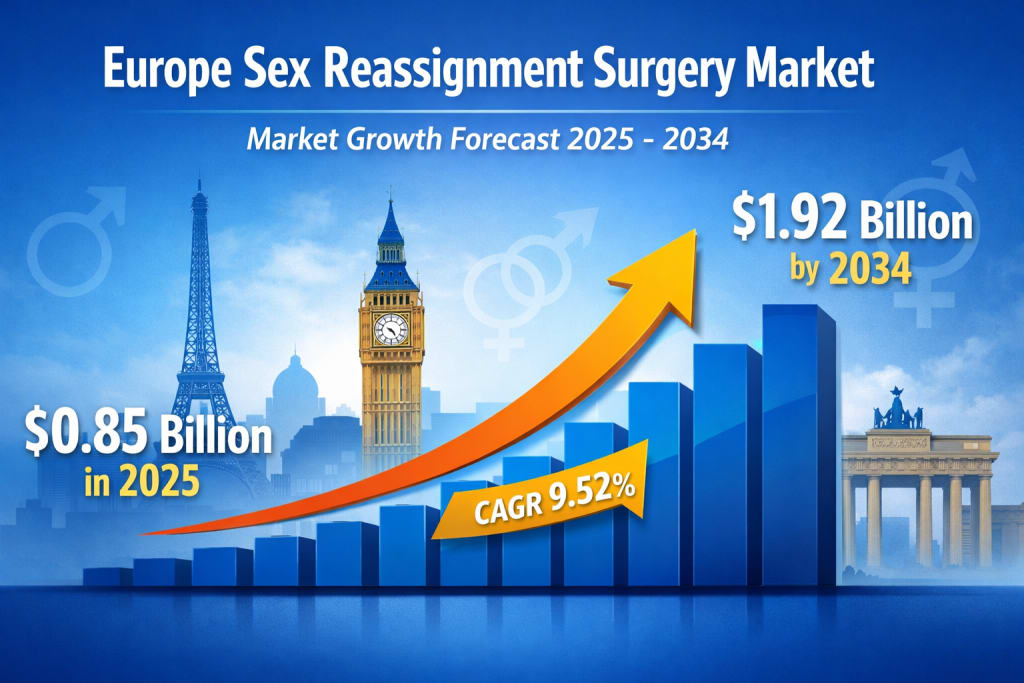
The Europe Sex Reassignment Surgery (SRS) Market is projected to experience consistent and meaningful growth during the forecast period, reflecting a broader transformation in healthcare access, social awareness, and legal recognition of gender identity across the region. According to Renub Research, the market is expected to expand from US$ 0.85 billion in 2025 to US$ 1.92 billion by 2034, registering a compound annual growth rate (CAGR) of 9.52% from 2026 to 2034.
Sex reassignment surgery—often referred to as gender-affirming surgery—includes a range of medical procedures designed to align an individual’s physical characteristics with their gender identity. These procedures can involve chest or breast surgeries, genital reconstruction, facial feminization or masculinization, voice modification, and body contouring. Typically, surgical interventions form part of a broader continuum of gender-affirming care that may also include psychological counseling, hormone therapy, and long-term medical follow-up.
Across Europe, increasing recognition of transgender healthcare needs, improved surgical outcomes, and growing social acceptance are collectively driving demand for professional, high-quality sex reassignment procedures.
Europe Sex Reassignment Surgery Market Outlook
Over the past decade, Europe has emerged as one of the most progressive regions for gender-affirming healthcare. Many countries have taken steps to integrate SRS into public or semi-public healthcare systems, significantly lowering financial barriers for eligible patients. At the same time, advancements in surgical techniques and post-operative care have improved both functional and aesthetic outcomes, strengthening patient confidence in these procedures.
Rising awareness of gender dysphoria as a legitimate medical condition has also contributed to increased demand. Advocacy organizations, public education campaigns, and more accurate media representation have helped normalize conversations around transgender health, encouraging more individuals to seek appropriate medical care. As a result, Europe’s SRS market continues to evolve from a niche medical segment into a structured and expanding healthcare industry.
Key Growth Drivers
Increasing Social Acceptance and Legal Recognition
One of the most powerful drivers of the Europe SRS market is the growing social acceptance of transgender and gender-diverse individuals. Many European nations have strengthened anti-discrimination laws and legal frameworks recognizing gender identity, allowing individuals to change legal gender markers and access healthcare services with greater ease.
The European Union has also taken visible steps to support LGBTQ+ rights. The adoption of the LGBTIQ Equality Strategy 2020–2025 underscores the EU’s commitment to building inclusive societies. Although challenges persist, improved legal recognition has reduced institutional barriers and encouraged individuals to pursue surgical gender-affirming treatments.
Urban centers, in particular, have seen rising demand as inclusive healthcare policies and specialized providers become more accessible.
Improved Access to Gender-Affirming Healthcare
Access to specialized gender-affirming healthcare has expanded significantly across Europe, supporting market growth. Several national healthcare systems now provide partial or full reimbursement for sex reassignment surgeries, making these procedures financially attainable for a broader population.
The emergence of multidisciplinary care models—integrating mental health professionals, endocrinologists, surgeons, and rehabilitation specialists—has enhanced patient outcomes and safety. Dedicated gender clinics and specialized hospital departments have also improved procedural availability, though waiting lists remain a concern in many countries.
Despite progress, disparities persist. As of late 2024, nearly half of EU member states still require a psychiatric diagnosis for access to trans-specific healthcare, contrary to World Health Organization guidelines. These inconsistencies highlight both ongoing challenges and opportunities for market reform.
Advancements in Surgical Techniques and Post-Operative Care
Technological innovation plays a central role in expanding the European SRS market. Modern surgical techniques now offer improved precision, reduced complication rates, and faster recovery times. Innovations in microsurgery, tissue reconstruction, and minimally invasive procedures have enhanced long-term functional outcomes and patient satisfaction.
Post-operative care has also improved, with standardized recovery protocols, physical therapy, and follow-up services becoming integral parts of treatment pathways. These advancements increase trust in surgical outcomes and encourage more individuals to consider surgery as a viable and beneficial option.
Market Challenges
Uneven Access and Long Waiting Periods
Despite progress, unequal access to sex reassignment surgery remains a major challenge across Europe. While countries such as Germany and France offer relatively comprehensive care, others face limited infrastructure, specialist shortages, and extended waiting lists—sometimes lasting several years.
These delays can negatively affect mental health and overall well-being, forcing some patients to seek treatment abroad or rely on private providers at significantly higher costs. Addressing regional disparities is essential for equitable market growth.
Regulatory and Ethical Complexity
The regulatory environment for SRS varies widely across Europe, creating inconsistencies in eligibility criteria, consent requirements, and assessment processes. Ethical debates around age limits and informed consent further complicate policy frameworks.
For providers, navigating these regulations increases administrative burdens and may discourage market entry. While demand continues to rise, regulatory complexity can slow service expansion and limit patient access.
Market Segmentation Insights
Male-to-Female Sex Reassignment Surgery
Male-to-female (MTF) procedures represent one of the largest segments in the European SRS market. These surgeries may include genital reconstruction, breast augmentation, facial feminization, and voice modification. Advances in surgical precision and aesthetic outcomes have improved satisfaction rates, supporting sustained demand.
Augmentation Mammoplasty
Augmentation mammoplasty is a widely requested procedure among transgender women seeking enhanced breast size and symmetry. Improvements in implant materials and surgical techniques have increased safety and reduced recovery times, making this segment a key contributor to overall market growth.
Genital Surgery
Genital reconstruction procedures—such as vaginoplasty, phalloplasty, and metoidioplasty—remain central to the SRS market. Although highly complex and resource-intensive, continued innovation has improved functional outcomes, sustaining strong demand across Europe.
Voice and Airway Surgery
Voice and airway surgeries are gaining importance as voice plays a critical role in gender expression. These procedures, often combined with speech therapy, are increasingly recognized as essential components of gender-affirming care.
End-User Landscape
Hospitals
Hospitals remain the primary setting for complex and multi-stage sex reassignment surgeries, offering multidisciplinary teams and advanced infrastructure. Public hospitals dominate in countries with national healthcare coverage, while private hospitals address unmet demand.
Specialty Clinics
Specialty clinics focused exclusively on gender-affirming care are expanding rapidly. These facilities offer personalized treatment plans, shorter waiting times, and highly specialized expertise, complementing hospital-based services.
Country-Level Market Insights
France
France’s SRS market benefits from integration within the public healthcare system, skilled surgical teams, and strong advocacy support. While public coverage reduces costs, demand continues to outpace capacity, supporting growth in private healthcare providers.
United Kingdom
The UK market operates through structured referral pathways and multidisciplinary assessment models. Long waiting lists within public healthcare have driven expansion in private clinics, ensuring continued market growth.
Germany
Germany stands out as one of Europe’s most advanced SRS markets, supported by robust healthcare infrastructure, insurance coverage, and clinical expertise. The country also attracts international patients seeking high-quality reconstructive procedures.
Competitive Landscape
The European SRS market features a mix of public healthcare institutions, private hospitals, and specialized clinics. Key organizations analyzed in the market include:
Mount Sinai Health System
Boston Medical Center
Rumer Cosmetic Surgery
The London Transgender Clinic
Phuket Plastic Surgery Institute
Gender Surgery Amsterdam
UCSF Transgender Care
Transgender Surgery Institute of America
Center for Gender Confirmation Serbia
Papillon Gender Clinic
Each company is evaluated across five viewpoints: overview, key personnel, recent developments, SWOT analysis, and revenue performance.
Final Thoughts
The Europe Sex Reassignment Surgery Market is entering a period of sustained expansion, driven by rising awareness, technological progress, and improving healthcare access. While challenges such as regulatory complexity and uneven service availability remain, long-term fundamentals point toward continued growth.
With the market projected to reach US$ 1.92 billion by 2034, Europe is positioned as a global leader in gender-affirming surgical care. Ongoing policy reform, medical innovation, and social acceptance will play a critical role in shaping a more inclusive and accessible future for transgender healthcare across the region.




Comments
There are no comments for this story
Be the first to respond and start the conversation.