
United States Combine Harvesters Market Size Forecast 2026–2034
Mechanization, Precision Agriculture, and Rising Food Demand Drive Sustainable Growth Across American Farms

United States Combine Harvesters Market Overview
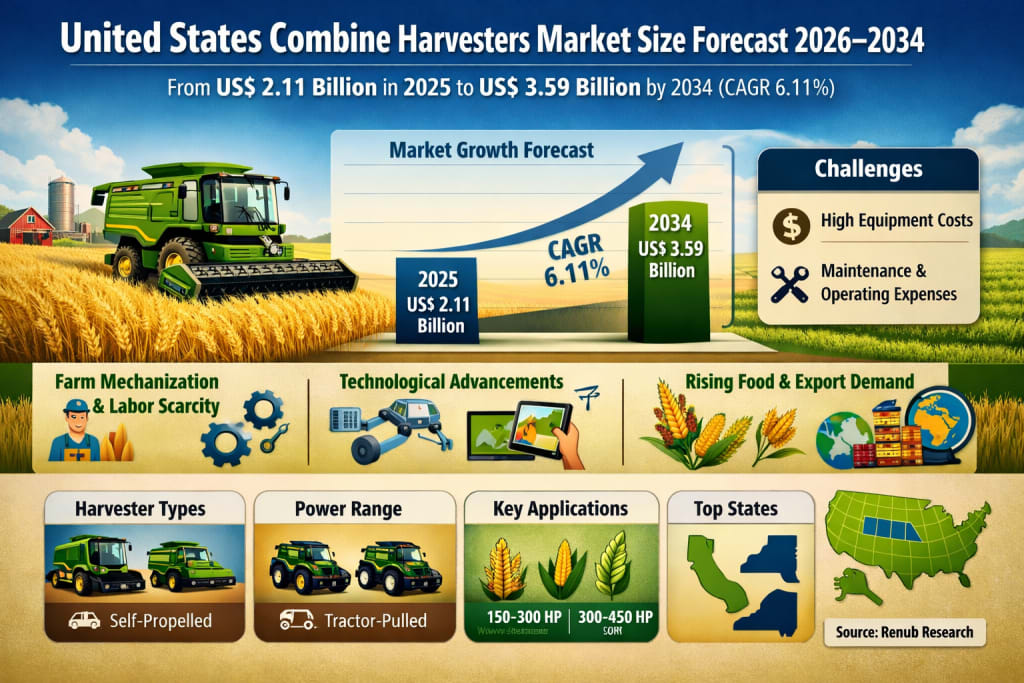
The United States combine harvesters market is poised for steady expansion over the coming decade, reflecting the country’s continued shift toward agricultural mechanization and precision farming. According to Renub Research estimates, the market is projected to grow from US$ 2.11 billion in 2025 to US$ 3.59 billion by 2034, registering a compound annual growth rate (CAGR) of 6.11% during 2026–2034.
This growth trajectory is supported by structural changes within U.S. agriculture, including labor scarcity, rising operational costs, expanding farm sizes, and the growing need for high-performance harvesting solutions. Combine harvesters have become indispensable for large-scale grain producers, offering efficiency, speed, and accuracy while minimizing post-harvest losses.
United States Combine Harvesters Market Outlook
A combine harvester is a multifunctional agricultural machine designed to perform reaping, threshing, and winnowing in a single operation. These machines are extensively used for harvesting crops such as wheat, corn, soybeans, barley, and rice. Their ability to complete multiple harvesting processes simultaneously significantly reduces manpower requirements while enhancing productivity.
Technological evolution has reshaped modern combine harvesters, integrating GPS navigation, yield monitoring, automated controls, precision sensors, and data analytics. These features enable farmers to optimize harvesting routes, improve fuel efficiency, and collect real-time yield data for future agronomic planning.
In the United States, where large-scale commercial farming dominates, combine harvesters play a vital role in maintaining productivity. Labor shortages, coupled with the need to complete harvesting within narrow seasonal windows, have accelerated adoption. American farmers value combines for their durability, adaptability across multiple crops, and compatibility with advanced agricultural technologies.
Key Growth Drivers in the United States Combine Harvesters Market
Rising Farm Mechanization and Labor Scarcity
The increasing mechanization of U.S. agriculture remains the strongest growth driver for the combine harvesters market. As farm sizes expand and rural labor availability declines, manual harvesting has become both impractical and costly. Combine harvesters allow farmers to harvest vast acreages within limited timeframes while reducing dependency on seasonal labor.
High labor wages and persistent worker shortages have further strengthened the economic case for mechanized harvesting. By integrating multiple operations into a single machine, combine harvesters reduce labor intensity and improve overall operational efficiency.
In July 2024, a major Wisconsin-based manufacturer introduced a next-generation combine model featuring enhanced grain capacity and faster unloading speeds, underscoring continuous innovation in the sector.
Technological Advancements and Precision Agriculture
Technological innovation is transforming combine harvesters into intelligent, data-driven machines. Modern combines are increasingly equipped with auto-steering, real-time yield mapping, telematics, and remote diagnostics, enabling farmers to make data-backed decisions during and after harvest.
Precision agriculture adoption in the U.S. has significantly boosted demand for technologically advanced harvesting equipment. Farmers are now using harvesting data to refine planting density, fertilization strategies, and irrigation planning.
In February 2024, Deere & Company launched its latest S-series combines, focusing on efficiency, automation, and operator comfort. Such innovations enhance productivity while reducing operator fatigue and fuel consumption.
Growing Demand for Food Crops and Export Commodities
The United States remains one of the world’s largest producers and exporters of grain crops. Rising domestic consumption and international demand for wheat, corn, and soybeans require high-capacity harvesting solutions to ensure timely supply.
Combine harvesters enable rapid, efficient harvesting of large crop volumes while maintaining grain quality. As production increases to meet food, feed, and biofuel requirements, farmers are investing in high-capacity machines capable of delivering consistent output.
According to United States Department of Agriculture, U.S. agricultural exports reached approximately US$ 175 billion in 2024, highlighting the importance of efficient harvesting systems in maintaining global competitiveness.
Challenges in the United States Combine Harvesters Market
High Capital Investment Requirements
Despite their benefits, combine harvesters require substantial upfront investment. Modern machines equipped with advanced technology can be prohibitively expensive for small and mid-sized farmers. Beyond the initial purchase cost, expenses related to maintenance, spare parts, insurance, and financing further increase the total cost of ownership.
Volatility in commodity prices can also delay purchasing decisions, as farmers remain cautious during periods of uncertain profitability. While rental and financing options exist, cost sensitivity continues to restrain broader adoption.
Maintenance Complexity and Operating Costs
Modern combine harvesters incorporate complex mechanical, hydraulic, and electronic systems. Maintenance requires skilled technicians and specialized training, increasing service costs. Breakdowns during peak harvest periods can result in significant productivity losses.
Additionally, rising fuel prices and routine servicing expenses place pressure on farm margins. These operational challenges underscore the importance of reliability and after-sales support when selecting harvesting equipment.
Segment Analysis of the United States Combine Harvesters Market
Tractor-Pulled Combine Harvesters
Tractor-pulled combines remain relevant among small-scale farmers and budget-constrained operations. These machines rely on tractors for power and offer a more affordable alternative to self-propelled models. While capacity and speed are lower, their affordability and simpler maintenance make them suitable for smaller fields and niche farming segments.
Wheel-Type Combine Harvesters
Wheel-type combine harvesters dominate the U.S. market due to their versatility and high maneuverability. They perform well across dry and firm soil conditions commonly found in major farming regions. Compatibility with advanced harvesting attachments and precision technologies further strengthens their market position, especially among large commercial farms.
Small-Size Combine Harvesters
Small-size combine harvesters cater to small farms, specialty crop growers, and diversified agricultural operations. Their compact design enhances maneuverability in irregular fields while reducing fuel consumption. Demand is rising among new entrants and farmers seeking cost-effective mechanization solutions.
150–300 HP Combine Harvesters
The 150–300 horsepower segment offers an optimal balance between power and efficiency for medium-sized farms. These machines handle major grain crops effectively while keeping operating costs manageable. Replacement demand and incremental technological upgrades support stable growth in this segment.
300–450 HP Combine Harvesters
High-horsepower combines in the 300–450 HP range are designed for large-scale commercial farming. These machines deliver superior throughput, automation, and performance across extensive acreage. Demand is particularly strong among large grain producers and agricultural contractors operating under tight harvest schedules.
Application Analysis: Wheat Harvesting
Wheat harvesting represents one of the most significant applications for combine harvesters in the United States. Narrow harvest windows and large cultivation areas necessitate efficient harvesting solutions. Advanced combines equipped with variable threshing systems and yield monitors help minimize grain losses while maximizing quality and efficiency.
State-Level Market Insights
California
California’s combine harvester market is shaped by high labor costs, labor shortages, and diverse agricultural output. Grain and rice harvesting in regions such as the Central Valley drives demand for high-performance machines. Environmental regulations and fuel-efficiency considerations further encourage adoption of technologically advanced models.
New York
New York’s market reflects stable demand from mixed farming operations. Small- to medium-sized farms prefer versatile, mid-capacity combines emphasizing reliability and ease of maintenance. Replacement purchases dominate demand, supporting steady market performance.
Washington
Eastern Washington’s wheat-focused agriculture supports strong demand for high-capacity combines. Large farm sizes, export-oriented production, and labor constraints drive investment in technologically advanced, high-horsepower machines.
New Jersey
New Jersey’s combine harvester market is niche but stable, reflecting limited grain acreage and high land values. Farmers prioritize compact, cost-effective machines with high efficiency and maneuverability. Replacement demand remains the primary growth driver.
Competitive Landscape
The U.S. combine harvesters market is moderately consolidated, with global and regional manufacturers competing through innovation, dealer networks, and after-sales service. Key players include AGCO Corporation, CLAAS KGaA mbH, KUBOTA Corporation, Mahindra & Mahindra Ltd., and Yanmar Holdings Co. Ltd..
Companies focus on automation, precision farming integration, fuel efficiency, and operator comfort to maintain competitiveness.
Final Thoughts
The United States combine harvesters market is positioned for sustained growth through 2034, driven by mechanization, technological innovation, and expanding food production requirements. While high equipment costs and maintenance complexity present challenges, the long-term benefits of efficiency, productivity, and data-driven farming continue to outweigh constraints.
As American agriculture evolves toward smarter and more sustainable practices, combine harvesters will remain a cornerstone of modern farming—supporting food security, export competitiveness, and economic resilience across the United States.



Comments
There are no comments for this story
Be the first to respond and start the conversation.