
Europe Electric Vehicle Market Size and Forecast 2025–2033
How Policy, Technology, and Consumer Mindsets Are Powering Europe’s Electric Future

Introduction
The European automotive industry is undergoing one of the most dramatic transformations in its history. As concerns over climate change, air pollution, and energy security continue to intensify, electric vehicles (EVs) are rapidly shifting from being a niche alternative to becoming a central pillar of mobility across the continent. Europe is no longer just experimenting with electric transport—it is actively building an ecosystem around it.
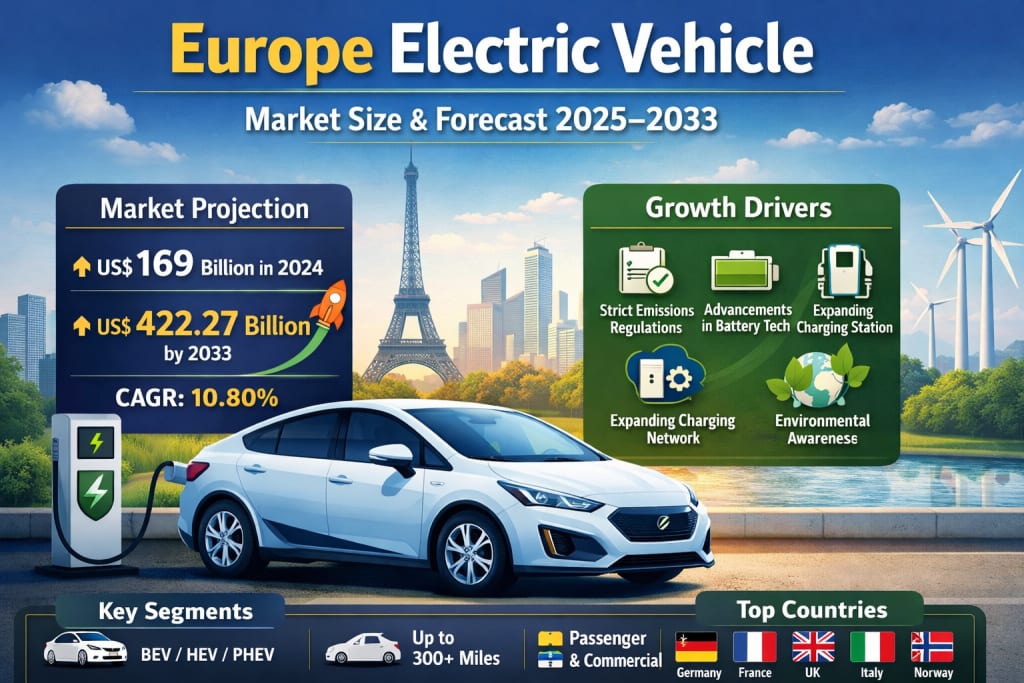
According to Renub Research, the Europe Electric Vehicle Market is expected to reach US$ 422.27 billion by 2033, growing from US$ 169 billion in 2024, at a compound annual growth rate (CAGR) of 10.80% from 2025 to 2033. This strong expansion reflects not only rising consumer acceptance but also aggressive policy support, rapid technological progress, and heavy investments by automakers and infrastructure providers.
From compact city cars to luxury electric SUVs and commercial fleets, EVs are reshaping how Europeans think about transportation. What was once seen as expensive and impractical is now increasingly viewed as smart, responsible, and future-ready. The shift is not just about replacing engines—it is about redefining mobility itself.
Europe Electric Vehicle Market Overview
Unlike traditional internal combustion engine vehicles that rely on fossil fuels, electric vehicles are powered by electricity stored in rechargeable batteries. These batteries supply energy to one or more electric motors, which in turn provide the torque and motion needed to drive the vehicle. The result is a cleaner, quieter, and more efficient mode of transport.
One of the biggest advantages of EVs is their environmental benefit. Since they produce no tailpipe emissions, they significantly reduce urban air pollution and help lower overall carbon footprints. This has become especially important in European cities, where air quality regulations are tightening and sustainability targets are becoming more ambitious.
Beyond environmental benefits, EVs are also becoming more attractive due to improvements in technology, driving range, charging speed, and overall performance. Modern electric cars now compete directly with conventional vehicles in terms of comfort, safety, and features—often surpassing them in digital integration and driving experience.
Another crucial factor behind the growing adoption of EVs is the expansion of charging infrastructure. European countries are investing heavily in public and private charging networks, especially in urban areas and along major highways. This is helping to reduce “range anxiety” and making EV ownership more practical for everyday use.
At the same time, changing consumer attitudes are playing a major role. As awareness of climate change and sustainability grows, more people are choosing electric vehicles as a way to contribute to a cleaner future—without sacrificing convenience or performance.
Growth Drivers for the Europe Electric Vehicle Market
Stringent Emissions Regulations and Policy Support
One of the strongest forces behind Europe’s EV boom is regulation. The European Union has positioned itself as a global leader in climate action, with ambitious targets to reduce greenhouse gas emissions. The “Fit for 55” package aims to cut emissions by 55% by 2030, and by 2035, the EU plans to effectively ban the sale of new internal combustion engine vehicles.
These policies are pushing automakers to accelerate their electrification strategies. At the same time, governments across Europe are offering incentives such as purchase subsidies, tax benefits, reduced registration fees, and access to low-emission zones. Together, these measures lower the financial barrier for consumers and make EVs a more attractive option.
The result is a powerful combination of regulatory pressure and financial encouragement, driving both supply and demand. Manufacturers are investing billions in new electric models, while consumers are increasingly willing to make the switch.
Advancements in Battery Technology
Battery technology sits at the heart of the electric vehicle revolution. Over the past decade, significant progress has been made in battery chemistry, energy density, safety, and charging speed. Lithium-ion batteries have become more efficient and affordable, and the industry is already preparing for the next wave of innovation, including solid-state batteries.
These advancements are steadily reducing the cost of EVs, as batteries are the most expensive component of an electric car. As prices fall, EVs become more competitive with traditional vehicles, especially when considering lower running and maintenance costs.
Improvements in driving range and faster charging times are also addressing two of the biggest concerns among potential buyers: range anxiety and charging convenience. With many new models offering ranges well above 300 miles, EVs are no longer limited to short city trips—they are now viable for long-distance travel as well.
Expansion of Charging Infrastructure
A strong charging network is essential for widespread EV adoption, and Europe is making impressive progress in this area. By the end of 2023, there were around 700,000 public charging points installed across the continent, representing a year-on-year growth of about 35%.
Major initiatives are accelerating this expansion. For example, Volkswagen France launched the “Electrify France” network with the goal of installing 150 ultra-fast charging stations across its dealerships. These stations are open 24/7 and include high-power chargers capable of significantly reducing charging time.
In addition, partnerships and alliances are helping unify charging networks across borders, making it easier for EV drivers to travel across Europe. This growing infrastructure is playing a critical role in boosting consumer confidence and supporting the transition to electric mobility.
Challenges in the Europe Electric Vehicle Market
High Upfront Costs
Despite rapid progress, high upfront costs remain a barrier for many consumers. Even though battery prices are falling, EVs are still often more expensive than comparable internal combustion engine vehicles. For budget-conscious buyers, especially in countries with limited subsidies, this price gap can delay adoption.
While the total cost of ownership for EVs is often lower due to reduced fuel and maintenance costs, the initial purchase price continues to influence buying decisions. Bridging this gap will be crucial for achieving truly mass-market adoption.
Supply Chain Limitations
Another significant challenge lies in the supply chain for critical raw materials such as lithium, cobalt, and nickel—key components of EV batteries. Europe currently depends heavily on imports for these materials, making the market vulnerable to geopolitical tensions, price volatility, and supply disruptions.
These constraints can increase production costs and slow down manufacturing timelines. To reduce this risk, European policymakers and companies are increasingly focusing on building local battery supply chains and recycling capabilities, but this transition will take time.
Country-Level Market Insights
Germany Electric Vehicle Market
Germany stands as one of the most important EV markets in Europe, supported by strong government policies, a powerful automotive industry, and rising environmental awareness. Leading manufacturers such as Volkswagen, BMW, and Mercedes-Benz are investing heavily in electrification to stay competitive in a rapidly changing global market.
Incentives such as purchase subsidies and tax benefits have helped boost adoption, while investments in charging infrastructure continue to improve usability. However, challenges remain, including high vehicle costs and reliance on imported battery materials. Still, Germany’s long-term commitment to sustainable mobility suggests that it will remain a key driver of Europe’s EV growth.
France Electric Vehicle Market
France has emerged as a major force in Europe’s electric transition, with EVs accounting for a significant share of new car sales in recent years. Government incentives and the introduction of more affordable models have played a central role in this growth.
The launch of large-scale charging initiatives, such as the “Electrify France” network, is further strengthening the ecosystem. With ambitious plans to boost domestic EV production and expand infrastructure, France is positioning itself as a leader in clean transportation.
United Kingdom Electric Vehicle Market
The UK is one of the fastest-growing EV markets in Europe, driven by strong policy targets and increasing consumer interest. The government aims for 80% of new car sales to be zero-emission by 2030 and 100% by 2035, creating a clear roadmap for the industry.
While challenges such as high electricity costs and public perception remain, supportive policies and expanding infrastructure are helping to maintain momentum. The UK’s transition to electric mobility is becoming an integral part of its broader climate strategy.
Europe Electric Vehicle Market Segmentation
By Product
Battery Electric Vehicles (BEV)
Hybrid Electric Vehicles (HEV)
Plug-in Hybrid Electric Vehicles (PHEV)
By Range
Up to 150 Miles
151–300 Miles
Above 300 Miles
By Vehicle Type
Two-Wheeler
Passenger Cars
Commercial Vehicles
By Vehicle Class
Low Priced
Mid Priced
Luxury
By Countries
France, Germany, Italy, Spain, United Kingdom, Belgium, Netherlands, Russia, Poland, Greece, Norway, Romania, Portugal, and Rest of Europe.
Company Analysis
The European EV market is highly competitive, with both global and regional players investing heavily in innovation, manufacturing capacity, and brand positioning. Key companies covered in the market include:
Tesla, Inc.
BMW Group
BYD Company Ltd.
Mercedes-Benz Group AG
Ford Motor Company
Nissan Motor Co. Ltd.
Toyota Motor Corporation
Audi AG
Each of these companies is focusing on four major aspects: overview, key persons, recent developments, and financial insights, reflecting how strategic leadership and continuous innovation are shaping the future of electric mobility in Europe.
Final Thoughts
The European electric vehicle market is no longer just about early adopters or environmental enthusiasts—it is becoming the new mainstream. With the market projected to grow from US$ 169 billion in 2024 to US$ 422.27 billion by 2033, the scale of this transformation is impossible to ignore.
Driven by strong regulations, rapid technological progress, expanding infrastructure, and shifting consumer attitudes, Europe is building one of the world’s most advanced EV ecosystems. While challenges such as high upfront costs and supply chain dependencies remain, the overall direction is clear: electric mobility is not a trend—it is the future of transportation in Europe.
For automakers, investors, policymakers, and consumers alike, the coming decade will define how quickly and how effectively this transition unfolds. One thing is certain: Europe’s roads are getting quieter, cleaner, and far more electric. ⚡🚗
About the Creator
Tom Shane
Tom Shane is a content writer specializing in SEO-driven blogs, product descriptions, and thought leadership. He crafts engaging, research-backed content that connects with audiences and drives results.
Europe Powder Dietary Supplements Market Size and Forecast 2025
Europe Powder Dietary Supplements Market Outlook The Europe powder dietary supplements market is entering a phase of rapid and sustained expansion, driven by rising health awareness, shifting dietary habits, and a strong consumer focus on preventive healthcare. In 2024, the market is valued at USD 5.97 billion and is projected to reach USD 15.79 billion by 2033, growing at an impressive CAGR of 11.44% from 2025 to 2033.
By shibansh kumar5 days ago in Trader
Legrand SA: Global Electrical Solutions and Investment Insights
Legrand SA is a leading global provider of electrical and digital building infrastructure solutions. Headquartered in France, the company has established itself as a prominent player in the electrical industry, offering a wide range of products including switches, sockets, cable management systems, lighting solutions, and smart building technologies. With operations in over 90 countries, Legrand SA combines innovation, quality, and sustainability to meet the evolving needs of residential, commercial, and industrial clients worldwide.
By Hammad Nawaz3 days ago in Trader
The Pride Flag and the Diversion
For nearly a decade, the LGBTQIA Pride Flag rippled in the wind at Christopher Park, a kaleidoscope of color staked into the soil of America’s first national monument to LGBTQIA+ liberation. That flag came down this week. Federal officials, citing new guidance from the Trump Administration, silently lowered the rainbow flag from its pole across the street from the Stonewall Inn. The birthplace of the modern gay rights movement now flies only the United States flag.
By Tim Carmichael2 days ago in Pride




Comments
There are no comments for this story
Be the first to respond and start the conversation.