
Europe Online Education Market Size and Forecast 2025–2033
How Digital Learning, Workforce Upskilling, and Government Initiatives Are Reshaping Education Across Europe

Europe Online Education Market: Big Growth, Bigger Transformation
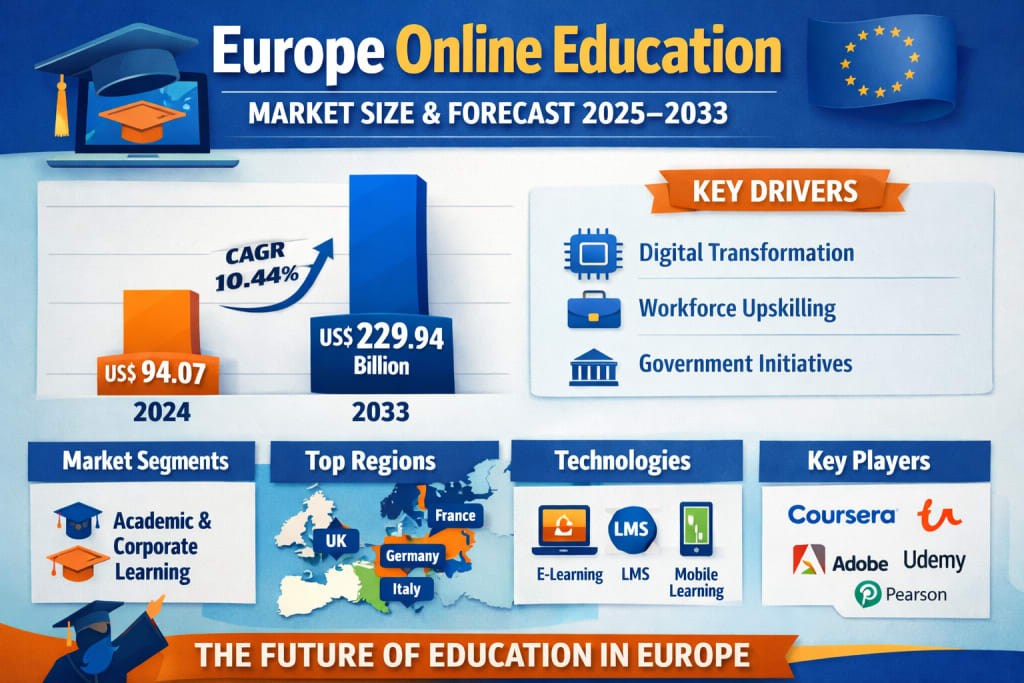
The Europe Online Education Market is entering a powerful phase of expansion, driven by rapid digitalization, changing workforce needs, and strong policy support across the region. According to Renub Research, the market is expected to grow from US$ 94.07 billion in 2024 to US$ 229.94 billion by 2033, registering an impressive compound annual growth rate (CAGR) of 10.44% from 2025 to 2033.
This growth story is not just about technology replacing classrooms. It reflects a much deeper transformation in how Europeans learn, reskill, and stay competitive in a fast-changing economy. The rising need for continuous skill development, the normalization of remote and hybrid work, and sustained government backing for digital education are all accelerating the adoption of online learning across academic and corporate sectors.
From universities offering fully online degrees to enterprises training thousands of employees through digital platforms, e-learning has moved from a “nice-to-have” option to a strategic necessity. Europe’s strong digital infrastructure, widespread internet access, and high smartphone penetration further strengthen the foundation for this market’s long-term growth.
Europe Online Education Market Overview
More people across Europe now have access to digital learning resources thanks to continuous improvements in mobile and internet technologies. High-speed connectivity and the widespread use of smartphones allow students and professionals to access e-learning platforms from almost anywhere. Web-based course materials, video conferencing tools, and collaborative digital platforms have made online education more interactive, flexible, and accessible to a wide range of learners.
One of the biggest advantages of online education is flexibility. Learners can study at their own pace and at times that suit their schedules. This is especially valuable for working professionals, individuals with family responsibilities, and people living in remote or underserved areas who may not have easy access to traditional educational institutions. Whether for formal education or continuing professional development, more Europeans are choosing digital learning models that offer personalized and asynchronous experiences.
At the same time, governments and policymakers across the region increasingly recognize that digital skills are critical for future economic competitiveness. As a result, numerous initiatives now focus on promoting e-learning, strengthening digital literacy, and supporting the development of advanced technological skills among citizens.
Technology itself is also making online education more effective and engaging. Artificial intelligence is being used in adaptive learning systems to personalize content based on individual performance. Virtual reality (VR) and augmented reality (AR) are creating immersive learning experiences, such as virtual laboratories and simulations, that help learners acquire practical and transferable skills that are often difficult to gain through traditional teaching methods alone.
Key Factors Driving the Europe Online Education Market Growth
Growing Initiatives for Collaborative Higher Education
One of the most important growth drivers is the rise of collaborative initiatives in higher education aimed at accelerating digital transformation. Universities, research institutions, and corporate partners are increasingly working together to develop flexible, accessible, and high-quality e-learning programs.
These collaborations often focus on creating online and open courses that can be accessed by students across different countries. By removing geographical and institutional barriers, such initiatives allow learners from diverse backgrounds to benefit from the same high-quality educational content. Shared digital platforms and joint program development also help institutions scale their offerings more efficiently and reach a much broader audience.
Government funding plays a crucial role in supporting these efforts. A notable example is the OpenEU coalition, launched in 2024 under the leadership of Universitat Oberta de Catalunya. This initiative brought together multiple universities and organizations with the goal of promoting digital transformation in higher education and creating a pan-European open university model. Backed by the European Commission’s European Universities initiative, such programs highlight how policy support and institutional collaboration are shaping a stronger and more integrated e-learning ecosystem across Europe.
Policies and Initiatives of the Government
European governments are central to the growth of the online education market through strategic policies, funding programs, and infrastructure investments. The European Digital Education Action Plan 2021–2027, for example, aims to improve access to digital education, enhance digital skills, and encourage innovation in teaching and learning across member states.
Programs such as Erasmus+ further support cross-border education and training initiatives, including virtual mobility, digital collaboration, and online skill development. In addition, many governments are investing in teacher training programs focused on digital pedagogy and are upgrading digital infrastructure in schools and universities.
By addressing digital divides and ensuring that both educators and learners are better prepared for technology-driven education, these initiatives are creating a more supportive environment for the sustained growth of online learning in Europe.
Growing Use of Online Learning Environments
The strong educational base in Europe, combined with the rapid adoption of digital tools, is also fueling market expansion. Many leading European institutions are now implementing blended learning models that combine traditional classroom teaching with online platforms. This approach offers greater flexibility while maintaining academic rigor.
A significant indicator of this shift is the growing participation in online courses and digital learning materials across the region. The increasing demand for flexible, career-oriented education is especially visible among working professionals seeking to upgrade their skills or transition into new roles.
Personalized learning is another major trend shaping the market. AI-driven content, adaptive learning systems, and gamified elements are making online education more engaging and effective. Supported by robust digital infrastructure and strong policy backing, Europe is well positioned to remain a global leader in both academic and corporate e-learning.
Challenges in the Europe Online Education Market
Digital Pedagogy and Teacher Preparation
Despite rapid progress, many educators still face challenges in adapting to online teaching. Effective digital instruction requires new skills, including managing virtual classrooms, using educational software efficiently, and keeping students engaged in an online environment. In some cases, limited access to training and professional development slows down this transition.
Resistance to change and digital fatigue also pose obstacles. Without adequate institutional support and continuous training in digital pedagogy, the quality of online education may vary significantly across institutions and regions. Strengthening teacher training programs and encouraging pedagogical innovation will be essential to ensure the long-term success and sustainability of online education in Europe.
Assurance of Quality and Accreditation
Ensuring consistent quality and credibility remains another major challenge. As the number of e-learning platforms and online courses continues to grow, maintaining uniform academic standards and verifying the legitimacy of credentials becomes increasingly complex.
Many online programs are not yet fully aligned with recognized accreditation frameworks, which can limit their acceptance in the labor market. In addition, the lack of standardized assessment methods can raise concerns about the reliability and comparability of online qualifications. To build trust among students, employers, and educators, European institutions and regulators need to establish robust quality assurance systems and clear regulatory guidelines for online education.
Europe Online Education Market Overview by Regions
The European online education market is expanding rapidly due to rising demand for flexible learning solutions, supportive government policies, and continuous technological innovation. The shift toward lifelong learning and professional upskilling is further strengthening market growth across key countries.
United Kingdom Online Education Market
The UK online education market has seen strong growth driven by the increasing demand for accessible and flexible learning options across academic and professional fields. The widespread adoption of digital technologies in education and corporate training is a major factor behind this expansion.
More students and professionals are choosing online platforms to continue their education, gain new certifications, or upgrade existing skills. Government support and private sector investment are helping to accelerate innovation in learning technologies, making education more inclusive and adaptable. As a result, online learning is playing a central role in reshaping the UK’s education landscape.
Germany Online Education Market
Germany’s online education market is growing steadily due to rising demand for flexible and accessible learning models. The integration of digital platforms into traditional education systems is transforming how courses and training programs are delivered.
Technologies such as artificial intelligence and mobile learning applications are improving both the effectiveness and personalization of online education. Government initiatives supporting digital literacy and the adoption of digital tools in education are further boosting market growth, positioning Germany as one of Europe’s key leaders in e-learning.
Italy Online Education Market
Italy is experiencing rapid growth in online education as demand increases for flexible learning solutions. Digital platforms are helping modernize traditional teaching methods and expand access to a wide range of courses and training programs.
Technological innovations, including AI-driven learning systems and mobile applications, are improving engagement and learning outcomes. Supportive government policies aimed at promoting digital literacy and technology adoption in education are also accelerating the shift toward online learning, strengthening Italy’s role in the European e-learning market.
France Online Education Market
France’s online education sector is expanding significantly as more learners seek accessible and adaptable education options. The adoption of digital platforms is transforming traditional educational models and enabling wider access to training and academic programs.
Advances in technology, particularly in AI and mobile learning, are enhancing both the quality and customization of online education. Government initiatives that encourage digital transformation in education and support digital skills development are further reinforcing France’s position as a major player in Europe’s online education market.
Market Segmentation
By Type
Academic
Higher Education
Vocational Training
K-12 Education
Others
Corporate
Large Enterprises
SMBs
Government
By Provider
Content
Services
By Technology
Online e-learning
Learning Management System (LMS)
Mobile e-learning
Rapid e-learning
Virtual classroom
Others
By Region
France, Germany, Italy, Spain, United Kingdom, Belgium, Netherlands, Russia, Poland, Greece, Norway, Romania, Portugal, Rest of Europe
Competitive Landscape
The European online education market features a mix of global technology leaders and specialized education providers. Key players covered in the market include:
Coursera Inc.
Instructure Holding Inc.
Adobe Inc.
Alphabet Inc.
Udemy
Pearson Inc.
Stride Inc.
NetEase Inc.
These companies are focusing on platform innovation, content expansion, partnerships, and acquisitions to strengthen their market presence and meet the evolving needs of learners and institutions.
Final Thoughts
The Europe Online Education Market is clearly moving into a new era of scale, sophistication, and strategic importance. With the market projected to grow from US$ 94.07 billion in 2024 to US$ 229.94 billion by 2033 at a CAGR of 10.44%, online learning is no longer a supplementary option—it is becoming a core pillar of Europe’s education and workforce development systems.
Driven by the need for continuous upskilling, strong government support, and rapid technological innovation, digital education is reshaping how knowledge is delivered and consumed across the continent. While challenges remain around teacher preparation, quality assurance, and accreditation, the overall trajectory is unmistakably positive.
As Europe continues to invest in digital infrastructure, policy frameworks, and innovative learning models, online education will play an increasingly central role in building a more resilient, inclusive, and future-ready society.
About the Creator
United States Microgrid Market Size, Share Analysis, Industry Trends and Forecast 2034
Why the United States Microgrid Market Is Powering Energy Independence: Trends & Future Outlook Energy resilience is becoming one of the most important priorities in the United States. Extreme weather events, aging infrastructure, and rising electricity demand are pushing communities and businesses to rethink how power is generated and distributed. The United States microgrid market is emerging as a powerful solution, offering localized energy systems that can operate independently or alongside the main grid.
By Jackson Watson2 days ago in Trader
Asia-Pacific Viscosupplementation Market Trends & Summary (2025–2033)
Introduction: A Market Lubricated by Demographics and Innovation The Asia-Pacific viscosupplementation market is entering a decisive growth phase, shaped by powerful demographic shifts, evolving patient preferences, and continuous innovation in orthopedic care. According to Renub Research, the Asia-Pacific Viscosupplementation Market is expected to reach US$ 3.80 billion by 2033, up from US$ 1.60 billion in 2024, growing at a robust CAGR of 10.1% from 2025 to 2033.
By shibansh kumar6 days ago in Trader
'Till Death We Do Art
There would be nothing divine in this world without art. Nature may surpass the divine to all intents and purposes, but like everything it absorbs and is absorbed by, it remains here, stuck on the surface of this world, ever-present, physically bound to the universe.
By Avocado Nunzella BSc (Psych) -- M.A.P 4 days ago in Art



Comments
There are no comments for this story
Be the first to respond and start the conversation.