
Asia-Pacific Viscosupplementation Market Trends & Summary (2025–2033)
Rising Joint Care Needs, Aging Populations, and Minimally Invasive Therapies Fuel a High-Growth Regional Market

Introduction: A Market Lubricated by Demographics and Innovation
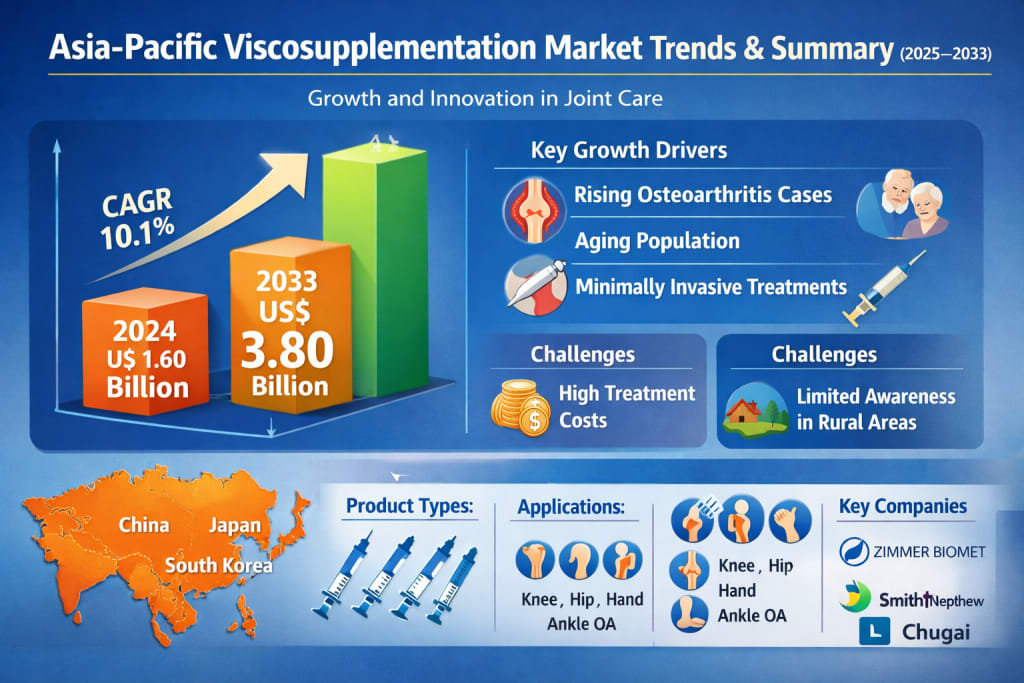
The Asia-Pacific viscosupplementation market is entering a decisive growth phase, shaped by powerful demographic shifts, evolving patient preferences, and continuous innovation in orthopedic care. According to Renub Research, the Asia-Pacific Viscosupplementation Market is expected to reach US$ 3.80 billion by 2033, up from US$ 1.60 billion in 2024, growing at a robust CAGR of 10.1% from 2025 to 2033.
This impressive expansion is being driven primarily by the rising incidence of osteoarthritis (OA) and osteoporosis, along with a growing preference for minimally invasive, non-surgical therapies. As populations age across major Asian economies such as China, Japan, India, and South Korea, joint-related disorders are becoming one of the most pressing public health and quality-of-life challenges in the region.
Viscosupplementation—most commonly involving injections of hyaluronic acid (HA) into affected joints—has emerged as a practical and increasingly popular solution. It offers pain relief, improved mobility, and a way to delay or avoid joint replacement surgery. In healthcare systems under pressure from aging demographics and rising chronic disease burdens, this therapy fits perfectly into the broader shift toward outpatient, cost-conscious, and patient-friendly treatments.
Asia-Pacific Viscosupplementation Industry Overview
The Asia-Pacific viscosupplementation industry is benefiting from a convergence of medical need, healthcare expansion, and technological progress. The growing prevalence of osteoarthritis, combined with longer life expectancy across the region, has created a steadily expanding patient pool seeking effective joint pain management solutions. Countries such as China, Japan, and South Korea are at the forefront of this growth, supported by improving healthcare access, higher awareness of joint health, and expanding reimbursement frameworks for orthopedic procedures.
Technological innovation is also playing a crucial role. Newer hyaluronic acid formulations, including single-injection and longer-lasting products, are making treatment more convenient and attractive for both patients and physicians. These innovations reduce the number of clinic visits required, improve patient compliance, and enhance overall treatment outcomes.
At the same time, the market is seeing increased activity from both domestic and international pharmaceutical and medical device companies. Product launches, strategic partnerships, and mergers are intensifying competition while also expanding availability across diverse healthcare settings. However, challenges remain. Regulatory differences between countries, limited awareness in rural areas, and the high cost of certain advanced products continue to restrict broader adoption in parts of the region.
Despite these hurdles, the long-term outlook remains highly positive. Continued investments in research and development, along with patient education initiatives and gradual improvements in healthcare coverage, are expected to keep the Asia-Pacific region among the fastest-growing markets for viscosupplementation therapies over the next decade.
The Rising Burden of Osteoarthritis and Obesity
One of the most powerful forces behind market growth is the surging prevalence of osteoarthritis. Globally, osteoarthritis is already one of the leading causes of disability, and Asia-Pacific is no exception. An April 2020 article by the Centers for Disease Control and Prevention highlighted that approximately 32.5 million Americans suffer from osteoarthritis, with women disproportionately affected. Meanwhile, regional studies in Asia reveal similarly concerning trends.
For instance, research published by the National Center for Biotechnology Information in January 2021 reported that 64.3% of the elderly population in rural Ballabgarh, Haryana, had knee osteoarthritis, with a significant negative impact on quality of life. Such findings underscore how widespread and debilitating joint disorders have become, especially among older adults.
Obesity further compounds this problem. A 2021 study titled “Prevalence of Obesity in India and its Neurological Implications” noted that 40.3% of Indians are obese, with South India recording particularly high rates. Excess body weight places additional stress on weight-bearing joints, accelerating cartilage degeneration and increasing the risk of osteoarthritis.
Together, these trends are creating a rapidly expanding patient base that is actively seeking therapies like viscosupplementation to reduce pain, improve mobility, and maintain independence—all without immediately resorting to surgery.
Key Growth Drivers in the Asia-Pacific Viscosupplementation Market
1. Rising Prevalence of Osteoarthritis
The single most important driver of the market is the growing burden of osteoarthritis across Asia-Pacific. Aging populations in China, Japan, South Korea, and increasingly in India and Southeast Asia are translating into higher rates of joint degeneration. At the same time, lifestyle changes—such as reduced physical activity, poor dietary habits, and rising obesity—are causing osteoarthritis to appear at younger ages.
Viscosupplementation offers a compelling solution in this context. By restoring lubrication and shock absorption within the joint, hyaluronic acid injections can reduce pain, improve joint function, and delay the need for surgical intervention. For healthcare systems facing rising surgical costs and long waiting lists, this makes viscosupplementation an attractive intermediate treatment option.
2. Growing Preference for Minimally Invasive Treatments
Patients today are increasingly drawn to treatments that offer faster recovery, fewer complications, and lower overall risk. This shift in mindset is strongly benefiting viscosupplementation. As a minimally invasive, outpatient procedure, it aligns perfectly with modern patient expectations and healthcare efficiency goals.
Compared to joint replacement surgery, viscosupplementation requires no hospitalization, involves minimal downtime, and carries significantly lower risk. As awareness grows and injection techniques continue to improve, more patients and physicians are adopting it as a first-line or early-stage treatment for osteoarthritis and chronic joint pain.
3. Technological Advancements in Hyaluronic Acid Products
Innovation in hyaluronic acid formulations is another major catalyst for market growth. The development of single-injection regimens and extended-release products has transformed the patient experience. Fewer injections mean greater convenience, better adherence to treatment, and reduced burden on healthcare facilities.
Longer-lasting formulations also provide more sustained pain relief and improved functional outcomes, boosting patient satisfaction and physician confidence in these therapies. As research and development spending increases across the region, even more advanced and tailored products are expected to enter the market, further accelerating adoption.
Challenges Facing the Market
High Cost of Treatment
Despite its benefits, the high cost of viscosupplementation remains a significant barrier in many Asia-Pacific countries. Advanced HA formulations, particularly single-injection and long-acting products, are often expensive and not fully covered by insurance or public healthcare systems.
In regions where out-of-pocket healthcare spending is common, especially in rural and semi-urban areas, many patients opt for cheaper but less effective alternatives such as corticosteroid injections or oral pain medications. Unless pricing becomes more competitive or reimbursement policies improve, cost will continue to limit the market’s full potential.
Limited Awareness in Rural Areas
Another major challenge is the lack of awareness and access in rural and underserved regions. Many patients are unfamiliar with viscosupplementation as a treatment option and continue to rely on traditional remedies or over-the-counter painkillers.
In some areas, healthcare providers themselves may have limited exposure to newer orthopedic treatments due to resource constraints or lack of updated training. Bridging this awareness and access gap through education programs, infrastructure development, and policy support will be crucial for broader market expansion.
Country-Level Market Insights
China
China’s viscosupplementation market is growing steadily, driven by a rapidly aging population and increasing awareness of non-surgical joint treatments. Urban centers, in particular, are seeing rising adoption as patients seek alternatives to joint replacement surgery. Innovations in HA formulations are improving convenience and outcomes, but high costs and uneven insurance coverage continue to limit penetration in rural areas.
Japan
Japan represents one of the most mature markets in the region, supported by one of the world’s oldest populations. With a high prevalence of knee osteoarthritis, demand for viscosupplementation remains strong. Major players such as Chugai Pharmaceutical, Seikagaku, Bioventus, Fidia Farmaceutici, Sanofi, Bloomage Freda Biopharm, Zimmer Biomet, and Ferring Pharmaceuticals are active in the market.
Seikagaku’s ARTZ, launched in 1987, continues to hold a strong position. However, high healthcare costs and strict regulatory approval processes can slow the introduction of new products.
India
In India, osteoarthritis affects an estimated 22% to 39% of the population, making it one of the most common rheumatological conditions. Knee osteoarthritis, in particular, is a major cause of disability among older adults, especially women.
While demand for non-surgical treatments like viscosupplementation is rising, cost and limited insurance coverage remain key obstacles. Still, as awareness grows and healthcare access improves, India is expected to become a major growth engine for the regional market.
South Korea
South Korea’s market is expanding rapidly thanks to an aging population, a high prevalence of knee osteoarthritis, and a well-developed healthcare system. The country offers a wide range of single, three, and five-injection regimens, with hospitals and orthopedic clinics serving as the primary treatment centers. Policy support and greater insurance coverage could further accelerate adoption in the coming years.
Market Segmentation Overview
By Product:
Single Injection
Three Injection
Five Injection
By Application:
Knee Osteoarthritis
Hip Osteoarthritis
Hand/Wrist Osteoarthritis
Ankle/Foot Osteoarthritis
Others
By End User:
Hospitals
Orthopedic Clinics / Ambulatory Surgical Centers
By Country:
China
Japan
India
South Korea
Thailand
Malaysia
Indonesia
Australia
New Zealand
Rest of Asia Pacific
Competitive Landscape and Key Companies
The Asia-Pacific viscosupplementation market is highly competitive, with both global and regional players investing in product development and market expansion. Key companies profiled include:
Anika Therapeutics, Inc.
Zimmer Biomet
Smith & Nephew PLC
F. Hoffmann-La Roche Ltd.
Sanofi
Chugai Pharmaceutical Co.
Lifecore Biomedical
LG Life Sciences Ltd.
These companies are evaluated across four key dimensions: Overview, Key Persons, Recent Developments, and Revenue. Strategic partnerships, product launches, and geographic expansion remain central to their growth strategies in the region.
Final Thoughts: A Market Built for Long-Term Growth
The Asia-Pacific viscosupplementation market stands at a powerful intersection of demographic necessity, technological innovation, and evolving healthcare preferences. With the market projected to grow from US$ 1.60 billion in 2024 to US$ 3.80 billion by 2033, the outlook is undeniably strong.
While challenges such as high treatment costs and limited rural awareness persist, ongoing investments in R&D, healthcare infrastructure, and patient education are steadily reshaping the landscape. As more patients seek effective, minimally invasive solutions for joint pain, viscosupplementation is set to become an increasingly central pillar of orthopedic care across the Asia-Pacific region over the next decade.
About the Creator
Keep reading
More stories from shibansh kumar and writers in Trader and other communities.
GCC Dark Chocolate Market Size and Forecast 2025–2033
Introduction The Gulf Cooperation Council (GCC) region is witnessing a notable shift in consumer preferences, with health awareness, premium indulgence, and lifestyle-driven consumption reshaping the food and beverage landscape. One of the clearest beneficiaries of this shift is dark chocolate—a product once seen as a niche indulgence but now increasingly positioned as a healthier, more sophisticated alternative to traditional confectionery.
By shibansh kumar3 days ago in Trader
United States Online Food Delivery Market Size, Trends & Growth Forecast 2034
How the United States Online Food Delivery Market Is Changing the Way People Eat The rise of online food delivery has transformed how Americans access meals. What began as a convenience service for busy evenings has grown into a deeply integrated part of everyday life. Across cities and suburbs alike, digital ordering platforms now influence restaurant operations, consumer habits, and even urban culture.
By Jackson Watson5 days ago in Trader
Australia Graphite Market: Powering the Clean‑Energy Transition and Industrial Demand
The Australia graphite market is undergoing a dramatic transformation as global demand for critical battery materials accelerates alongside robust industrial consumption. According to the latest IMARC Group analysis, the market was valued at USD 519.80 million in 2025 and is projected to expand to USD 2,258.71 million by 2034, representing a substantial compound annual growth rate (CAGR) of 17.73% during 2026–2034.
By Amélie Belle8 days ago in Trader




Comments
There are no comments for this story
Be the first to respond and start the conversation.